



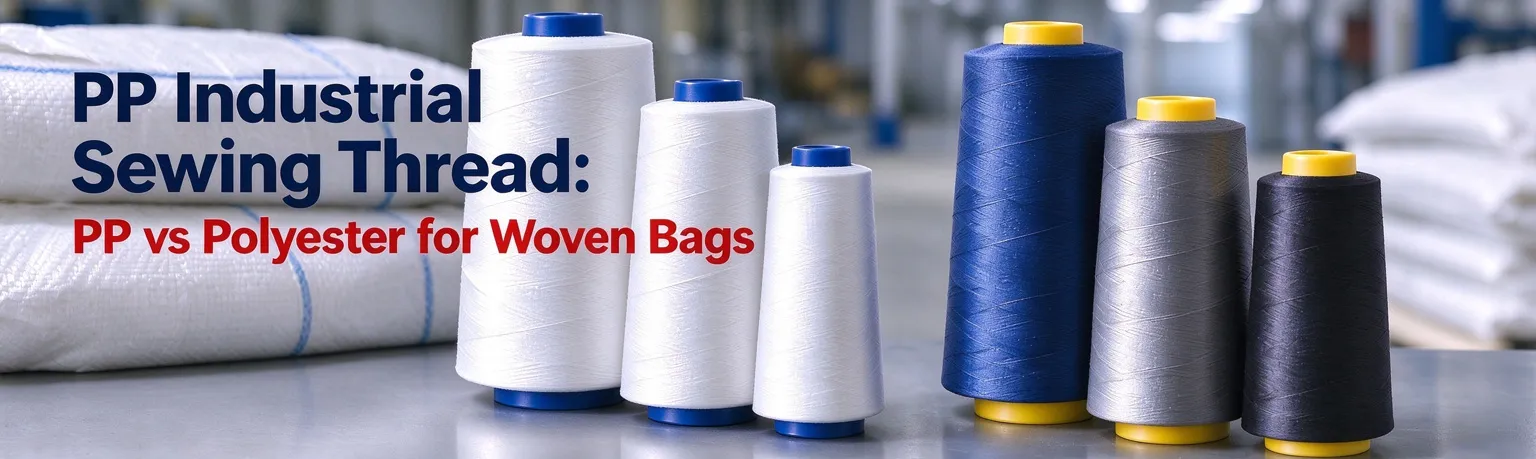
The sewing thread is a critical part of woven bag seam performance. For PP woven bag production, the two common choices are PP industrial sewing thread and polyester thread, and the selection can affect seam strength, UV durability, heat performance, chemical resistance and cost. This guide compares the two for woven bag manufacturing, explains where each fits, and notes the data caveat buyers should know when sizing the market.
Quick answer: In the PP vs polyester thread choice for woven bags, PP sewing thread is generally the more economical option and offers strong resistance to many chemicals and moisture. Suitable polyester grades can provide higher tenacity, better UV durability and better heat performance. Select the thread according to seam construction, thread size, machine conditions and the bag’s storage and handling environment rather than polymer type alone.
Definition: PP industrial sewing thread is polypropylene yarn manufactured for industrial sewing and woven bag-closing applications. Polyester sewing thread is made from PET-based fibers or filaments and is available in different constructions, including high-tenacity grades. Both materials are supplied on cones for industrial sewing and bag-closing machines.
PP Industrial Sewing Thread: Properties
PP sewing thread is lightweight, economical and resistant to many chemicals and moisture. It is commonly used for general woven bag closing where cost control and chemical resistance are important. Polypropylene has a lower thermal limit than polyester, so thread size, lubrication, machine settings and sewing conditions should be checked when needle heat or elevated service temperatures are expected.
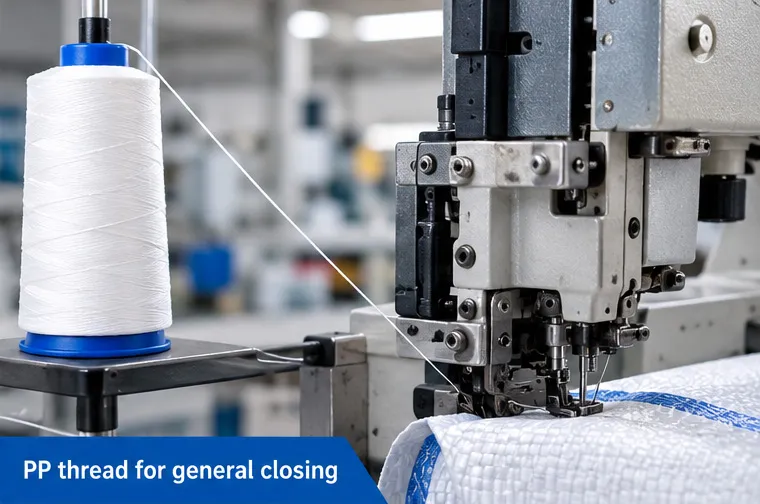
Key takeaway: PP sewing thread is a practical choice for many general-duty woven bag seams when the thread specification and machine conditions are properly matched to the application.
Polyester Sewing Thread: Properties
Suitable high-tenacity polyester grades can provide higher tensile performance at comparable thread sizes, along with good UV stability and resistance to elevated sewing temperatures. These characteristics make polyester useful for outdoor storage, demanding seams and applications where longer-term seam durability is important. Actual performance depends on thread construction, size, finish, machine settings and the surrounding environment, while the trade-off is generally higher material cost.
| Property | PP thread | Polyester thread |
|---|---|---|
| Relative cost | Generally lower | Generally higher |
| Tensile performance | Suitable for many general-duty seams; grade-dependent | High-tenacity grades can provide higher strength at comparable sizes |
| UV performance | Depends on grade and UV stabilization | Suitable grades generally provide better resistance to prolonged UV exposure |
| Heat performance | Lower thermal limit than polyester | Generally higher thermal performance than PP |
| Chemical resistance | Resistant to many chemicals; verify the specific chemical exposure | Good resistance for many applications; verify the specific chemical exposure |
PP vs Polyester Thread: How to Choose
- General PP woven bag closing—PP thread is often the economical choice when standard seam performance, chemical resistance and normal operating conditions are required.
- Outdoor or tropical storage—specify a UV-resistant thread grade and UV-stabilized fabric when prolonged sunlight exposure is expected; suitable polyester grades can be considered where longer-term seam strength retention is required.
- Heavy or high-stress seams—select thread size, construction and seam design according to the required load and handling conditions; high-tenacity polyester is one option for demanding applications.
- High-speed sewing—evaluate thread lubrication, construction, needle temperature, machine settings and sewing speed rather than choosing by polymer type alone.
For context on the wider semi-finished segment, the PP webbing market in 2026 tracks the sister product used for handles and reinforcements.
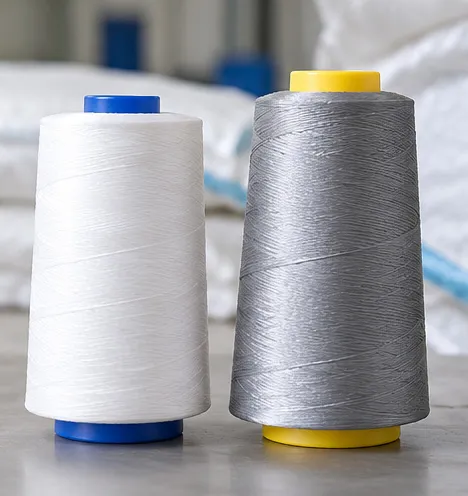
Market Demand for PP Industrial Sewing Thread
PP industrial sewing thread is consumed wherever woven PP packaging is sewn and closed, so its demand follows the bag and FIBC markets more closely than thread-specific search interest. Those downstream markets are expanding: the global FIBC (bulk bag) market was valued at roughly USD 6.6–7.8 billion in 2025 and is forecast to reach USD 10–14 billion by the mid-2030s at a 4–7% CAGR, with woven polypropylene making up about 73–78% of FIBC material by value Future Market Insights. The broader PP woven bags market was estimated near USD 22.4 billion in 2025 and is projected to about USD 35 billion by 2034 (roughly 5% CAGR), with Asia Pacific holding close to half of global value Dataintelo. Dedicated polypropylene-thread research places the strongest near-term growth in Asia-Pacific, Latin America and the Middle East, where packaging, agriculture and industrial-fabric output are rising Market Research Intellect.
For buyers, the practical implication is the same as the planning approach above: thread requirements scale with bag production volume and seam construction. SITONG PACKAGING supplies PP and polyester thread to bag manufacturers and converters across high-growth export regions—including Africa, South America, Central America and Asia—where woven-bag and FIBC consumption is concentrated.
Industrial Sewing Thread Specification Checklist
| Item | What the buyer defines |
|---|---|
| Material | PP or polyester, selected according to seam duty |
| Thread size | Tex, ticket or another sizing system required by the buyer or machine |
| Thread construction | Filament or spun construction, according to the required seam performance and sewing application |
| Seam application | Bag construction, seam type and expected load or handling conditions |
| Colour | Match the bag fabric or use a contrasting colour for visual inspection |
| Finish | Lubrication and finish suitable for the sewing machine, speed and application |
| Cone and MOQ | Cone size, net weight, packing format and minimum order quantity |
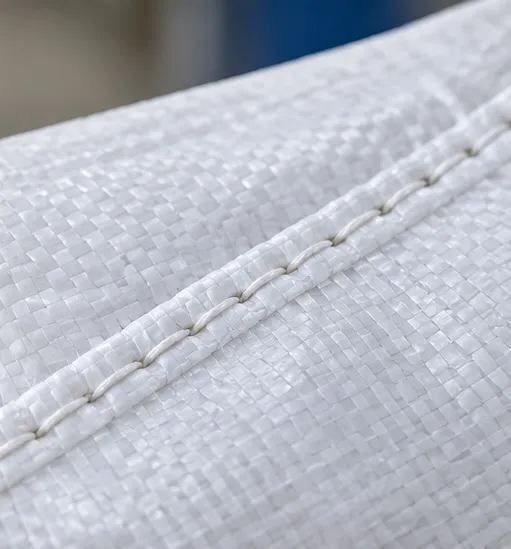
A Manufacturing Note
SITONG PACKAGING has manufactured woven polypropylene packaging since 1998, with plants in Haicheng (Anshan), Liaoning and Cambodia, around 20 production lines at roughly 100 tonnes per day, and shipments to more than 70 countries from the port of Dalian. The semi-finished product range includes PP webbing, PP thread and polyester thread for bag manufacturers and converters, with quality controls applied to the supplied specifications. The polypropylene woven bag production process shows where sewing fits into the manufacturing line, while the PP woven fabric demand in 2026 article provides additional context on demand for upstream woven packaging materials.
Conclusion
PP industrial sewing thread is a cost-effective option for many general-purpose woven bag seams, with good resistance to many chemicals and moisture. Polyester sewing thread is worth considering when the application requires higher tenacity, better UV durability or greater resistance to sewing heat. Match the thread to the seam construction, machine conditions and service environment, and size thread demand from actual production volumes rather than keyword data alone. SITONG PACKAGING supplies PP and polyester thread as semi-finished materials for bag manufacturers and converters.
Frequently Asked Questions
Neither material is universally better. PP sewing thread is often selected for economical general-purpose seams and resistance to many chemicals, while suitable polyester grades are commonly specified when higher tenacity, UV durability or heat performance is required. The choice should be based on seam construction, thread size, machine conditions and the bag’s end-use environment.
PP sewing thread is generally an economical option with good resistance to many chemicals and moisture. It is widely used for general-purpose woven bag seams where the required seam performance can be achieved with a PP specification matched to the machine and application.
Consider polyester when the application requires higher tenacity, prolonged UV exposure or better resistance to sewing heat, provided the selected grade is suitable for the machine and seam construction. For high-speed sewing, evaluate the complete thread and machine setup rather than choosing polyester solely because the line runs fast.
Thread is one component of overall seam performance. Seam strength also depends on thread size and construction, stitch type, stitch density, sewing tension, fabric strength and sewing quality.
Both materials can be used on industrial bag-closing equipment, but the machine may require adjustments to thread tension, needle selection, lubrication and sewing speed. When changing thread material or size, the seam should be tested and the settings re-qualified for the specific bag construction.
Base it on production volume—bags per run times seam length times thread consumption—rather than keyword search volume, which for “pp thread” is not cleanly quantified in available datasets.
Yes. SITONG PACKAGING supplies semi-finished PP webbing, PP thread and polyester thread for bag manufacturers and converters, with quality controls applied to the supplied specification.
The final MOQ, cone specification and lead time vary by thread material, size, colour and production requirements, so buyers should confirm the current specification with the sales team before ordering.