

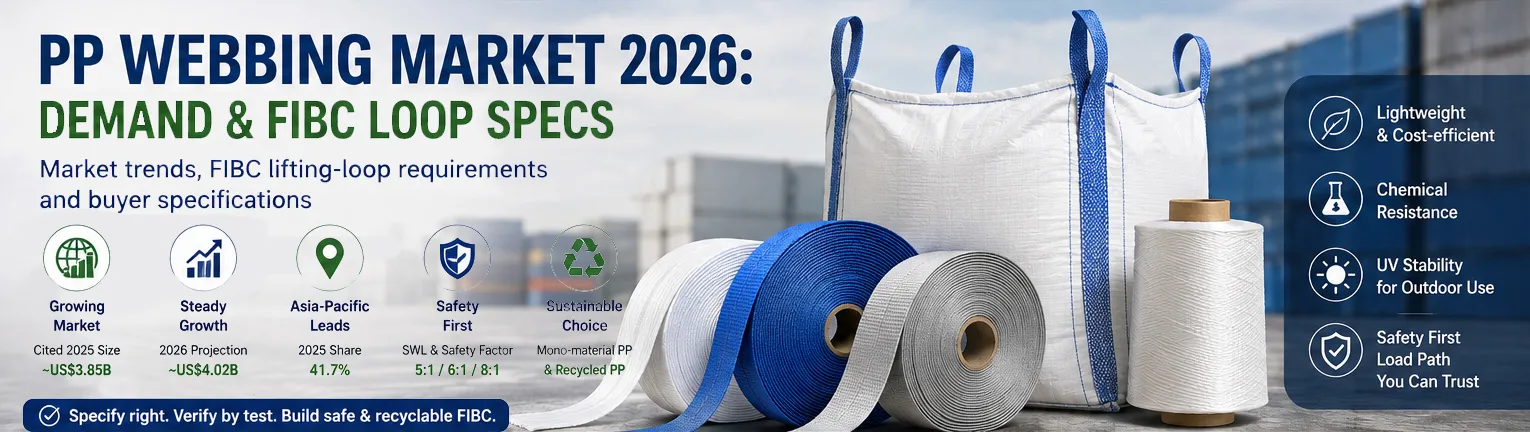
PP webbing is widely used in industrial strapping, reinforcement and FIBC lifting-loop applications, making its demand closely linked to bulk packaging and material-handling markets. Secondary market-research reports published in 2026 indicate continued growth in the global PP webbing sector, although reported market sizes and regional shares vary significantly by product definition, application scope, geography and forecast period. This article therefore uses the cited market reports as directional sources rather than treating one report as a definitive global market total. The focus is on the practical questions buyers can act on: where PP webbing demand is concentrated, how PP webbing connects to FIBC lifting systems, what specifications matter in an RFQ, and how to verify supplier capability before purchase.
PP webbing is a woven or knitted polypropylene load-bearing material commonly used in FIBC lifting loops and reinforcement components, while PP multifilament yarn is an upstream or complementary material that may be used in webbing or sewing applications depending on the design. Because the lifting device is part of the load path, its breaking strength, construction, attachment method and performance with the FIBC body must be qualified as part of the complete bag design. Specifying webbing is therefore both a material and a safety-performance decision.
Quick Answer: The PP webbing market is closely tied to industrial packaging, material handling and FIBC applications. For FIBC lifting loops, buyers should focus less on webbing material name alone and more on finished-webbing breaking strength, construction, attachment, UV performance, applicable SWL and the type-test requirements of the complete FIBC. Asia-Pacific remains an important production and demand region, but supplier selection should be based on tested performance, consistency, documentation and total delivered cost rather than regional market share alone.
PP Webbing Market Size and Regional Demand
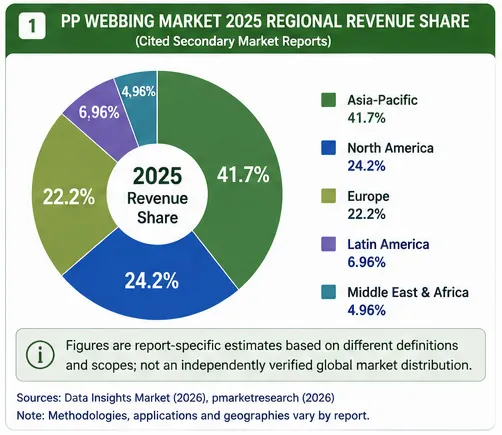
Published market-research reports point to continued growth in PP webbing demand, but the reported market size varies considerably between studies because researchers define PP webbing differently by product type, application, geography and revenue scope. Some reports focus mainly on industrial webbing, while others include broader textile, automotive, logistics or consumer applications. For buyers, regional demand direction is therefore more useful than treating one published percentage as a universal market share.
- Asia-Pacific: A major production and consumption region, supported by large-scale polypropylene processing, woven packaging manufacturing and industrial supply chains.
- North America: Demand is linked to industrial, logistics, material-handling and specialized webbing applications.
- Europe: Demand is increasingly influenced by technical performance, product consistency, sustainability requirements and regulatory expectations.
- Other markets: Latin America, the Middle East and Africa also use PP webbing across packaging, agriculture, construction and industrial applications.
Buyer takeaway: Regional market share alone does not determine the best sourcing location. Buyers should compare webbing construction, breaking strength, production consistency, testing, documentation, lead time, MOQ and delivered cost when evaluating suppliers.
How PP Webbing Connects to FIBC Lifting Loops
PP webbing and PP multifilament yarn are related but not interchangeable terms. Multifilament yarn is a fibrous PP input that can be used in certain textile constructions, while PP webbing is a finished woven or knitted strip used for applications such as lifting loops, reinforcement and handling. For FIBC procurement, buyers should specify the finished webbing construction and required mechanical performance rather than relying on the yarn description alone.
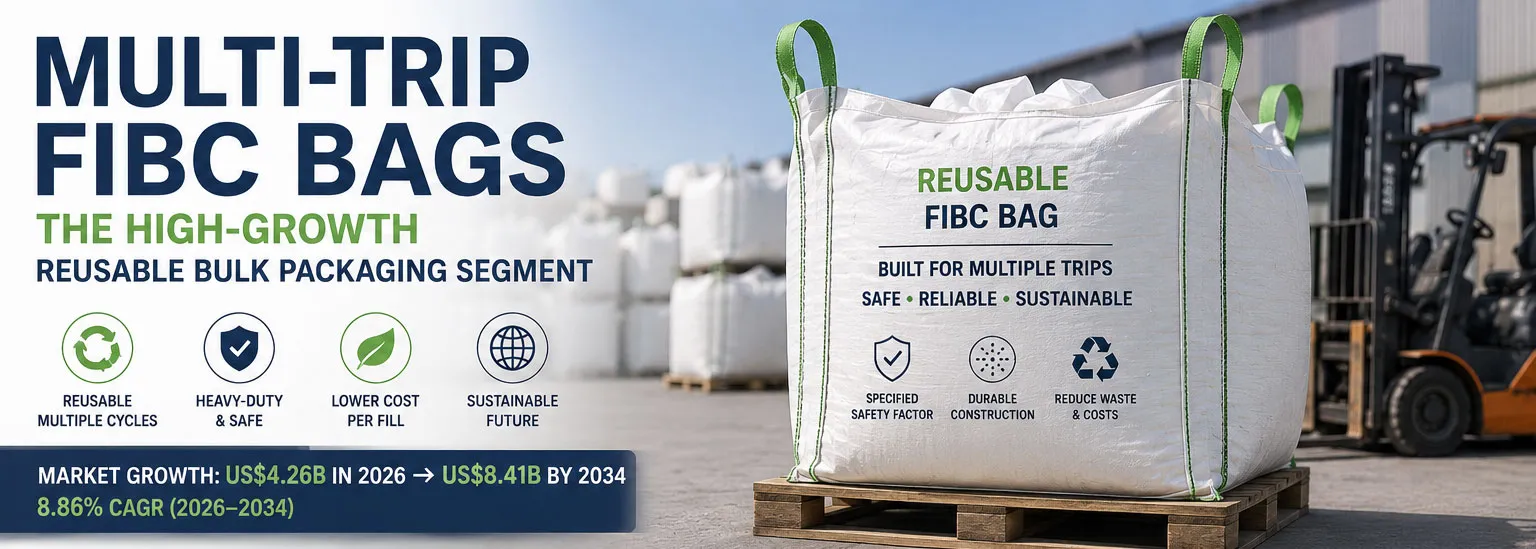
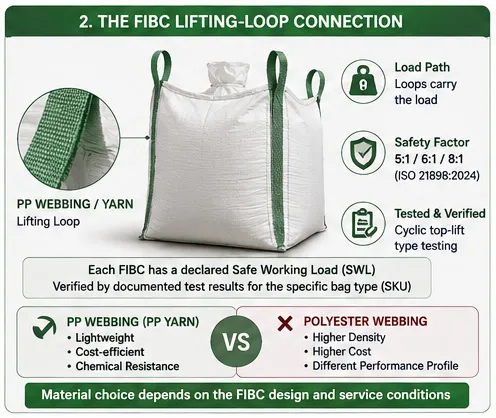
FIBC lifting systems are designed around the safe working load (SWL) declared for the individual FIBC type. Although commercial FIBCs are available across a wide range of load capacities, the applicable SWL is the value specified, tested and marked for the particular design rather than a generic market range. The lifting device, webbing, attachment points and bag body should therefore be evaluated as one qualified system.
- FIBC safety factor. ISO 21898:2024 defines the safe working load (SWL) and safety factor in relation to the complete FIBC and its cyclic top-lift performance. Applicable safety factors include 5:1, 6:1 and 8:1 depending on the FIBC type and design. Buyers should therefore specify the required SWL and applicable safety factor for the finished FIBC, then verify the lifting devices, webbing, attachment points and bag construction through the required type-testing and documentation. The safety factor should not be treated as a standalone certification of the webbing itself.
- Why PP can be selected. PP offers low density, generally competitive material economics and useful chemical-resistance characteristics, which can make it suitable for many FIBC applications. Polyester may be preferred where different strength, dimensional-stability, temperature or durability requirements apply, so the material choice should be based on the complete FIBC design and service conditions.
- Reinforcement stitching. Sewing thread is used to join and reinforce FIBC components, and the selected thread material should be specified according to the bag design, required mechanical performance and compatibility with the production process.
Demand for PP yarn and webbing is closely associated with applications such as agricultural, chemical, mineral and construction bulk packaging, which rely on strong, cost-effective loops and reinforcement.
PP webbing is a finished textile strip produced from polypropylene tape or yarn, depending on the webbing construction and manufacturing route. For FIBC applications, the finished webbing is converted into lifting loops or other reinforcement components and then attached to the bag body. The resin, tape or yarn, webbing construction, sewing and attachment method should therefore be considered as a connected production chain rather than as interchangeable material terms.
PP Webbing Market Trends in 2026
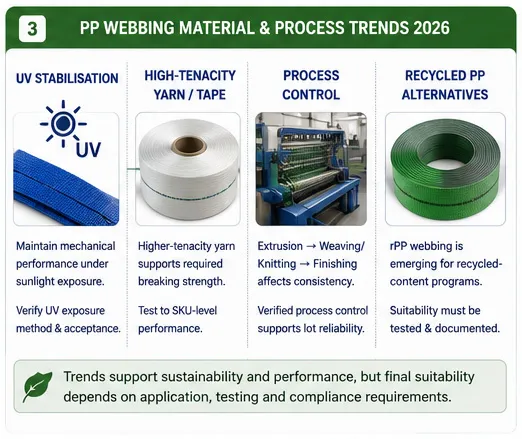
- UV stabilisation. UV exposure can reduce the mechanical performance of polypropylene components over time, so UV resistance should be considered according to the FIBC’s intended service conditions and applicable test requirements. For FIBC applications covered by ISO 21898:2024, buyers should verify the required UV-resistance evaluation and supporting test documentation rather than relying only on an additive claim.
- High-tenacity yarn. Higher-tenacity yarn can support specified breaking strength; note GSM is fabric mass per area, tensile/burst is measured mechanical performance, and “high-strength/lightweight” is a commercial positioning to demonstrate by SKU-level test results.
- Process control (extrusion, weaving/knitting, finishing). For webbing, process control from tape extrusion through weaving or knitting and finishing affects dimensional consistency and mechanical performance; verified production control supports lot-to-lot reliability — distinguish the weaving/knitting route from loop conversion, which is a separate downstream step.
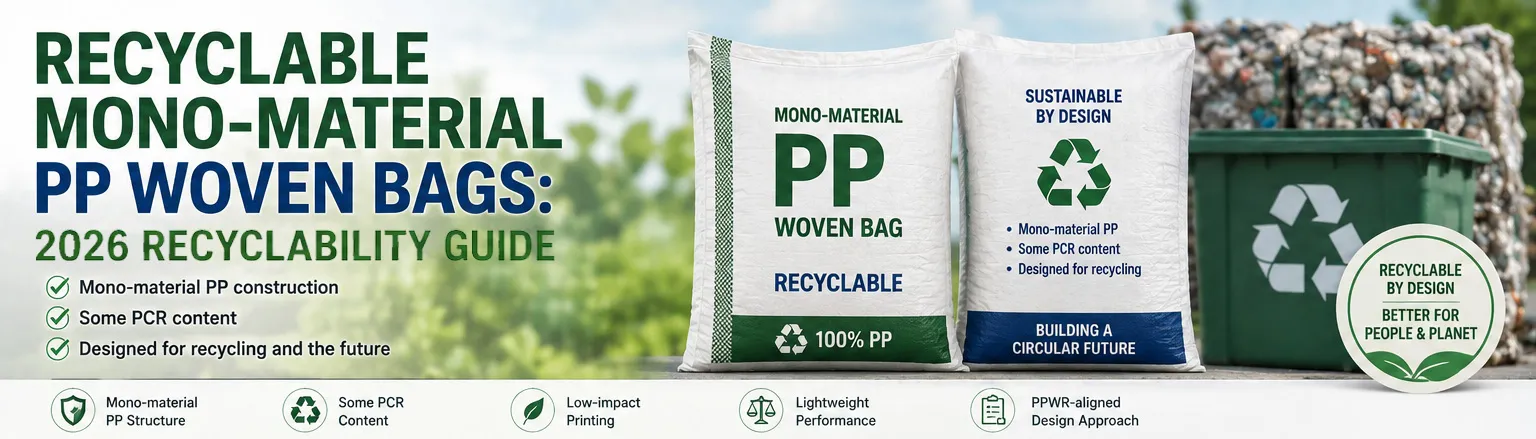
- Recycled alternatives. rPP webbing is emerging where regulation and brand goals push recycled content.
What Buyers Should Specify
For a PP webbing or polypropylene thread order, define the following with the applicable test method and SKU-level acceptance values; the buyer and supplier should agree the exact method and acceptance before production:
| Spec lever | What to define |
|---|---|
| Breaking strength | Required value, test method and SKU acceptance |
| Width / denier | Finished width and yarn/tape specification |
| UV stabilisation | Additive requirement, exposure method and acceptance |
| Construction | Weave/knit pattern, layers and finishing |
| Colour / finish | Natural, coloured or coated |
| Compliance | Applicable target-market requirements, such as REACH-related chemical requirements, customer-specific restricted-substance requirements and required declarations or test documentation |
| Test documentation | COA, test report and lot traceability where required |
Key Takeaway: Match breaking strength and UV requirements to the qualified FIBC design and documented SKU acceptance.
These specs feed directly into OEM and custom FIBC and bag programs, where the loop and seam are qualified alongside the fabric.
Why Asia-Pacific Is Important for PP Webbing Sourcing
Asia-Pacific is an important PP webbing production and sourcing region because polypropylene processing, tape extrusion, weaving, FIBC manufacturing and related packaging supply chains are concentrated across several Asian markets. For buyers, the advantage is not simply regional scale but access to integrated production capabilities and established export logistics. Supplier evaluation should still focus on finished-webbing performance, lot consistency, testing, traceability, MOQ, lead time and delivered cost.
Sources and Methodology
This article combines secondary market-research estimates with technical information for FIBC applications. Market-size and regional-demand figures are treated as report-specific estimates because different research providers may use different definitions of PP webbing, application categories, geographic scope and forecast periods. Buyers should verify the original report, publication date, market definition and methodology before using market-size figures for investment or procurement planning.
The FIBC safety discussion references ISO 21898:2024, Packaging — Flexible intermediate bulk containers (FIBCs) for non-dangerous goods, which covers materials, construction, design, type testing and marking requirements for applicable FIBCs. The standard includes requirements relating to safe working load, safety factor, cyclic top-lift testing and UV-resistance evaluation. Buyers should confirm the applicable edition, product classification, testing requirements and customer or regulatory requirements for the specific FIBC design.
Market references and technical requirements should therefore be used as procurement guidance rather than as a substitute for the applicable standard, laboratory test report, customer specification or contractual requirement.
Key Takeaways
- The cited secondary reports estimate the global PP webbing market at about US$3.85 billion in 2025 and US$4.02 billion in 2026, with Asia-Pacific representing the largest cited regional share.
- PP webbing is a finished load-bearing component used in applications such as FIBC lifting loops, while PP multifilament yarn is a related upstream or complementary material.
- FIBC safety is determined by the qualified bag and lifting system, including SWL, applicable safety factor, construction and documented type testing under the relevant standard.
- For RFQs, buyers should define breaking strength, dimensions, construction, UV requirements, compliance requirements, test methods and documentation rather than specifying material name alone.
For bag and FIBC manufacturers reading the PP webbing market 2026 data, the practical point is unchanged: webbing and yarn are where load safety is set. Specify breaking strength and UV against the bag’s safety factor, verify the supplier’s yarn, tape and webbing production capability, lot consistency, testing and export logistics, and qualify the loop together with the fabric in any OEM/custom program.
Frequently Asked Questions
According to the cited Data Insights Market and pmarketresearch reports, the global PP webbing market was estimated at about US$3.85 billion in 2025 and projected at about US$4.02 billion in 2026. These figures are secondary market estimates, so buyers should verify the original report definitions, forecast period and publication date before using them for planning.
The cited 2025 regional revenue estimates place Asia-Pacific first at 41.7%, followed by North America at 24.2% and Europe at 22.2%. These figures should be treated as report-specific estimates rather than a universal independently verified market split.
PP webbing offers low density, generally competitive material economics and useful chemical-resistance characteristics, making it suitable for many FIBC lifting applications. However, the appropriate material and construction depend on the required SWL, safety factor, service conditions and complete FIBC design.
ISO 21898:2024 provides for FIBC safety factors such as 5:1, 6:1 or 8:1 as applicable and defines the safety factor in relation to the certified SWL and cyclic top-lift test. The applicable value should be determined and verified for the complete FIBC type rather than treated as an independent rating of the webbing alone.
Define the required breaking strength, test method, finished width, yarn or tape specification, construction, UV-stabilisation requirements, colour or finish, target-market compliance requirements and required test documentation. For FIBC lifting applications, also state the applicable SWL and safety-factor requirements for the finished bag.
Recycled PP webbing is available for some applications where recycled-content objectives apply. For load-critical FIBC lifting components, suitability should be demonstrated through the required mechanical and type-test evidence for the finished design rather than assumed from the recycled material claim alone.
PP webbing can form part of the FIBC lifting load path, so its breaking strength, construction, attachment and environmental resistance must be evaluated together with the bag body and lifting system. The applicable SWL, safety factor and type-test results should be verified for the complete FIBC design.
Asia-Pacific is the largest regional share in the cited secondary market estimates, but buyers should compare individual suppliers on webbing construction, production capability, lot consistency, testing, traceability, documentation and export logistics rather than assume that regional market share guarantees supplier suitability.
PP webbing is used for applications such as FIBC lifting loops, reinforcement, industrial strapping and other load-bearing or handling components. In FIBC applications, the webbing is part of the lifting system and must be selected according to the required SWL, safety factor, construction, attachment method and applicable testing requirements.
PP multifilament yarn is a fibrous polypropylene material made from multiple continuous filaments, while PP webbing is a finished textile strip produced using a defined weaving or webbing construction. They can be related within the same manufacturing supply chain, but they are not interchangeable specifications. Buyers should specify the finished webbing dimensions, construction and mechanical performance required for the application.