


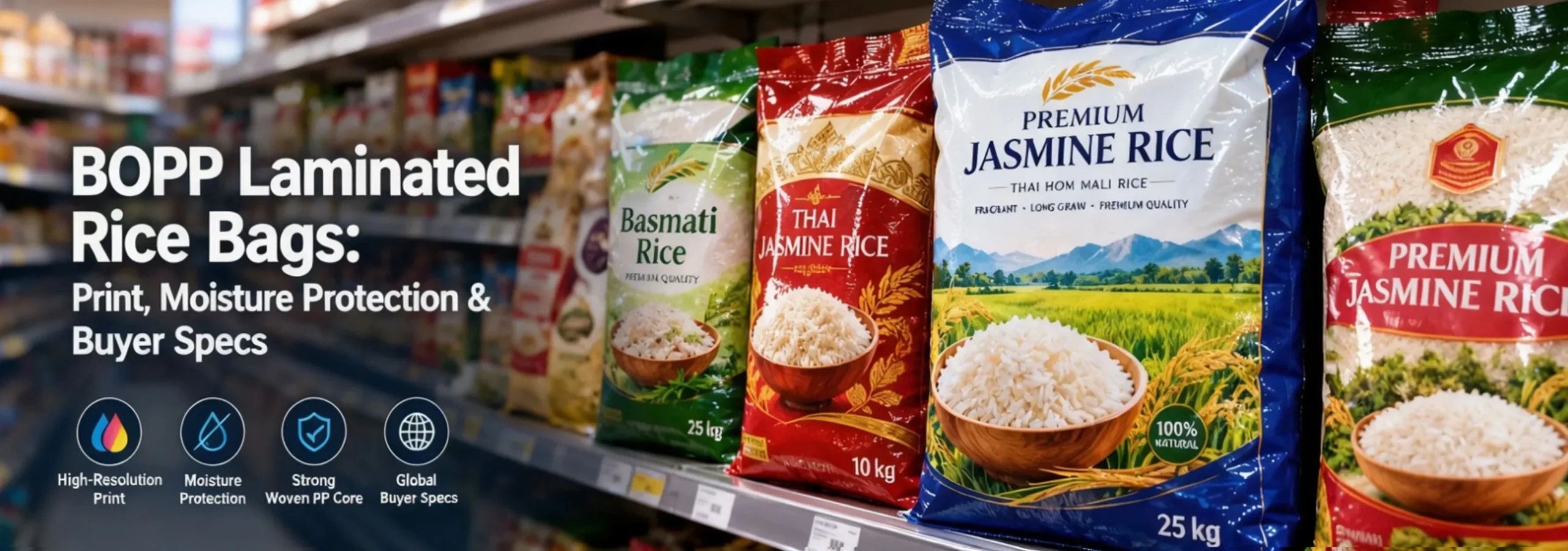
Rice is one of the most widely branded staple foods, so the packaging has to protect the product while presenting the brand clearly. BOPP laminated rice bags combine woven polypropylene fabric with a biaxially oriented polypropylene (BOPP) film laminated to the bag surface, creating a smooth printable face with improved resistance to surface moisture and handling abrasion. This guide explains the main BOPP rice-bag formats, printing and liner options, and the specifications global buyers should confirm before ordering.
Quick answer: BOPP lamination adds a smooth PP film surface to woven fabric, supporting detailed multi-colour printing and improving resistance to surface moisture and handling abrasion. BOPP rice bags are commonly supplied in 5, 10, 25 and 50 kg formats, with open-mouth, valve, gusseted and optional PE liner constructions selected according to the product and filling line.
Definition: A BOPP laminated rice bag is a PP woven sack with a biaxially oriented polypropylene (BOPP) film laminated to one or both faces. The film creates a smooth printable surface and improves resistance to surface moisture and abrasion. Overall moisture performance depends on the film structure, liner, seams, closure and storage conditions.
Why BOPP Laminated PP Woven Bags Work for Rice Packaging
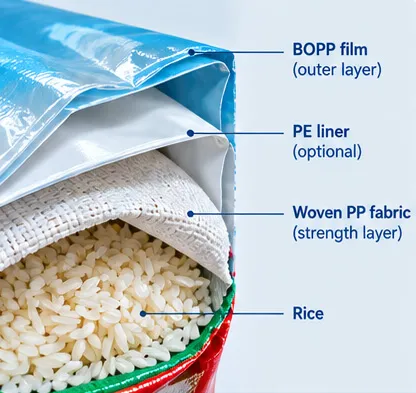
Plain woven PP provides the structural strength required for rice packaging, but its textured surface can limit graphic detail and print presentation. BOPP lamination creates a smoother face that can support detailed multi-colour printing, while the film can improve resistance to surface moisture and handling abrasion. For retail-focused rice packaging, BOPP woven bags can therefore combine structural strength with a more controlled printed surface.
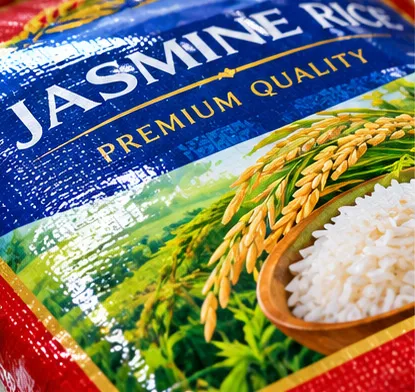
Key takeaway: BOPP adds value mainly through the bag surface: it supports detailed branding and provides additional surface protection, while the woven PP structure provides the mechanical strength needed for filling, stacking and transport.
BOPP Laminated vs Plain PP Woven Rice Bags
| Attribute | BOPP laminated PP woven bag | Plain PP woven bag |
|---|---|---|
| Print presentation | Smooth surface suitable for detailed multi-colour graphics | Textured woven surface with more limited graphic presentation |
| Surface protection | BOPP film can improve resistance to surface moisture and handling abrasion | Protection depends mainly on the woven fabric, coating and any liner |
| Branding | Suitable for retail-focused branded packaging | Suitable for simpler printed or functional packaging |
| Construction | Woven PP plus BOPP laminate and printing | Woven PP with printing or other specified treatment |
| Cost consideration | Additional film, lamination and printing processes can increase packaging cost | Simpler construction can reduce material and conversion cost |
PP Woven Rice Bag Sizes and BOPP Features
| Attribute | Typical option | Buyer consideration |
|---|---|---|
| Bag size | 5 kg, 10 kg, 25 kg, 50 kg | Match filled weight, retail format and finished-bag dimensions |
| Closure / fill | Open-mouth, valve or gusseted construction | Match the filling, sealing and handling equipment |
| Detailed multi-colour printing, with finish selected for the design | Approve artwork, colour references and print coverage before production | |
| BOPP structure | Single-side or specified laminate construction | Confirm film specification, finish and lamination side |
| Inner liner | Optional PE liner | Consider when additional moisture or aroma protection is required |
| Custom features | Handles, gussets or other application-specific options | Specify only when required by filling, transport or retail handling |
Moisture Protection and Storage Performance
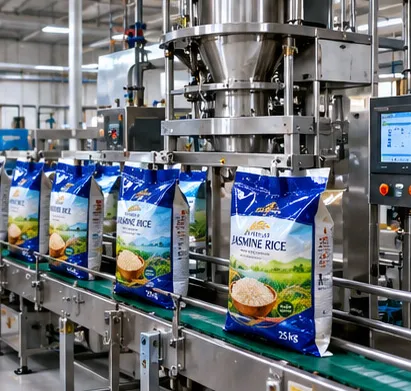
Rice can absorb moisture during storage and distribution, so the bag construction should match the expected climate and handling conditions. BOPP lamination creates a smoother outer surface and can improve resistance to surface moisture, while an optional PE inner liner can provide an additional layer of protection where moisture or aroma control is important. These packaging features can help reduce exposure to external moisture, but actual storage performance still depends on rice moisture content, sealing quality, temperature, humidity and warehouse conditions. For high-volume packing, BOPP laminated bags can be designed for automated filling when their dimensions, mouth or valve construction, gusset and venting requirements match the equipment. Buyers should confirm finished-bag tolerances and closure geometry with the machine supplier before approving production samples. The wider automated filling PP woven bags guide covers the line-side requirements in detail.
Buyer’s Specification Checklist
- Bag size—confirm filled weight, finished-bag dimensions and required bag tolerance.
- Fabric specification—define GSM, tape denier, weave construction and strength according to the filled weight.
- BOPP film—specify laminate side, film specification and gloss or matte finish where required.
- Printing—confirm printing method, colour requirements, artwork, print coverage and approval process.
- Closure—select open-mouth, valve or gusseted construction according to the filling and sealing equipment.
- Liner—specify PE liner material and thickness when additional moisture or aroma protection is required.
- Food-contact compliance—confirm the applicable food-contact documentation and destination-market requirements when the packaging is used for food.
- MOQ and lead time—confirm production quantity, sampling schedule, printing preparation and delivery requirements.
The broader BOPP laminated PP woven bags guide covers the material and process in full, while the PP woven bags market in 2026 outlines where branded demand is growing.
Regional Buyer Considerations
Rice packaging requirements vary by market, pack size, retail format and distribution conditions. Buyers may need to balance print quality, surface moisture protection, bag strength, filling-line compatibility and landed cost. For export orders, specifications should therefore be matched to the destination climate, filling method, storage conditions and applicable food-contact requirements rather than using one standard bag for every market.
A Manufacturing Note
SITONG PACKAGING has manufactured woven polypropylene packaging since 1998, with plants in Haicheng, Liaoning and Cambodia and around 20 production lines running at roughly 100 tonnes per day. The company ships to more than 70 countries from the port of Dalian, with annual output of approximately 30,000 tonnes across its woven PP operations. Extrusion, weaving, printing, lamination and sewing are held in-house, allowing buyers to specify bag dimensions, BOPP lamination, printing, liners and closure construction for different rice-packaging requirements. When comparing PP laminated bags manufacturers, buyers should also evaluate process control, sampling capability, quality inspection and the supplier’s ability to reproduce the approved specification consistently.
Conclusion
BOPP laminated rice bags combine the load-bearing structure of a PP woven rice bag with a smooth BOPP surface for detailed printing and improved resistance to surface moisture and handling abrasion. For global buyers, the key specifications are bag size, fabric strength, BOPP film, printing, liner, closure and filling-line compatibility. Matching these specifications to the rice product, destination climate and distribution conditions helps create packaging that meets the actual requirements of the supply chain.
Frequently Asked Questions
BOPP (biaxially oriented polypropylene) is a PP film laminated to the surface of a woven polypropylene rice bag. It creates a smooth printable face and can improve resistance to surface moisture and handling abrasion. The final performance depends on the film structure, liner, seams, closure and storage conditions.
BOPP creates a smoother surface that supports detailed multi-colour graphics and can improve resistance to surface moisture and handling abrasion. Plain woven PP remains suitable for applications where simpler printing and construction meet the packaging requirement.
Common retail and wholesale sizes are 10 kg, 25 kg, 50 kg and 100 kg, with valve, open-mouth or gusseted block-bottom options depending on the filling line.
Not always. A PE inner liner can provide an additional layer of protection when moisture or aroma control is important, particularly in demanding storage or distribution conditions. The need for a liner depends on the rice product, climate, sealing method and required storage performance.
Reverse rotogravure is commonly used for detailed, high-quality graphics on BOPP laminated bags, particularly for larger production runs. Other printing methods may be available depending on the bag construction, artwork, order volume and supplier’s equipment. Buyers should approve artwork, colour references and print-registration requirements before production.
BOPP laminated rice bags are polypropylene-based structures, but actual recyclability depends on the specific construction and the collection and recycling system in the destination market. Buyers prioritising end-of-life recycling should confirm whether the BOPP film, woven PP fabric and any PE liner are accepted by the relevant recycling infrastructure.
Specify the filled weight and finished-bag dimensions, fabric GSM and strength, BOPP film specification (single or double side, gloss or matte), printing method and artwork, liner requirement, closure style, filling-line compatibility, food-contact documentation where applicable, MOQ and lead time.
Yes, when the finished-bag dimensions, tolerances, mouth or valve construction, gusset and venting requirements match the filling equipment. Buyers should provide the machine supplier’s bag specifications or drawings to the packaging manufacturer and validate production samples before placing a large order.