
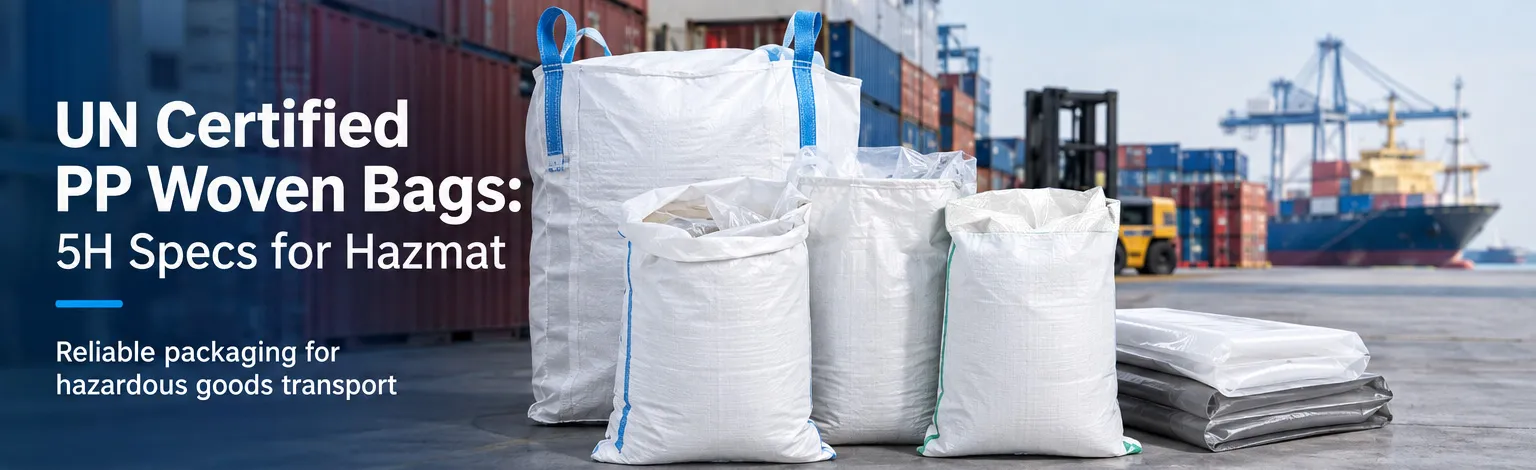
When hazardous goods are transported, the packaging must meet the applicable dangerous goods requirements for the substance, packing group and transport mode. UN certified PP woven bags are commonly used to describe woven polypropylene bags manufactured as UN specification packaging in the 5H family, built and tested to a specified performance level. This guide explains the codes, the tests and what a buyer must confirm before shipping.
Quick answer: UN-certified PP woven bags are produced to the UN “5H” specification for woven plastics. Depending on the applicable dangerous goods requirements, the design type must pass the prescribed performance tests, including the relevant drop test for bags. The required 5H construction and performance level must match the dangerous goods, packing group and applicable transport regulations. SITONG PACKAGING produces UN-certifiable woven PP bags to the 5H build; the buyer must confirm the current UN design-type test documentation for the substance, UN number, packing instruction and transport mode before shipment.
Definition: A UN specification PP woven bag is a woven polypropylene sack manufactured and tested as a UN “5H” packaging—woven plastics. The UN specification mark identifies the packaging type and its tested performance level together with other required identification information. The packaging must be used only where the applicable dangerous goods regulations and packing instruction permit that design type for the substance being shipped.
UN Certified PP Woven Bags: Understanding the 5H Codes
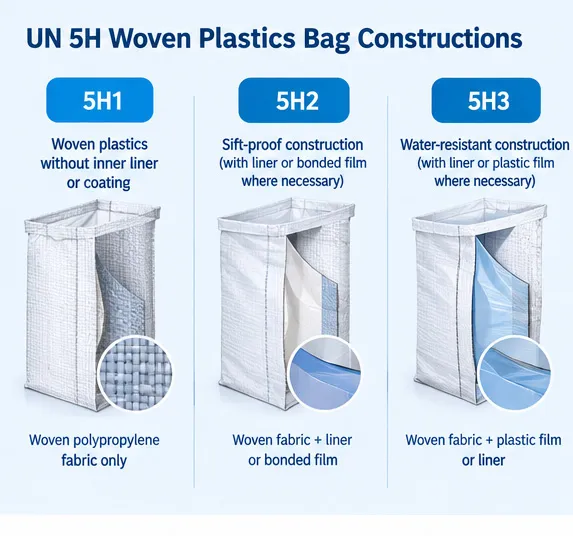
The UN packaging code “5H” denotes plastics, woven. The digits that follow define the construction:
| Code | Construction | Typical use |
|---|---|---|
| 5H1 | Woven plastics, without inner liner or coating | Dry solids where the fabric alone is sufficient |
| 5H2 | Woven plastics, sift-proof; a liner or bonded film may be used to achieve the sift-proof construction | Fine powders and dusty solids needing a barrier |
| 5H3 | Woven plastics, water-resistant; a suitable liner or plastic film may be used to provide water resistance | Used where protection against moisture entering the bag is required |
Direct answer — 5H1 vs 5H2 vs 5H3: All three are woven-plastics bag constructions under the UN system. 5H1 is woven plastics without an inner liner or coating; 5H2 is sift-proof; and 5H3 is water resistant. A liner, film or other construction feature may be used where necessary to achieve the required performance. The correct design type depends on the dangerous goods and applicable packing instruction.
Key takeaway: The code is not a quality grade—it is a construction definition. The right code is set by the physical form and hazard of the product, not by preference.
UN PP Woven Bag Design-Type Testing
A UN package is proven by test, not by description. A 5H bag submitted for certification undergoes design-type testing that typically includes:
- Drop test—the filled bag is dropped onto a rigid, non-resilient surface in the prescribed manner to verify that it can withstand the required impact without failure affecting transport safety.
- Design-type verification—the tested packaging must conform to the specified construction, materials and other requirements applicable to its packaging code.
- Additional tests where applicable—other performance tests may apply to particular packaging types or dangerous goods requirements. A leakproofness or internal-pressure test is not a universal requirement for 5H woven-plastics bags, which are specified as bags for solid contents.
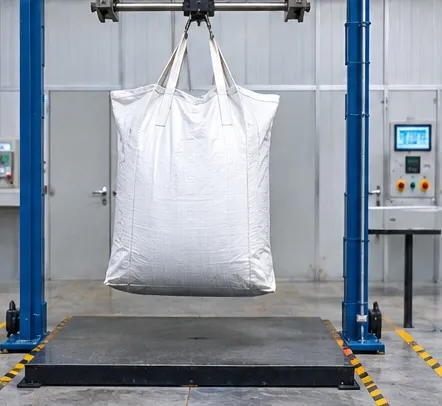
The completed design-type test establishes the packaging’s demonstrated performance level. UN performance levels are identified as X, Y or Z: X indicates a design type approved for Packing Groups I, II and III; Y for Packing Groups II and III; and Z for Packing Group III only. The applicable performance level and other marking information must correspond to the tested design type and dangerous goods requirements.
Reading the UN Mark
The UN mark on an approved bag encodes the essentials: the “UN” symbol, the packaging code (e.g., 5H2), the performance level (X/Y/Z), the country and year of manufacture, and the manufacturer’s identification code. For a 5H woven-plastics bag, the marking also identifies the applicable mass or other specification information required by the regulations. Buyers should compare the complete marking with the design-type test documentation and the applicable dangerous goods packing instruction. The UN mark alone does not establish that the package is permitted for every substance or transport situation.
Where UN PP Woven Bags Are Used
The 5H construction is used for certain regulated solid dangerous goods where the applicable packing instruction permits woven-plastics bags. Potential applications include selected industrial chemicals, hazardous powders and regulated fertilizers. The exact packaging type depends on the substance’s UN number, hazard classification, packing group and applicable packing instruction. For the fertilizer segment specifically, the fertilizer PP woven bags guide covers the product-protection side, while the UN layer adds the compliance proof for cross-border hazardous movement. The wider range of woven polypropylene bags made for non-hazardous dry goods is covered separately.
Regulatory Context Buyers Must Track
UN marking originates in the UN Model Regulations on the Transport of Dangerous Goods and is adopted into modal rules: IMDG for sea, ADR for road, and IATA DGR for air. A UN specification mark does not by itself make a shipment compliant across every mode; the shipper must also follow the applicable packing instruction, quantity limits, marks, labels and documentation for the chosen route. Trade measures add a second layer—covered in the PP woven bags trade remedy risk in 2026 briefing—so a compliant bag and a compliant tariff posture are different workstreams.
A Manufacturing Note
SITONG PACKAGING has manufactured woven polypropylene packaging since 1998, with plants in Haicheng (Anshan), Liaoning and Cambodia, around 20 production lines at roughly 100 tonnes per day, and shipments to more than 70 countries from the port of Dalian. The company provides in-house production and quality control covering woven fabric, dimensions and seam integrity. For projects requiring a 5H UN specification, the complete bag design—including woven fabric, liner or coating where applicable, dimensions, closure and other construction details—should be defined against the applicable dangerous goods packing instruction and tested design documentation. Sustainability requirements such as the EU’s PPWR may also affect the packaging specification, covered in the PPWR-compliant woven PP bags guidance. Buyers should request the current design-type test documentation for the exact bag design before production and shipment.
Conclusion
UN certified PP woven bags are commonly used to describe woven polypropylene bags manufactured as UN specification packaging within the 5H family. The key checks are the correct 5H construction, demonstrated performance level, complete UN marking and compatibility with the applicable dangerous goods packing instruction. Before the first shipment, buyers should verify the substance’s UN number and packing requirements, the design-type test documentation, bag specification and transport-mode rules rather than relying on the UN mark alone. SITONG PACKAGING produces UN-certifiable 5H woven PP bags with in-house QC; the buyer’s job is to confirm the documentation before the first hazardous shipment.
Frequently Asked Questions
“5H” is the UN packaging code for woven plastics. The suffix defines construction: 5H1 without liner or coating; 5H2 sift-proof, where a liner or bonded film may be used to achieve the sift-proof construction; 5H3 water-resistant, where a liner or plastic film may be used to provide water resistance.
No. A standard woven PP bag is not UN certified. Certification requires the correct 5H construction and a passed design-type test with a valid UN mark and test report. SITONG produces UN-certifiable 5H bags; the buyer confirms the current design-type test documentation.
The required tests depend on the packaging design and applicable dangerous goods regulations. For woven-plastics bags, the design-type drop test is a key performance test, while other tests may apply to specific packaging types or requirements. The resulting performance level is identified as X, Y or Z: X covers Packing Groups I, II and III; Y covers Packing Groups II and III; and Z covers Packing Group III only.
For hazardous powders, a sift-proof woven-plastics construction such as 5H2 may be permitted where the applicable packing instruction allows it; a 5H3 bag may be selected when water resistance is also required. The correct code cannot be determined from the word “powder” alone—check the substance’s UN number, packing instruction, packing group and transport mode.
A UN specification package may be used across different transport modes only when the applicable modal regulations permit that packaging for the specific dangerous good (IMDG for sea, ADR for road, IATA DGR for air). The UN mark alone does not make every shipment compliant; the shipper must follow the additional rules of the chosen mode.
Yes. A liner or bonded plastic film may be used to achieve the required 5H2 sift-proof or 5H3 water-resistant construction. The liner or film must be suitable for the intended dangerous goods and form part of the tested packaging design where required.
Request the current UN design-type test documentation and compare it with the exact bag construction, 5H code, performance level and UN marking offered for production. Also confirm that the applicable dangerous goods packing instruction permits that packaging for your substance and transport mode. Do not rely on a generic UN certificate or a UN mark without checking the underlying design documentation.
The PPWR addresses sustainability (recyclability, recycled content) and is a separate workstream from UN hazard compliance. Both can apply to the same bag, so spec the 5H build and the PPWR requirements together.
Buyer Checklist for UN-Certified PP Woven Bags
- Substance scope—confirm the UN number, hazard class and packing group of the dangerous good.
- 5H code—specify 5H1, 5H2 or 5H3 from the product form and any liner or coating requirement.
- Performance level—verify that the X, Y or Z performance level of the tested design is permitted for the applicable packing group and substance.
- Test documentation—request the current design-type test report and UN mark image for the exact bag design.
- Modal rules—align the bag with IMDG (sea), ADR (road) or IATA DGR (air) requirements for the route.
- Liner or coating—define the liner or bonded film material where 5H2 or 5H3 construction is required.
- Bag construction—confirm dimensions, fabric specification, closure, seams and any liner, coating or film used in the tested design; specify any anti-static or special-feature requirements where applicable.