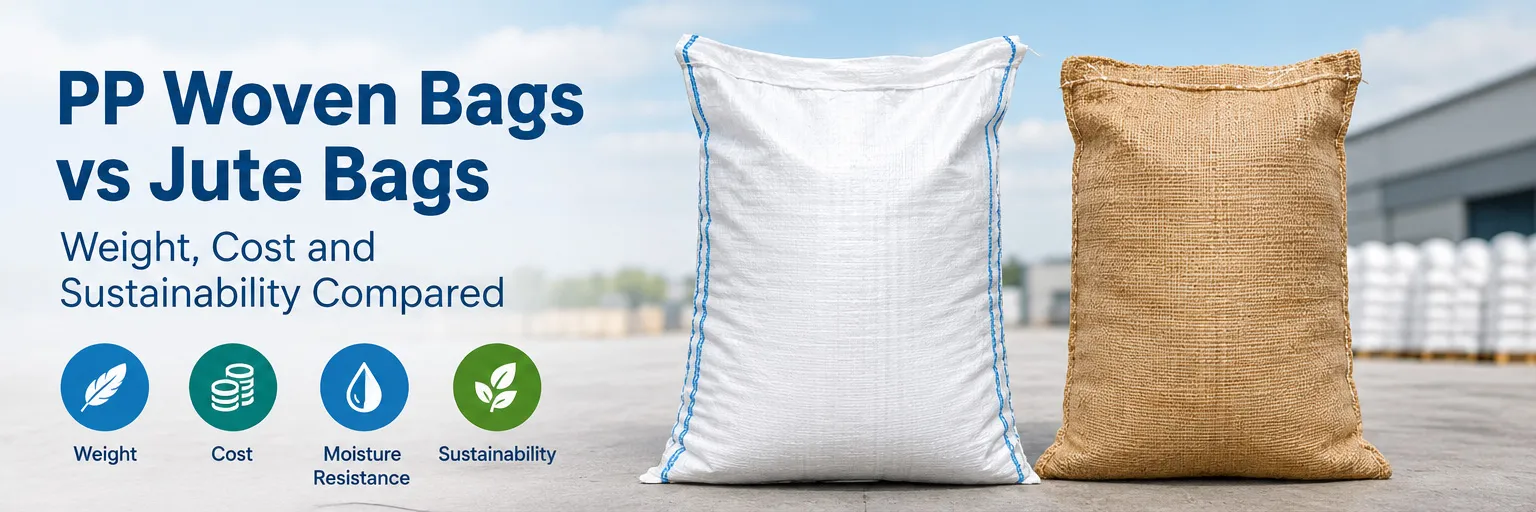

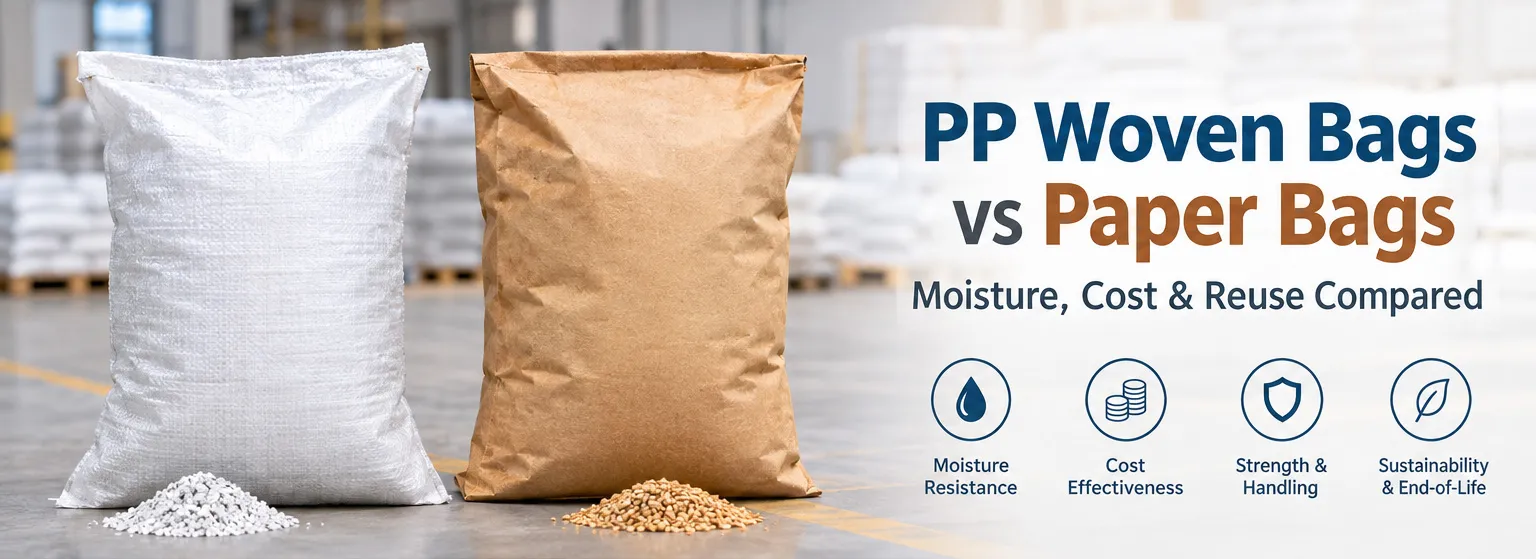
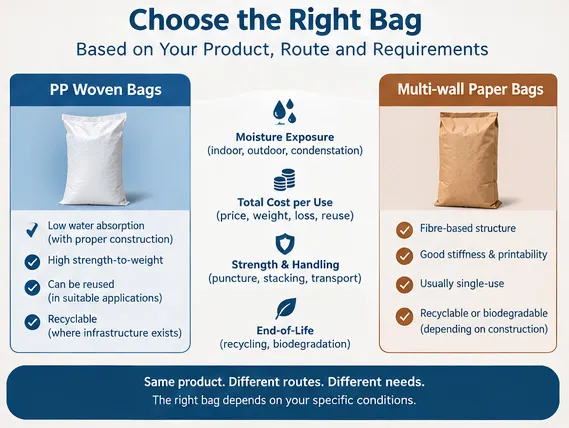
The choice in the pp woven bags vs paper bags decision depends on the product, moisture exposure, handling conditions, filling system and end-of-life requirements. PP woven bags (also known as woven polypropylene bags) offer a lightweight woven structure with low water absorption, while multi-wall paper bags provide a fibre-based structure with different stiffness, printability and end-of-life characteristics. This guide compares the two on moisture, cost, strength, reuse and end-of-life considerations so specifiers can match the bag to the product and the route.
Quick answer: PP woven bags can offer strong resistance to liquid water and high strength at relatively low package weight, while the standard woven fabric needs coating, lamination or a liner for a full moisture barrier. Multi-wall paper offers a paper-based appearance and can be biodegradable or recyclable depending on the bag construction. The better choice depends on moisture exposure, required barrier, filling equipment, handling conditions and whether the bag is designed for reuse.
Definition: A PP woven bag is woven polypropylene fabric cut and sewn into a sack. Multi wall paper bags are made from multiple plies of kraft paper, typically formed into valve or open-mouth sacks. Both can be used for dry bulk products, but their performance differs in moisture resistance, puncture resistance, stiffness, barrier design and end-of-life options.
PP Woven Bags vs Paper Bags: At a Glance
| Attribute | PP woven bag | Multi-wall paper bag |
|---|---|---|
| Material | Woven polypropylene fabric | Multiple plies of kraft paper, typically formed into valve or open-mouth sacks |
| Moisture behaviour | Polypropylene has low water absorption; standard woven fabric is porous, while coatings, laminations or liners can add a moisture barrier | Paper can lose strength when exposed to water; wet-strength treatments, films or liners can improve moisture performance |
| Package weight | Can provide high strength at relatively low package weight, depending on GSM and construction | Package weight depends on paper grade, ply count and bag construction |
| Unit price | Depends on GSM, construction, printing, lamination, order volume and market conditions | Depends on paper grade, ply count, valve or open-mouth construction, printing and order volume |
| Reuse | Can be designed and approved for multiple trips in suitable applications | Typically used for a single filling and distribution cycle |
| Print and branding | Surface printing or BOPP lamination can provide strong graphics | Direct printing on kraft paper provides a paper-based appearance |
| End-of-life | Recyclable where suitable polypropylene collection and reprocessing systems exist; not biodegradable | Paper-based components can be recyclable or biodegradable depending on construction and local waste infrastructure |
| Typical applications | Can be used for cement, fertilizer, chemicals, sand, grain and other dry bulk products | Can be used for cement, flour, sugar, dry food and other dry bulk products depending on the required construction |
At a glance: PP woven bags generally provide low water absorption and high strength at relatively low package weight, while multi-wall paper bags provide a fibre-based structure with good stiffness and printability. Neither material is automatically the lower-cost or more sustainable option; the result depends on construction, route, service life and end-of-life infrastructure.
Moisture Resistance: PP Woven vs Paper Bags
Moisture performance depends on the construction of the bag, not only the base material. Untreated multi-wall paper can lose strength when exposed to water, while wet-strength treatments, films or liners can improve its resistance. Standard PP woven fabric is porous and should not be described as fully waterproof on its own, but coated or laminated PP woven bags, or bags with an inner PE liner, can provide additional protection against liquid water and water-vapour transmission. Actual performance depends on the bag construction, barrier specification, storage conditions and duration of moisture exposure.
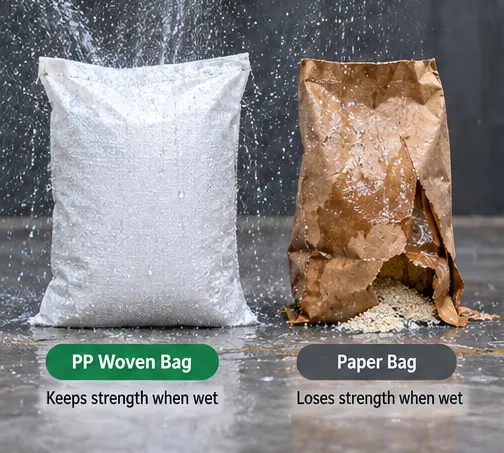
For products that are themselves moisture-sensitive—cement that sets, fertilizer that cakes, grain that molds—packaging selection should consider both liquid-water exposure and water-vapour transmission, matched to the product, storage period and transport conditions.
PP Woven Bags vs Paper Bags: Cost per Use
| Factor | PP woven bag | Multi-wall paper bag |
|---|---|---|
| Unit price (volume) | Depends on GSM, construction, printing, lamination, order volume and market conditions | Depends on paper grade, ply count, valve or open-mouth construction, printing and order volume |
| Reuse | Can be designed and approved for multiple trips in suitable applications | Typically used for a single filling and distribution cycle |
| Wet-strength performance | Polypropylene has low water absorption; coatings, laminations or liners can add moisture protection to the porous woven structure | Paper can lose strength when wet; wet-strength treatment, films or liners can improve moisture resistance |
| Print and branding | BOPP lamination or surface print | Direct print on kraft |
Key takeaway: Compare total packaging cost rather than unit price alone. The relevant calculation can include bag price, filling-line performance, product loss, freight weight, storage conditions, damage rates and any validated reuse cycles. The lower unit price does not automatically produce the lower cost per packed tonne.
Strength and Handling
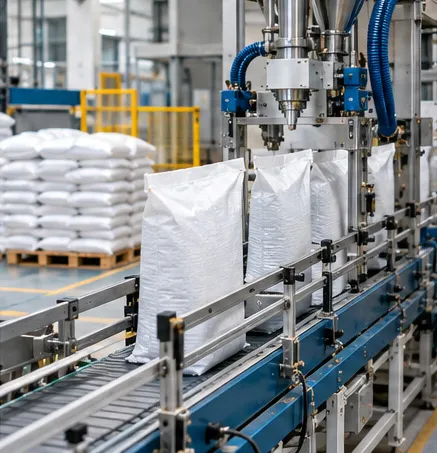
PP woven fabric has high tensile strength for its weight and resists punctures from sharp or granular loads. Paper bags perform well when dry but are vulnerable to stacking pressure when damp and to tear at the valve. On automated lines, the bag construction must be matched to the filling speed, valve or open-mouth format, de-aeration requirements, sealing method and equipment tolerances. The hermetic PP woven bags for grain storage show how the material is engineered for sealed, moisture-safe duty.
Sustainability: Compare the Full Packaging System
Neither material should be described as automatically more sustainable in every application. Paper is based primarily on renewable fibre and can offer established recycling or biodegradation pathways depending on the bag construction and local waste system. PP woven bags can be lightweight, durable and recyclable where suitable polypropylene collection and reprocessing infrastructure exists. Their environmental performance depends on resin source, package weight, manufacturing, transport distance, service life, reuse rate, coatings or liners and end-of-life treatment. A meaningful comparison should therefore use the same functional unit—the same packed product, route, service life and end-of-life scenario—rather than comparing the raw materials alone.
Which Should You Specify?
| Consider PP woven bags when… | Consider multi-wall paper bags when… |
|---|---|
| The route or storage involves moisture, condensation or outdoor exposure and the selected construction provides the required barrier | The route is predominantly dry and the selected paper construction provides the required strength and barrier |
| The bag is specifically designed and approved for multiple trips | A single filling and distribution cycle is appropriate for the application |
| High strength-to-weight performance and puncture resistance are important | Paper stiffness, printability or a paper-based appearance is important |
| Suitable polypropylene recycling or controlled reuse infrastructure is available | Suitable paper recycling or other end-of-life infrastructure is available for the actual bag construction |
The PP woven bags Africa market illustrates why route conditions matter. Many supply chains involve long inland or ocean transport, seasonal humidity and variable storage conditions, so buyers may place greater emphasis on moisture resistance, puncture resistance and bag durability. The appropriate bag construction still depends on the product, route, filling system and local packaging requirements.
A Manufacturing Note
SITONG PACKAGING has manufactured woven polypropylene packaging since 1998, with plants in Haicheng (Anshan), Liaoning and Cambodia, around 20 production lines at roughly 100 tonnes per day, and shipments to more than 70 countries from the port of Dalian. Extrusion, weaving, coating, printing and sewing are held in-house, allowing GSM, lamination and liner specifications to be adjusted for different products, filling systems and transport conditions. Buyers tracking the wider market can read the PP woven bags market in 2026 for broader market context.
Conclusion
PP woven bags vs paper bags is best evaluated through the product, route and required packaging performance rather than a single material preference. PP woven bags can offer low water absorption, high strength-to-weight performance and optional coating, lamination or liner systems, so they are often the more suitable choice where moisture, outdoor exposure or reuse across trips drive the specification. Multi-wall paper bags can offer stiffness, printability and fibre-based end-of-life options depending on their construction. For cement, fertilizer, grain, sand, chemicals and food products, buyers should compare moisture exposure, filling equipment, handling requirements, package weight, total cost and local end-of-life infrastructure before selecting the bag type.
What Should Buyers Specify When Comparing PP Woven and Paper Bags?
- Product moisture sensitivity—describe whether the product absorbs water, cakes or degrades on humidity.
- Route and storage—state expected humidity, condensation, outdoor dwell and storage period.
- Bag construction—specify fabric GSM, coating or lamination, ply count for paper, valve or open-mouth top.
- Reuse cycles—state whether the bag is single-use or designed for multi-trip duty.
- Barrier requirement—specify any PE liner, BOPP lamination, paper wet-strength treatment or other barrier layers.
- Filling-line compatibility—match bag geometry, valve or open-mouth, de-aeration and tolerances to the equipment.
- Print and branding—state the print method, finish and any food-contact documentation where the bag contacts food.
- Compliance—where the bag will contact food or other regulated products, specify the applicable food-contact or product-specific requirements for the destination market.
- End-of-life—define whether recycling infrastructure, composting or landfill is the realistic route.
- Cost per packed tonne—compare bag price, freight weight, validated reuse cycles, damage rates and product loss on the same functional unit.
For buyers sourcing cement PP woven bags, the specification should define filling method, bag dimensions, GSM, coating or lamination, valve or open-mouth construction, stacking requirements, moisture exposure and the expected distribution route. These parameters are more useful for supplier comparison than the material name alone.
Frequently Asked Questions
PP woven bags generally tolerate wet handling better than untreated paper. However, standard woven PP fabric is porous and is not automatically waterproof on its own; coated or laminated PP woven bags, or bags with an inner PE liner, are used where a stronger barrier is needed. Multi-wall paper can lose strength and perform inconsistently in wet conditions, particularly at the seams or valve where untreated plies absorb water.
There is no universal unit-price winner because cost depends on material weight, bag construction, printing, lamination, liners, valves, order volume and market conditions. For procurement, compare the total cost per packed tonne or shipment, including bag price, freight weight, filling-line performance, product loss, damage rates and any validated reuse cycles.
Yes. Multi-wall paper sacks are widely used for cement and other dry bulk products, and some constructions include wet-strength treatment, polyethylene film or other barrier layers. PP woven bags are another option and are often the more suitable choice where moisture—ambient humidity, condensation or rain—cannot be reliably excluded and high puncture resistance is required. The appropriate construction depends on the filling system, moisture exposure, handling conditions, product requirements and distribution route.
Neither material is automatically more environmentally friendly in every application. Paper is based primarily on renewable fibre and can be biodegradable or recyclable depending on the bag construction. PP woven is lightweight, durable and recyclable where suitable infrastructure exists. A meaningful comparison should use the same functional unit—the same packed product, route, service life and end-of-life infrastructure—rather than a generic material preference.
Yes, PP woven bags can be designed for automated filling and palletising systems. Valve or open-mouth construction, bag dimensions, de-aeration, sealing method and equipment tolerances should be matched to the filling line. Actual line performance depends on both the bag construction and the equipment configuration.
Yes, with a suitable food-contact liner and documented construction. Grain, sugar and flour are common PP woven applications where a liner provides the barrier.
Neither material is automatically better for every ocean route. Buyers should evaluate container condensation, humidity, stacking, puncture risk, package weight and the required moisture barrier. Coated, laminated or lined PP woven bags can provide strong moisture protection and are often the more suitable choice where container condensation and high humidity are routine, while paper bags can also use engineered barrier or wet-strength constructions. The choice should be based on the actual route and product requirements.
PP woven bags can be recyclable when they are compatible with available polypropylene collection and reprocessing systems. Recycling performance depends on the bag construction, coatings, laminations, liners, printing and contamination level. Where recyclability is a requirement, buyers should specify a construction compatible with the intended local recycling stream.