
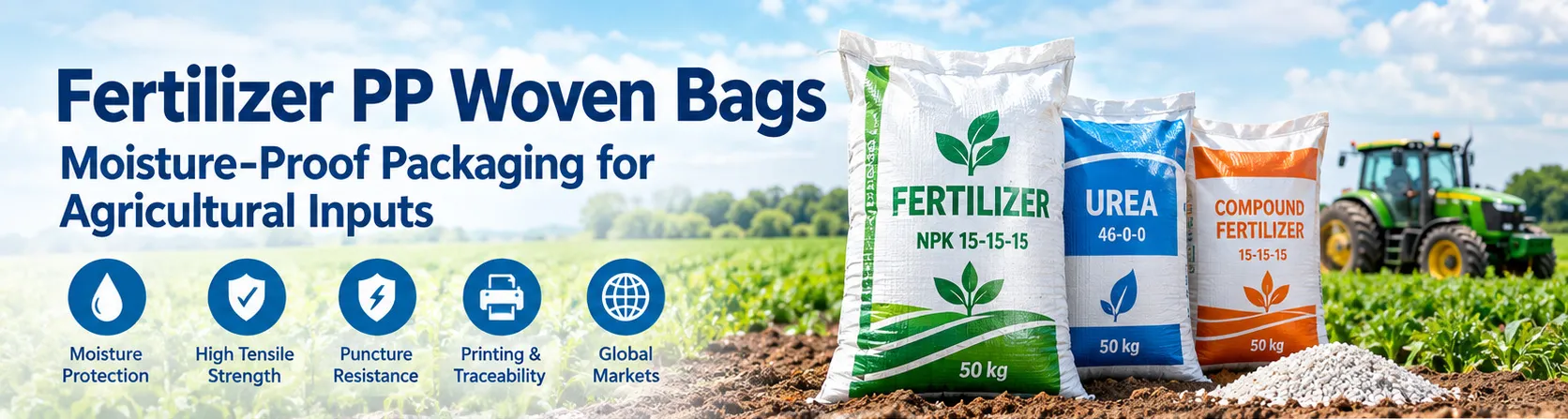
Fertilizer PP woven bags are widely used for agricultural inputs because they combine high tensile strength, low weight and flexible options for moisture protection and printing. Fertilizer and animal feed are steady procurement categories for Africa, Latin America, Central America and Asia. A fertilizer bag must resist moisture, punctures and handling abuse while carrying the brand and traceability a distributor or co-op requires. This guide covers bag structures, liner options and the market adaptations buyers should specify.
Fertilizer and Feed Packaging at a Glance
- Agriculture inputs share: strong demand for agricultural inputs
- Core requirements: moisture protection, tensile strength, puncture resistance, clean filling and durable printing
- SITONG export focus: Africa, Latin America, Central America and Asia
- Core needs: Moisture proofing, puncture resistance, print and traceability
- Related formats: Bulk feed bags (US 320/KD6), poly feed bags (US 70/KD2)
Why Fertilizer and Feed Need Woven PP
Fertilizer is hygroscopic and heavy; animal feed requires appropriate cleanliness and contamination controls. Woven PP gives the tear strength to hold 25 kg to 50 kg filled weights and the conversion flexibility for lamination and liner. Because fertilizer and feed are recurring procurement categories, buyers prioritise supply stability and strength alongside moisture and contamination control.
A fertilizer bag is a moisture-and-abuse problem first, a print problem second. Get the barrier right, then the brand; the reverse order fails in the field.
Bag Structures for Fertilizer
| Structure | Use | Benefit |
|---|---|---|
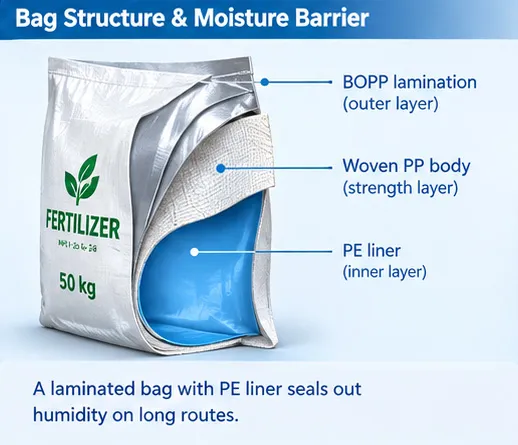
| BOPP laminated PP woven | Branded fertilizer | Moisture resistance, high-quality graphics and abrasion resistance |
| PE-lined woven | High-humidity routes | Internal moisture seal |
| Multi-wall / valve | Automated filling | Speed and clean close |
| Plain woven + sewn | Commodity bulk | Lowest cost |
Key takeaway: For fertilizer pp woven bags, lamination or a PE liner is the usual moisture defence; the choice depends on route humidity and filling method.
Bag Structures for Animal Feed
Animal feed is closer to food handling, so clean conversion and a liner that meets the relevant food-contact status matter. Feed bags often use the same woven PP body but with tighter cleanliness control and printed lot codes for traceability. Bulk feed bags (about US 320 volume, KD 6) are the larger format for mills and farms, while 25 kg to 50 kg retail or co-op bags dominate distribution.
Moisture-Proof and Liner Options
Moisture is the main enemy of bagged fertilizer: caking and lumping ruin flow at the spreader. A BOPP or PE lamination on the outside plus a PE liner inside gives a double defence on humid ocean and inland routes. For buyers prioritising recyclability, a mono-material PP structure may be considered instead of a mixed PP/PE or PP/BOPP construction, depending on the required moisture barrier and applicable recycling infrastructure; the barrier performance should be validated for the specific fertilizer and route.
Printing and Traceability for Brands
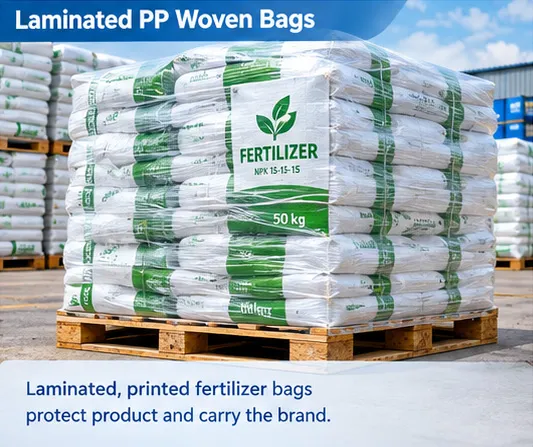
Distributors and co-ops want private-label bags with lot codes, application instructions and warning marks. Reverse-printed BOPP lamination gives a durable, scuff-resistant image; plain woven with flexo print is cheaper for commodity lots. Either way, the print spec should be fixed at order so the converter plates it correctly.
Target-Market Adaptations
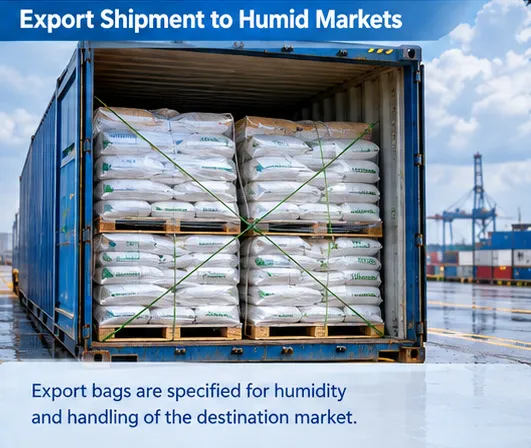
SITONG’s export focus spans Africa, Latin America, Central America and Asia, where humidity and long transit often make moisture-proofing important. Market requirements vary within each region, so bags should be specified by destination country and actual supply-chain conditions rather than by region alone. Specifying by market avoids both over-engineering and field failure.
Sourcing Fertilizer and Feed Bags
Buyers should start from product (fertilizer vs feed), route humidity and filling method, then fix lamination, liner, GSM and print. The feed fertilizer PP woven bags page covers the product range, the agricultural PP woven bags hub sets the wider agriculture context, and the polypropylene grain bags South America article shows how the same region buys related agriculture packaging.
How to Choose Fertilizer and Feed Bags
Lead with moisture risk and the fill weight, then confirm print and traceability. Feed and fertilizer are not identical, so confirm food or feed-contact status only where the application requires it.
Specification Checklist
Use this checklist when briefing a supplier or comparing options. Confirm each point against the actual product and supply chain rather than a single headline claim.
| Spec to confirm | What to verify | Why it matters |
|---|---|---|
| Lamination | BOPP or PE lamination for moisture | Fertilizer needs a barrier |
| GSM | GSM for the fill weight | Balance strength and cost |
| Liner | Inner liner if moisture risk is high | For hygroscopic goods |
| Printing | Print and traceability needs | For brand and batch control |
| Feed status | Feed-grade status only if applicable | Feed differs from fertilizer |
| Documents | Specification and test records | Supports audit |
Frequently Asked Questions
Fertilizer is hygroscopic and cakes when it absorbs humidity, so a BOPP or PE lamination plus, on humid routes, a PE liner, keeps the product free-flowing through storage and transit.
For 25 kg to 50 kg fertilizer bags, woven PP constructions fall within a broad GSM range, with the appropriate specification depending on bag dimensions, filling weight, stacking, drop performance and transport conditions.
Feed packaging requires appropriate cleanliness and contamination controls, and any applicable food-contact status depends on the intended use and destination market, while fertilizer bags focus on moisture and puncture resistance.
On humid ocean or inland routes, a PE liner inside a laminated bag gives the best moisture defence. Dry, short routes may use lamination alone.
Yes. Reverse-printed BOPP lamination carries durable brand print and lot codes; plain woven with flexo print is a lower-cost option for commodity lots.
The strongest moisture protection is usually required where fertilizer faces high humidity, long storage or extended transport; specify the bag by destination climate, warehouse conditions and transport route.
Yes. A mono-material PP structure with an inner PP layer can replace a mixed laminate for recyclability while keeping much of the moisture barrier.
Fix product, route humidity, filling method, lamination, liner, GSM and print up front so the converter plates and lines the bag correctly the first time.
Share the product, fill weight, lamination type, GSM, liner need, print and traceability, and destination. Request specification and test records so the quote reflects a spec you can verify at incoming inspection.
Conclusion
Fertilizer PP woven bags provide a strong combination of mechanical strength, low packaging weight, moisture-protection options and flexible printing. Buyers should choose lamination or a PE liner by route humidity, separate feed (clean, food-contact) from fertilizer (moisture, puncture), and fix print and traceability for the destination market, Africa, Latin America, Central America and Asia.