

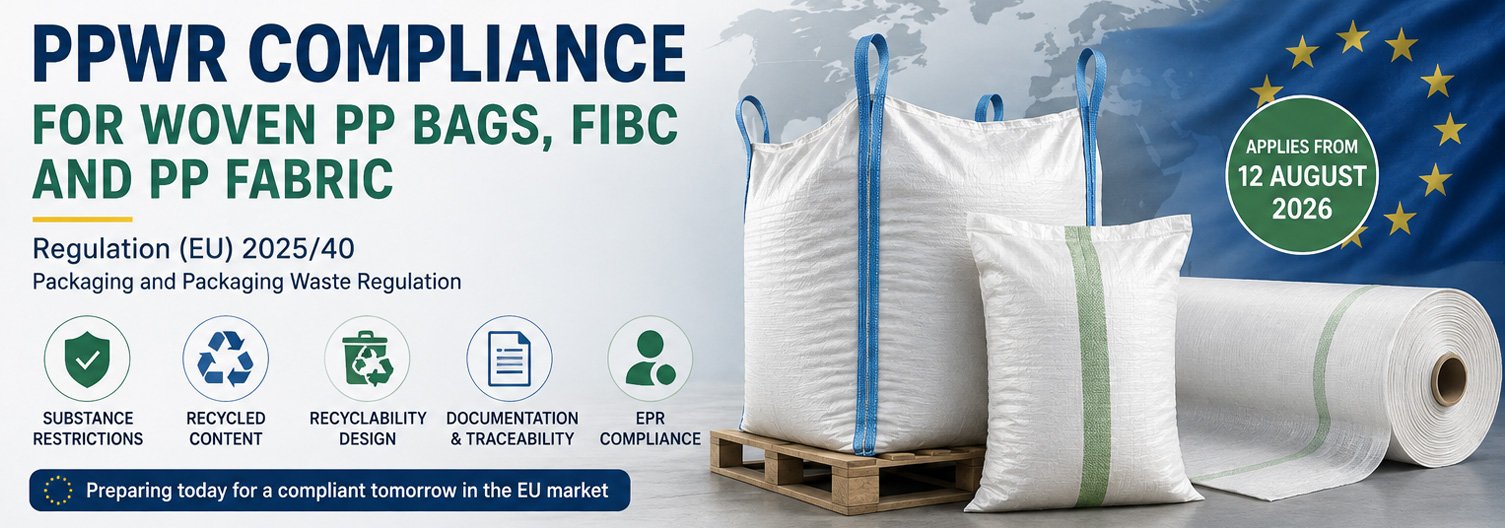
Regulation (EU) 2025/40, known as the Packaging and Packaging Waste Regulation (PPWR), generally applies across the EU from 12 August 2026. It introduces requirements covering packaging substances, recyclability, recycled content, labelling, and extended producer responsibility. For plastic packaging outside the specific PET and contact-sensitive categories, Article 7 sets a minimum recycled-content target of 35%, rising to 65%; the timing of the recycled-content obligation is linked to 1 January 2030 or three years after the relevant Article 7(8) implementing act enters into force, whichever is later. Importers and manufacturers of plastic packaging should therefore prepare traceable material and conformity documentation well before the recycled-content requirements take effect.
PPWR is a directly applicable EU regulation rather than a directive. It replaces Directive 94/62/EC from 12 August 2026, while specific obligations may have different application dates and some EPR and administrative requirements continue to depend on Member State arrangements. Businesses should therefore distinguish the harmonised EU requirements from market-specific registration, representation and implementation procedures.
Quick answer: PPWR (EU) 2025/40 generally applies from 12 August 2026 and introduces EU-wide rules covering packaging substances, recyclability, recycled content, labelling and extended producer responsibility. For woven PP bags and FIBC, the main preparation priorities are substance compliance, traceable post-consumer recycled content, recyclable packaging design, technical documentation and market-specific EPR requirements. The 35% recycled-content target for relevant plastic packaging is linked to the applicable 2030 trigger or three years after the Article 7(8) implementing act enters into force, whichever is later, while detailed recycled-content and Design-for-Recycling methodologies are still being developed.
What the PPWR Is and When It Applies
In practical terms: PPWR is the EU packaging regulation that sets requirements for packaging substances, recyclability, recycled content, labelling and producer responsibilities, with individual obligations entering into application on different dates.
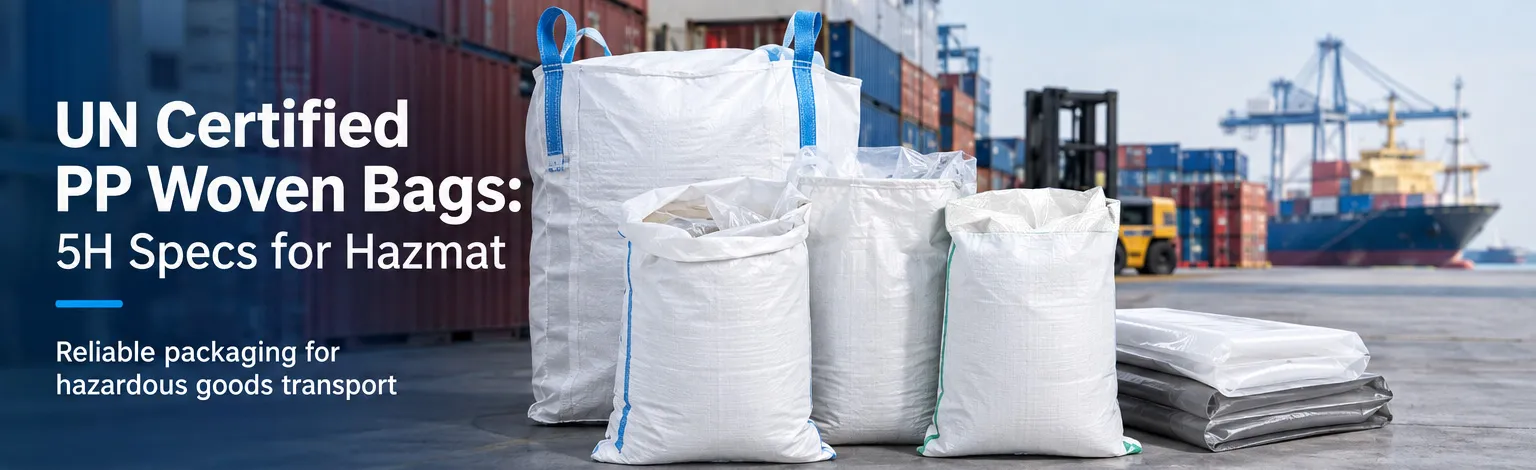
Woven PP bags and FIBC are plastic packaging formats made primarily from woven polypropylene. Woven PP bags are commonly used for dry bulk products such as agricultural and industrial materials, while FIBC bulk bags are flexible intermediate bulk containers designed for larger-volume handling. Under PPWR, the applicable requirements depend on whether the product is packaging or a packaging component, its intended use, the packaging configuration and the economic operator’s role in placing it on the EU market.
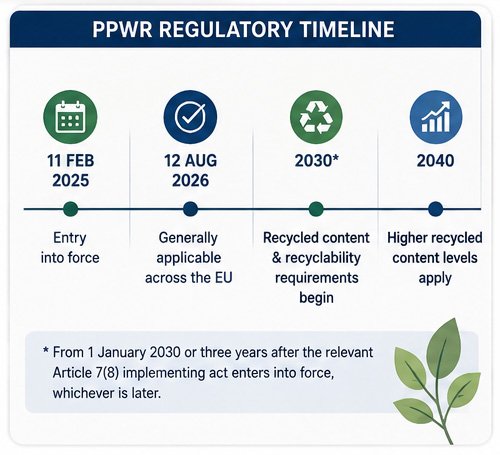
The EU published Regulation (EU) 2025/40 on 22 January 2025. It entered into force on 11 February 2025 and became generally applicable on 12 August 2026. Because it is a regulation rather than a directive, its provisions are directly applicable without transposition into national law, while specific obligations may have different application dates or depend on subsequent implementing and delegated acts.
PPWR applies to packaging and packaged products placed on the EU market, with specific obligations depending on the role of the economic operator and how the packaging is made available. Producers must register and fulfil Extended Producer Responsibility (EPR) obligations in the Member States where they first make packaging or packaged products available, subject to the applicable national arrangements. For producers established outside the EU, the appointment of an EPR authorised representative may depend on the requirements of the relevant Member State and current EU rules.
Substance Restrictions: Heavy Metals and PFAS
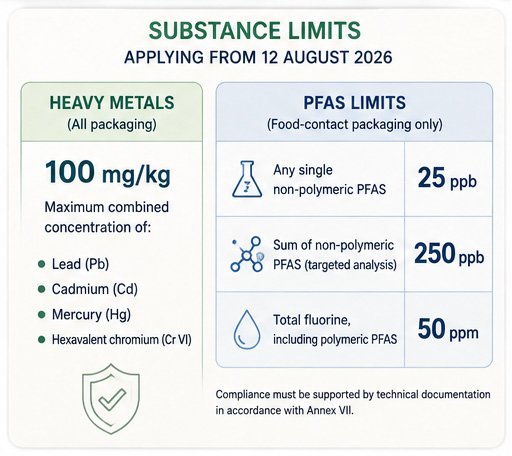
From 12 August 2026, the combined concentration of lead, cadmium, mercury and hexavalent chromium in packaging or packaging components must not exceed 100 mg/kg.
PFAS limits are a separate requirement for food-contact packaging: PPWR sets limits of 25 ppb for any PFAS, 250 ppb for the sum of targeted PFAS, and 50 ppm for PFAS including polymeric PFAS, subject to the conditions in Article 5. Compliance with these requirements must be supported by the technical documentation required under Annex VII. The thresholds are:
| PFAS parameter (food-contact packaging) | Limit |
|---|---|
| Any single non-polymeric PFAS | 25 ppb |
| Sum of non-polymeric PFAS (targeted analysis) | 250 ppb |
| Total fluorine, including polymeric PFAS | 50 ppm |
For woven PP bags and FIBC, the practical implication is upstream: ink, lacquer, adhesive, coating, and other packaging components should be reviewed as part of the compliance assessment. Manufacturers and importers should maintain the technical documentation and conformity evidence required by PPWR so they can demonstrate compliance to the relevant authorities when requested.
PPWR Recycled-Content Requirements for Woven PP Packaging
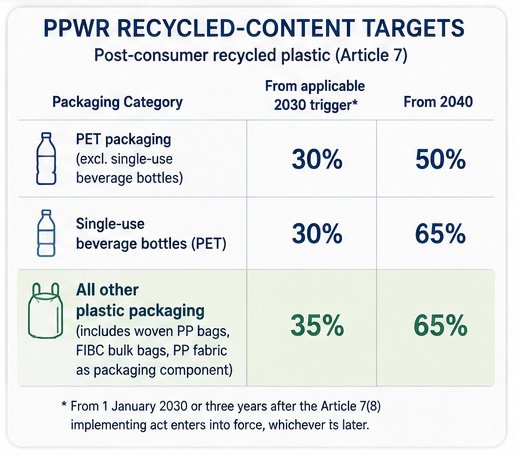
Article 7 sets minimum recycled-content requirements for plastic packaging based on post-consumer recycled plastic. For plastic packaging outside the specific PET, contact-sensitive, and single-use beverage bottle categories, the target is 35% from the applicable 2030 trigger and 65% from 2040. Importantly, the first target applies from 1 January 2030 or three years after the Article 7(8) implementing act enters into force, whichever is later. The calculation, verification, technical documentation, sustainability criteria for recycling technologies, and third-country equivalence rules are being developed through the Article 7(8), 7(9), and 7(10) acts.
Woven PP sacks and FIBC used as plastic packaging generally fall within the “all other plastic packaging” category for Article 7 purposes, subject to the specific packaging configuration and applicable exceptions. PP woven fabric should not be treated automatically as finished packaging; where it is supplied as a component intended for packaging placed on the EU market, its treatment should be assessed according to its intended use and role in the packaging supply chain.
| Plastic packaging category | Article 7 recycled-content target | Timing |
|---|---|---|
| Contact-sensitive PET (non-beverage) | 30% | 2030 trigger under Article 7 |
| Other contact-sensitive plastic (non-PET) | 10% | 2030 trigger under Article 7 |
| Single-use plastic beverage bottles | 30% | 2030 |
| Other plastic packaging (woven PP bags and FIBC) | 35% | 2030 trigger under Article 7 |
| Other plastic packaging (woven PP bags and FIBC) | 65% | 2040 |
Important: For the first recycled-content requirement, Article 7 uses 1 January 2030 or three years after the relevant Article 7(8) implementing act enters into force, whichever is later.
Article 7 contains specific exceptions and derogations, including certain small plastic components, some contact-sensitive food packaging where recycled content would create a health-related compliance issue, and specified packaging categories such as certain medicinal and dangerous-goods packaging. Whether a particular woven PP sack or FIBC qualifies for an exception depends on its intended use, packaging configuration, and the conditions in Article 7. Importers and manufacturers should assess the exact packaging format rather than assuming that every product is automatically subject to the same recycled-content treatment.
Recyclability Grading and Design for Recycling
PPWR introduces recyclability performance grades A, B and C within its current framework, with the framework referring to performance levels of at least 95%, 80% and 70% respectively. The detailed Design-for-Recycling criteria and assessment methodology are still being developed, and the application of the grades will depend on the relevant delegated acts and the regulation’s specific provisions. Packaging placed on the EU market will therefore need to be assessed against the final applicable criteria and timetable rather than treated as compliant solely because it currently appears to meet a percentage threshold.
For woven PP packaging, material compatibility and packaging construction will be important considerations when Design-for-Recycling criteria are applied. Mono-material PP structures may offer advantages because they can simplify material identification and recycling compared with more complex multi-material constructions, but the final assessment will depend on the applicable packaging category, components, sorting and recycling processes, and the detailed EU criteria adopted under Article 6. Manufacturers should therefore avoid treating a specific construction as automatically compliant until the relevant criteria are available.
The Article 7 Acts: How Recycled Content Will Be Calculated
The 35%/65% targets are fixed, but the method for calculating, verifying and documenting recycled content is still being written. The European Commission opened a call for evidence on 14 August 2026 (closing 16 September 2026) and is preparing a package of three legal acts under Article 7, with indicative adoption in the fourth quarter of 2026:
- Article 7(8) — an implementing act on the calculation and verification methodology (data flows, traceability, aggregation, evidence retention, independent third-party audits). Legal deadline: 31 December 2026.
- Article 7(9) — a delegated act on sustainability criteria for plastic recycling technologies (environmental and economic performance, output quality, emissions). Same deadline.
- Article 7(10) — an implementing act on equivalence for recyclates collected or recycled outside the EU.
Article 7(10) will establish how recycled content collected or recycled in third countries can be assessed, verified, and certified as equivalent for PPWR purposes. The regulation requires the methodology to consider environmental and human-health protection, environmentally sound recycling, high-quality recycling, resource efficiency, and relevant third-party verification. The implementing act is still under preparation, so importers sourcing rPP from China or other non-EU countries should treat traceability, recycling-process records, and independent verification as preparation measures rather than as a finalised PPWR certification checklist.
The Commission’s 30 June 2026 implementing decision under the Single-Use Plastics Directive provides a separate example of how third-country recyclate may be subject to environmental and verification conditions. That decision does not determine the PPWR Article 7(10) methodology. Importers should therefore use it only as contextual information and wait for the PPWR-specific equivalence rules before treating any third-country recyclate process as definitively accepted under Article 7.
What PPWR Means for Woven PP Bags, FIBC and PP Fabric
The practical PPWR assessment can involve PP woven bags, FIBC bulk bags and, where supplied as packaging components, PP woven fabric. The specific obligations depend on the packaging format, intended use, economic operator’s role and the applicable PPWR provisions.
- Material specification. Suppliers should identify the post-consumer recycled content used in each relevant packaging format and maintain records that support the applicable recycled-content claim. Because the calculation methodology and verification rules under Article 7 are still being finalised, manufacturers should build traceable material records that can be reconciled with the final EU requirements.
- Substance dossiers. The compliance assessment should consider relevant inks, coatings, adhesives and other packaging components, particularly where they may contribute to substances regulated under Article 5.
- Traceability. Manufacturers should build plant-level and time-period records that can trace post-consumer recycled content through the supply chain and can be reconciled with the final Article 7 calculation and verification methodology.
- Labelling and EPR. Harmonised material-composition labelling is expected to apply from 12 August 2028 or 24 months after the relevant implementing acts enter into force, whichever is later. EPR registration and representation requirements should be checked separately for each Member State and producer role.
Compliance Checklist for Importers and Manufacturers
- Confirm the applicable PPWR requirements for the packaging format and intended use.
- Request technical documentation covering applicable substance restrictions.
- Identify whether the recycled content is post-consumer and document its source.
- Keep batch, supplier, and production records that support recycled-content claims.
- Review the bag construction, coatings, liners, printing and other components against the Design-for-Recycling requirements as the applicable EU criteria are finalised.
- Confirm the intended EU market and check the relevant EPR registration arrangements.
- Ask whether the supplier can provide documentation for recycled content sourced or recycled outside the EU.
- Keep an approved product specification covering material composition, structure, printing, and relevant compliance requirements.
What Should EU Importers Ask a Woven PP Bag Supplier?
| What to ask | Why it matters |
|---|---|
| What is the material composition? | Supports the technical documentation and conformity assessment for the applicable packaging configuration |
| Does the bag contain PCR? | Determines recycled-content traceability |
| Is the recycled content post-consumer? | Article 7 focuses on post-consumer plastic waste |
| Where is the recyclate sourced and recycled? | Relevant to third-country equivalence |
| Can you provide substance compliance documentation? | Supports Article 5 requirements |
| Is the bag designed for recycling? | Relevant to future DfR assessment |
| Can you provide production and batch records? | Supports traceability and verification |
| Which EU markets do you currently supply? | Helps assess EPR and market-specific requirements |
Key Takeaways
- PPWR (EU) 2025/40 has generally applied EU-wide since 12 August 2026 and replaces Directive 94/62/EC.
- Woven PP bags and FIBC that fall within the relevant “all other plastic packaging” category are subject to a 35% post-consumer recycled-content target from the applicable 2030 trigger and 65% by 2040, subject to the regulation’s exceptions and final implementation rules.
- The 100 mg/kg heavy-metal limit applies to packaging and packaging components, while the PFAS limits apply specifically to food-contact packaging from 12 August 2026.
- Recyclability grades (A/B/C, ~70% floor) are expected to become mandatory from 1 January 2030 or 24 months after the relevant delegated acts enter into force, whichever is later, subject to the final Design-for-Recycling criteria.
- The Article 7 calculation and third-country equivalence acts are still in preparation (Q4 2026), but importers should build auditable rPP records today.
PPWR is not simply a one-time certificate; it is an ongoing compliance process covering material selection, documentation, recycled-content traceability, packaging design, and EPR responsibilities. For woven PP bag and FIBC suppliers, the priority now is to build reliable technical records and supply-chain traceability while the Commission finalises the detailed implementing and delegated acts.
Frequently Asked Questions
Regulation (EU) 2025/40 entered into force on 11 February 2025 and applies from 12 August 2026. Some individual requirements have later application dates or depend on subsequent implementing or delegated acts.
Woven PP bags and FIBC that fall within the relevant “all other plastic packaging” category are subject to a 35% minimum post-consumer recycled-content target from the applicable 2030 trigger and 65% by 2040, subject to Article 7 exceptions and the final implementation rules. The recycled content counted for this target is post-consumer recycled plastic as defined by the regulation.
The heavy-metal restriction applies from 12 August 2026 to packaging and packaging components, with a combined limit of 100 mg/kg for lead, cadmium, mercury and hexavalent chromium. The separate PFAS limits apply specifically to food-contact packaging and include 25 ppb for any PFAS, 250 ppb for the specified PFAS sum and 50 ppm for total fluorine, subject to the conditions in Article 5.
PPWR applies to packaging and packaging components within its scope, rather than automatically treating every PP woven fabric roll as finished packaging. If PP woven fabric is supplied as a component intended for use in packaging placed on the EU market, the relevant PPWR requirements and supplier-information obligations may apply. The exact treatment should be assessed according to the product’s intended use, construction, and role in the packaging supply chain.
Article 7(10) will set how recyclate collected or recycled outside the EU can count toward PPWR targets, but the rule is not yet finalised. The regulation requires the methodology to consider environmental and human-health protection, environmentally sound recycling, high-quality recycling, resource efficiency, and relevant third-party verification. Importers should treat traceability and independent verification as preparation measures rather than as a finalised certification checklist.
The detailed calculation and verification methodology is being developed through the Article 7(8) implementing act, which is due by 31 December 2026. The methodology is expected to address data flows, traceability, aggregation, evidence retention and third-party verification. Until the final act is adopted, businesses should build auditable records that can be reconciled with the final EU methodology rather than relying on an assumed calculation method.
PPWR provides specific exceptions and derogations that can cover certain small plastic components, compostable plastics, specified medicinal or dangerous-goods packaging and some contact-sensitive food packaging where recycled content would create a health-related compliance issue. Whether a particular woven sack or FIBC qualifies depends on the applicable Article 7 conditions, intended use and packaging configuration.
EPR registration and representation depend on the Member State and the producer’s role in the supply chain. PPWR allows Member States to require producers established in third countries to appoint an authorised representative for EPR, while current EU transitional measures affect the application of this provision. Non-EU manufacturers should therefore check the EPR registration and representation requirements in each target Member State rather than assuming that one identical EU-wide procedure applies.