

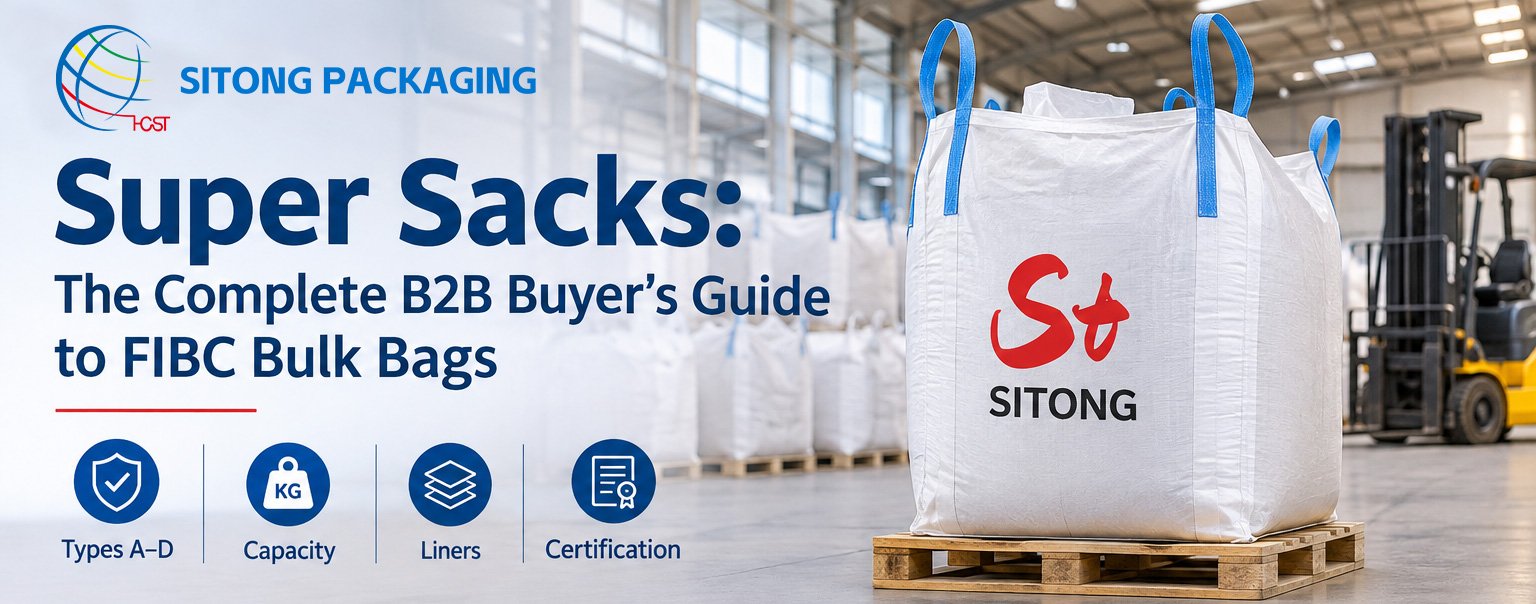
Super sacks are large flexible intermediate bulk containers (FIBCs) made primarily from woven polypropylene (PP) fabric. Also known as bulk bags or jumbo bags, they are designed to store and transport dry materials, with common safe working loads (SWL) ranging from 500 kg to 2,000 kg. They are widely used for powders, granules, agricultural products and industrial materials that are impractical to handle in smaller sacks.
The term “super sack” is commonly used in North America, while FIBC is the technical industry term. Although the basic construction is similar, bags differ in fabric strength, dimensions, lifting configuration, filling and discharge openings, liners and static-control properties. Some are designed for single use, while others are manufactured for qualified multiple trips.
This guide explains the main FIBC types, how to select capacity and dimensions, which liner options to consider, and what buyers should verify before placing an order.
For the full range of formats and configurations, see our FIBC bulk bags overview.
What Is a Super Sack?
FIBCs are available in several body constructions, including U-panel, four-panel and circular designs. Depending on the application, they can be fitted with different lifting loops, filling spouts, discharge outlets and inner liners.
Compared with conventional 25 kg or 50 kg woven sacks, FIBCs allow larger quantities of material to be handled in a single container. Common applications include fertilizer, animal feed, grain, cement, minerals, chemicals and plastic resins. The appropriate construction depends on the product’s density, flow characteristics, handling equipment and storage conditions.
Before ordering, buyers should confirm the SWL, safety factor, bag dimensions, lifting configuration and intended number of trips rather than relying on the term “super sack” alone.
Types of Super Sacks: Understanding FIBC Types A, B, C and D
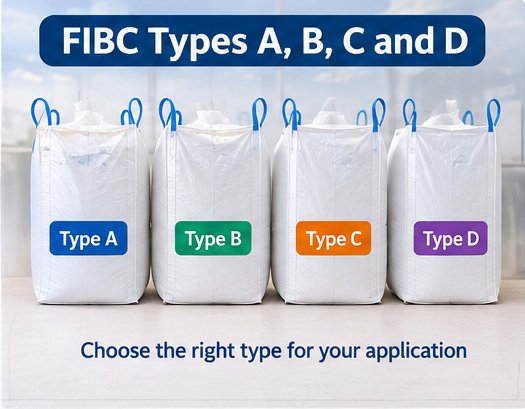
The letter classification describes how a bag handles static electricity. It matters whenever the contents can produce a combustible dust or the site has a flammable atmosphere. Choosing the wrong type is a safety issue, not a cost optimisation.
| Type | Static-control design | Grounding | General application |
|---|---|---|---|
| Type A | No specific static protection | No grounding provision | Non-hazardous applications without combustible dust or flammable atmospheres |
| Type B | Low breakdown-voltage fabric, designed to prevent sparks and propagating brush discharges | No direct grounding connection | Certain combustible dust applications with MIE above 3 mJ, subject to risk assessment; not suitable where flammable gases or vapors are present |
| Type C | Conductive fabric or interwoven conductive threads | Must be grounded before filling and remain grounded during filling and discharge | Applications requiring controlled static dissipation, including certain combustible dust and flammable atmospheres |
| Type D | Static-dissipative fabric designed to prevent incendive discharges | No direct external grounding connection required | Qualified applications involving combustible dust or certain flammable atmospheres, subject to operating conditions and compatibility requirements |
The correct FIBC type depends on the product’s ignition characteristics, the surrounding atmosphere and the conditions during filling and discharge. Type B may be considered for certain combustible dust applications where the minimum ignition energy (MIE) exceeds 3 mJ, but it is not suitable for environments containing flammable gases or vapors. Type C requires a verified grounding connection throughout filling and discharge, while Type D relies on qualified static-dissipative fabric without a direct external grounding connection.
Static classification should be confirmed through appropriate test documentation and a site-specific risk assessment. Buyers should also verify that the selected liner is compatible with the tested bag construction. See our Type C FIBC grounding and compliance guide for further details.
Capacity, Size and Dimensions
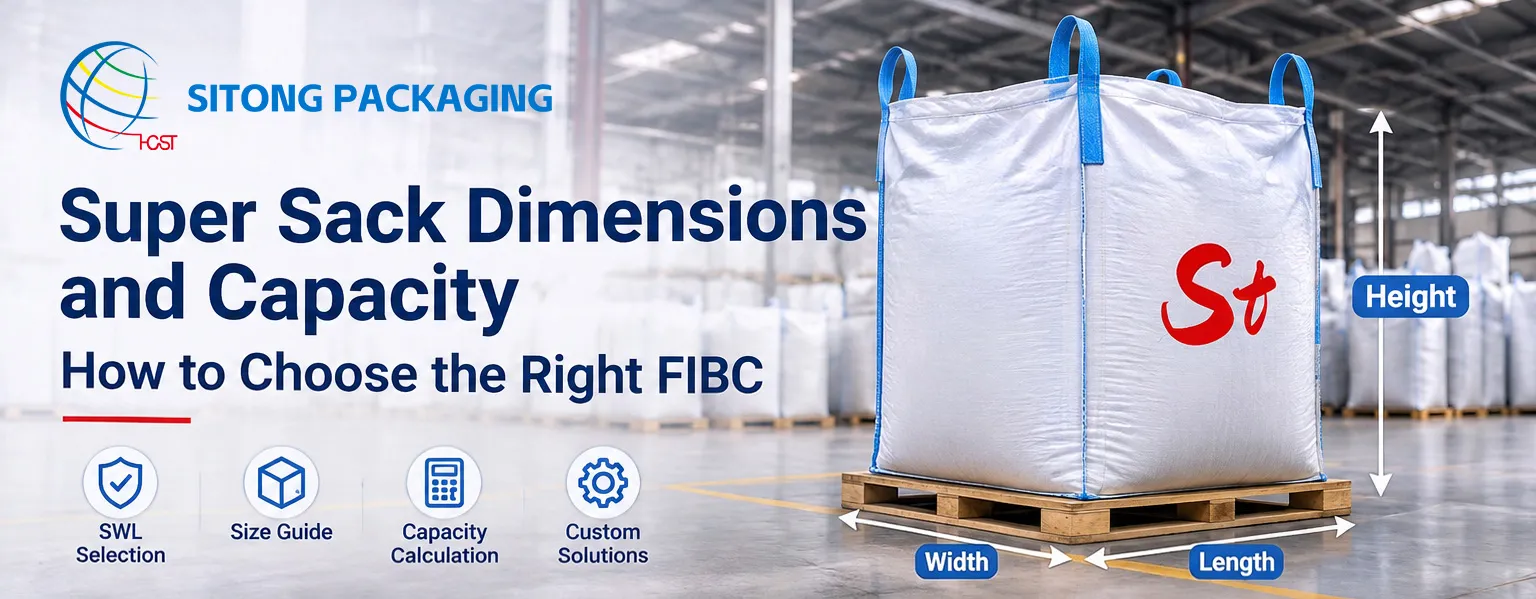
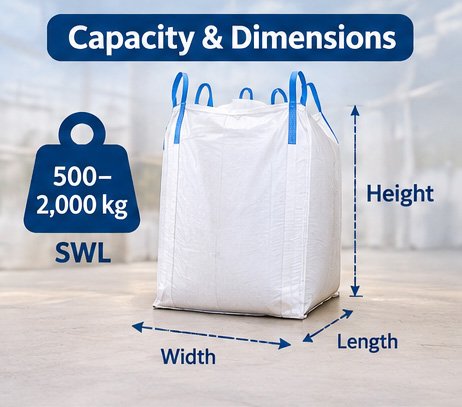
Super sack capacity should be specified by both safe working load (SWL) and usable volume. Common SWL ratings include 500 kg, 1,000 kg, 1,500 kg and 2,000 kg, while the required bag volume depends on the bulk density of the material.
For example, a 1,000 kg load of a lightweight agricultural product may require a larger bag volume than 1,000 kg of dense mineral powder. Buyers should therefore provide the product’s bulk density and target filling weight when requesting a quotation.
Common FIBC footprints include approximately 90 × 90 cm and 100 × 100 cm, although actual dimensions and heights vary by design. U-panel, four-panel, circular and baffle constructions also affect the filled shape and available volume.
Bag dimensions and SWL should be checked against the actual filling and handling process. Confirm the lifting equipment, stacking arrangement, filling height and discharge requirements before finalizing the design. For a more detailed sizing reference, see our super sack dimensions and capacity guide.
| Requirement | Specification to confirm | Why it matters |
|---|---|---|
| Load capacity | 500–2,000 kg SWL | Defines the maximum permitted working load |
| Safety factor | 5:1 / 6:1, as applicable | Indicates the tested lifting performance relative to SWL; confirm against the applicable standard and test records |
| Bag structure | U-panel / 4-panel / Circular / Baffle | Affects filled shape and handling |
| Moisture protection | PE liner / Barrier liner | Protects moisture-sensitive products |
| Static control | Type A / B / C / D | Matches the electrostatic risk |
| Discharge | Spout / Closed bottom | Matches unloading equipment |
| Reuse | Single-trip / Multi-trip | Defines intended service life |
Liners and Barrier Options
The woven PP body provides the main load-bearing structure, while an inner liner can improve product containment and provide additional protection against moisture, oxygen or contamination.
Common options include PE liners for basic containment, co-extruded films for enhanced barrier performance, and aluminium foil laminates for applications requiring higher moisture or oxygen barriers. The appropriate choice depends on product sensitivity, storage conditions and the required shelf life.
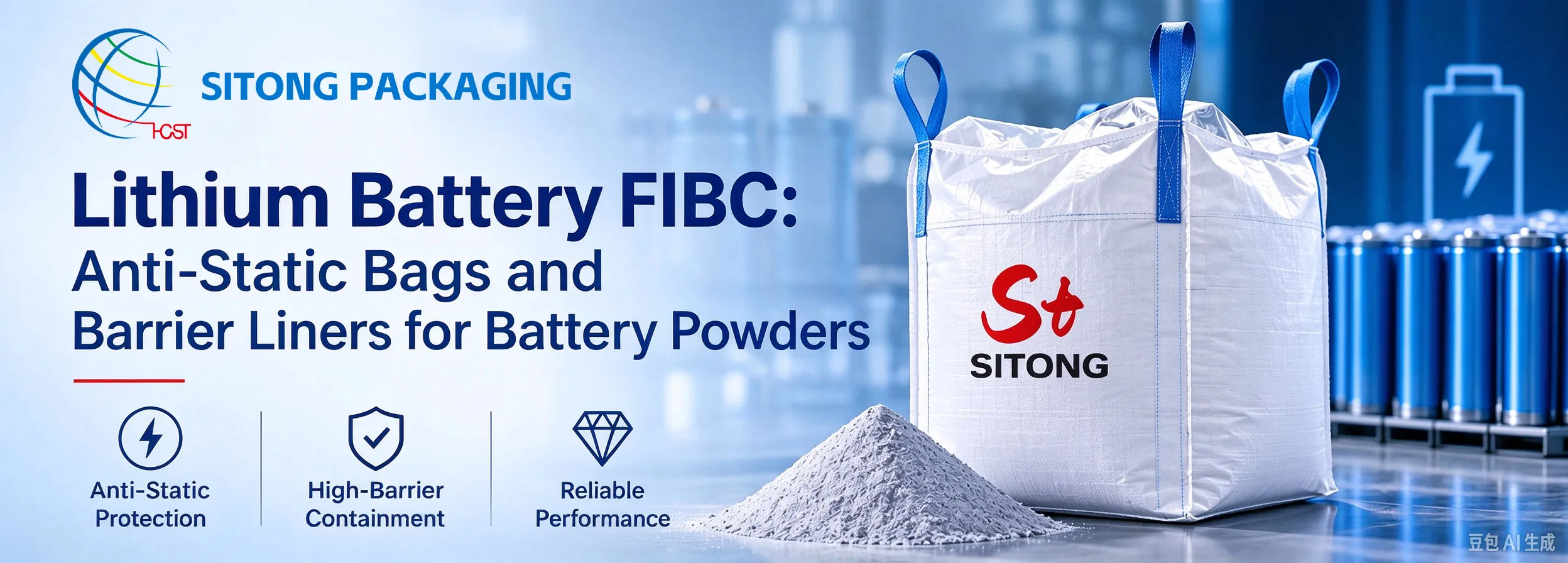
For static-control FIBCs, liner selection is also a safety consideration. An incompatible liner can affect the electrostatic performance of the complete bag assembly. Buyers should therefore specify the liner material, thickness, construction and sealing method, and request test evidence for the intended FIBC-and-liner combination.
See our FIBC liner types guide for a comparison of available materials and constructions.
Certification and Documents
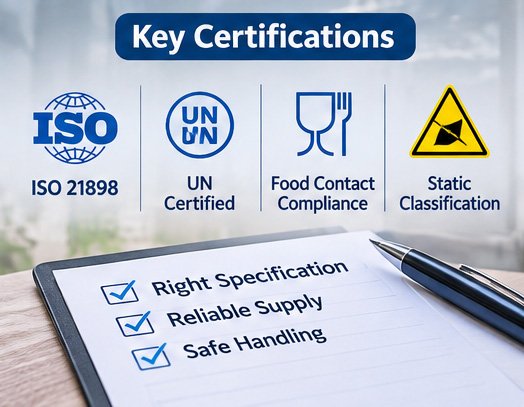
The documents required for a super sack depend on its contents, intended use and destination market. Buyers should distinguish between structural performance, dangerous-goods transport approval, food-contact compliance and electrostatic classification.
For FIBCs intended for non-dangerous goods, ISO 21898:2024 provides requirements for design, testing and marking. Buyers should check the applicable test documentation, SWL, safety factor and FIBC classification when reviewing a manufacturer’s technical records.
For dangerous goods, confirm whether the FIBC requires UN performance testing and markings under the applicable transport regulations. The approved packaging design, contents and transport conditions must match the intended application.
For food-contact applications, request relevant material declarations and supporting compliance documentation for the intended market. A food-contact claim should be supported by the actual materials and production controls used for the bag.
For static-control applications, request the applicable Type A, B, C or D classification and supporting test records, including information on compatible inner liners where relevant.
A general statement that a bag is “certified” is not sufficient. Buyers should check that the documentation identifies the relevant construction and matches the product being ordered.
Specification Checklist for a Super Sack Order
Prepare the following information before requesting a super sack quotation:
- Product details — material name, bulk density, particle size, moisture content and flow characteristics.
- Load requirements — target filling weight, safe working load (SWL) and required bag volume.
- Bag construction — U-panel, four-panel, circular or baffle design.
- Dimensions — length, width, height and required filling capacity.
- Static classification — Type A, B, C or D, based on the product hazards and site risk assessment.
- Liner requirements — material, thickness, barrier properties and sealing method.
- Filling and discharge — top construction, filling spout, bottom outlet, discharge spout or closed bottom.
- Lifting and stacking — lifting loop configuration, handling equipment and stacking requirements.
- Usage requirements — single-trip or qualified multi-trip design, including the required safety factor.
- Compliance and testing — UN performance testing, food-contact documentation or electrostatic test records, where applicable.
- Order details — order quantity, printing artwork, packaging method, destination and required delivery schedule.
Sourcing and Manufacturer Considerations
When comparing super sack manufacturers, look beyond the quoted unit price. Check whether the supplier can reproduce the required fabric weight, dimensions, lifting loops, seam construction and liner configuration across repeat orders. For bulk packaging, variations in these details can affect filling efficiency, handling and compatibility with downstream equipment.
SITONG PACKAGING has manufacturing facilities in Haicheng, Liaoning, China, and Cambodia, with manufacturing experience dating back to 1998. Across its packaging operations, the company has around 20 production lines and an annual production capacity of approximately 30,000 tonnes. Its in-house processes include PP weaving, coating and lamination, printing, cutting and sewing for woven PP packaging and FIBC products.
For OEM projects, buyers can discuss bag dimensions, fabric specifications, lifting configurations, filling and discharge openings, liner options and printing requirements during the technical inquiry. Visit our FIBC bags manufacturer page to learn more about our manufacturing capabilities.
Specifying Your Next Super Sack Order
Choosing the right super sack starts with matching the bag construction to the material, filling process and handling requirements. Before requesting a quotation, prepare the target SWL, dimensions, product bulk density, liner requirements, lifting configuration and any applicable compliance requirements.
Providing these details allows the manufacturer to assess the required bag construction, materials and handling features before quoting. Contact SITONG PACKAGING to discuss your super sack specifications and OEM requirements.
Frequently Asked Questions
A super sack is also known as an FIBC, bulk bag, jumbo bag or big bag. These terms generally describe flexible bulk containers made from woven polypropylene, although the actual construction and specifications vary.
Common FIBC safe working loads include 500 kg, 1,000 kg, 1,500 kg and 2,000 kg. The correct rating depends on the bag design, product density and handling requirements. Always follow the SWL stated on the bag.
Single-trip FIBCs are designed for one filling and must not be reused. Reusable FIBCs are designed for a limited or specified number of filling and discharge cycles, depending on their classification and design. They must be inspected before reuse and used in accordance with the manufacturer’s instructions and applicable standards. Under ISO 21898:2024, reusable FIBCs must be used with the same type of contents as in their first use.
Yes, FIBCs can be designed for food-related applications using suitable materials, liners and manufacturing controls. Buyers should verify the applicable food-contact requirements and supporting documentation for the destination market.
Provide the target SWL, bag dimensions, product bulk density, static classification, liner requirements, filling and discharge configuration, order quantity and destination. These details help the manufacturer recommend a suitable construction.