




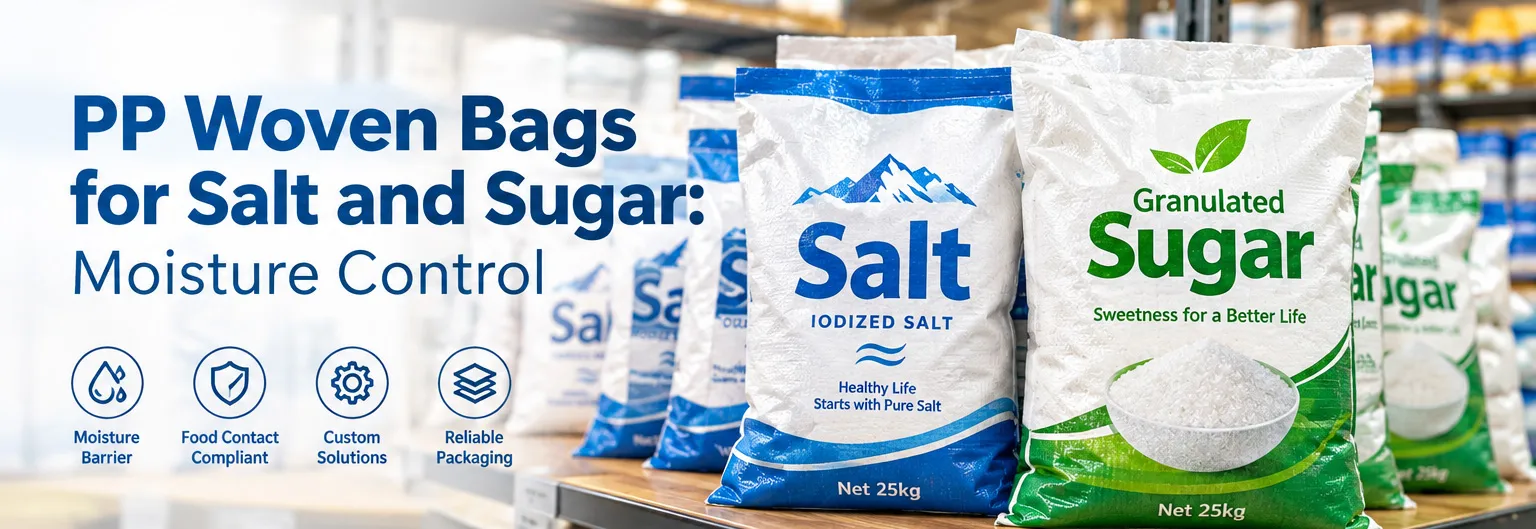
Salt and sugar look like easy products to pack: dry, free-flowing, chemically stable. They are not. Both are hygroscopic, both cake once moisture has been absorbed, and both lose saleable value long before they spoil. That is why PP woven bags for salt and sugar are specified around moisture management first and print second. Depending on the storage environment, the transport route and the destination’s food-contact requirements, a suitable construction may combine coated PP fabric, BOPP lamination, a PE liner and a moisture-resistant closure. This guide explains how salt and sugar packaging is specified, which barrier options limit moisture uptake, and what the documentation for food grade PP woven bags has to cover.
Quick answer: Plain uncoated PP woven bags generally provide limited moisture protection, because the woven structure allows air and vapour to move between the tapes. For moisture-sensitive salt and sugar packaging, buyers commonly choose coated PP woven bags, BOPP laminated bags, or woven bags with a PE liner. The final construction should match the humidity, the storage time, the filling method and the food-contact rules of the destination market.
Definition: A hygroscopic product absorbs moisture from the surrounding air. Salt and sugar are both hygroscopic; as relative humidity approaches the point at which the product begins to deliquesce, surface moisture forms, crystals bridge, and the contents set into a solid mass.
Why Salt and Sugar Are Harder to Pack Than Grain
Grain is packaged with an eye on respiration, insects and mould. Salt and sugar present a different problem set, and one that packaging can address more directly.
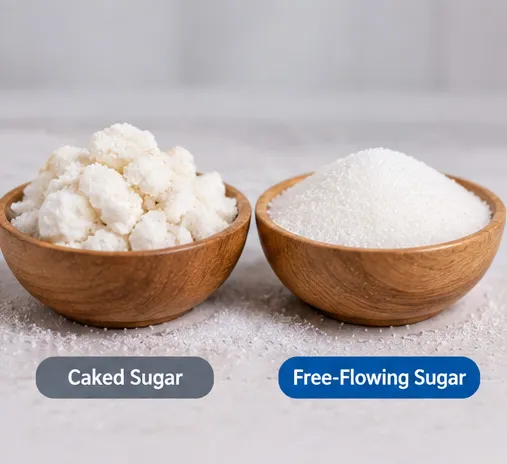
- Moisture uptake causes caking. Crystals absorb surface moisture and bond as they dry again, turning a free-flowing product into a block that must be broken up or discarded.
- Salt can create corrosion concerns. Salt exposure may accelerate corrosion of metal components in filling equipment and in the storage environment, so closures, liners and handling practices are chosen with that in mind.
- Both are dense. A 25 kg or 50 kg fill concentrates load at the seam and the base, which makes the closure and the bottom construction as important as the fabric.
- Both are retail-facing. Unlike industrial resin or mineral fill, salt and sugar are frequently sold branded at consumer level, so print quality and scuff resistance carry commercial weight.
Key Takeaway: The failure mode for salt and sugar is usually physical and visible — a caked bag on a shelf — rather than immediate spoilage. Packaging design, storage conditions and handling practice all influence the final product quality.
Moisture: What Actually Keeps It Out
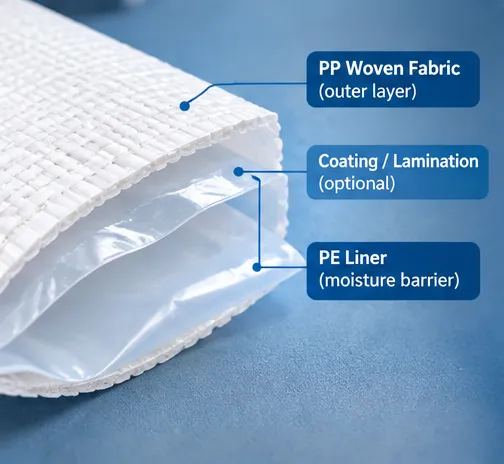
The important starting point is that a woven structure is permeable by nature. Air moves between the tapes. Any moisture protection comes from what is added to the fabric or placed inside the bag.
| Construction | What it changes | Suited to |
|---|---|---|
| Uncoated woven PP | Breathable structure; limited resistance to moisture vapour transmission | Dry inland routes with short storage; not advised for hygroscopic retail product |
| PP extrusion coated fabric | Closes the interstices between tapes; reduces air and vapour passage | General-purpose salt and sugar where the route is moderate |
| BOPP laminated fabric | Adds a film face: barrier plus a high-quality print surface | Branded retail packs where shelf presentation and scuff resistance matter |
| Woven PP with a loose or attached PE liner | Provides the barrier layer independently of the fabric | Humid coastal routes, long sea legs, or extended warehouse storage |
| Liner plus coated or laminated fabric | Barrier with a sealed closure path | Higher-risk routes and premium retail product |
The closure is the part most often overlooked. A barrier fabric with an open sewn seam still admits vapour through the needle holes and the mouth. Where moisture control is the specification, the closing method — heat seal, tape over seam, or an inner liner that is sealed or folded — has to be specified alongside the fabric.
Food-Contact Compliance Depends on Destination
There is no single global food-contact standard for packaging materials. The framework that applies is the one in force where the product is sold, and the documentation has to name it.
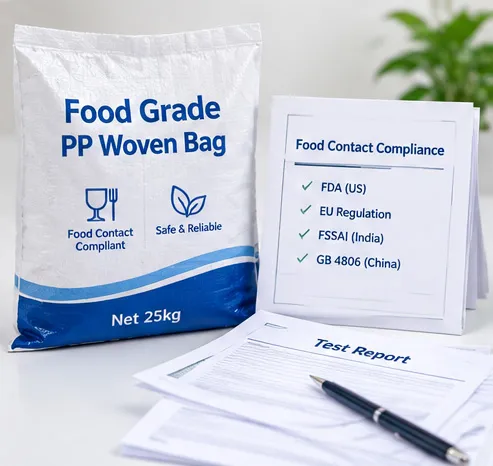
- United States — food-contact packaging materials are generally evaluated under FDA food-contact requirements applicable to the specific material and use.
- European Union — plastic materials intended to contact food fall under EU food-contact material legislation, including composition and migration requirements; see the European Commission’s food contact materials guidance.
- India — food packaging requirements are defined by the applicable FSSAI regulations.
- China — national food-contact material standards, including the GB 4806 series, may apply depending on the packaging structure and intended use.
Two cautions follow. First, a management-system certificate is not a food-contact declaration: ISO 9001 or BRCGS describe how a plant is managed, not whether a particular resin, ink or adhesive meets a particular migration limit. Second, the declaration has to cover the whole construction — fabric, coating, ink, adhesive and liner — because food-contact suitability depends on the complete packaging structure, including fabric, coating, ink, adhesive and liner where applicable.
Specification Checklist for Salt and Sugar Packing
| Item | What the buyer defines |
|---|---|
| Product form | Refined or coarse salt, crystal size; granulated, icing or brown sugar — each behaves differently |
| Fill weight and bag style | Fill weight, dimensions, and open-mouth, block-bottom, pinch-bottom or valve format |
| Moisture strategy | Coated, laminated, lined, or a combination, matched to route and storage duration |
| Closure | Sewn, heat sealed or taped, and whether the closure is sealed against vapour |
| Fabric | GSM and weave density, with tensile requirement tied to a named test method |
| Food-contact requirement | The destination regulation, and a declaration covering every layer of the construction |
| Method, colour count, finish, and the agreed colour tolerance with a retained reference sample | |
| Acceptance | Sampling plan, test reports, and the tolerances checked on receipt |
Recommended PP Woven Bag Structures for Salt and Sugar
Different markets and channels rarely need the same construction. The right salt packaging bags or sugar packaging bags depend on moisture exposure, transport conditions and storage duration. As a starting comparison:
- Dry inland distribution with short storage: a coated PP woven bag may be sufficient.
- Branded retail salt and sugar: BOPP laminated fabric, which combines the barrier with a high-quality print surface.
- Humid climate or a long sea leg: a PP woven bag with a PE liner, or a coated fabric combined with a liner.
- Premium food applications: a laminated structure with a sealed liner and documented food-contact evidence.
These are starting points rather than fixed rules: the correct structure follows the product form, the route and the storage duration, and should be confirmed against the buyer’s own conditions.
Storage and Handling Realities
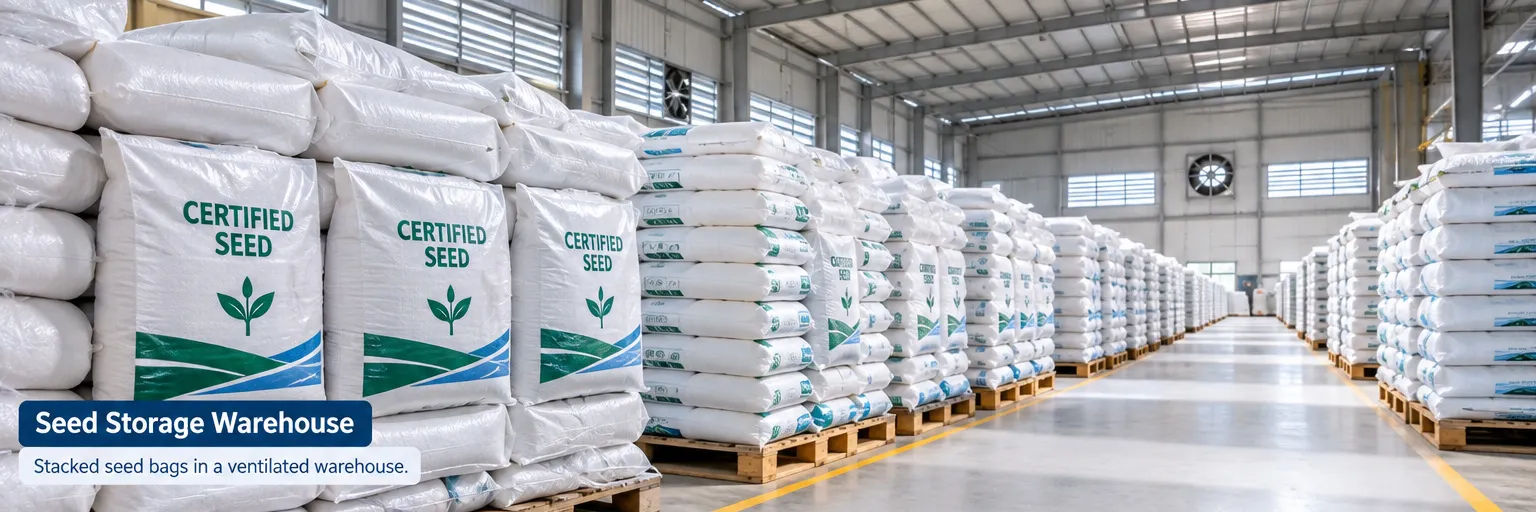
Packaging is only one part of moisture control. Bags stored directly on a concrete floor, or palletised against an outside wall in a humid season, will pick up moisture regardless of construction. Practical measures that matter as much as the bag:
- Store on pallets, off the floor and away from external walls.
- Keep warehouse ventilation adequate during humid seasons.
- Rotate stock so the oldest lots ship first.
- Do not compress stacks to the point where bag mouths are deformed.
A supplier can help here by providing a loading and stacking configuration, and by stating how long the chosen construction is intended to protect the product under defined conditions. That statement should be tied to the product’s own sensitivity rather than to a generic shelf-life claim.
Choosing a Supplier for These Products
The test is whether the supplier treats salt and sugar as a distinct specification or quotes a general-purpose sack. Differences in crystal size, fill weight, route humidity and retail channel all change the answer, and a converter that asks about them is likely to specify correctly.
For salt and sugar packaging projects, buyers usually need a supplier that can manage the complete bag structure rather than only produce woven fabric: material selection, coating or lamination, printing, liner fitting, sewing and quality documentation all influence final moisture performance.
SITONG PACKAGING has produced woven polypropylene packaging since 1998, with plants in Haicheng (Anshan), Liaoning and in Cambodia, around 20 production lines at roughly 100 tonnes per day, shipping to more than 70 countries from the port of Dalian. Fabric weaving, coating and lamination, printing, liner fitting and conversion are held in-house, so the moisture strategy, the closure method and the food-contact documentation can be specified on one sheet and traced to a production lot. Buyers can review the food grade PP woven bags requirements for their market, discuss a private-label build through the OEM custom bag programme, or take a full specification to an experienced PP woven bags manufacturer.
Conclusion
Specifying PP woven bags for salt and sugar comes down to three decisions: how much moisture barrier the route requires, whether the closure matches that barrier, and which food-contact framework the declaration must satisfy. Get those right and the product arrives free-flowing and saleable; get the closure wrong and even the strongest fabric in the specification will not save the pallet.
Frequently Asked Questions
Usually not for retail or humid routes. Woven fabric permits vapour transfer between the tapes, so a coating, lamination or liner is normally specified. On short, dry, inland routes a coated fabric may be sufficient.
Because the closure or the seam is the path of least resistance. Needle holes from sewing, an unfolded liner mouth, or a closure that is not sealed against vapour will admit moisture even when the fabric itself is laminated.
A laminated or coated fabric improves the barrier and adds print quality; a liner provides the barrier independently and can be sealed. For humid coastal routes or long storage, a liner combined with a coated fabric is often specified.
No. “Food grade” is a general description. Compliance means the specific construction — fabric, coating, ink, adhesive and liner — meets the requirements of the regulation in force at the destination, evidenced by a declaration and testing.
The one in force where the product is sold. US shipments fall under the FDA food contact framework, EU shipments under the EU plastics regulation, India under FSSAI packaging requirements, and China under the GB 4806 series.
Possibly, but check both products. Crystal size, bulk density and moisture sensitivity differ, and salt’s corrosiveness affects equipment and closure choices. Confirm filling behaviour on your own line before committing.
Indirectly. A BOPP laminated construction delivers both the print surface and a film barrier, so the print choice and the barrier choice are made together. Direct printing on a coated fabric does not add a barrier layer.
The construction sheet naming every layer, the food-contact declaration with the destination regulation, the closure method, test reports tied to named methods, and a recommended loading and stacking configuration.