



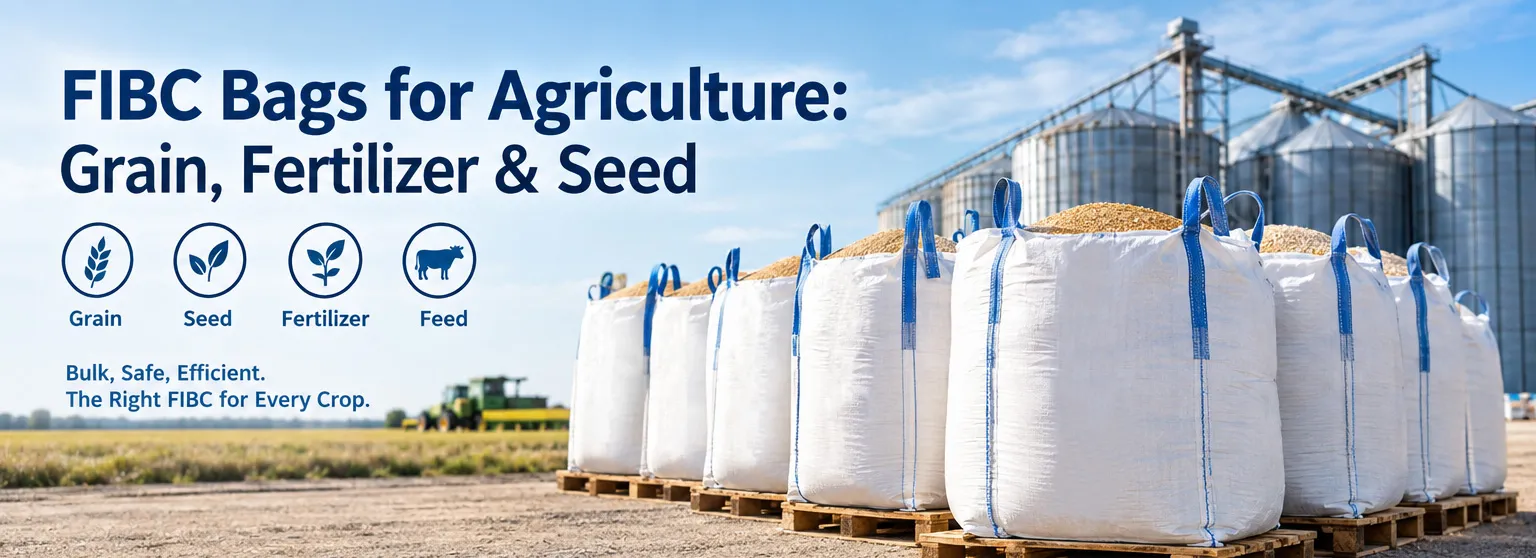
FIBC bags for agriculture move the world’s staple commodities: grain, fertilizer and seed are packed by the hundreds of millions in Flexible Intermediate Bulk Containers every year. Their lifting loops, large capacity and customizable construction let buyers match the bag to product sensitivity, filling equipment, storage and transport. Ventilated constructions can support airflow for suitable products, while liners or laminated fabrics add moisture and contamination protection. This guide covers which fibc bags for agriculture fit each product and what buyers should specify.
Agricultural FIBC at a Glance
- Main applications: grain, seed, fertilizer and animal feed
- Typical advantage: high load capacity with efficient lifting and handling
- Main products: Grain, seed, fertilizer, feed
- Barrier option: PE liners or laminated fabric add moisture and contamination protection
Why Agriculture Relies on FIBC
Bulk bags suit agriculture because they scale from a few hundred kilograms to over a tonne, stack and lift on standard equipment, and can be specified for the product’s sensitivity. For suitable grain and seed, ventilated FIBC can help manage condensation and airflow risk. For fertilizer, a PE liner or laminated fabric can improve moisture protection and reduce leakage. For export, printed and traceable bags support private-label and compliance needs.
Agriculture is one of the largest FIBC end-uses because the bag solves both volume and product-care at once: bulk handling plus ventilation, cleanliness or barrier as the crop requires.
FIBC Types for Agriculture
| Product | Recommended FIBC | Key feature |
|---|---|---|
| Grain | Ventilated or breathable FIBC | Airflow, moisture control, pest resistance |
| Seed | Clean, ventilated FIBC | Germination protection, traceability |
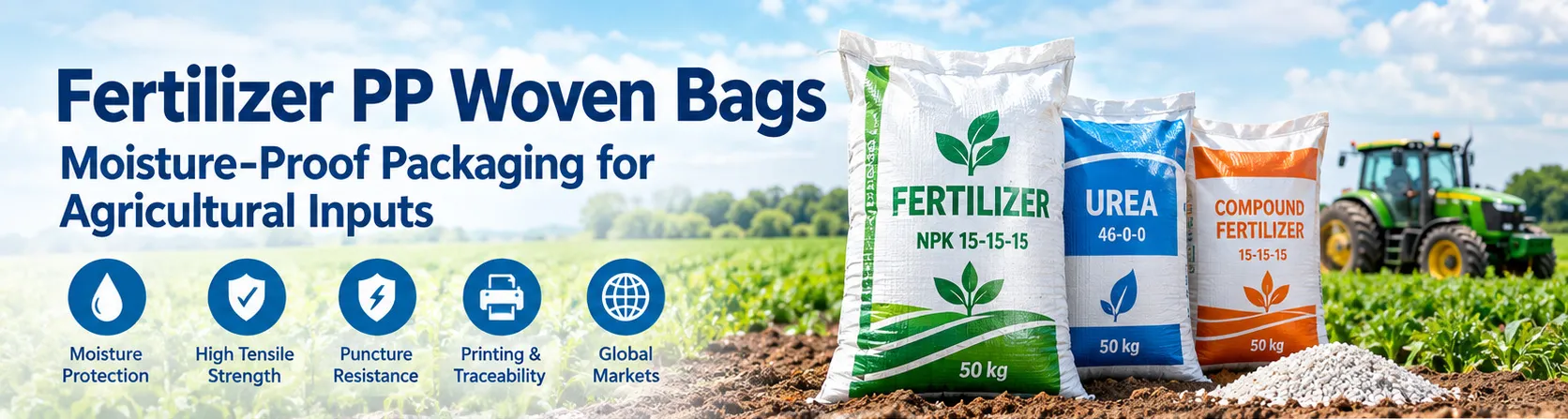
| Fertilizer | Lined or laminated FIBC | Moisture barrier, tear resistance |
| Feed | Clean, lined FIBC | Contamination control, printing |
Key takeaway: Match the FIBC feature to the crop. Fibc bags for agriculture are not one product; a ventilated grain bag and a laminated fertilizer bag solve different problems.
Grain and Seed Storage
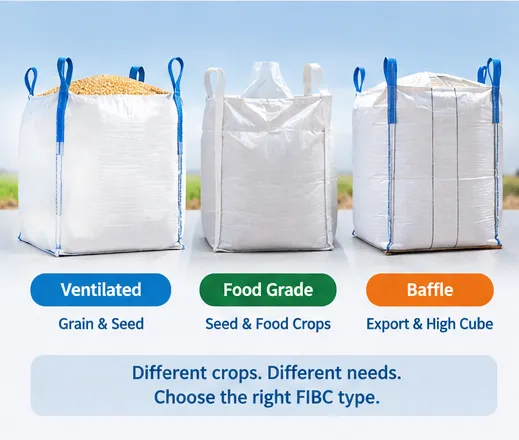
Grain and seed can be sensitive to moisture, temperature and condensation during storage and transport, so ventilated FIBC with breathable panels can help manage airflow. Clean conversion and appropriate documentation help protect seed quality and keep the lot traceable. For export, buyers often require printed bags with lot codes and a documented clean status.
Fertilizer Handling
Fertilizer is hygroscopic and abrasive. A laminated outer fabric or a PE liner keeps moisture out and reduces leakage, while a stronger weave and lifting loop rating handle the weight. Where fertilizer is classed as dangerous goods, the UN marking and design type must be confirmed rather than assumed from a generic bulk bag.
Food-Grade and Baffle FIBC in Agriculture
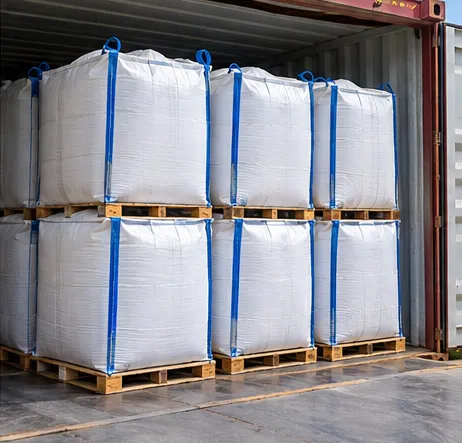
Food-contact FIBC should be manufactured with materials and additives suitable for the intended application and produced under appropriate cleanliness controls. Baffle (Q-bag) FIBC hold their square shape when filled, improving palletisation and container utilisation, which matters for export where cube efficiency can improve freight economics.
Market Growth and Sourcing
Agriculture remains one of the largest FIBC user groups, and demand keeps rising in export-oriented regions, Africa, Southeast Asia and Latin America, where grain, sugar and pulses move in bulk. Buyers should qualify suppliers on the specific bag type, liner or lamination, food-contact status where relevant, and the documentation needed for their market.
Sourcing Agricultural FIBC
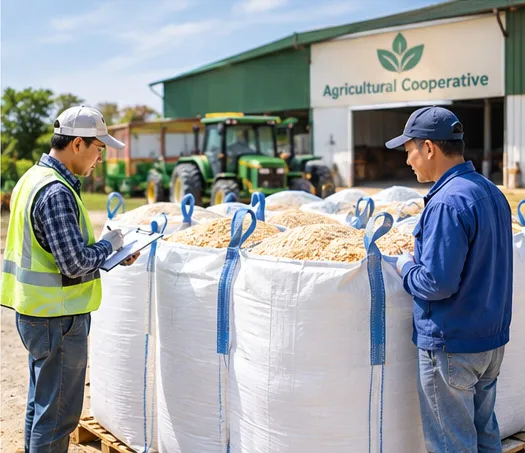
Buyers building an agriculture program should start from the crop and the route, then select the bag type. The agricultural PP woven bags page covers woven options for the same crops, while the food-grade FIBC compliance guide explains the documentation for food-contact use. A qualified FIBC manufacturer can supply ventilated, baffle and lined designs with the test and UN documents your market requires.
How to Choose Agricultural FIBC
Start from the product and the supply chain, not from a single feature. Grain, seed and fertilizer each carry different moisture, food-contact and stacking needs, so confirm the points below before requesting a quote.
Specification Checklist
Use this checklist when briefing a supplier or comparing options. Confirm each point against the actual product and supply chain rather than a single headline claim.
| Spec to confirm | What to verify | Why it matters |
|---|---|---|
| SWL and safety factor | SWL with 5:1 or 6:1 safety factor for the use | Match to fill and stacked weight |
| Liner | Liner type by moisture and food risk | Grain and fertilizer needs differ |
| Food contact | Food-contact status only where required | Avoid over-specifying where not needed |
| UV stability | UV stabilization for the outdoor season | Exposure varies by climate |
| Baffle | Baffle option for stack stability | Useful for dense fills |
| Documents | Test or qualification records | Supports import and audit |
Frequently Asked Questions
Agriculture is an important FIBC application across export-oriented supply chains, including grain, pulses, fertilizer, feed and other bulk agricultural products.
Ventilated and humidity-controlled bulk bags cut condensation, sprouting and spoilage; Ventilated and humidity-controlled bulk bags can help manage condensation, spoilage and handling risk when the bag matches the product and storage environment.
Ventilated or breathable FIBC are preferred for grain because they allow airflow and control moisture during storage and transit. Seed often needs clean conversion plus traceability.
Yes. Fertilizer is hygroscopic and abrasive, so laminated or lined FIBC with stronger weave are typical, while grain uses ventilated bags for breathing.
A baffle (Q-bag) FIBC holds a square shape when filled, improving palletisation and container cube efficiency, which can improve space utilisation on export lanes.
Only where the intended application and destination regulations call for food-contact-compliant packaging. Processed food crops and some seed treatments need clean, food-contact-compliant liners and documentation.
Agricultural FIBC demand is supported by bulk handling of grain, seed, fertilizer, feed and other products, particularly where efficient lifting, storage and transport are required. Growth varies by country and application.
Request the bag type specification, liner or lamination detail, food-contact status where relevant, and UN marking or test documents for any dangerous-goods fertilizer shipment.
State the product, fill weight, safety factor, liner and food-contact needs, UV requirement, print and traceability, and the destination port. Request test or qualification documents so the supplier quote matches a verifiable specification.
Conclusion
FIBC bags for agriculture are a scalable, product-specific solution: ventilated bags protect grain and seed, lined or laminated bags protect fertilizer, and baffle designs improve export cube efficiency. Buyers should specify the bag type by crop and route and qualify suppliers on the matching documentation.