


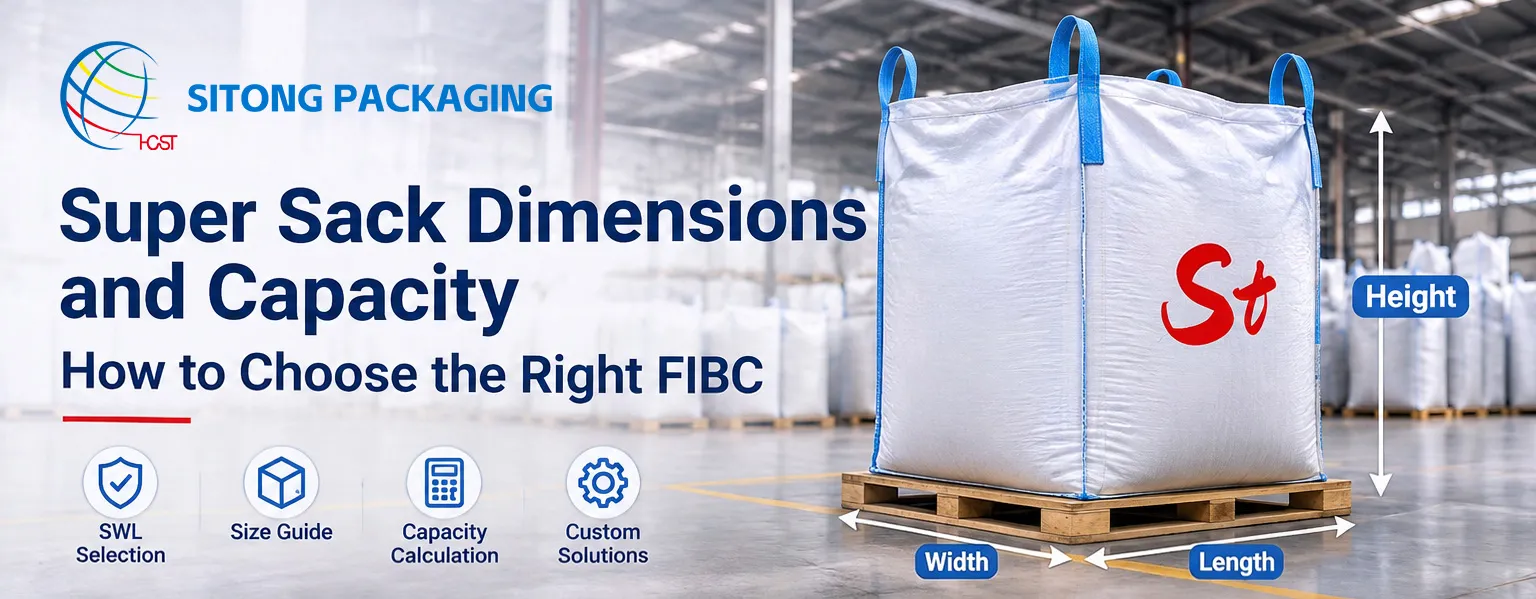
Super sack dimensions and capacity depend on the product’s bulk density, target filling weight and bag construction. A super sack, also known as an FIBC or jumbo bag, is specified by its safe working load (SWL) and physical dimensions. Common load ratings range from 500 kg to 2,000 kg, although higher-capacity designs are also available. The required volume depends on how much space the material occupies at the target weight, while the bag’s footprint, height, shape and internal baffles determine how that volume is accommodated. This guide explains how to match FIBC dimensions to your material, filling equipment and handling requirements.
Buyers often ask for “standard dimensions” expecting a single answer. There is no universal size. A 1,000 kg bag of dense mineral concentrate can be physically small, while the same rated bag filled with a light, fluffy product needs a much larger volume. The correct specification starts with how much the product weighs and how much space it takes up.
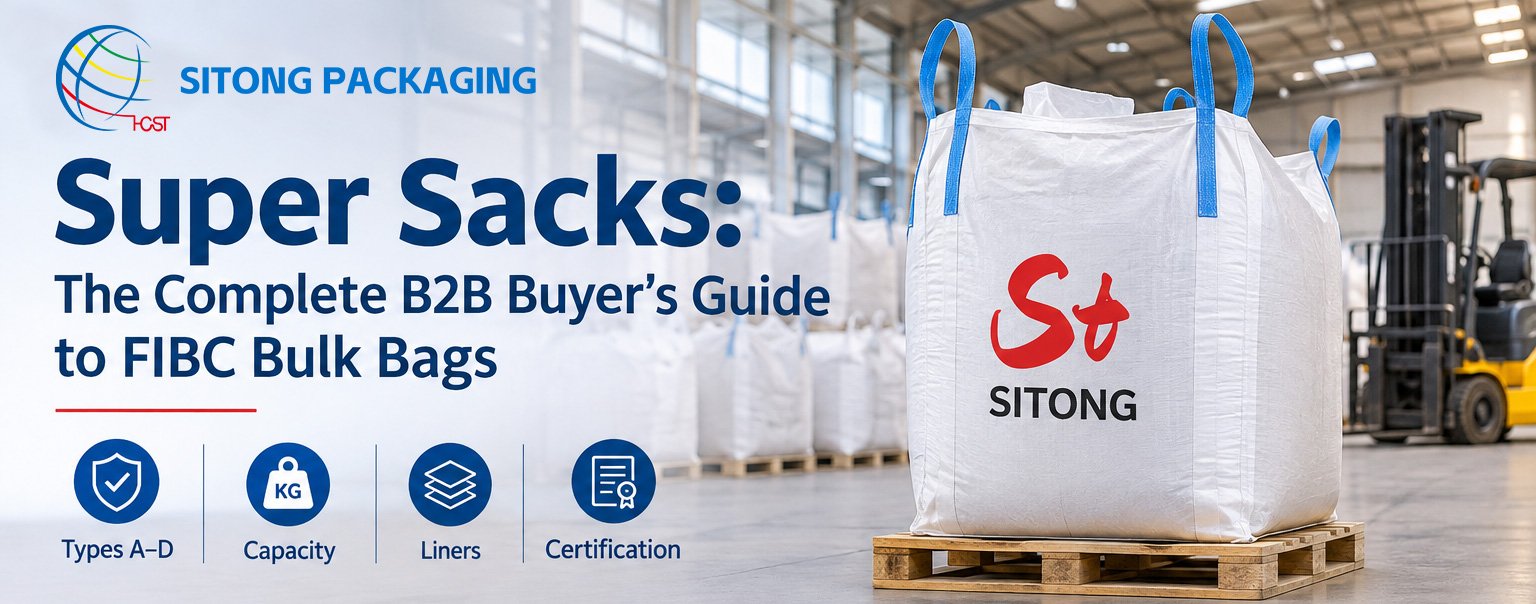
For a broader introduction to types, liners and certification, see our super sacks buyer’s guide.
How Capacity Is Stated: SWL and Volume
Two numbers define a super sack’s capacity. The safe working load (SWL) is the maximum load the bag is designed to carry under its test basis. The volume, usually given in cubic metres, is the internal space available to the product. The link between them is bulk density: volume multiplied by bulk density gives the filled weight.
To estimate the required bag volume, divide the target product weight by its bulk density:
Required volume (m³) = Target filling weight (kg) ÷ Bulk density (kg/m³)
For example, if you need to pack 1,000 kg of material with a bulk density of 800 kg/m³, the estimated product volume is 1.25 m³.
This is a preliminary sizing calculation, not the final bag specification. Allow for variations in bulk density, filling behaviour and the space needed for the bag’s top closure. The manufacturer should confirm the finished dimensions and usable capacity based on the actual filling conditions.
Product characteristics are among the first details a manufacturer needs when sizing an FIBC. Two products with the same target weight can require very different bag volumes. Also consider whether the material is aerated during filling, settles afterward or contains particles with inconsistent sizes. These factors affect the finished bag dimensions and filling performance. Provide the product’s approximate bulk density, target weight and filling method when requesting a quotation.
For an overview of FIBC types, liners and construction options, see our types of FIBC guide, which explains how different designs affect bag shape and usable volume.
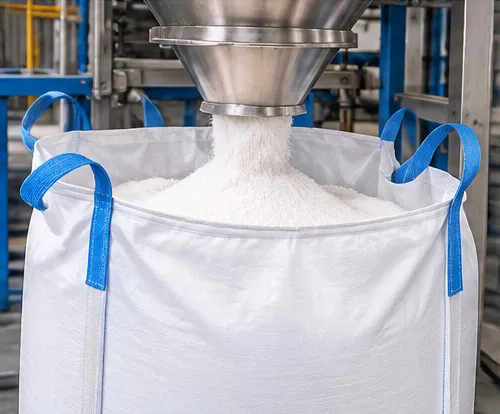
Common FIBC Safe Working Load (SWL) Ratings
FIBC bags are available in different safe working load (SWL) ratings to suit different product weights and handling requirements. The following ranges are common reference points rather than fixed dimensional standards.
| Rated SWL | Typical specification considerations |
|---|---|
| 500 kg | Suitable for smaller loads and applications requiring more manageable individual bag weights |
| 1,000 kg | A common choice for agricultural products, feed ingredients, plastic resins and many industrial materials |
| 1,500 kg | Requires appropriate fabric strength, lifting loops and seam construction for the rated load |
| 2,000 kg and above | Requires careful verification of the complete bag design, lifting equipment and handling conditions |
A higher SWL does not automatically mean a larger bag. The required dimensions depend on product density and filling volume, while the fabric, seams and lifting loops must be designed for the specified load. Always confirm the rated SWL and test documentation for the actual bag design.
Dimensions, Shape and Aspect Ratio
FIBC dimensions vary according to the required volume, body construction and handling conditions. Square-bottom bags are commonly specified by footprint width and length, while circular FIBCs use a tubular body design. For example, 90 × 90 cm and 100 × 100 cm are possible square footprints for certain bulk bag designs, but neither is a universal standard for 1,000 kg bags. The required height must also be calculated from the product volume and confirmed against the filling equipment, pallet dimensions and storage arrangement.
- Footprint — must fit the pallet, the filling station and any stack pattern.
- Height — sets volume but affects stability and stacking height.
- Shape — square bodies generally provide a more regular pallet footprint, while circular FIBCs use a tubular body construction suited to specific filling and handling requirements.
- Baffles — internal panels help the bag hold a square shape and use pallet space better.
Baffle construction changes the usable volume and the way the bag sits on a pallet. Our guide to baffle FIBC bags explains the design. When comparing dimension charts, check whether the stated volume assumes a baffled or unbaffled bag.
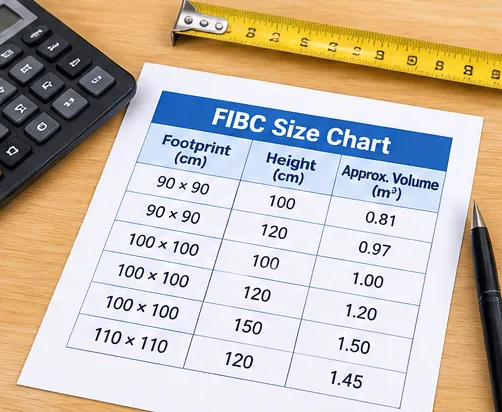
The following examples show the theoretical geometric volume of a bag with a square footprint, calculated from its stated width, length and height. They are reference calculations rather than guaranteed usable capacities.
| Footprint (cm) | Height (cm) | Approx. Geometric Volume (m³) |
|---|---|---|
| 90 × 90 | 100 | 0.81 |
| 90 × 90 | 120 | 0.97 |
| 100 × 100 | 100 | 1.00 |
| 100 × 100 | 120 | 1.20 |
| 100 × 100 | 150 | 1.50 |
| 110 × 110 | 120 | 1.45 |
The calculations use footprint area multiplied by height, assuming a rectangular volume. Actual FIBC capacity depends on the finished bag construction, filling level, top closure and material behaviour. Circular and baffled bags require separate dimensional assessments. Use these figures as an initial reference when comparing an FIBC size chart, and confirm the usable capacity with the manufacturer.
Safety Factor and Duty Cycle
The safety factor describes the relationship between an FIBC’s test load and its rated safe working load (SWL). A 5:1 ratio is commonly associated with single-trip FIBCs, while certain multi-trip designs use a 6:1 ratio. The applicable ratio depends on the bag design and relevant testing requirements, so buyers should verify it against the manufacturer’s test documentation. Neither ratio permits loading the bag beyond its stated SWL.
The intended number of trips also affects bag selection. Repeated lifting, abrasion, sunlight exposure and storage conditions can affect fabric, seams and lifting loops over time. If a bag is intended for reuse, confirm that its design, testing and inspection requirements support the specified number of trips. Do not assume that a single-trip FIBC is suitable for repeated use.
Choosing Capacity by Product
Dense minerals and aggregates. Mineral concentrates, sand and other dense materials can reach the rated load before the bag is fully expanded. Focus on SWL, fabric strength, seam construction and lifting-loop design. Confirm that the filled bag remains compatible with the forklift or lifting equipment.
Grain, feed and plastic pellets. These materials often require more volume at the same target weight than dense minerals. Consider bulk density, filling behaviour and the finished bag height. Baffle FIBCs may help maintain a more regular shape during pallet storage and container loading.
Fine powders and chemicals. Consider product containment, moisture protection and discharge requirements. Depending on the material and operating environment, the bag may require a PE liner, barrier liner or a specified electrostatic classification. For potentially combustible powders, the complete FIBC and liner configuration must match the site’s electrostatic risk assessment and relevant handling requirements.
In every application, specify the filling and discharge arrangement alongside the target weight and dimensions. Filling spouts, open tops, discharge spouts and flat bottoms must be compatible with the equipment used at both ends of the supply chain.
Specification Checklist for Super Sack Sizing
Before requesting an FIBC quotation, prepare the following information to help the manufacturer recommend a suitable bag design.
- Product details — material name, bulk density, particle size and filling behaviour.
- Load requirement — target filling weight and required SWL.
- Bag dimensions — footprint, height and required usable volume.
- Body construction — U-panel, 4-panel or circular construction, with or without internal baffles.
- Top and bottom options — open top, filling spout, duffle top, flat bottom or discharge spout.
- Liner requirements — liner material, thickness, dimensions and barrier properties, if needed.
- Lifting and handling — loop configuration, lifting equipment, pallet dimensions and stacking conditions.
- Safety and service life — single-trip or multi-trip design, safety factor and electrostatic classification where applicable.
- Additional requirements — UV protection, coating, printing and relevant test documentation.
Sourcing and Manufacturer Considerations
A dimension chart is a starting point, not a complete jumbo bag specification. Ask the supplier how the quoted volume is measured, what construction it assumes, and whether the same dimensions can be maintained across repeat orders. A manufacturer that works from your product data is better placed to recommend a suitable design than one that simply assigns a catalogue size. The FIBC bulk bags overview gives background on the formats behind the size charts.
SITONG PACKAGING manufactures FIBC and PP woven packaging at its facilities in Haicheng, Liaoning, China, and Cambodia. With around 20 production lines and an annual production capacity of approximately 30,000 tonnes across its manufacturing operations, the company supports custom bag dimensions, fabric specifications, lifting-loop configurations, liners and filling and discharge designs.
For buyers with specific filling-line or pallet requirements, providing a drawing, existing bag sample or equipment dimensions helps the technical team evaluate the proposed FIBC construction before production. Explore our FIBC bags manufacturer page for more information about our manufacturing capabilities and customization options. Confirm the exact bag-and-liner construction, its test basis and the handling conditions during the technical inquiry before sample approval.
Matching Capacity to Your Material
Choosing the right super sack dimensions starts with the material and the way it will be handled. A suitable FIBC must accommodate the required product volume while meeting the rated load, filling, lifting, storage and discharge requirements.
Before placing an order, confirm the finished dimensions, bag construction, liner configuration and applicable test documentation with the manufacturer. Providing your target weight, bulk density and equipment requirements makes it easier to develop a specification that works in actual operating conditions.
If you need custom FIBC dimensions or a specific bag configuration, contact SITONG PACKAGING with your product and handling requirements for a suitable bulk bag solution.
Frequently Asked Questions
There is no universal standard size for a super sack. Square footprints such as 90 × 90 cm and 100 × 100 cm are used in some FIBC designs, but the correct dimensions depend on product bulk density, target filling weight, required volume and handling equipment. Confirm the finished dimensions with the manufacturer before ordering.
Divide the target filling weight by the product’s bulk density to estimate volume, then confirm how the material settles. Give both weight and density to the supplier so the bag is not sized on weight alone.
Not necessarily. A dense product can reach a high load in a small bag; a light product needs more volume at the same load. Dimensions follow density as much as weight.
Baffles help the bag hold a square shape and use pallet space more effectively, which changes usable volume. When comparing size charts, check whether the quoted volume assumes baffles.
A 5:1 safety factor means the FIBC is tested against a load five times its rated SWL under the applicable test basis. It is commonly associated with single-trip bags. This ratio does not allow the bag to be loaded above its stated SWL.
A liner occupies some internal space and may affect how the bag fills, depending on its thickness and installation. Specify the liner material, dimensions and configuration together with the FIBC so the manufacturer can confirm the finished capacity.