

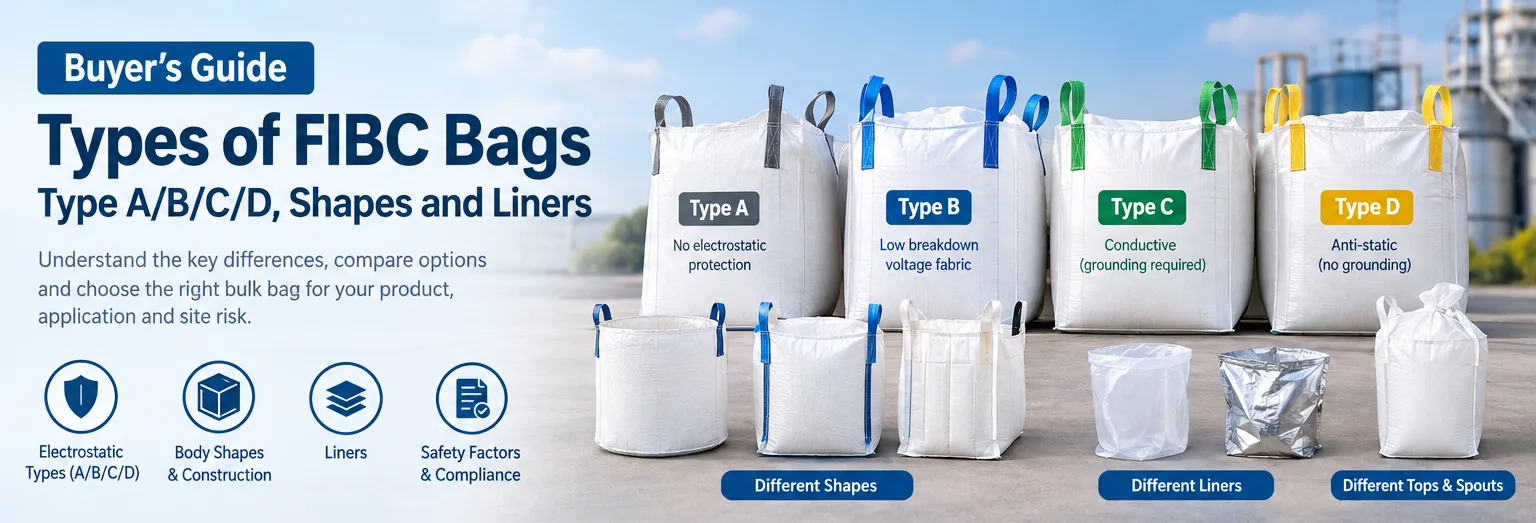
Choosing the right types of FIBC bags starts with the product hazard, handling requirements and intended operating environment—not price alone. A flexible intermediate bulk container (FIBC), also called a bulk bag, can be specified by electrostatic type (A, B, C or D), body construction, shape, liner and safe working load (SWL). These are separate specification dimensions, and the correct combination depends on the material being handled and the site’s risk assessment. This buyer’s guide explains the main FIBC bag types, their differences and the documentation procurement, EHS and operations teams should verify before requesting quotes.
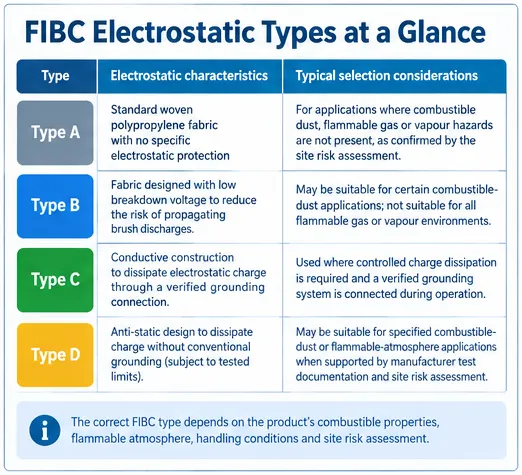
FIBC Electrostatic Types at a Glance
| Type | Electrostatic characteristics | Typical selection considerations |
|---|---|---|
| Type A | Standard woven polypropylene fabric with no specific electrostatic protection | For applications where combustible dust, flammable gas or vapour hazards are not present, as confirmed by the site risk assessment |
| Type B | Fabric designed with low breakdown voltage to reduce the risk of propagating brush discharges | May be suitable for certain combustible-dust applications; it does not eliminate all electrostatic ignition risks and is not suitable for every flammable gas or vapour environment |
| Type C | Conductive FIBC designed to dissipate electrostatic charge through a verified grounding connection | Used in applications requiring controlled charge dissipation where the specified grounding system is connected and verified throughout the relevant operation |
| Type D | FIBC designed to dissipate electrostatic charge without a conventional grounding connection, subject to its tested design and operating limits | May be suitable for specified combustible-dust or flammable-atmosphere applications when supported by the manufacturer’s test documentation and site risk assessment |
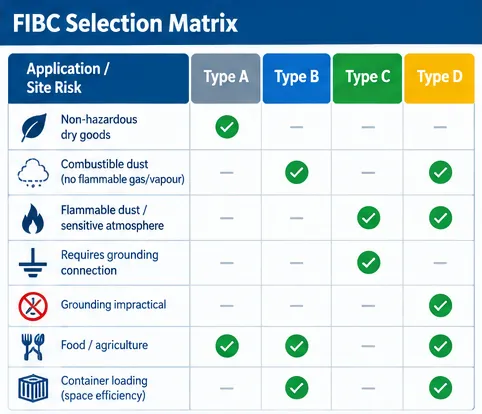
How to choose: The correct FIBC electrostatic type depends on the combustible properties of the product, the possibility of a flammable atmosphere, filling and discharge conditions, and the site’s ignition-risk assessment. Type C requires a verified grounding connection. Type D does not rely on conventional grounding in the same way, but it is not universally suitable for every hazardous application. Confirm the bag’s classification, test documentation and operating limitations with the manufacturer and the site’s EHS team before use.
FIBC Bag Shapes and Body Construction
FIBC bag types are also distinguished by body construction and shape, which affect load distribution, filling and discharge performance, storage stability, and transport efficiency. These features are independent of the electrostatic classification: for example, an FIBC baffle bag can be designed with a suitable Type A, B, C or D construction, subject to its material design and verified performance.
| Construction | Main design feature | Typical application considerations |
|---|---|---|
| 4-panel FIBC | Four fabric panels sewn together | General-purpose bulk handling and flexible customization |
| U-panel FIBC | A U-shaped fabric section forms the base and two sides | Load distribution and seam design requirements |
| Circular or tubular FIBC | Woven tubular body with fewer vertical side seams | Applications where body geometry, seam reduction and product containment are important |
| Baffle FIBC (Q-bag) | Internal corner baffles help the filled bag retain a more cubic shape | Improved space utilization in warehouses, on pallets and in containers |
| Conical or ventilated FIBC | Tapered construction or ventilation panels, depending on the design | Discharge-flow requirements or products that need airflow, where the design is appropriate |
Choose the body construction according to the product’s flow characteristics, filling and discharge equipment, lifting requirements, storage conditions and transport plan. A baffle design may improve space utilization, but its actual performance depends on the bag dimensions, baffle design, filling ratio and product characteristics. Ventilated FIBCs should be specified only when their airflow and product-protection characteristics match the application.
For more detail, see our FIBC baffle bag guide and heavy-duty FIBC guide for mining applications.
FIBC Liner Types and Selection
An FIBC liner can provide a moisture barrier, protect product purity or help meet specific chemical-compatibility requirements. The correct liner depends on the product, filling and discharge process, storage environment and electrostatic design of the complete bag.
| Liner type | Typical selection purpose | Key specification checks |
|---|---|---|
| PE liner, form-fit or loose | Moisture protection and product containment | Film thickness, dimensions, fit and compatibility with the product |
| Conductive or electrostatically suitable liner | Applications where the complete FIBC design requires controlled electrostatic behaviour | Electrical characteristics, compatibility with the FIBC classification and supporting test documentation |
| Aluminium or foil-based barrier liner | Applications requiring a higher moisture, gas or odour barrier | Barrier performance, seals, product compatibility and handling requirements |
| VCI liner | Corrosion protection for compatible metal products | Corrosion-inhibition requirements, metal compatibility and storage conditions |
A standard PE liner should not automatically be assumed suitable for a Type C FIBC. Depending on its construction and installation, a liner may affect electrical continuity or the intended discharge path. Specify the complete liner-and-bag configuration, confirm the manufacturer’s instructions, and verify the required grounding path and test documentation before use in a hazardous application.
See our FIBC liner types guide for more detail on liner materials and selection.
FIBC Safe Working Load (SWL) and Safety Factor
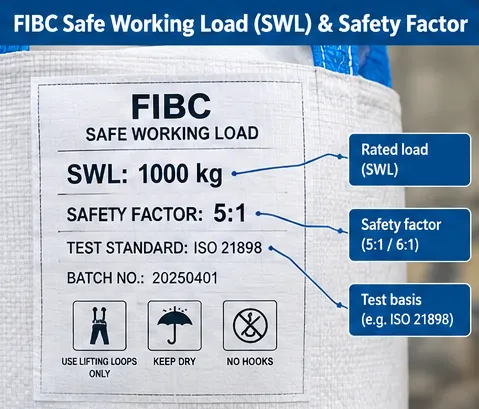
The safe working load (SWL) is the maximum load specified for the FIBC under its stated conditions of use. The safety factor describes the relationship between the test load and SWL within the applicable test framework; it does not mean that a bag can be loaded above its rated capacity.
Common FIBC ratings include 5:1 for single-trip designs and 6:1 for certain multi-trip designs. These are common conventions, not substitutes for checking the actual product specification and applicable standard. A higher numerical safety factor alone does not establish suitability for a particular load, handling cycle or hazardous application.
Before approving a bag, verify:
- Rated SWL and any applicable product or handling limitations.
- Whether the bag is designed for single-trip or multi-trip use.
- The stated safety factor and relevant test standard.
- Test reports and identification that correspond to the exact bag design or SKU.
- Inspection, handling and reuse requirements supplied by the manufacturer.
For reusable FIBCs, confirm that the bag’s design and documentation specifically support the intended reuse conditions. Do not infer reusability from appearance or safety-factor labeling alone.
FIBC Standards and Compliance Verification
FIBC compliance depends on the intended application, product hazards, destination market and the specific bag design. Different standards address different requirements, so buyers should confirm which standards and regulations apply to their products and shipments.
- IEC 61340-4-4: Addresses electrostatic classification and testing requirements for flexible intermediate bulk containers within its scope. Verify the applicable edition and the requirements relevant to the intended hazardous environment.
- ISO 21898: Covers requirements and testing for FIBCs used to transport non-dangerous goods within the standard’s scope. Confirm the applicable edition and product requirements.
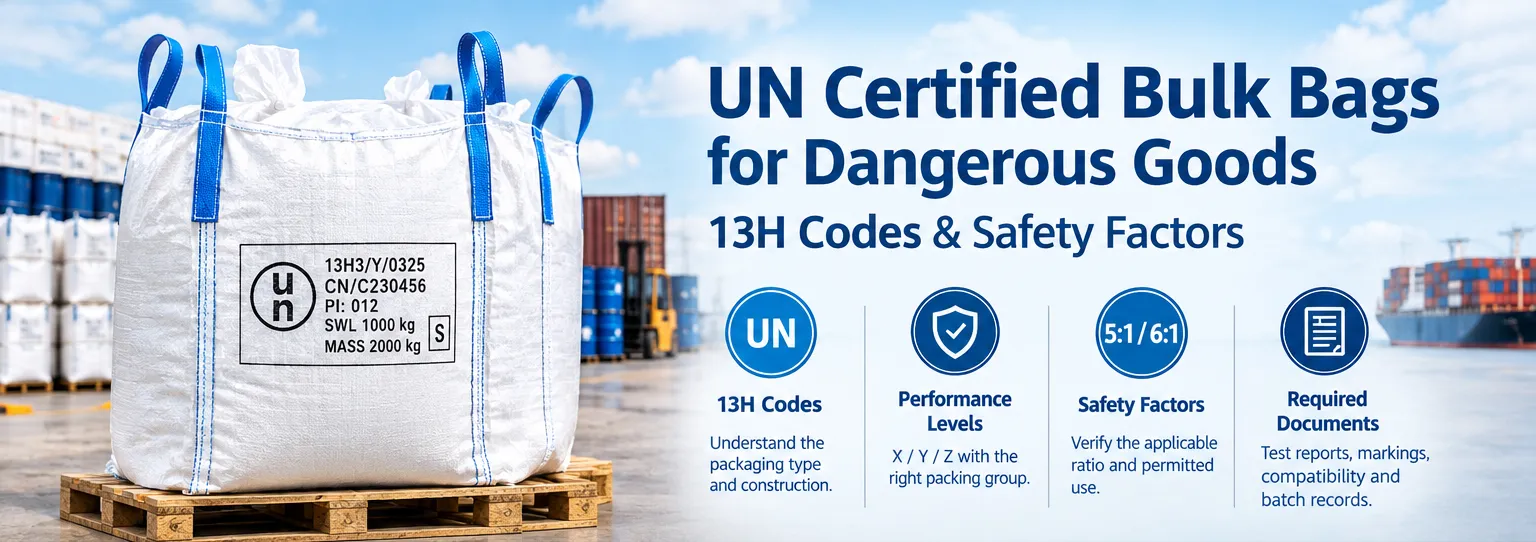
- UN dangerous goods packaging requirements: Apply where the goods and transport arrangements fall within the relevant dangerous-goods regulations. Confirm the required packaging approval, marking and transport documentation for the specific shipment.
Before placing an order, request documentation identifying the bag design, safe working load (SWL), applicable safety factor, electrostatic classification where relevant, test methods and any required approvals. Check that the evidence corresponds to the proposed construction, including relevant seams, lifting loops, liner configuration and intended use.
A general company certificate or marketing statement does not, by itself, prove that a specific FIBC is suitable for a particular application. Confirm the applicable requirements with the supplier and, where necessary, the site’s EHS team or a qualified compliance specialist.
FIBC Supplier Audit and MOQ Checklist
When evaluating FIBC bags manufacturers, compare the complete specification and supporting documentation rather than price alone. Use the following checklist before requesting a quotation or approving a supplier.
| Audit item | What to confirm |
|---|---|
| Electrostatic classification | Type A, B, C or D matched to the application risk assessment, with relevant test evidence |
| SWL and safety factor | Rated load, applicable test basis and single-trip or multi-trip designation |
| Body construction | 4-panel, U-panel, circular, baffle or other required design |
| Liner specification | Material, dimensions, thickness, barrier requirements and electrical compatibility where applicable |
| Filling and discharge | Top closure, filling spout, discharge spout and compatibility with operating equipment |
| MOQ and lead time | Minimum order quantity, sample availability, production schedule and shipment lead time |
| Quality documentation | Product specifications, test reports, traceability and market-specific declarations or approvals where applicable |
| Packaging and shipping | Bag dimensions, bale or pallet configuration, container-loading plan and destination requirements |
SITONG PACKAGING manufactures FIBCs at facilities in Haicheng, Anshan, Liaoning, China, and Cambodia, serving international markets. Buyers should confirm the production site, product specifications, minimum order quantity, lead time and shipment arrangements for their specific order.
Explore our FIBC bags manufacturer page and FIBC bag product range for company capabilities and available product information. When requesting a quotation, provide the bag dimensions, SWL, electrostatic type, liner specification, filling and discharge design, order quantity and destination.
Conclusion
Choosing the right types of FIBC bags means matching four key requirements: electrostatic classification, body construction, liner specification and verified safe working load (SWL). Type A, B, C and D address different electrostatic design requirements, while 4-panel, U-panel, circular and FIBC baffle bag constructions serve different handling, storage and transport needs.
Before ordering, confirm the product hazard, intended operating environment, bag dimensions, liner compatibility, rated load, applicable test documentation, MOQ and delivery schedule. For buyers comparing FIBC bags manufacturers, a complete specification and verifiable product documentation provide a stronger basis for supplier evaluation than price alone.
Visit SITONG PACKAGING’s FIBC bags manufacturer page or FIBC bag product page to review the available product information and discuss your application-specific requirements.
Frequently Asked Questions
The main electrostatic types are Type A, Type B, Type C and Type D. FIBCs can also be classified by body construction, such as 4-panel, U-panel, circular and baffle designs, and by liner type. These are separate specification dimensions, so the correct combination depends on the product, operating environment and handling requirements.
Type A FIBCs have no specific electrostatic protection and are intended for applications where electrostatic ignition hazards are not present. Type C FIBCs use conductive construction and require a verified grounding connection during relevant filling and discharge operations. The appropriate type must be determined from the site’s risk assessment and the bag’s supporting test documentation.
Yes. Baffles control the filled bag’s shape, while Type C and Type D describe electrostatic design characteristics. A baffle FIBC can incorporate a suitable electrostatic design, provided the complete bag meets the relevant performance requirements and is supported by appropriate documentation.
The safety factor expresses the relationship between the test load and the safe working load under the applicable test framework. A 5:1 rating is commonly associated with single-trip FIBCs and 6:1 with certain multi-trip designs. Verify the actual bag’s rating, test basis and intended service life instead of relying on the ratio alone.
The liner must be compatible with the product and the complete FIBC’s electrostatic design. For a Type C bag, confirm that the specified liner does not compromise the intended electrical continuity or grounding path. Moisture-barrier and foil liners should be evaluated against the product requirements and manufacturer documentation before use in hazardous applications.
Food-contact suitability depends on materials, manufacturing hygiene, contamination controls and the relevant food-contact requirements, not on the electrostatic type alone. For container loading, a baffle FIBC may improve space utilization by maintaining a more cubic shape. Confirm food-contact documentation or actual loading performance for the specific bag design before purchasing.