

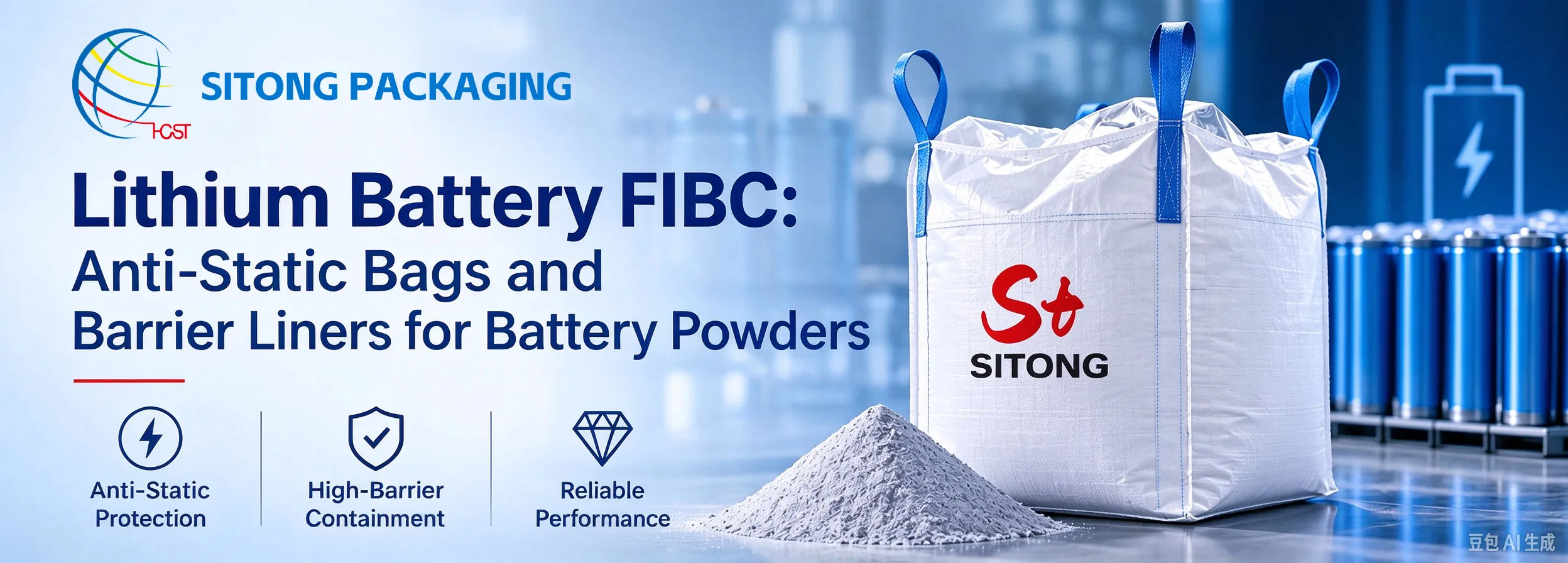
Lithium battery FIBC are used to package and transport cathode active materials, anode powders, battery precursors and recovered materials such as black mass. These products vary in particle size, bulk density, flow behavior and sensitivity to moisture or oxygen, so a single bulk bag construction is not suitable for every application.
For battery material handling, buyers need to evaluate three main packaging requirements: electrostatic control, fine-powder containment and protection against environmental exposure. Depending on the material and operating conditions, the specification may include a Type C or Type D FIBC, a compatible inner liner and additional moisture or oxygen barrier layers. This guide explains the key options and the information buyers should provide when sourcing lithium battery FIBC.
For the fundamentals of bulk bag formats, capacities and configurations, see our FIBC bulk bags overview.
Why New-Energy Materials Need Specialized FIBC
The new-energy materials handled in FIBC include several distinct product families, and each raises packaging requirements that a general-purpose sack does not meet:
- Cathode active materials (CAM) — Lithium iron phosphate (LFP), nickel-manganese-cobalt (NMC), lithium cobalt oxide and related compounds, often supplied as fine powders.
- Anode materials — Graphite, silicon-based and pre-lithiated anode powders.
- Precursors and salts — Nickel, cobalt and manganese hydroxides, sulphates and other battery-grade intermediates.
- Recycling streams — “Black mass” and recovered active materials from end-of-life battery processing.
These material groups should not be treated as one packaging category. Graphite and silicon-based anode materials, cathode powders, metal-containing precursors and recycled black mass can have different moisture limits, contamination risks and handling characteristics. The required FIBC construction should therefore be based on the individual product specification and SDS rather than the general label of lithium battery material.
The packaging requirements vary with the material’s particle-size distribution, flow characteristics and chemical stability. Fine powders may require additional containment measures, while moisture-sensitive or oxygen-sensitive grades need suitable barrier protection. Material purity also matters, particularly for high-value cathode and anode products, where contamination during filling, storage or discharge can affect product quality. The FIBC and liner should therefore be specified according to the actual material properties and handling conditions.
Risk 1 — Electrostatic Discharge and Combustible Dust
Fine powders can generate and retain electrostatic charge during filling, discharge and handling, and a combustible-dust atmosphere can form if the powder is dispersed. Type A FIBC provide no specific electrostatic protection. Where the material or operating environment presents an electrostatic ignition risk, buyers should evaluate a suitable static-control FIBC based on the material’s properties and site risk assessment.
Two main FIBC constructions are considered when electrostatic control is required:
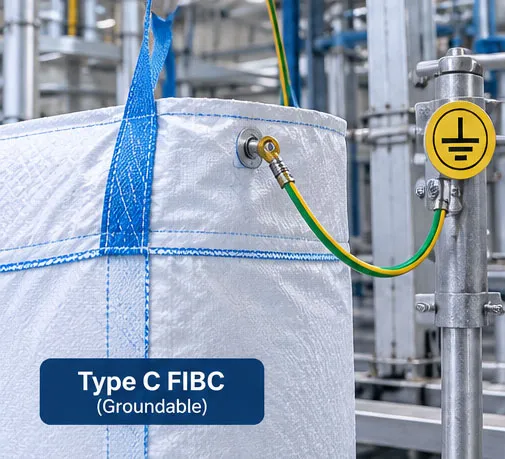
- Type C (conductive / groundable) FIBC — Uses conductive elements incorporated into the bag structure. The designated grounding points must be connected to a verified earth system during filling and discharge. Safe performance depends on both the qualified bag construction and correct grounding at the operating site.
- Type D (static-dissipative) FIBC — Uses specially engineered fabric designed to dissipate electrostatic charge without requiring a direct external ground connection. Its performance must be established through the applicable qualification tests rather than inferred from a general surface-resistance value.
These anti-static bulk bags — including conductive FIBC bags (Type C) and static-dissipative Type D designs — are intended for applications where electrostatic control is required, with the two types offering different approaches to static protection.
Both types must be selected according to the powder’s ignition characteristics, the surrounding hazardous-area classification and the actual filling and discharge process. Buyers should request the relevant test reports, bag labels and instructions for use. The compatibility of the inner liner with the selected FIBC type must also be checked. Where available, combustible-dust test data such as minimum ignition energy (MIE), minimum explosible concentration (MEC), and maximum explosion pressure (Pmax) can help the site’s EHS team assess the actual handling risks.
IEC 61340-4-4:2018, published by the International Electrotechnical Commission, specifies electrostatic classification and test methods for FIBC, including relevant requirements for inner liners. Buyers should verify the classification and test documentation for the actual bag construction and liner combination rather than relying on a general supplier statement. Compliance with the standard does not replace a site-specific assessment of combustible dust, flammable atmospheres and operating conditions. For more details, see our Type C FIBC grounding and compliance guide and our Type D FIBC guide.
Risk 2 — Ultra-Fine Powder Leakage
Fine battery powders require more than a standard woven FIBC body. Powder containment depends on the fabric construction, liner integrity and the sealing of filling and discharge openings.
An inner PE liner can provide an additional containment layer, while a tighter fabric construction may help reduce powder migration through the woven body. For particularly fine or valuable materials, buyers should also review liner thickness, seam construction, inlet and outlet closures, and the method used to seal the liner after filling.
Baffle panels can improve bag shape retention and stacking efficiency, but they should not be treated as a substitute for a suitable powder-containment liner. The complete bag and liner construction should be evaluated under the intended filling, transport and discharge conditions.
Our FIBC liner types guide explains how liner material and construction affect powder containment and barrier performance.
Risk 3 — Moisture, Oxygen and Light Sensitivity
The required barrier level depends on the chemical composition and storage requirements of the battery material. Buyers should confirm the maximum allowable moisture content, oxygen exposure limits and any light-protection requirements before selecting a liner.
Common options include:
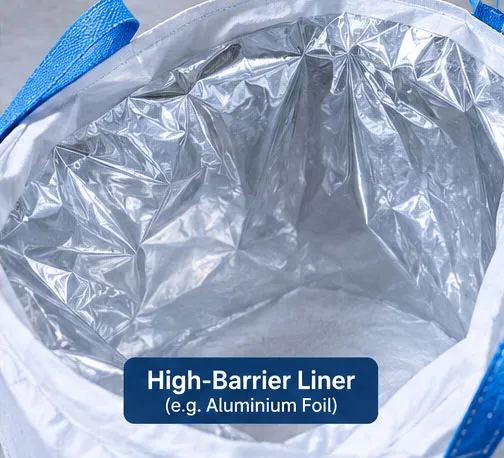
- Aluminium foil laminate — A multi-layer structure used where a high-barrier FIBC liner is required for strong moisture, oxygen and light protection. Its performance depends on the foil layer, laminate structure and sealing integrity.
- Metallized or co-extruded barrier film — An alternative for applications requiring a controlled moisture or oxygen barrier. Performance varies by material combination and film thickness.
- Opaque PE-based liners — May be suitable where light protection or basic moisture control is required without the full barrier performance of a foil laminate.
For technical comparison, request the liner’s water vapor transmission rate (WVTR) and oxygen transmission rate (OTR), together with the test conditions and film structure. Desiccants may be considered where required by the material specification, but they do not replace an adequately sealed barrier liner.
Type C vs Type D: Which to Specify
The choice depends mainly on the site’s grounding capability and the result of a risk assessment, not on a fixed rule:
| Selection factor | Type C FIBC | Type D FIBC |
|---|---|---|
| Static-control design | Conductive components | Static-dissipative fabric |
| External grounding | Required during use | No direct external grounding required |
| Site requirements | Verified grounding system and procedures | Verified operating conditions and risk assessment |
| Inner liner | Must be compatible with the Type C construction | Must be compatible with the Type D construction |
| Key verification | Grounding continuity and applicable qualification tests | Applicable electrostatic performance and ignition tests |
| Buyer documentation | Test records, grounding instructions and labels | Test records, operating instructions and labels |
Neither type is universally suitable for every battery powder. The selection should be based on the material’s minimum ignition energy, the presence of combustible dust or flammable atmospheres, the site classification and the complete bag-and-liner combination. Buyers should confirm these details with their EHS team and the FIBC supplier before approving the specification.
FIBC and Liner Compatibility
Selecting the bag body and liner separately does not guarantee that the finished packaging will perform as intended. Their compatibility needs to be assessed as a complete construction.
For Type C FIBC, buyers should confirm that the liner does not interfere with the conductive design or required grounding path. For Type D FIBC, the liner must be compatible with the qualified static-dissipative construction. The liner’s barrier properties and sealing performance should also meet the material’s storage requirements.
Before approving production, request the applicable test documentation for the proposed bag-and-liner combination and review a sample under the intended filling and discharge conditions.
Capacities and Customization
The required FIBC capacity depends on the material’s bulk density, target filling weight, available storage space and handling equipment. Buyers should specify the target SWL and required bag dimensions together rather than selecting a standard capacity based on weight alone.
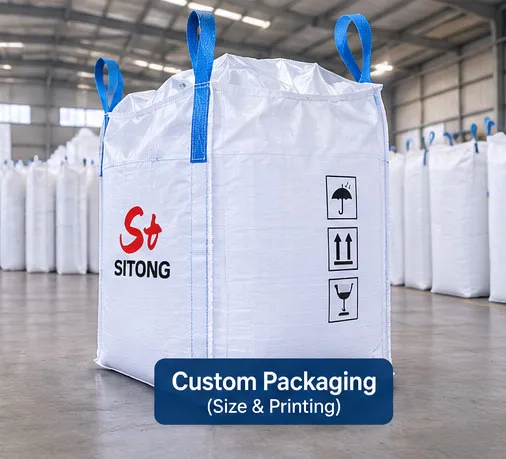
Customization options may include Type C or Type D fabric construction, compatible inner liners, filling and discharge spouts, lifting loops, dimensions and printing. The complete construction should be reviewed against the filling line, transport method and receiving equipment before sample approval.
For OEM specifications and production inquiries, visit our FIBC manufacturer page.
Specification Checklist for Lithium Battery FIBC
Before requesting a quotation, prepare the following information to help the manufacturer assess the required bag construction:
- Material details — Product name, chemical composition, particle-size distribution, bulk density and relevant SDS.
- Handling risks — Combustible-dust classification, minimum ignition energy where available, and the site’s hazardous-area assessment.
- Electrostatic requirements — Type C or Type D preference, grounding arrangements and required qualification documents.
- Powder containment — Liner material, thickness, sealing method, filling and discharge opening configurations.
- Barrier performance — Maximum moisture content, WVTR, OTR, light-protection requirements and expected storage conditions.
- Bag specifications — Dimensions, target SWL, lifting loops, top and bottom construction, and filling equipment compatibility.
- Cleanliness requirements — Acceptable contamination limits, liner handling, packaging environment and any customer-specific cleanliness procedures.
- Order details — Printing, quantity, packaging format, delivery destination and required lead time.
Sourcing and Manufacturer Considerations
For lithium battery material packaging, buyers should evaluate more than the manufacturer’s general FIBC production capacity. The supplier needs to confirm whether the proposed bag construction, liner combination and electrostatic classification meet the intended application.
Before placing an order, request the relevant Type C or Type D qualification records, liner specifications, barrier test data and sample details. Where combustible dust is involved, the final packaging design should also be reviewed against the site’s handling and safety requirements.
SITONG PACKAGING operates manufacturing facilities in Haicheng, Liaoning, China, and Cambodia, with around 20 production lines and an annual production capacity of approximately 30,000 tonnes across its manufacturing operations. Its production capabilities cover woven fabric, coating, printing, cutting and sewing for FIBC and PP woven packaging.
For lithium battery packaging projects, the required electrostatic classification, liner structure and supporting test documentation should be reviewed during the technical inquiry. Buyers should confirm the required specifications and qualification arrangements before proceeding to sample approval and production.
Specifying FIBC for Your Battery Line
The right lithium battery FIBC starts with the material specification, not simply a bag type. Particle size, moisture limits, electrostatic hazards, filling conditions and discharge requirements all influence the final construction.
Frequently Asked Questions
These are the questions buyers most often ask about lithium battery FIBC.
The choice depends on the powder’s electrostatic properties, minimum ignition energy, hazardous-area classification and handling conditions. Type C or Type D may be considered where electrostatic control is required, but the complete bag-and-liner combination must be qualified for the intended application.
Type C FIBC use conductive components that must be connected to a verified grounding system during operation. Type D FIBC use specially engineered static-dissipative fabric and do not require a direct external ground connection. Both require appropriate qualification and site-specific risk assessment.
Not all battery materials require foil liners. The choice depends on the material’s moisture and oxygen sensitivity, storage conditions and required barrier performance. Aluminium foil laminates are an option for demanding applications, while other multi-layer or PE-based liners may be suitable for less sensitive materials.
Powder containment depends on the woven fabric, inner liner integrity, seam construction and filling and discharge closures. Buyers should specify the powder characteristics and review the complete bag construction under actual operating conditions.
Request the applicable IEC 61340-4-4 qualification and test records for Type C or Type D FIBC, inner-liner compatibility information, liner WVTR and OTR data where required, and instructions for safe use. Additional transport documentation should be confirmed according to the material’s regulatory classification.
Provide the material name and SDS, particle-size distribution, bulk density, target filling weight, moisture and oxygen limits, electrostatic requirements, liner specifications, filling and discharge methods, and destination. These details help the manufacturer assess the required construction and production feasibility.