


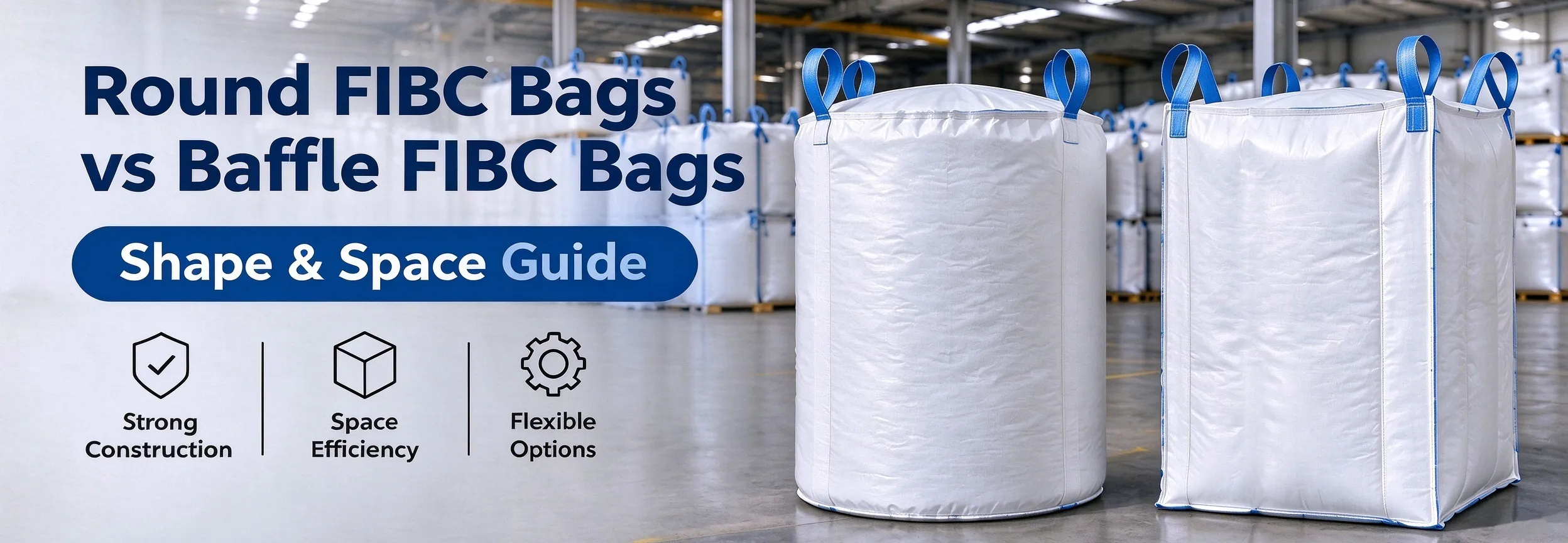
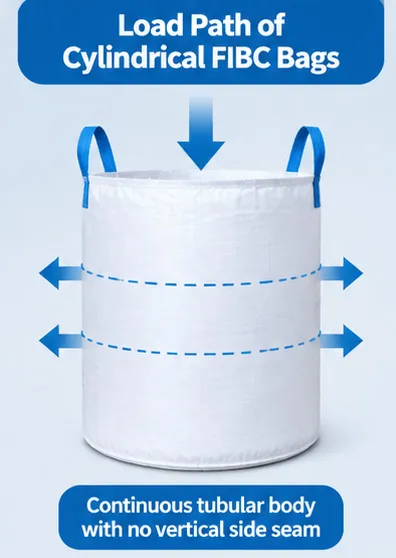
Flexible intermediate bulk containers (FIBCs), also called bulk bags, are available in several constructions, including four-panel, U-panel, circular and baffle designs. Round or cylindrical FIBC bags use a continuous tubular woven body without vertical side seams, unlike conventional panel-built bags. This construction can reduce seam-related sift paths and influence how the bag expands during filling and lifting. However, overall strength, leakage resistance and discharge performance depend on the complete bag design, fabric specifications and manufacturing quality. This guide compares cylindrical FIBC bags with four-panel and baffle bags to help buyers select the right construction for their materials, handling systems and storage requirements.
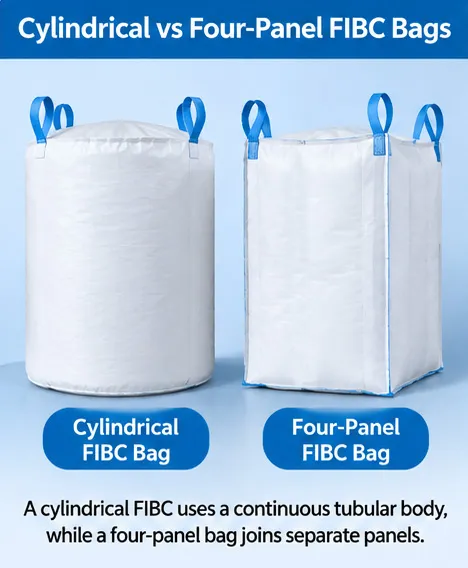
How the Three Structures Are Built
Understanding the main types of FIBC bags helps buyers compare construction, handling performance and storage efficiency before requesting a quote. The most common body designs include four-panel, U-panel and circular tubular bags, while baffle construction is an additional design feature used to improve shape retention. These categories describe different aspects of a bulk bag and should be evaluated together with liner, discharge and electrostatic requirements.
| Construction | Body | Side seams |
|---|---|---|
| 4-panel | Four separate panels sewn at corners | Vertical seams on each side |
| U-panel | One U-shaped fabric forms base + two sides | Two vertical seams |
| Circular / tubular | One continuous woven tube | None on the body wall |
Quick answer: A circular FIBC removes the vertical side seam by using a continuous tubular body. Without vertical side seams, the side-wall load path differs from a panel-built bag, and there are fewer sewn seam paths for fine material to sift through. It is not automatically “stronger” — SWL and safety factor still come from the fabric and test file — but the construction changes where stress and potential leak paths occur.
Stress Path and Failure Mode
In panel-built FIBCs, vertical seams join separate fabric panels and must withstand the loads generated during filling, lifting and handling. In a cylindrical FIBC, the continuous tubular body eliminates vertical side seams, changing the way the side wall responds to tension and expansion. This design can reduce reliance on sewn vertical joints, but it does not guarantee uniform stress distribution or greater overall strength. Performance also depends on fabric weight, weave construction, bag dimensions, top and bottom attachments, lifting loops and manufacturing quality. Buyers should verify the rated safe working load (SWL), safety factor and relevant test documentation for the complete bag rather than infer strength from its shape alone.
Sift-Proofing for Fine Powders
Fine powders and granules may benefit from cylindrical FIBC construction because the continuous tubular body removes vertical side seams that could otherwise become sift paths. However, a seamless side wall does not make the entire bag sift-proof. Leakage can still occur at the top and bottom attachments, discharge spout, closures or other sewn connections. For fine or dusty products, specify the required sift resistance and verify the fabric, seam construction, closures and liner where necessary. For combustible or potentially explosive dusts, select the electrostatic protection class according to the product hazard and site risk assessment; cylindrical construction alone does not establish static safety.
Materials Best Suited to Cylindrical FIBC Bags
| Material type | Fit |
|---|---|
| Fine powders (cement, minerals, flours) | Potential fit — fewer seam sift paths |
| Granules and free-flowing solids | Potential fit — shape behaviour during discharge |
| Coarse, irregular lumps | Potentially limited benefit — assess material shape and handling requirements |
| Hazardous / ignitable powders | Requires correct electrostatic class regardless of shape |
Specification and Test Documentation for Buyers
Procurement teams increasingly ask for verifiable specifications rather than a unit price alone. For a cylindrical FIBC, confirm the following before requesting a quote:
| Specification | What buyers should confirm |
|---|---|
| Bag dimensions | Required width, height and filled volume |
| Fabric construction | GSM, weave density and coating where applicable |
| SWL and safety factor | Rated capacity and supporting test documentation |
| Lifting loops | Number, length, configuration and handling compatibility |
| Top and bottom design | Filling inlet, discharge outlet and closure requirements |
| Sift resistance | Fabric, seams, closures and liner requirements |
| Electrostatic classification | Required type and applicable verification documents |
| Shape and stacking | Cylindrical or baffle configuration, pallet and container constraints |
Select the FIBC electrostatic classification according to the material’s ignition risk, filling and discharge process, grounding arrangements and site risk assessment. Confirm the applicable classification and test requirements for the intended application, and request the corresponding compliance and test documentation, including IEC 61340-4-4 evidence where applicable. Do not assume that cylindrical construction, a liner or a particular fabric automatically provides the required electrostatic protection. The final bag specification should be verified against the applicable requirements before use.
Cylindrical vs Baffle FIBC Bags
Cylindrical FIBC bags and baffle FIBC bags address different design priorities. A cylindrical bag uses a continuous tubular body without vertical side seams, which can reduce seam-related sift paths. A baffle bag uses internal fabric panels to help the filled bag retain a squarer shape, improving space utilisation in suitable pallet, warehouse and container-loading applications. These features are not mutually exclusive: a cylindrical FIBC can also incorporate baffles. When comparing bulk bags, evaluate the complete design against the material’s flow characteristics, leakage-control requirements, filling and discharge equipment, stacking stability and transport density rather than selecting by shape alone.
Which FIBC construction should you choose?
- Cylindrical FIBC bags: Consider when eliminating vertical side seams and reducing seam-related sift paths are important.
- Four-panel or U-panel FIBC bags: Consider when conventional panel construction fits the handling process and product requirements.
- Baffle FIBC bags: Consider when a squarer filled shape and improved pallet or container space utilisation are priorities.
The final choice should account for material flow, leakage-control requirements, filling and discharge equipment, SWL, electrostatic classification and transport constraints. A cylindrical bag can also incorporate baffles, so the two features are not mutually exclusive.
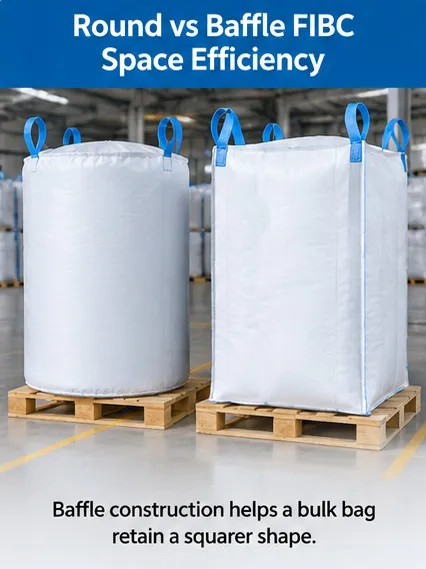
For the shape-stability alternative, see the baffle FIBC bags guide, which explains how internal panels hold a cubic shape for storage and transport density.
Market Context and SITONG Capability
Demand for FIBC bulk bags spans agriculture, construction, minerals, chemicals and other bulk-material industries. For buyers, the practical choice depends on material characteristics, handling requirements, storage conditions and transport economics rather than market growth figures alone.
SITONG PACKAGING manufactures FIBC bags at facilities in Haicheng, Anshan, Liaoning, China, and Cambodia, serving customers in more than 70 countries. Buyers evaluating cylindrical, panel-built or baffle FIBC bags can visit the FIBC bags manufacturer page for manufacturing information and the FIBC bag product page for product options and specification discussions.
Conclusion
Round and cylindrical FIBC bags use a continuous tubular woven body without vertical side seams, making them worth considering for applications where seam-related sift paths and side-wall construction are important. They are not automatically stronger or fully sift-proof, and their suitability depends on fabric specifications, closures, top and bottom attachments, lifting design and verified SWL. Compared with a fibc baffle bag, cylindrical construction prioritises body configuration and seam reduction, while baffles help maintain a squarer shape and improve space utilisation in suitable applications. Before purchasing bulk bags, compare the material requirements, filling and discharge process, electrostatic classification and complete-bag test documentation, then consult an experienced FIBC bags manufacturer to confirm the specification.
Frequently Asked Questions
It is a bulk bag whose side wall is a single continuous tubular woven body, with only the top and bottom attached separately. The body has no vertical side seam, which changes how load is carried and reduces seam-based sift paths.
Not automatically. Safe working load and safety factor come from the fabric, construction and test file, not from the shape alone. The cylindrical body changes the stress path and leak paths, not the rated capacity by default. Buyers should verify the SWL, safety factor and relevant test documentation for the complete bag.
Fine powders, granules and free-flowing solids may benefit most because the seamless body can reduce seam-based sift paths and influence how the bag holds its shape. Coarse, irregular lumps see less advantage, and leakage can still occur at top, bottom and outlet connections.
Yes, but only when the correct electrostatic type is selected and verified. The electrostatic class (A/B/C/D) is independent of the body shape. Select the class from the product hazard and site risk assessment, and request the relevant IEC 61340-4-4 test documentation. A cylindrical body, liner or fabric does not by itself establish static safety.
Cylindrical FIBC bags and baffle FIBC bags address different priorities. A cylindrical bag removes vertical side seams, which can reduce seam-related sift paths. A baffle bag uses internal panels to help the filled bag retain a squarer shape for space-efficient storage and transport. The better option depends on the material, sift-resistance requirements, discharge process and available pallet or container space; the two are not mutually exclusive.
Request bag dimensions, fabric GSM and weave density, SWL with safety factor from the bag’s test file, lifting-loop configuration, top and bottom (inlet/outlet) design, sift-resistance details, the required electrostatic classification with supporting test documents, and the cylindrical or baffle configuration with pallet and container constraints. Verifiable specs beat a unit price alone.