

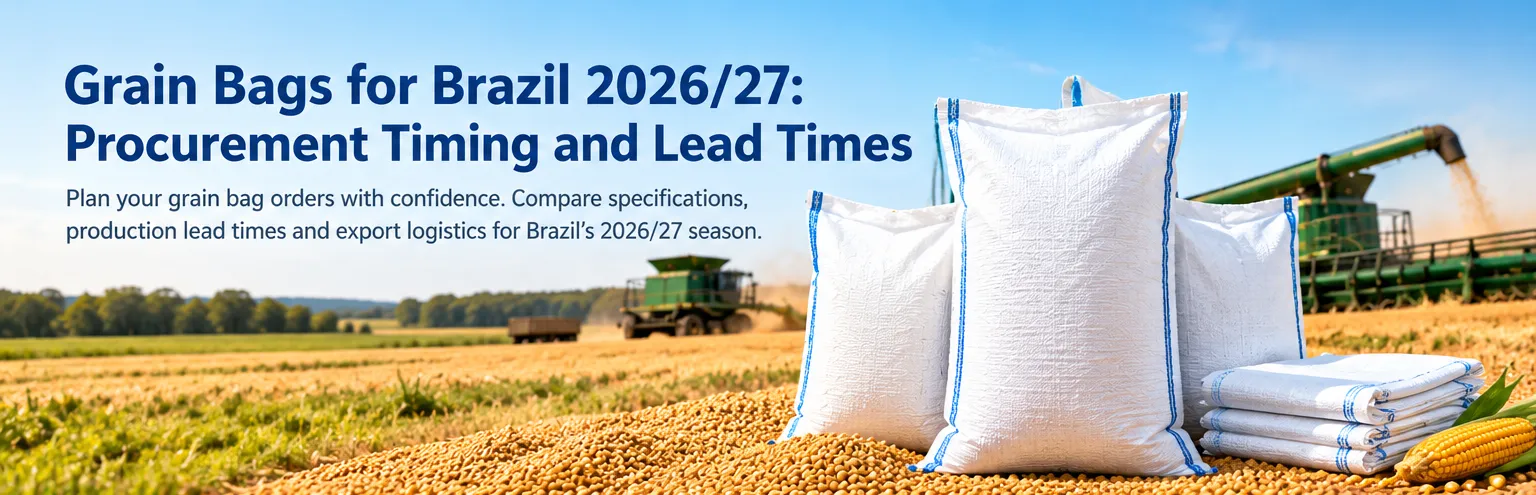
Brazil’s 2026/27 grain season creates an important planning window for agricultural packaging buyers sourcing grain bags, PP woven bags and woven polypropylene bags for soybean and corn supply chains. Actual packaging demand depends on how grain is stored and transported, the share handled in bags, filling weights and destination requirements.
This guide explains how to plan grain bag procurement around Brazil’s seasonal shipping requirements, compare bag specifications and coordinate production lead times. Buyers should confirm current crop information, bag performance requirements, supplier capacity and freight schedules before committing to an order.
The recommended planning windows in this guide are indicative. Actual lead times depend on order quantity, printing and sampling requirements, factory scheduling, transport arrangements and the required delivery date.
Grain Bag Procurement: Key Takeaways
- When to start: Begin specification and volume discussions around 10–12 weeks before the planned shipment date.
- When to reserve capacity: Aim to confirm supplier capacity approximately 8–10 weeks ahead, subject to the supplier’s actual schedule.
- What to confirm: Bag size, fabric construction, moisture protection, printing, quantity and destination.
- What affects delivery: Sample approval, production capacity, quality checks, freight availability and destination handling.
- How to choose the bag: Match the construction to the commodity, storage conditions and actual transport route.
Brazil’s 2026/27 Crop Outlook and Grain Bag Demand
Brazil’s crop outlook provides useful context for agricultural packaging procurement, but projected grain output should not be treated as a direct measure of bag demand. The number of bags required depends on the share of grain handled in bagged form, the filling weight, local storage practices and the destination market.
When reviewing the 2026/27 outlook, buyers should distinguish between official crop estimates, private analyst forecasts and final harvested volumes. Record production does not automatically mean that all grain will require woven sacks, as a substantial share of bulk grain moves through storage facilities and export terminals without individual bags.
Stock levels and export demand can also influence procurement timing. If updated forecasts indicate tighter supplies or stronger export flows, buyers may benefit from confirming bag specifications and supplier capacity earlier. Treat this as a risk-management measure rather than a guaranteed prediction of market shortages.
How Arco Norte Logistics Affects Grain Bag Procurement
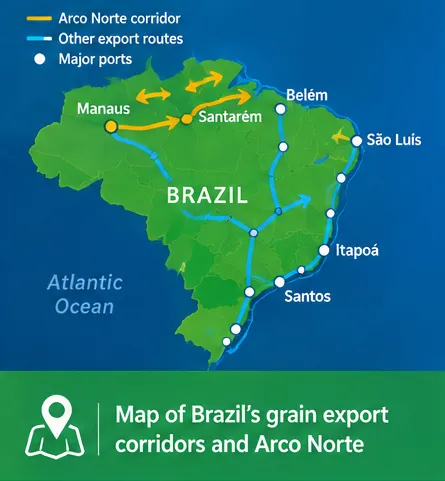
Brazil’s Arco Norte export corridor is an important consideration when planning agricultural packaging for soybean and corn supply chains. The relevant logistics route may affect inland handling, warehouse conditions, port operations and the time bags spend in transit.
For buyers sourcing PP woven bags for grain, specifications should be based on the actual delivery route rather than the destination region alone. Confirm expected storage duration, exposure to rain or humidity, stacking requirements, handling equipment and whether the packaged grain will move through warehouses or container terminals.
A route change does not automatically require a different bag design. Instead, use the route assessment to determine whether the existing bag construction, coating, liner, closure and stacking configuration remain suitable. Verify any new requirements with the packing operation and logistics provider before approving production.
Grain Bag Specifications: What Buyers Should Confirm
The right grain bag specification depends on the commodity, filling equipment, storage environment and transport route. Before requesting a quotation, buyers should confirm the following requirements with their packaging supplier.
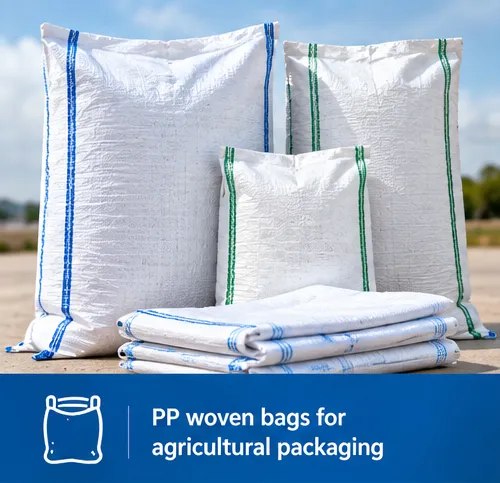
Woven polypropylene bags are made from polypropylene tapes woven into a fabric structure. For agricultural packaging, the fabric construction, bag dimensions, seams, closure and optional coating or liner should be specified according to the intended load and handling conditions. Buyers sourcing PP woven bags for grain should assess the complete bag design rather than selecting on fabric weight alone.
| Specification | What to confirm | Procurement consideration |
|---|---|---|
| Bag capacity | 25 kg, 50 kg or another required filling weight | Match the filling line, handling process and destination market |
| Fabric construction | Woven polypropylene fabric, yarn and construction details | Assess load requirements, seam strength and handling conditions |
| Fabric weight (GSM) | Confirm through the proposed bag specification and testing | Evaluate alongside fabric construction, seams and bag dimensions |
| Moisture protection | Uncoated, coated, laminated or another suitable construction | Select according to the commodity and expected moisture exposure |
| Inner liner | Whether a PE liner is required | Assess moisture protection, filling compatibility and closure requirements |
| Closure and seams | Sewn, stitched or another specified closure | Confirm compatibility with the filling and handling process |
| Printing and traceability | Brand artwork, lot code and other required information | Confirm print approval and production identification before manufacture |
Breathable woven bags may be appropriate for some dry agricultural products when ventilation and handling requirements permit. Laminated bags or bags with an inner liner may provide additional protection against external moisture, but they do not replace proper grain drying, moisture control or suitable storage conditions.
For guidance on selecting the right construction, see our guide on how to choose PP woven bags for grain. Buyers considering extended storage or additional moisture protection can also read our guide to hermetic PP woven bags for grain storage. The final specification should be selected according to the grain condition, storage environment and transport requirements.
Grain Bag Procurement Lead Times for Brazil’s 2026/27 Season
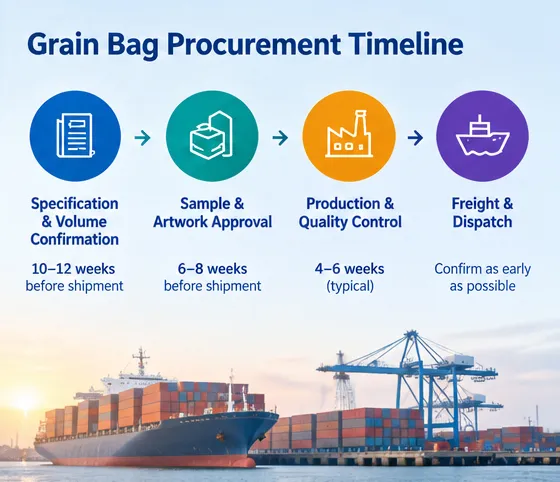
Buyers planning grain bag shipments to Brazil should work backward from the required delivery date and confirm the supplier’s actual production schedule. As an initial planning guideline, begin specification and volume discussions 10–12 weeks before the planned shipment date, and aim to reserve production capacity 8–10 weeks ahead where feasible.
| Procurement stage | Suggested planning window | Key action |
|---|---|---|
| Specification and volume confirmation | 10–12 weeks before the planned shipment date | Confirm bag size, construction, quantity and destination |
| Capacity and quotation approval | Around 8–10 weeks before | Agree on pricing, production capacity and delivery terms |
| Sampling and artwork approval | Around 6–8 weeks before | Approve samples, printing and any required testing |
| Production and quality control | Allow approximately 4–6 weeks where applicable | Confirm the factory’s actual lead time and inspection requirements |
| Freight booking and dispatch | Confirm as early as possible | Check vessel schedules, port routing and applicable freight surcharges |
These windows are indicative planning targets, not guaranteed delivery times. Some stages may overlap, while custom printing, sample revisions, raw-material availability, production queues and quality inspections can extend the schedule.
The table covers procurement and manufacturing planning rather than the full end-to-end transit period. Buyers should add the expected inland transport, export handling, ocean freight, customs clearance and final delivery time when setting the required arrival date.
For fourth-quarter shipments, request an updated freight quotation and confirm any applicable peak-season or general rate surcharges directly with the freight provider. Do not assume that a surcharge or vessel schedule will remain unchanged throughout the booking period.
Sourcing PP Woven Grain Bags
When requesting a quotation for agricultural PP woven bags, provide the required bag dimensions, filling weight, estimated order quantity, fabric and coating requirements, printing artwork, liner preference and destination. If available, include the filling method, stacking conditions and expected storage duration.
Ask the supplier to confirm the proposed construction, sample and artwork approval process, production lead time, quality inspection requirements, minimum order quantity and quotation validity. Providing these details at the quotation stage helps reduce specification changes and makes supplier comparisons more meaningful.
Regional Context for Agricultural Packaging Buyers
Brazil’s grain season is part of a wider market for agricultural PP woven bags. Buyers evaluating regional sourcing options should compare bag construction, printing requirements, order quantities, production schedules and destination-specific logistics.
For additional regional context, read our guide to polypropylene grain bags in South America. For other markets, consult the relevant regional packaging guide where a verified, published page is available.
Regardless of the sourcing region, buyers should request a written specification and confirm production capacity, quality requirements and delivery terms before placing an order.
Conclusion
Planning grain bags for Brazil’s 2026/27 season starts with a realistic assessment of crop forecasts, the required packaging format and the delivery schedule. Buyers should confirm specifications early, account for the actual export route, approve printing and samples in advance, and leave sufficient time for production, freight and destination handling.
When comparing suppliers, request a written specification, confirmed production lead time, quotation validity and quality-control requirements. For sourcing options and custom agricultural packaging, visit our PP woven bags manufacturer page to discuss bag dimensions, fabric construction, printing and order quantities.
Frequently Asked Questions
Start specification and quantity discussions 10–12 weeks before the planned shipment date, and aim to reserve supplier capacity around 8–10 weeks ahead where feasible. Confirm sample approval, production and freight schedules separately, as the full delivery timeline depends on the order and destination.
Confirm filling weight, bag dimensions, fabric construction, seam strength, moisture protection, printing and closure requirements. Final specifications should match the commodity, filling process and intended handling conditions.
Neither construction is universally better. Breathable bags may suit some applications, while laminated bags or bags with liners can provide additional protection from external moisture. The appropriate choice depends on the grain condition, storage environment and transit requirements.
No. A liner should be selected according to moisture exposure, storage duration, product requirements and the intended packaging construction. A liner alone cannot guarantee safe grain storage or prevent spoilage.
Artwork approval, sample revisions, production capacity, material availability, quality inspection, freight bookings and destination logistics can all affect delivery. Confirm the manufacturing schedule and transit estimate separately with the supplier and freight provider.