

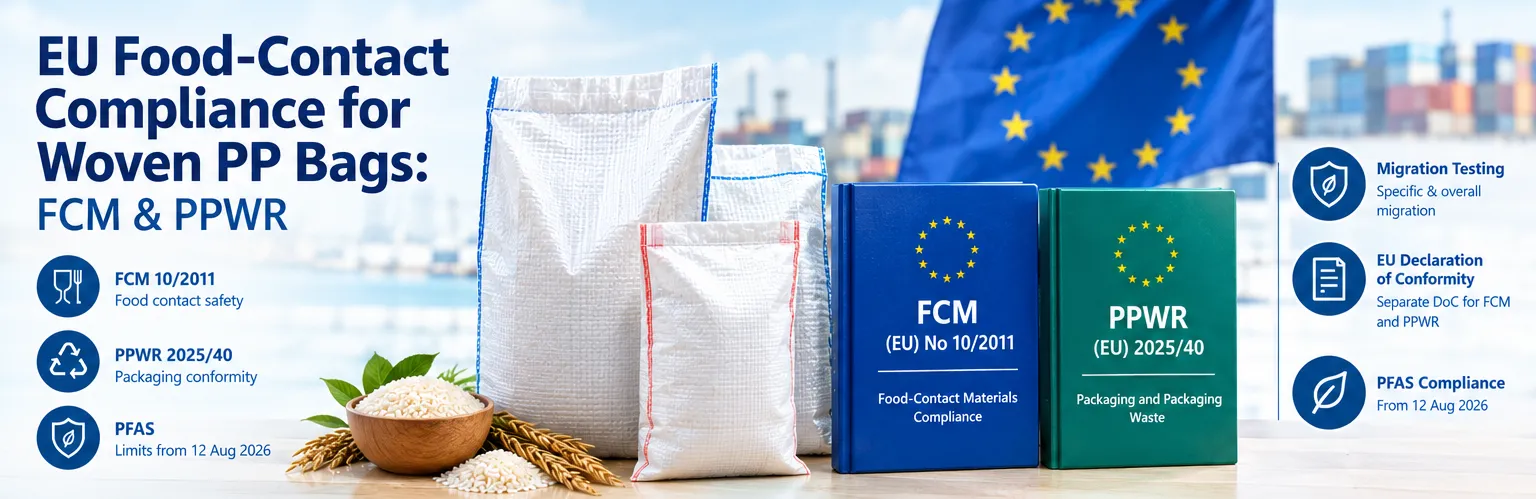
Exporters of food-contact PP woven bags to the European Union face two parallel, non-interchangeable compliance systems in 2026. The first is the food contact materials (FCM) framework built on Regulation (EU) No 10/2011. The second is the Packaging and Packaging Waste Regulation (PPWR), (EU) 2025/40, which from 12 August 2026 requires a separate EU Declaration of Conformity. Treating one as a substitute for the other is a common and costly mistake. This guide explains both systems for EU food contact PP woven bags and the documentation a buyer or exporter must hold.
At a Glance: EU Compliance for Food-Contact PP Woven Bags
Food-contact PP woven bags intended for the EU market may need to satisfy both the applicable food-contact materials (FCM) legislation and the Packaging and Packaging Waste Regulation (PPWR).
- FCM compliance: Assess the applicable food-contact rules, including Regulation (EU) No 10/2011 where relevant, based on the packaging materials and intended use.
- PPWR conformity: From 12 August 2026, the PPWR’s applicable conformity assessment, technical documentation and EU Declaration of Conformity requirements apply.
- PFAS: Food-contact packaging placed on the market from 12 August 2026 must meet the applicable PFAS thresholds under Article 5(5).
- Buyer documentation: Request the applicable declarations, supporting test evidence, material specifications and traceability records for the exact packaging construction.
A supplier’s “food grade” claim alone does not establish compliance with every applicable EU requirement.
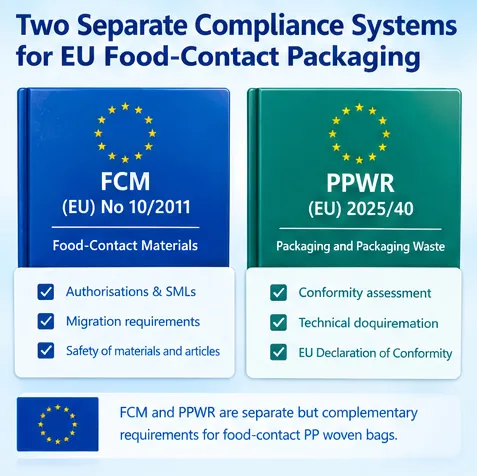
FCM vs PPWR: Key Differences for EU Food-Contact Packaging
| System | What it covers | Key 2026 date |
|---|---|---|
| FCM — (EU) No 10/2011 | Safety of materials in contact with food; authorisations, SMLs | Regulation (EU) 2025/351: products meeting the conditions in Article 4(1) and first placed on the market before 16 September 2026 may continue to be placed on the market until stocks are exhausted. |
| PPWR — (EU) 2025/40 | Packaging waste, conformity, recyclability, substances | Applies from 12 Aug 2026 |
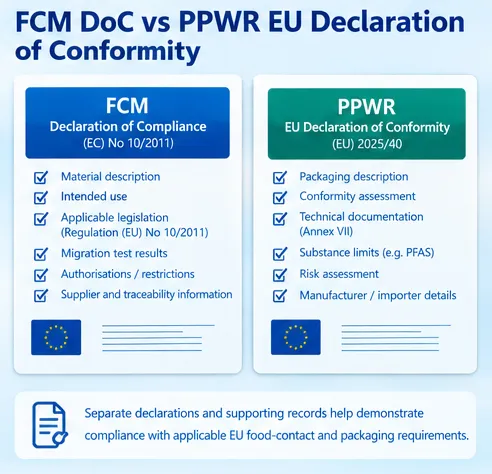
Key point: PPWR does not replace the FCM rules. A food-contact woven PP bag needs both the FCM compliance path (migration, authorisations) and the PPWR conformity path (DoC, substance limits). They are documented separately.
2026 FCM Regulatory Updates for Plastic Food-Contact Materials
EU food-contact compliance for plastic materials is governed by Regulation (EC) No 1935/2004, Regulation (EC) No 2023/2006 on good manufacturing practice, and, where applicable, Regulation (EU) No 10/2011 on plastic materials and articles intended to come into contact with food.
In 2026, exporters should pay particular attention to three regulatory instruments:
- Commission Regulation (EU) 2025/351: This regulation amends requirements for plastic food-contact materials, recycled plastics and manufacturing quality control. Under Article 4(1), plastic materials and articles that comply with the previous applicable rules and were first placed on the market before 16 September 2026 may continue to be placed on the market until stocks are exhausted, subject to the conditions in the regulation. This transitional arrangement should not be confused with the separate PPWR PFAS restrictions that apply from 12 August 2026.
- Commission Regulation (EU) 2026/245: This regulation amends Annex I to Regulation (EU) No 10/2011, including authorisations and conditions of use for several substances.
- Commission Regulation (EU) 2026/250: This regulation corrects Regulation (EU) 2024/3190 concerning BPA and certain other bisphenols in food-contact materials. Buyers should check the applicable transitional provisions for the specific article and its market-placement date.
For food-contact PP woven bags, the applicable requirements depend on the material composition, intended food contact, manufacturing process and any relevant transitional provisions. Before issuing a Declaration of Compliance, verify the current consolidated legal text and the specific conditions applicable to the bag, its coatings, inks, adhesives and liners. A regulatory amendment does not automatically mean that every component or finished bag is subject to the same requirement or deadline.
PPWR Compliance From 12 August 2026: DoC, PFAS and Heavy Metals
From the application date of (EU) 2025/40, a manufacturer must complete the conformity assessment set out in Annex VII and issue an EU Declaration of Conformity. The following substance limits are central to food-contact packaging:
PFAS Limits Under PPWR Article 5(5)
For food-contact packaging covered by Article 5(5) of Regulation (EU) 2025/40, the PFAS restrictions use three separate thresholds:
| Requirement | Threshold |
|---|---|
| Any PFAS measured by targeted analysis | 25 ppb |
| Sum of PFAS measured by targeted analysis | 250 ppb |
| PFAS, including polymeric PFAS | 50 mg/kg (50 ppm) |
Polymeric PFAS are excluded from quantification under the first two thresholds. The thresholds must be interpreted according to Article 5(5), including its definitions and analytical requirements.
If total fluorine exceeds 50 mg/kg, additional evidence may be required upon request to establish how much of the measured fluorine is attributable to PFAS. Total fluorine is a screening indicator, not proof that all measured fluorine originates from PFAS.
The applicable assessment should identify the packaging materials covered, the analytical method used, the test results and any supporting evidence required under the regulation. A test result should not be interpreted independently of the legal threshold and its measurement basis.
Manufacturers and importers should document the applicable test method, results, material scope and market-placement date when assessing compliance.
Migration Testing for Food-Contact PP Woven Bags
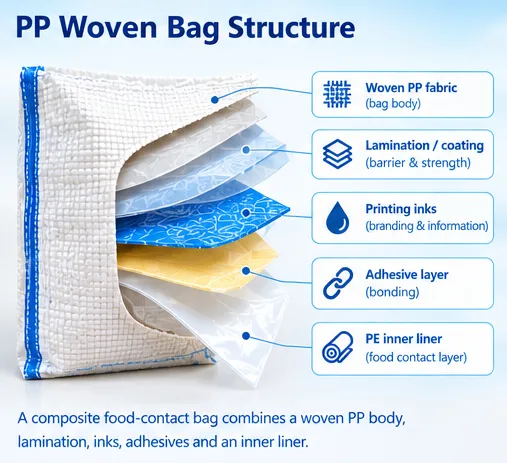
A food-contact PP woven bag may contain several components, such as a woven PP body, a laminated film, printing inks, adhesives and an inner liner. The compliance assessment should start with the complete packaging specification and its intended conditions of use, including the food type, contact duration, temperature and whether the bag is designed for direct food contact.
Where Regulation (EU) No 10/2011 applies, migration assessment should address the relevant plastic materials and applicable overall or specific migration requirements. The assessment should also consider substances that may migrate from inks, adhesives and other components, as well as non-intentionally added substances (NIAS), where relevant under the applicable framework.
Not every component is assessed in exactly the same way. The appropriate testing strategy depends on the construction, the intended food-contact surface, possible migration through other layers, and whether a functional barrier or other specific provision applies.
Recycled plastic used in food-contact materials must follow the applicable EU requirements for recycled plastics and food-contact safety. Buyers should request documentation that identifies the recycled material, its regulatory route and its intended use, rather than relying on a generic “food grade” statement.
For procurement, the practical objective is to match the migration assessment, supplier declarations and traceability records to the exact bag specification that will be manufactured and supplied.
EU Food-Contact and PPWR Documentation Checklist
EU food-contact compliance and PPWR conformity should be documented as separate but coordinated workstreams. The precise documents depend on the bag construction, intended use and applicable legislation.
| Document or record | Purpose |
|---|---|
| FCM Declaration of Compliance (DoC) | Documents compliance with the applicable food-contact legislation, including Regulation (EU) No 10/2011 where applicable |
| PPWR EU Declaration of Conformity | Documents conformity with the applicable PPWR requirements under Regulation (EU) 2025/40 |
| Technical documentation | Records the packaging design, materials, intended use, applicable requirements, risk assessment and supporting evidence |
| Migration and substance test reports, where applicable | Supports assessment of specific migration, overall migration or relevant substance restrictions |
| Supplier declarations and traceability records | Helps verify material composition, component specifications and supply-chain information |
Under Regulation (EU) 2025/40, manufacturers must complete the applicable conformity assessment, prepare the technical documentation required by Annex VII and draw up the EU Declaration of Conformity in accordance with the applicable requirements, including the model in Annex VIII. The PPWR requires the declaration and technical documentation to be retained for five years for single-use packaging and ten years for reusable packaging. These PPWR retention periods should be distinguished from any separate recordkeeping obligations under food-contact legislation or other applicable rules.
The EU does not generally issue a universal, purchasable certificate that replaces a manufacturer’s food-contact compliance assessment. Buyers should request the relevant declarations, supporting evidence and traceability information for the actual packaging specification rather than relying on a generic “food grade” certificate.
Third-party testing may be appropriate or commercially required, but the applicable legal obligations and the evidence needed should be determined for the specific product and intended use.
OEM Specification Checklist for Food-Contact PP Woven Bags
Before requesting a quotation or compliance review, buyers should prepare the following information:
- Intended use: Food type, direct or indirect contact, storage duration and temperature conditions.
- Bag construction: Woven PP body, coating or lamination, printing inks, adhesives and any inner liner.
- Material details: Virgin or recycled content, supplier specifications and relevant declarations.
- Performance requirements: Bag dimensions, filling weight, closure method, moisture protection and transport conditions.
- Compliance evidence: Applicable FCM declarations, PPWR documentation, migration reports and substance test results, as relevant to the final construction.
A PP woven bags manufacturer can use these details to review the proposed structure, identify documentation gaps and determine which assessments are appropriate before sample approval and mass production.
Final compliance must be established for the actual packaging design and intended use; it should not be inferred from a generic product description.
Food-Contact Compliance for Bulk Bags and FIBCs
Food grade bulk bags and food grade FIBC packaging require a product-specific assessment of the materials, intended food contact and storage conditions. For bulk applications, buyers should also consider the liner specification, filling and discharge design, handling requirements and traceability of the final packaging. The same food-contact compliance principles apply, but the required evidence must match the actual bag construction and intended use.
Related Guides and OEM Support
Use these related resources to review material selection, packaging compliance and manufacturing options:
- Food-grade PP woven bags: Review bag materials, construction options and food-contact packaging considerations.
- PPWR-compliant woven PP bags: Learn more about PPWR requirements for packaging, conformity documentation and substance restrictions.
- Custom PP woven bag manufacturing: Discuss bag specifications, sampling, production requirements and the documentation needed for your intended application.
For OEM projects, confirm the intended food-contact conditions and final bag construction before approving samples or production. The applicable compliance assessment should cover the packaging actually supplied.
Official EU Sources
The following official sources support the regulatory discussion in this guide. Always check the current consolidated text and the relevant article or annex before making a product-specific compliance decision.
- Regulation (EU) 2025/40 — Packaging and Packaging Waste Regulation (PPWR): Official text on EUR-Lex. See Article 5 for substance requirements and Annexes VII and VIII for technical documentation and the EU Declaration of Conformity.
- Regulation (EU) No 10/2011 — Plastic food-contact materials: Official text on EUR-Lex. Review the applicable provisions on authorised substances, migration and declarations of compliance.
- Commission Regulation (EU) 2025/351: Official text on EUR-Lex. Review its amendments and transitional provisions for plastic food-contact materials and recycled plastics.
- Commission Regulation (EU) 2026/245: Official text on EUR-Lex. This regulation amends Annex I to Regulation (EU) No 10/2011 concerning the authorisation or conditions of use of several substances.
- Commission Regulation (EU) 2026/250: Official text on EUR-Lex. This regulation corrects Regulation (EU) 2024/3190 concerning BPA and certain other bisphenols in food-contact materials.
- European Commission PPWR Guidance, C/2026/3084: Official guidance on EUR-Lex. This guidance explains selected implementation issues, including the enforcement approach for PFAS limits in food-contact packaging.
The regulations establish the applicable legal requirements. Commission guidance helps explain their implementation but should not be treated as a substitute for the binding legal text.
Conclusion
Exporting EU food contact PP woven bags requires a product-specific assessment of both applicable food-contact materials legislation and the Packaging and Packaging Waste Regulation (PPWR).
For plastic materials covered by Regulation (EU) No 10/2011, compliance should be supported by the appropriate declarations, migration assessment and material documentation. Under Regulation (EU) 2025/40, manufacturers must also address the applicable packaging conformity requirements, technical documentation and EU Declaration of Conformity. The PPWR PFAS limits for food-contact packaging apply from 12 August 2026.
For buyers, the most reliable starting point is a complete packaging specification covering the woven PP body, coatings, printing inks, adhesives and any inner liner, together with the intended food-contact conditions.
Working with an experienced PP woven bags manufacturer can help coordinate material specifications, sample development, testing and compliance documentation. However, conformity must be established for the actual packaging design and intended use, not inferred from a general food-grade claim.
Frequently Asked Questions
No. PPWR and the EU food-contact materials framework address different requirements. Regulation (EU) No 10/2011 applies to relevant plastic food-contact materials, while PPWR establishes packaging-related requirements, including conformity assessment and restrictions on certain substances in packaging. The applicable obligations should be assessed separately.
Regulation (EU) 2025/40 applies from 12 August 2026. Manufacturers must complete the applicable conformity assessment, prepare technical documentation and draw up the EU Declaration of Conformity before placing affected packaging on the market.
Article 5(5) establishes thresholds of 25 ppb for any PFAS measured by targeted analysis, 250 ppb for the sum of PFAS measured by targeted analysis, and 50 ppm for PFAS including polymeric PFAS. The first two thresholds exclude polymeric PFAS from quantification. If total fluorine exceeds 50 mg/kg, additional evidence may be required under the regulation to establish the quantity attributable to PFAS.
There is no universal EU-issued food-contact certificate that replaces the applicable manufacturer’s compliance assessment. Buyers should request the relevant Declaration of Compliance, supporting evidence and traceability records for the actual packaging specification. Other specific approval or certification requirements may apply to particular materials or uses.
Under the PPWR conformity procedure, the written EU Declaration of Conformity and technical documentation must be retained for five years for single-use packaging and ten years for reusable packaging, as specified in Annex VII.
Recycled plastic must meet the applicable EU requirements for food-contact safety and recycled plastics. The relevant regulatory route depends on the material and intended use. Buyers should verify the material’s suitability and request supporting documentation rather than relying on a generic food-grade claim.