


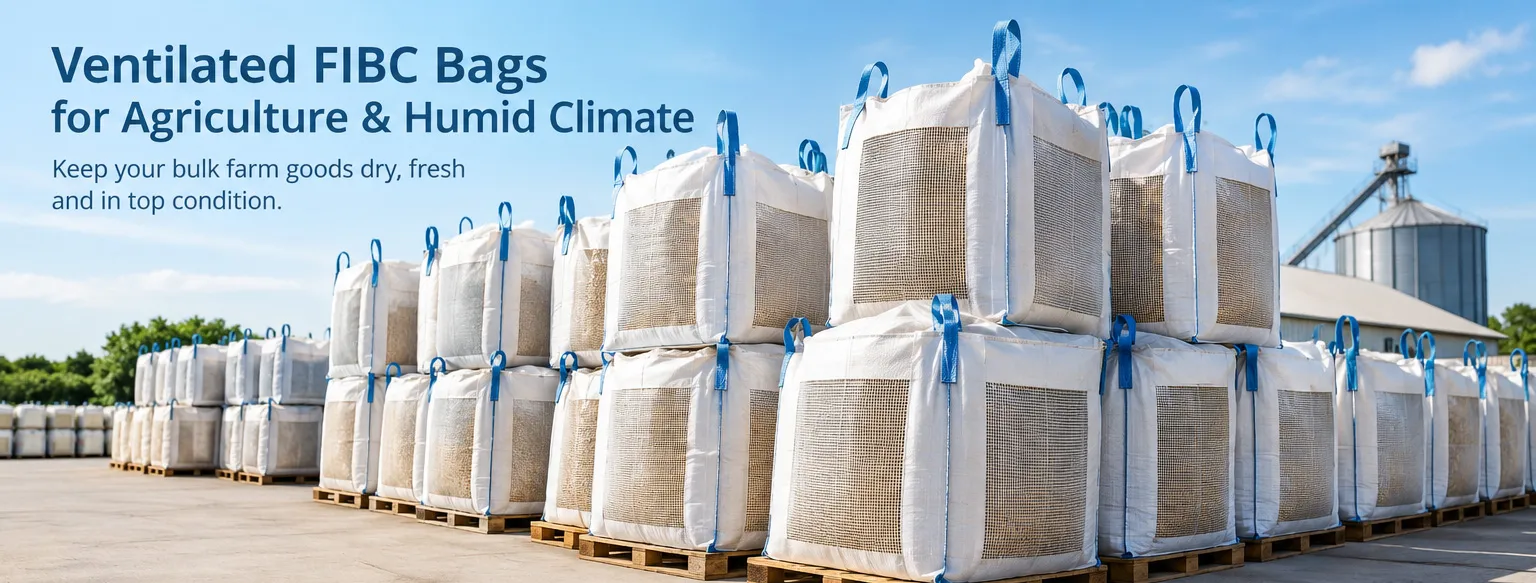
When bulk agricultural and moisture-sensitive products move through hot, humid supply chains, a standard sealed FIBC can trap moisture and may cake or spoil the load. A ventilated FIBC — built with mesh side panels or breathable woven fabric — lets air circulate so the product can help reduce moisture buildup and hold its condition better through transit. This article covers how ventilated bulk bags work, where demand is growing, and what buyers should specify.
Quick Answer
A ventilated FIBC uses mesh or breathable panel construction to promote air exchange, helping limit condensation, caking, and spoilage for moisture-sensitive bulk products in humid or high-temperature routes. Specify panel type, mesh area, UV stability, and liner requirement per crop and climate.
What Are Ventilated FIBC Bags?
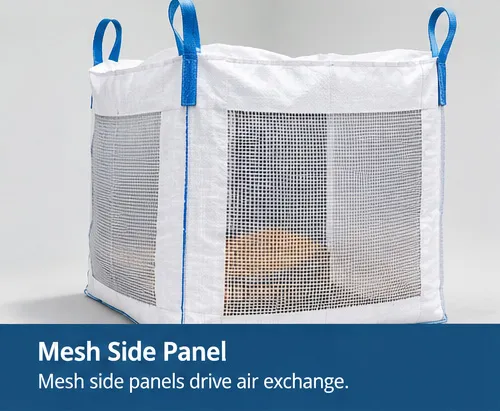
A ventilated FIBC is a flexible intermediate bulk container whose body incorporates open mesh sections or inherently breathable fabric instead of fully sealed woven panels. The mesh is typically a coarser weave or a netting panel sewn into the side walls. The lifting loops, base, and top remain structurally standard, so the bag still handles like any FIBC on a fork truck or crane.
Mesh and Breathable Panels
Ventilation is delivered two ways: integrated mesh side panels (the most common agricultural design) or a fully breathable low-denier fabric. Mesh panels give high airflow for fast-drying crops; breathable fabric gives a smoother inner surface that suits finer powders needing some air exchange without product loss.
Why Ventilation Matters for Agriculture
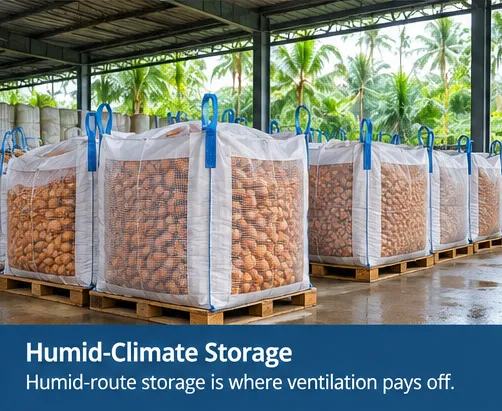
Many agricultural commodities are moisture-sensitive or generate residual heat and moisture — onions, potatoes, citrus pulp, processed feed, salt, and some fertilizers. In a sealed bag on a hot truck or in a humid warehouse, that moisture condenses on the inner wall and cakes or degrades the load. Ventilation can help break that cycle by letting humid air escape and drier air circulate, though results depend on the product and route.
Where Ventilated FIBC Bags Are Used
Market research points to ventilated FIBC demand concentrated in the humid, hot climates that need it most. Verified Market Reports and 360iResearch frame regional demand as shaped by agriculture, mining, cement, and infrastructure materials, with South Africa, Nigeria, and Saudi Arabia among the active markets named for the Middle East and Africa, and soy, coffee, and sugar driving Latin American uptake. These bulk bags for storage are specified where humidity drives caking rather than where a sealed barrier is required, and specific market-size values should be checked against the latest publisher reports before quotation.
Humidity Control and Anti-Caking
Ventilation attacks the root cause of caking: trapped moisture. By allowing humid air to leave the bag and drier air to enter, the surface moisture that drives clumping is limited — ventilation lowers humidity at the wall but does not place the product below a dew point on its own. For products that still need a moisture barrier — food-grade powders, for example — the liner and the ventilation are separate design choices. A sewn-in PE liner provides the barrier, while mesh panels provide the air exchange; both are specified on the sheet rather than assumed to work together by default. The right answer is crop-specific, which is why the liner decision belongs on the specification sheet, not as an afterthought.
Specification Sheet for Ventilated FIBC
Define these items so suppliers quote against a standard rather than a vague “mesh bag”:
| Parameter | What to specify | Why it matters |
|---|---|---|
| Ventilation type | Mesh panels vs breathable fabric | Airflow level vs inner surface smoothness |
| Panel area | Number and size of mesh sides | Total air exchange for the route |
| SWL / SF | Safe working load and safety factor | Handles the filled product weight |
| UV stability | Required UV protection and exposure/testing target | Helps maintain fabric strength during outdoor storage and transit |
| Liner | With or without PE liner | Moisture barrier for sensitive product |
| Closure | Open top, duffle, or spout | Matches filling and discharge |
UV Stability and Material Options
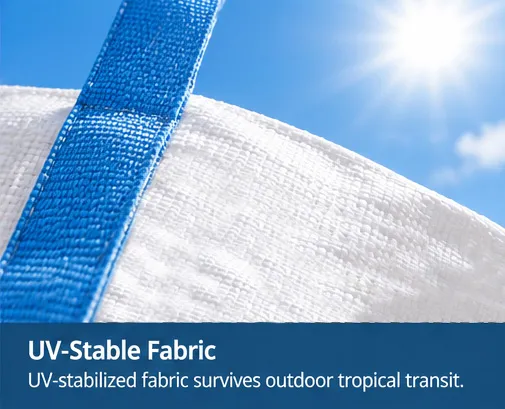
Ventilated FIBC used outdoors or on long tropical routes must resist UV. Specify a target UV retention (for example, a percentage of strength retained after a set number of hours of exposure) so the bag does not embrittle before use.
SITONG Manufacturing Capability
SITONG produces FIBC alongside its PP woven bag lines at its Haicheng, Anshan (China) and Cambodia plants, in operation since 1998, with 20 production lines and capacity around 100 tons per day (about 30,000 tons per year), more than 900 employees, and shipments to over 70 countries through the port of Dalian. For ventilated designs, the relevant capability is panel engineering: cutting and sewing mesh side panels, integrating liners, and matching loop and base construction to the safe working load. Because SITONG also runs OEM custom production, buyers can supply crop, climate, and filling/discharge details and receive a matched sample rather than a generic mesh bag. The full product range is documented on the FIBC bulk bag product page. The company holds BRCGS, ISO 9001, ISO 14001, ISO 45001 (OHSMS), and OEKO-TEX certifications; certification registration numbers are not published and should be requested during supplier qualification.
Sourcing Checklist for Buyers
- State the crop, climate, and transit route so ventilation level is matched, not guessed.
- Choose mesh panels vs breathable fabric based on product fineness and needed airflow.
- Define safe working load and safety factor for the filled weight.
- Set a UV retention target if the bag sees sun or long tropical transit.
- Decide liner requirement up front — note that a full PE liner reduces direct air exchange, so liner and ventilation are separate design choices specified on the sheet.
- Match top and bottom style (open, duffle, spout) to your filling and discharge equipment.
- Request a matched sample and run-off before a full order; confirm FIBC MOQ during quotation, as it is typically more flexible than woven-bag runs.
How to Choose Ventilated FIBC Bags
Matching the bag to the crop and route is the real buying task. Start from the product and route: match panel type and liner to the crop’s particle size, the transit humidity, and how much direct air exchange the load can tolerate — coarse, fast-drying crops such as onions or potatoes often suit open mesh panels, while finer powders usually need breathable fabric with a liner, but the right call depends on the specific product and climate. Then set the panel area for the transit humidity, the UV target for any outdoor exposure, and the safe working load and safety factor for the filled weight. Treat ventilation and a full moisture barrier as separate design choices — specify both on the sheet rather than assuming they combine automatically.
Frequently Asked Questions
It is used for bulk agricultural and moisture-sensitive products that suffer condensation, caking, or spoilage in sealed bags on hot or humid routes — onions, potatoes, feed, salt, citrus pulp, and some fertilizers.
Mesh panels give high airflow and suit coarse, fast-drying crops. Breathable fabric gives a smoother inner surface for finer products that need some air exchange without product loss.
It reduces caking by letting humid air escape and drier air circulate, which helps limit the surface moisture that causes clumping. For moisture-sensitive goods, pair ventilation with a liner.
Yes. A sewn-in PE liner protects the product, but it also reduces direct air exchange around the product — so liner and mesh ventilation are separate design choices specified on the order, not assumed to combine automatically.
Set a target percentage of strength retained after a defined number of exposure hours, based on how long and where the bag sits outdoors. Do not leave UV as an unspecified default.
They can be, when built with food-contact-grade fabric and a certified liner; food-grade suitability depends on the materials, certificates, and destination-market requirements — confirm those rather than assuming mesh equals food-safe.
It depends on the filled product density and bag size; specify SWL and the required safety factor (commonly 5:1 or 6:1, but confirm the rating required by your specification) so the bag is engineered for the load, not estimated.
FIBC production is usually more flexible than standard PP woven bag runs; confirm exact MOQ during qualification, as it varies with panel complexity and liner requirements.
Conclusion
Ventilated FIBC are a climate-engineered answer to a real problem: moisture-sensitive bulk products spoiling in humid, hot supply chains across South America, the Middle East, and Africa. The buying decision is not “mesh or not” but a matched set of choices — panel type, ventilation area, UV stability, liner, and safe working load — built against the crop and route. Buyers who specify those variables and source from a supplier that treats FIBC as an engineered system improve the odds of dry, free-flowing product at discharge with a matched sample and spec validation, rather than risking a caked, rejected load.
Sources: Verified Market Reports, “Ventilated FIBC Bags Market” (verifiedmarketreports.com); 360iResearch, “Flexible Intermediate Bulk Container” (360iresearch.com).