


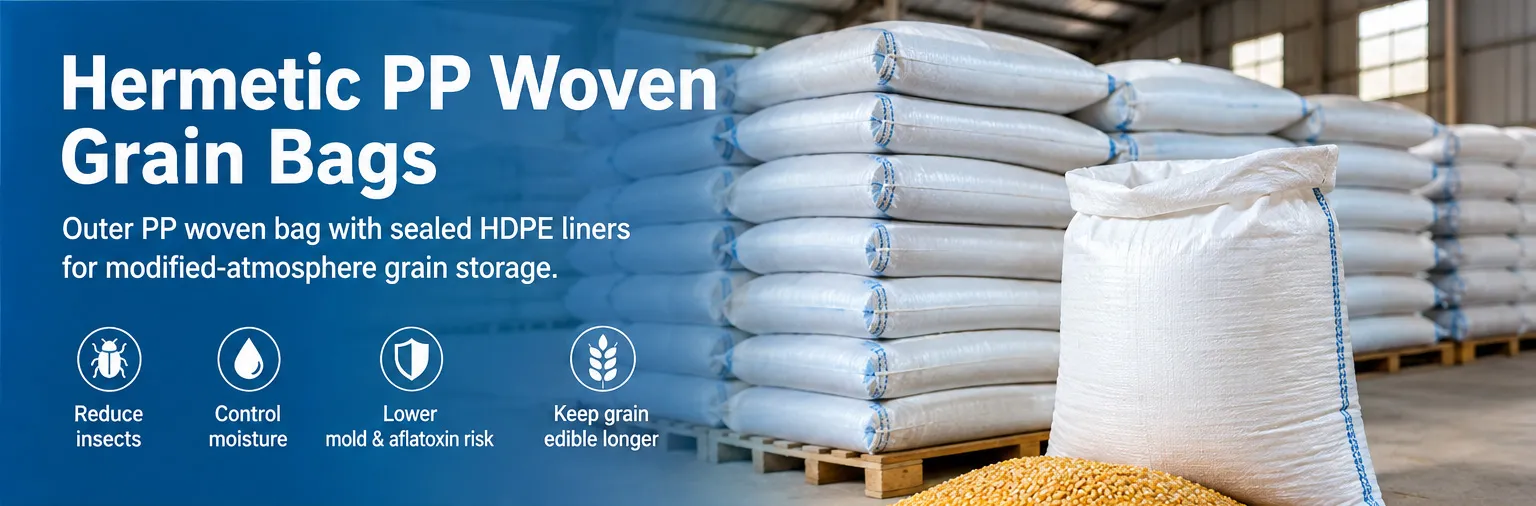
Across developing grain economies, post-harvest loss is often where a harvest is lost rather than in the field. Hermetic storage built around a standard PP woven bags manufacturer outer layer — the familiar pp woven bags for grain storage many importers already source — is one of the most practical, widely used ways to keep maize, rice, beans, and seed edible between harvest and market. This article explains how the technology works, the scale of the problem it solves, and what importers and procurement teams should specify when sourcing hermetic woven sacks.
Quick Answer
A hermetic PP woven bag is a multi-layer sack — typically an outer polypropylene woven bag with one or two sealed high-density polyethylene (HDPE) liners — that limits air and moisture exchange rather than fully blocking it. By reducing the oxygen available to stored-grain pests, it helps suppress insect breeding and slow mold growth, and it is commonly used alongside or instead of fumigants — though it is not a substitute for clean, dry grain and local rules may still require treatment. For African, South American, and Central American buyers, it can help turn post-harvest loss into a storable, marketable surplus — the actual reduction varies by crop, climate, and country.
Why Hermetic Grain Storage Matters
Hermetic storage is not a new material — it is a sealed-liner method applied to the ordinary polypropylene grain bags many importers already buy. By limiting air and moisture exchange, it gives cooperatives, NGOs, and brand owners a way to protect harvested maize, rice, beans, and seed between farm and market without relying on fumigants. The buying task is to specify the liner system, the outer bag’s size and GSM, and the sewing and closure — not to treat the woven bag as a separate redesign problem.
What Makes a Woven Bag “Hermetic”?
The word “hermetic” describes a sealed, low-air-exchange state — its effect depends on the sealing integrity of the liner system, not just the label. A normal woven polypropylene sack breathes: its weave lets air and humidity move, which is fine for dry, short-term shipping but risky for months of on-farm storage if the grain is not properly dried and sealed. A hermetic version solves this by adding sealed film layers inside the woven shell.
The Three-Layer PICS Structure
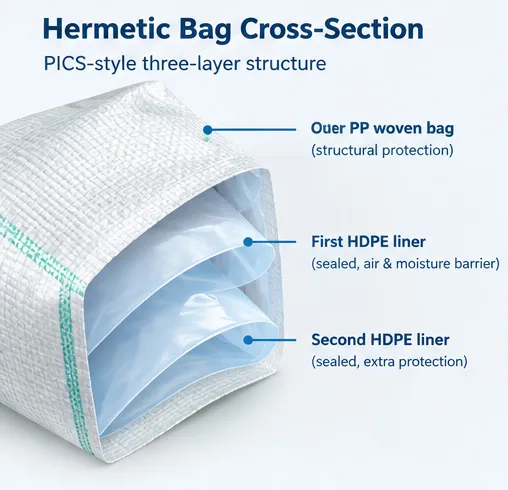
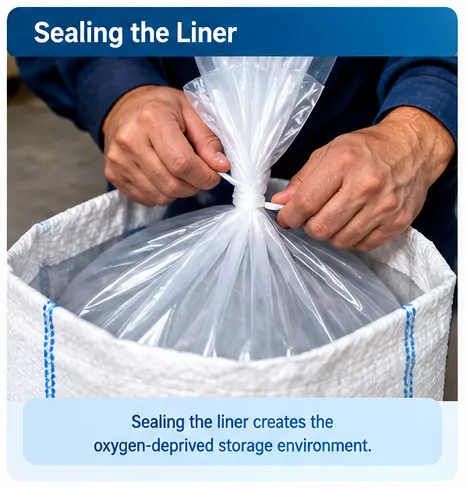
The well-known example is the Purdue Improved Crop Storage (PICS) bag: an outer ordinary polypropylene woven bag, an inner HDPE liner, and a second sealed HDPE liner (film thickness varies by product and program, so specify it). The farmer fills the liners, twists and ties each one closed, then slips them into the woven outer bag. The outer bag is the structural workhorse; the liners do the sealing.
Why the Outer PP Woven Layer Matters
The outer woven layer is not decorative. It resists tearing during handling, stacking, and transport, and it protects the delicate liners from puncture. That outer layer is exactly the product an agricultural PP woven bags supplier already produces at volume — the liner system does most of the protective work while the woven shell provides structure and puncture protection, so hermetic storage builds on an existing product rather than a separate industry.
Hermetic at a Glance
| Element | Role |
|---|---|
| Outer PP woven bag | Structural protection during handling and transport |
| Sealed HDPE liners | Limit air and moisture exchange (the main barrier) |
| Twist-tie or heat seal | Helps maintain the modified-atmosphere seal |
| Dry, clean grain | Required before sealing — storage does not dry grain |
Post-Harvest Loss and Grain Storage
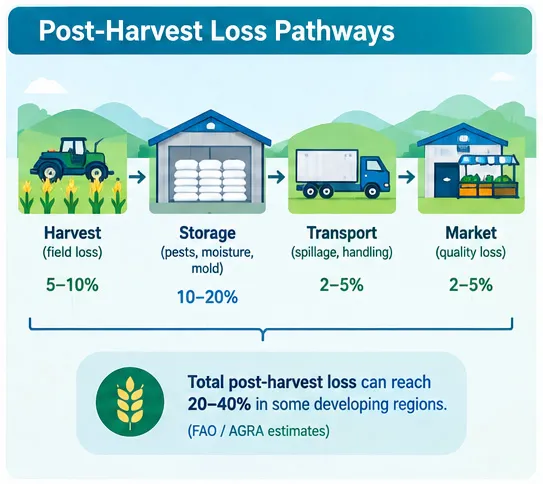
The scale of post-harvest loss is large enough to shape national food policy, though the exact figure varies by crop, climate, and country. The Food and Agriculture Organization has estimated that parts of sub-Saharan Africa lose a substantial share of harvested grain to pests, moisture, and poor storage. The Alliance for a Green Revolution in Africa (AGRA) has framed the annual economic cost of post-harvest losses on the continent in the billions of US dollars.
For importers serving Africa, South America, and Central America, this is not a marginal specification question — it is the structural reason woven storage sacks are ordered in container quantities by cooperatives, NGOs, and government programs.
How Hermetic Storage Protects Stored Grain
The protection mechanism is physical, not chemical. That distinction is why the approach is often considered for organic programs and smallholder contexts where phosphine fumigation is restricted or impractical — but the two should not be conflated, since certification and pest-control choices follow separate rules.
Oxygen Depletion and Insect Control
Once the liners are sealed, resident insects consume the limited oxygen and cannot reproduce. Most stored-product beetles and weevils struggle to complete their life cycle in a low-oxygen environment, so a modest initial infestation is less likely to become a total loss — actual performance depends on the initial infestation level, sealing quality, temperature, and storage duration.
Moisture and Mold Control
Sealed liners limit humid air reaching the grain, but they do not dry it. Because the grain must be dried to a safe moisture level before sealing (target moisture is crop-specific, often around 12–14% for paddy), the combination of low starting moisture and no new humidity helps keep mold from taking hold.
Aflatoxin Risk Reduction
Aspergillus molds that produce aflatoxin need oxygen and moisture to grow. By limiting both, hermetic storage lowers the conditions that favor aflatoxin formation — a food-safety benefit that matters, though food-contact compliance, grain safety, and aflatoxin control are separate requirements that should each be specified, and sealing does not remove aflatoxin already present — for any food-grade PP woven bags program supplying human consumption channels.
PICS and the Evidence
The PICS program, documented by the Institute of Food Technologists and field partners, reports deployment across dozens of countries and large numbers of farming households. Those adoption figures are published by the program itself and should be read as program-reported scale rather than an independent audit, but the underlying principle — modified-atmosphere storage in sealed liners — is well established in post-harvest research cited by CGIAR centers such as ICRISAT.
Crop Applications for Hermetic Woven Bags
- Maize and corn: a leading use case in sub-Saharan Africa, where weevil damage is severe.
- Rice and paddy: protects against moisture and insect loss in humid climates.
- Beans and cowpea: classic PICS crops with strong documented results.
- Seed: preserves germination rate for the next planting season when dried correctly.
Who Should Consider Hermetic Woven Bags?
Hermetic woven sacks suit buyers moving grain through hot, humid routes where insect and mold loss is high — cooperatives and smallholder programs in sub-Saharan Africa, rice and paddy handlers in humid climates, bean and cowpea programs with documented PICS results, and seed producers protecting germination. They are less critical for short, dry, climate-controlled distribution where a standard woven bag may meet the spec.
Specifications Buyers Should Specify
Hermetic performance depends on the liner, not the weave — but the outer bag must protect the liner. Procurement teams should put the following on a specification sheet:
| Parameter | What to specify | Why it matters |
|---|---|---|
| Outer fabric | PP woven, specify virgin or recycled construction and GSM | Tear resistance during stacking and transport |
| Liner | HDPE, specify thickness and layer count; sealable | Air and moisture barrier |
| Closure | Twist-tie or heat-sealable liner | Maintains the sealed atmosphere |
| Size | 25 kg, 50 kg, or other sizes — specify the target filling weight | Matches local handling norms |
| UV stability | Confirm if stored in sun | Prevents outer-layer degradation |
| Food contact | Confirm resin and liner compliance | Required for human-consumption channels |
Sourcing Hermetic PP Woven Bags from a Manufacturer
A buyer is really buying two things: a durable woven outer bag and a reliably sealed liner system. Manufacturers that already run circular looms, lamination, and bag-conversion lines can add liner insertion and custom sizing without new capital. SITONG operates woven-bag and FIBC production across its Haicheng, Anshan (China) and Cambodia plants, established in 1998, with 20 production lines and capacity around 100 tons per day (about 30,000 tons per year), more than 900 employees, and shipments to over 70 countries, exporting through the port of Dalian. The company holds BRCGS, ISO 9001, ISO 14001, ISO 45001 (OHSMS), and OEKO-TEX certifications; certification registration numbers are not published and should be requested directly from the supplier during qualification.
Due Diligence for Importers and NGOs
Because hermetic claims are easy to make and hard to verify visually, procurement teams should:
- Request liner material and micron documentation, not just a “hermetic” label.
- Ask for a sealed-sample inflation test or third-party barrier test.
- Confirm food-contact compliance for the destination market (FDA, FSSAI, or GB 4806 equivalents).
- Clarify MOQ and lead time — SITONG’s standard PP woven runs commonly start around 10,000 pieces, with FIBC more flexible.
- Verify the supplier’s export history to your region and audit their quality system.
Frequently Asked Questions
A normal PP woven bag breathes through its weave. A hermetic bag adds one or two sealed HDPE liners so air and moisture cannot move in or out, creating a modified-atmosphere environment inside.
In many smallholder and organic contexts, yes — the low-oxygen environment can reduce reliance on phosphine. But do not assume it replaces fumigation where quarantine rules or export requirements mandate it; for large commercial silos, hermetic liners are one tool among several and should be chosen on a risk basis.
Sealed liners lower the oxygen available inside the bag, which makes it hard for stored-product beetles and weevils to complete their life cycle. Results depend on the initial infestation level, sealing quality, storage temperature, and duration — it suppresses insects rather than guaranteeing zero.
Yes. Hermetic storage protects dry grain; sealing wet grain accelerates mold and spoilage. Target moisture is crop-specific, commonly around 12–14% for paddy.
The outer woven bag is often reusable; the liners are typically single-use because the seal is broken at opening. Some programs reuse liners if carefully cut and re-tied, but barrier integrity should be verified.
Maize, beans, cowpea, rice, and seed are the well-documented use cases, particularly where insect pressure and humidity are high.
SITONG’s standard PP woven bag production commonly starts near 10,000 pieces per run; FIBC and custom structures are usually more flexible. Confirm exact MOQ during supplier qualification.
Request liner micron and material data, a barrier or inflation test, and third-party food-contact documentation. Do not rely on the label alone.
It reduces the conditions Aspergillus needs to grow — oxygen and moisture — so it lowers aflatoxin risk relative to open storage, though it is not a substitute for starting with clean, dry grain.
How to Verify a Hermetic Bag Claim
When a supplier cites hermetic performance, ask for the liner’s film type and thickness, the sealed-layer construction, and any oxygen-depletion or moisture data from a documented test — not just the “hermetic” label. Confirm food-contact compliance for the destination market and request the supplier’s qualification records. A matched sample stored under your own crop, climate, and duration is the most reliable check before a full order.
Sources
- Purdue Improved Crop Storage (PICS) program — background on triple-layer sealed storage.
- CGIAR / ICRISAT post-harvest research on modified-atmosphere storage.
Conclusion
Hermetic PP woven bags address a structural weakness — post-harvest loss across Africa, South America, and Central America — as a procurement problem buyers can plan for. The outer woven layer is a standard manufacturer product, and the buyer specification is straightforward once the liner is treated as the real product. Importers, NGOs, and brand owners sourcing durable, food-grade, customizable woven storage sacks should put liner barrier data, food-contact compliance, and supplier qualification at the center of every order.
Sources: World Grain, “Africa seeks solutions for post-harvest losses” (world-grain.com); Institute of Food Technologists, “Sealing the Harvest: PICS Bags” (ift.org).