




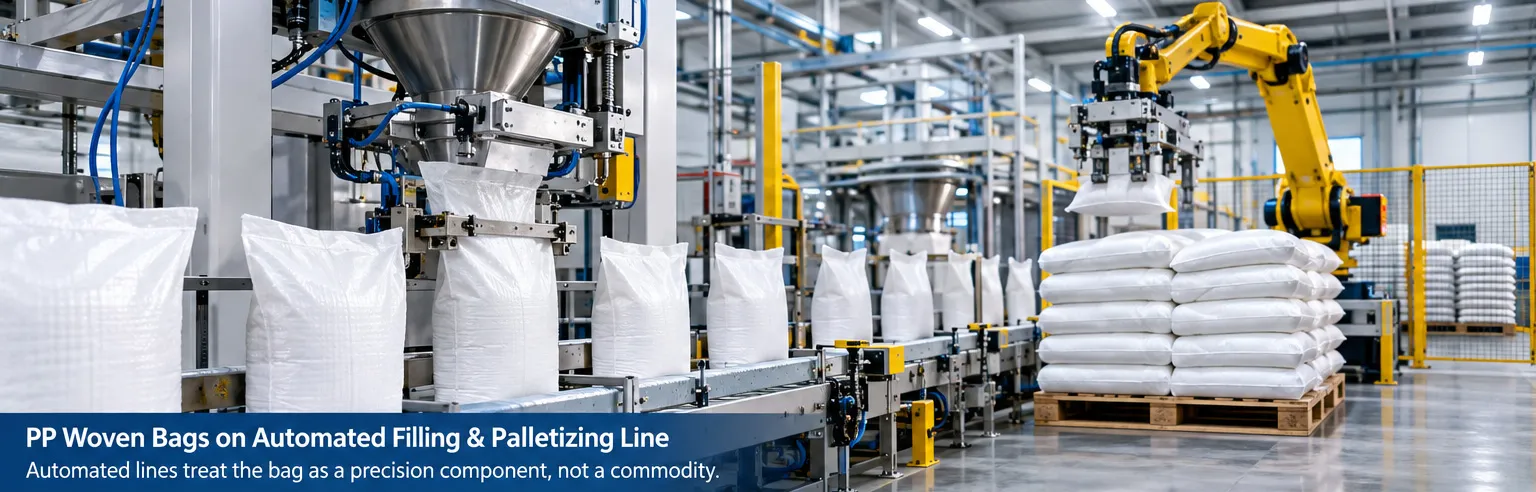
Cement plants, fertilizer blenders, and grain handlers are moving from manual scoop-and-sew lines to automated filling and palletizing. That shift changes what a PP woven bag must be. On a high-speed automated line, a bag is not a passive container — it is a component that has to seat, fill, seal, and stack within tight tolerances. This article focuses on the three specifications that most affect automated compatibility — dimensional tolerance, anti-skid surfaces, and micro-perforation — alongside how filling lines and closures shape the rest.
Quick Answer
For automated filling, specify PP woven bags with tight length/width/gusset tolerances (define the band per size with your equipment supplier), a controlled anti-skid (slip) surface, and intentional micro-perforation for fast air release during dense-product filling. These three variables strongly influence whether a line runs at rated speed or stalls on jams and bursts, though machine type, product flow, and closure method also matter.
Why Automated Filling Changes Bag Specs
A manual line tolerates variation: an operator tugs a skewed bag onto the spout and pads it by hand. An automated line — whether robotic, pneumatic, or mechanical — tolerates far less. If the bag mouth is off by a few millimeters, the spout misses; if the film or weave is too slick, the bag slides off the clamp; if the product is dense and the bag cannot vent, it balloons and bursts. HDIN Research’s 2026 outlook notes that buyers are shifting from “basic commodity sacks” to “highly engineered packaging,” and that automated filling investment is raising the bar on bag consistency.
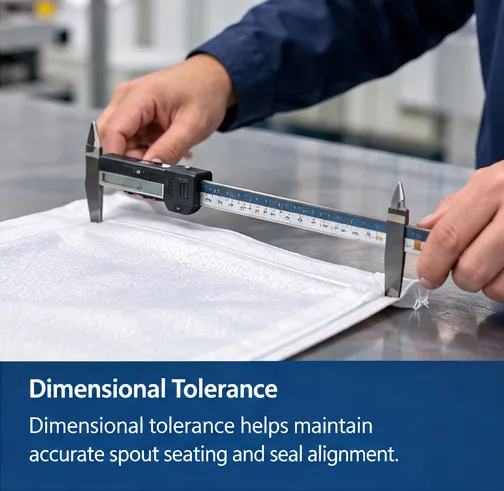
Dimensional Tolerance
Seat accuracy starts with geometry. Buyers should specify finished length, width, and gusset (if any) with an agreed tolerance band and how it is measured (flat lay vs filled). Tighter tolerance protects downstream steps: consistent top-edge height keeps heat-seal bars and sewing heads aligned, and consistent gusset depth keeps palletized stacks square. Expect tolerance to be discussed per size rather than as one global number; a 50 kg bag and a 5 kg bag have different practical bands.
Surface Friction and Anti-Skid Performance
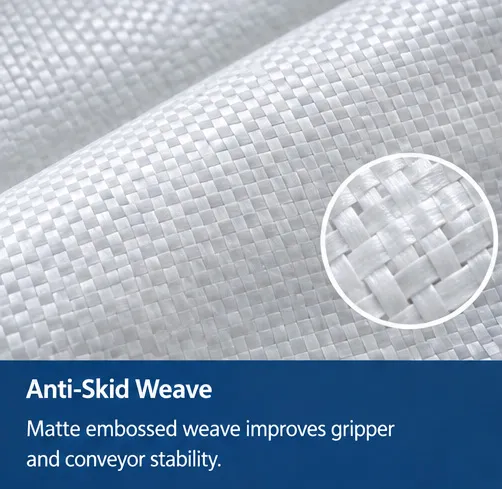
Slip is the silent killer of automated lines. A bag that slides in the clamp or on the conveyor causes misalignment, double feeds, and dropped stacks. Anti-skid is a controlled surface-friction property, achieved two ways: an embossed or matte finish on the woven fabric, or an applied coating. The trade-off is pallet stability versus film lamination — a heavily laminated glossy bag stacks beautifully but can be hard to grip; a matte embossed bag can grip well when its texture and coating are matched to the gripper, but may need a separate liner for moisture protection. Specify the slip requirement relative to the gripper type on your line.
Micro-Perforation (Air Release)
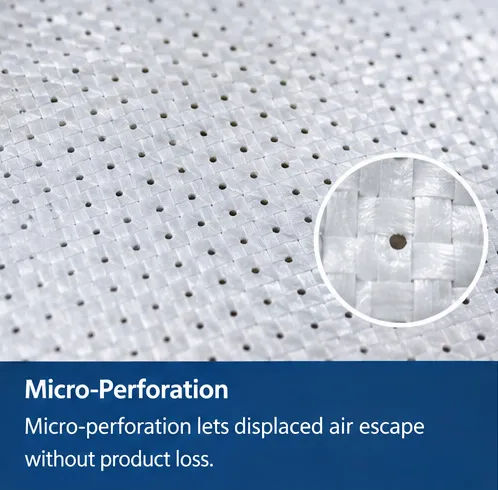
Dense, free-flowing products — cement, sand, resin pellet, rice — displace air as they fall. Without vents, that air pressurizes the bag, causing ballooning, seam stress, and dust at the spout. Micro-perforation (tiny, uniform holes sized for the product) lets air escape while retaining the product. The hole size and pattern must match the product’s particle size distribution, dustiness, and required permeability: too few and the bag balloons; too many and you lose product or invite moisture. For food and sensitive products, micro-perforation is often paired with a liner rather than used alone.
How Filling Lines Use the Bag
Two bag styles are commonly used on automated lines. Open-mouth bags are clamped, filled from the top, then sewn or heat-sealed — flexible and common for fertilizer and grain. Valve bags have a built-in sleeve that slides over the fill spout and is designed to close after filling, which is preferred for free-flowing powder and granular product because it can be cleaner and faster than an open mouth — though the exact closure depends on the valve construction. The bag style drives the spec: a valve bag needs a precisely located, consistently formed sleeve; an open-mouth bag needs a square, dimensionally stable top edge for the clamp. Robotic palletizers then demand predictable stack height and base rigidity, which loops back to tolerance and anti-skid.
Specification Sheet for Automated-Compatible Woven Bags
Put these items on the purchase order so the supplier quotes against a defined standard rather than a vague “strong bag”:
| Parameter | What to specify | Why it matters on the line |
|---|---|---|
| Finished dimensions | Length, width, gusset + tolerance band | Spout seating and seal-head alignment |
| Anti-skid | Surface type and target slip | Gripper and conveyor stability |
| Micro-perforation | Hole size, pattern, count | Air release without product loss |
| Fabric GSM | Target gram-per-square-meter | Burst strength and stack rigidity |
| Closure | Valve, sewn, or heat-seal | Matches the filling machine |
| Liner | With or without PE liner | Moisture and food-contact needs |
Common Failure Modes
- Spout miss / double feed: may result from off-tolerance top edge or inconsistent gusset.
- Bag slip in clamp: may result from an over-glossy or uncoated surface vs the gripper type.
- Ballooning and burst: may result from insufficient or wrong micro-perforation for the product.
- Dust at spout: may result from poor seam or liner fit during dense filling.
- Leaning pallet stacks: may result from variable bag height or weak base rigidity.
OEM Customization for Filling Equipment
Because the bag is part of the machine system, a practical sourcing path is OEM custom production against your filling line’s drawings: send the spout diameter, clamp geometry, target line speed, and product density, and request a matched sample for a run-off. A matched sample catches tolerance and slip problems before a full container ships. Working with a manufacturer that controls extrusion, circular-loom weaving, lamination, and conversion under one roof can shorten iteration versus a supplier that outsources those steps.
SITONG Manufacturing Capability
SITONG is a PP woven bags manufacturer with integrated extrusion, circular-loom weaving, lamination, printing, and bag-conversion lines across its Haicheng, Anshan (China) and Cambodia plants, in operation since 1998, with 20 production lines and capacity around 100 tons per day (about 30,000 tons per year), more than 900 employees, and shipments to over 70 countries through the port of Dalian. That vertical integration matters for automated-compatible bags: tolerance, anti-skid coating, and micro-perforation are process variables the supplier controls at the weaving, coating, and conversion stages, not afterthoughts. The company holds BRCGS, ISO 9001, ISO 14001, ISO 45001 (OHSMS), and OEKO-TEX certifications; certification registration numbers are not published and should be requested from the supplier during qualification.
Sourcing Checklist for Buyers
- Send the filling-line drawings: spout diameter, clamp geometry, target speed, product density.
- Define tolerance band per size and the measurement method (flat vs filled).
- State the gripper type so anti-skid surface is matched, not guessed.
- Specify micro-perforation hole size and pattern for the exact product.
- Request a matched sample and run-off before committing a full container.
- Confirm MOQ and lead time — SITONG’s standard PP woven runs commonly start around 10,000 pieces, with FIBC more flexible.
What Information Should You Send to a Manufacturer?
To get a matched sample quickly, send the filling-line drawings (spout diameter, clamp geometry, target line speed) and the product details (density, particle size, dustiness, moisture sensitivity). State the required tolerance band and measurement method, the gripper type for anti-skid, and the micro-perforation needs for the exact product. The more specific the brief, the faster a matched sample can be finalized before a full order.
Frequently Asked Questions
Specify finished length, width, and gusset with a per-size tolerance band (commonly define the band per size depending on bag size) and state whether it is measured flat or filled. The goal is consistent spout seating and seal-head alignment.
It is a controlled matte or embossed surface, or an applied coating, that raises grip so the bag does not slide in the clamp or on the conveyor. The right level depends on your gripper type.
Dense, free-flowing product displaces air as it falls. Micro-perforation lets that air escape so the bag does not balloon, stress its seams, or dust at the spout. Hole size must match the product.
Valve bags suit free-flowing powder and granules and run clean and fast on a spout. Open-mouth bags suit fertilizer and grain and are sewn or heat-sealed after filling. Choose based on your machine.
Yes, through OEM custom production against your line drawings plus a matched sample run-off. Integrated suppliers that control weave, coating, and perforation in-house can iterate quickly.
It can, which is why perforation is often paired with a PE liner for moisture-sensitive or food products. Specify liner requirement alongside perforation.
It depends on product weight and stack height; specify a target gram-per-square-meter so burst strength and stack rigidity meet line demands rather than guessing.
Conclusion
On an automated filling line, the PP woven bag is a precision component, not a commodity. Dimensional tolerance, anti-skid surface, and micro-perforation are the specifications that most influence line performance, and all three are set at the manufacturing stage. Buyers who specify them explicitly, request a matched sample, and source from an integrated PP woven bags manufacturer reduce the jams, bursts, and returns that vague “strong bag” orders create.
Source: HDIN Research, “Global Polypropylene Woven Bag and Sack Market Strategic Analysis and Commercial Outlook” (hdinresearch.com).