



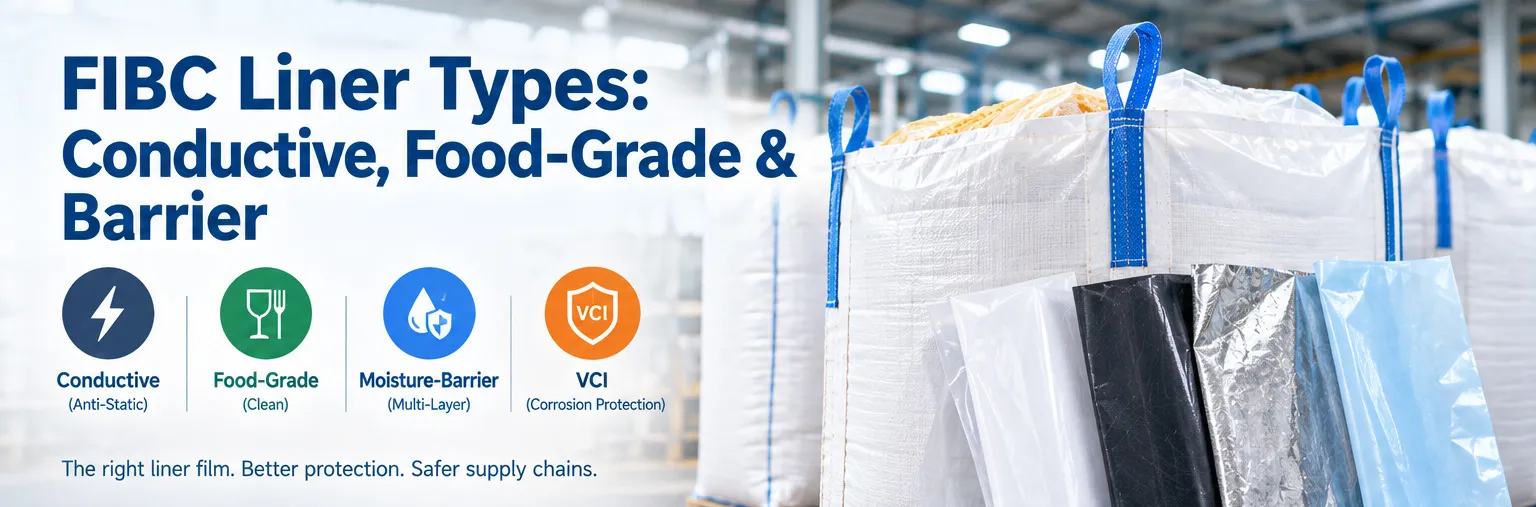
FIBC liner types influence how a bulk bag handles contamination, moisture, static and corrosion risks. The outer woven polypropylene shell gives a Flexible Intermediate Bulk Container its strength and shape, but the inner liner, the loose or form-fit film inserted inside, influences how the bag manages contamination, moisture, static and corrosion risks for products such as food powder, moisture-sensitive chemicals, flammable dusts or metal parts. Buyers specifying fibc liner types need to match the liner film to the product, the regulation and the handling environment rather than treat the liner as a generic plastic bag. This guide compares the four main FIBC liner categories and explains how to choose the right one.
FIBC Liner at a Glance
- Purpose: Protects the filler from contamination, moisture, static and corrosion
- Forms: Loose insert, form-fit (sewn to the bag), or integrated tubular liner
- Main families: Conductive/anti-static, food-grade/clean, moisture-barrier, VCI
- Standard link: Liner class connects to the FIBC static class (for example Type C)
- Typical materials: PE, PA, EVOH, aluminium-foil multilayer, conductive-grade film
What Is an FIBC Liner?
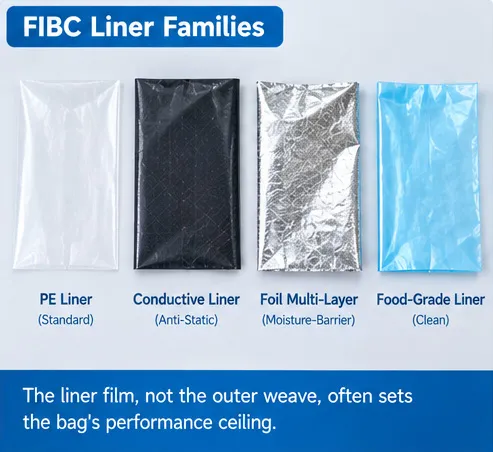
An FIBC liner is a thin plastic film placed inside the woven bulk bag to create a clean, sealed barrier between the bulk product and the permeable woven fabric. Woven PP alone lets fine powder sift through the interstices and lets humidity pass, so a liner can help manage contamination, fine-powder leakage or moisture exposure, but it is not required for every bulk material. Liners come as a loose bag dropped in before filling, a form-fit liner tailored to the bag’s dimensions, or a tubular liner integrated with the bag body.
A liner is selected for the product it protects, not for the weave it sits inside. The right liner class closes the gap between a strong bag and a safe, clean shipment.
The Four Main FIBC Liner Types
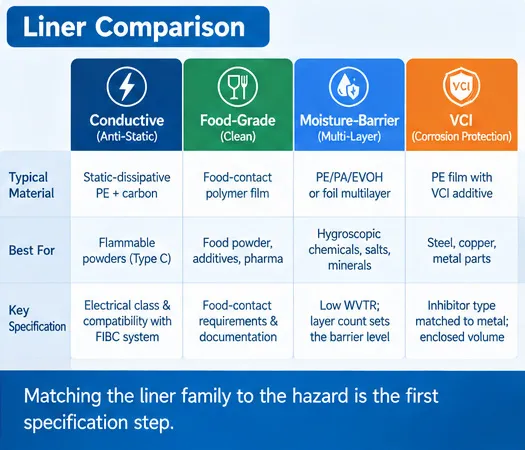
| Liner type | Typical material | Best for | Key specification |
|---|---|---|---|
| Conductive / anti-static | Static-dissipative PE with carbon or conductive masterbatch | Flammable powders in Type C FIBC | electrical classification and compatibility with the tested FIBC system; typical resistance ranges vary by construction and test method |
| Food-grade / clean | suitable food-contact polymer film, with controlled conversion | Food powder, additives, pharma | applicable food-contact requirements and supporting documentation |
| Moisture-barrier | PE/PA/EVOH or aluminium-foil multilayer | Hygroscopic chemicals, salts, minerals | Low WVTR; layer count sets the barrier level |
| VCI (volatile corrosion inhibitor) | PE film emitting corrosion inhibitor | Steel, copper, metal parts | Inhibitor type matched to metal; enclosed volume |
Key takeaway: The four fibc liner types solve four different problems: static, contamination, moisture and corrosion. A single bag rarely needs all four, but the wrong liner choice can reduce the protection the outer bag is designed to provide.
Conductive and Anti-Static Liners
For combustible powders handled in Type C FIBC, the liner configuration must be compatible with the bag’s grounding system. IEC 61340-4-4:2018 classifies inner liners and defines which liner grades may be used with which FIBC static class, including the L1 and L1C conductive-liner configurations for Type C. A standard non-conductive PE liner inside a Type C bag can isolate the product from the bag’s conducting structure and undermine the electrostatic-control design. Buyers should request the liner’s electrical classification and confirm that the supplied liner matches the tested FIBC configuration.
Food-Grade and Clean-Room Liners
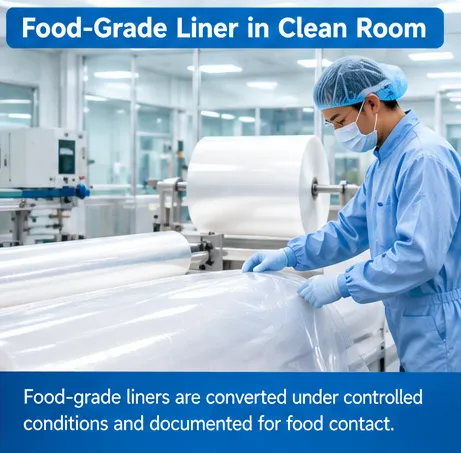
Food-contact applications require liner materials, additives and manufacturing controls suitable for the intended product and destination market. In the United States, applicable FDA food-contact provisions may include 21 CFR 177.1520 for certain olefin polymers; in China the GB 4806 framework applies. The relevant regulation should be confirmed for the actual liner construction. Clean-room conversion reduces particulates and foreign matter, and some suppliers offer foil or multilayer liners that also deliver a strong moisture barrier for sensitive food ingredients. For agriculture and food export, the liner is part of the brand’s food-safety file, not an optional extra.
Moisture-Barrier Liners
Hygroscopic products, salt, mineral powders, some fertilizers and food ingredients, absorb humidity through a single-layer PE liner. Moisture-barrier liners use multilayer co-extrusion, often pairing PE with PA, EVOH or aluminium foil, to drive the water-vapour transmission rate (WVTR) down. For long ocean routes through hot, humid lanes, a five-layer co-extruded or foil liner extends shelf life and protects the filler from caking. The trade-off is cost and rigidity: higher barrier means a thicker, less flexible film.
VCI Liners for Metal Parts
VCI (volatile corrosion inhibitor) liners create a corrosion-protective atmosphere around compatible metal products inside an enclosed package, protecting steel, copper and alloy parts from rust during storage and shipping. They are common for hardware, machined components and metal powders packed in FIBC. The inhibitor chemistry must match the metal, and the bag should be reasonably sealed so the vapour concentrates around the product.
How to Choose the Right FIBC Liner
Specifiers should work through the product hazard first, then the regulation, then the supply chain:
- Product sensitivity: Does it need anti-static, moisture, food-contact or corrosion protection?
- Regulation: Food contact (FDA/GB 4806), dangerous goods (UN marking), or electrostatic class (IEC 61340-4-4)?
- Handling: Will the bag be grounded (Type C) or used ungrounded (Type D)? The liner configuration should be compatible with the FIBC static class.
- Barrier level: Pick the layer count that meets the WVTR target without over-specifying cost.
- Form: Form-fit liners reduce film movement and wrinkles; loose liners are cheaper and easier to change.
How Liner Choice Affects Cost and Lead Time
Multilayer and foil liners cost more and need longer conversion lead times than plain PE. Conductive and food-grade liners add documentation and qualification steps. Buyers who lock the liner specification early avoid late changes that delay the whole FIBC order. For recurring volumes, sourcing the outer bag and the matched liner from one supplier keeps the qualification and the responsibility in one place.
Sourcing FIBC with Matched Liners
When a product needs more than a basic PE insert, treat the bag and liner as one qualified system. A qualified FIBC bulk bag manufacturer can supply the outer bag, the matched liner grade and the combined test documentation. For food applications, review the supplier’s food-grade FIBC compliance and liner food-contact status together. Where the bag must be grounded for combustible powder, align the liner with the Type C grounding and liner requirements so the complete system is documented and auditable.
Specification Checklist
Use this checklist when briefing a supplier or comparing options. Confirm each point against the actual product and supply chain rather than a single headline claim.
| Spec to confirm | What to verify | Why it matters |
|---|---|---|
| Product risk | List moisture, static, food-contact and corrosion exposure | One liner rarely covers every risk; match to the highest one |
| Barrier build | PE film thickness or multi-layer construction | Transmission rates scale with the build, not the label |
| Food contact | Applicable food-contact statement for the target market | Requirements differ by region and application |
| Anti-static | Conductive type and grounding method used with the FIBC system | Type C needs a verified bonding path; do not treat liner alone as protection |
| VCI | Compatibility with the metal and any coating | VCI supports corrosion control within a sealed atmosphere, not a standalone barrier |
| Supplier records | Test or qualification documents, not a marketing claim | Supports audit and traceability |
Frequently Asked Questions
The four main FIBC liner types are conductive/anti-static, food-grade/clean, moisture-barrier, and VCI (volatile corrosion inhibitor). Each protects against a different hazard: static, contamination, moisture or corrosion.
Not by itself. A non-conductive PE liner can affect the grounding path of a Type C bag. IEC 61340-4-4:2018 defines conductive-liner grades (such as L1 and L1C) that must be matched to the bag’s static class and tested as part of the complete system.
Food-contact liners use materials and additives suitable for the intended application and are produced under appropriate manufacturing and cleanliness controls. In the United States, applicable FDA food-contact provisions may include 21 CFR 177.1520 for certain olefin polymers; in China the GB 4806 framework applies. Buyers should request the applicable food-contact declaration and supporting documentation.
Use a moisture-barrier liner for hygroscopic products, salt, mineral powders, some fertilizers and sensitive food ingredients, especially on long, humid ocean routes. Multilayer PE/PA/EVOH or foil constructions lower the water-vapour transmission rate.
A VCI liner releases a corrosion inhibitor that protects steel, copper and other metal parts from rust inside the bag. It is used for hardware, machined components and metal powders, with the inhibitor matched to the metal.
Yes. Multilayer, foil, conductive and food-grade liners cost more and need longer lead times than plain PE. Specifying the liner early avoids late changes that delay the whole order.
For demanding applications it helps. Sourcing the outer bag and the matched liner from one supplier keeps the qualification, the test documentation and the responsibility in one place, which simplifies audits.
Keep the liner’s class or food-contact status and its test or qualification document together with the FIBC specification in the product master data, and require both from the supplier at qualification.
Share the product, fill weight, target safety factor, required barrier (moisture, static, food contact, corrosion), print and documentation needs, and the port or incoterm. Ask for test or qualification records rather than a headline claim so the quote reflects a spec you can audit.
Conclusion
FIBC liner types define the real performance ceiling of a bulk bag: the outer weave gives strength, but the liner decides whether the product stays safe, dry, clean and compliant. Buyers should match the liner family, conductive, food-grade, moisture-barrier or VCI, to the product hazard and the applicable standard, qualify the bag and liner as one system, and keep the liner documentation with the FIBC specification for audit.