



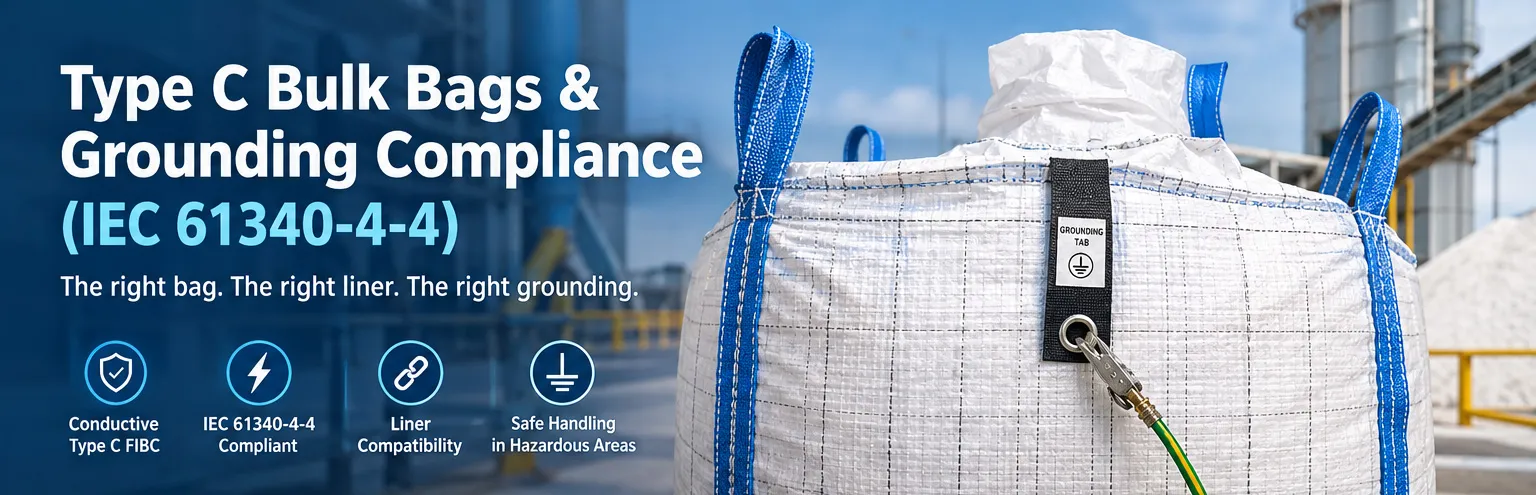
Polypropylene woven Type C bulk bags are widely used for combustible powders in chemical, mineral and other hazardous-area applications, but their electrostatic protection depends on a verified grounding path and correct operating procedures. IEC 61340-4-4:2018 also classifies inner liners and specifies how compatible liner configurations are used with Type C FIBC. The key procurement issue is therefore not simply whether a liner is “plastic” or “conductive,” but whether the selected liner and bag combination has been tested and documented for the intended application. This guide explains how Type C FIBC work, what IEC 61340-4-4 requires, and how to specify a bag-and-liner system that actually performs.
Type C FIBC at a Glance
- Static-control method: Conductive structure connected to earth
- Grounding: Required during filling and emptying
- Maximum resistance to designated earth bonding point: 1 × 10^8 Ω (100 MΩ)
- Standard: IEC 61340-4-4:2018
- Liners: Must match the applicable IEC classification and FIBC configuration
- Typical applications: Combustible powders, mineral materials, chemical powders and other bulk products handled in hazardous-area conditions
What Is a Type C Bulk Bag?
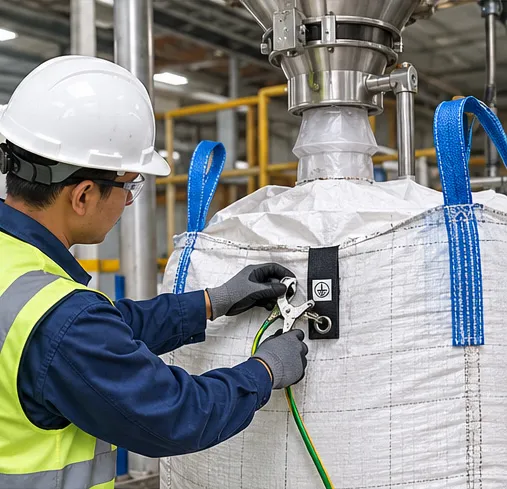
A Type C bulk bag is a conductive FIBC designed with conductive fabric, conductive plastic components, or fully interconnected conductive threads or filaments. The conductive structure is connected to one or more designated earth bonding points so electrostatic charge can be dissipated when the bag is properly grounded. Type C FIBC are intended to be connected to earth before filling and to remain grounded during filling and emptying operations. Type C is one of the main electrostatic-control designs available for anti-static bulk bags used in hazardous-area applications.
Type C FIBC are designed to control electrostatic ignition risk through a conductive structure connected to earth during filling and emptying operations.
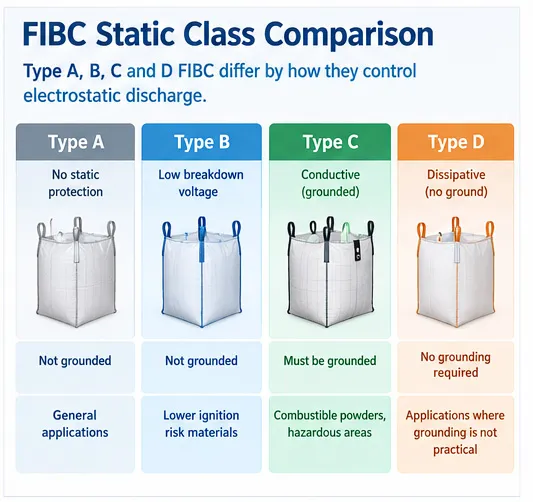
Type C sits alongside three sibling designs in the standard FIBC classification: Type A (no static protection), Type B (low breakdown voltage, no propagating brush discharge, still ungrounded) and Type D (static-dissipative, safe without grounding through controlled corona discharge). The choice depends on the dust’s minimum ignition energy and the site’s zone classification. When comparing the main types of FIBC bags, buyers should look at how each design controls electrostatic charge and whether grounding is required.
What IEC 61340-4-4 Means for Type C FIBC
IEC 61340-4-4 sets the test methods used to verify the electrostatic properties of flexible intermediate bulk containers, including surface resistance and the resistance of the bag’s conducting system to ground. Under the current edition (IEC 61340-4-4:2018), a compliant conductive system must present a continuous path to ground with resistance not exceeding 1×10^8 ohms. For Type C FIBC, the resistance-to-ground requirement is one of the key electrical performance criteria, but compliance also depends on the bag construction, liner configuration, designated bonding points and safe-use procedures.
IEC 61340-4-4:2018 provides the classification, test methods, design requirements and type-qualification framework for FIBC and their inner liners. For Type C FIBC, the resistance between the conductive or dissipative structure and the designated earth bonding point must remain within the specified maximum limit of 1 × 10^8 Ω (100 MΩ). Buyers should therefore request the applicable test or type-qualification documentation and verify that the tested FIBC configuration matches the production design and liner configuration. For sites inside the European Union, the ATEX directive 2014/34/EU governs equipment placed in explosive atmospheres, so the bag’s static class becomes part of the plant’s zone-risk file.
IEC 61340-4-4 provides the FIBC electrostatic classification and test framework, but it does not replace a site-specific hazardous-area risk assessment, operating procedure or applicable local regulatory requirements.
Why Liner Compatibility Matters for Type C FIBC
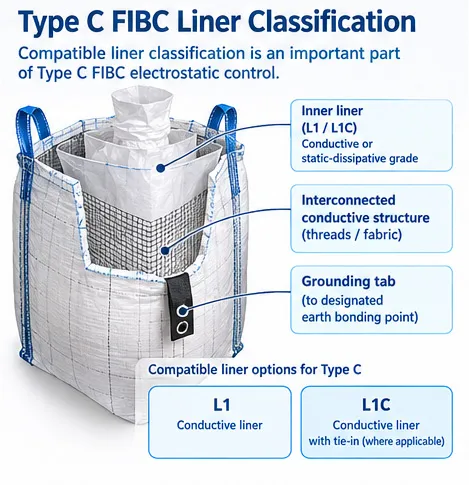
An inner liner can affect the electrostatic performance of a Type C FIBC, so it should be evaluated as part of the complete bag configuration rather than selected only by its base polymer. IEC 61340-4-4:2018 classifies inner liners and defines requirements for their use with different FIBC types, including Type C configurations. The relevant question is therefore whether the selected liner has the electrical characteristics and configuration required for the tested FIBC system, not simply whether the liner is made from PE or another plastic.
Buyers should request the applicable liner classification, electrical test or qualification documentation, and confirmation that the liner supplied matches the FIBC configuration that was tested. This avoids treating the outer Type C bag and its liner as unrelated components and helps ensure that the complete system is suitable for the intended hazardous-area application.
Type C vs Type D Bulk Bags
| Feature | Type C (conductive) | Type D (dissipative) |
|---|---|---|
| Static control method | Grounded conducting network | Controlled static dissipation, no ground |
| Operator action | Must bond to earth each cycle | No grounding required |
| Failure mode | Protection is compromised if required grounding is not maintained or the FIBC/liner configuration is not suitable | Performance depends on the specified Type D material, application conditions and safe-use requirements |
| Typical use | Combustible powders and hazardous-area bulk handling where grounding can be reliably maintained | Applications where the specified Type D construction is suitable and conventional grounding is not relied upon |
Key takeaway: Type C and Type D FIBC control electrostatic ignition risk in different ways. Type C uses a conductive or interconnected conductive structure that must be connected to earth during filling and emptying. Type D uses specially designed static-dissipative materials to control electrostatic discharge without relying on a conventional grounding connection. The correct choice depends on the material, hazardous-area conditions, FIBC design and operating procedure rather than on grounding convenience alone.
How to Specify a Compliant Conductive FIBC
Buyers should treat the bag and liner as one system and request evidence for each point below:
- Conductive structure: Verify that the conductive fabric, threads, tapes or other conductive elements meet the applicable IEC 61340-4-4 requirements and provide the required resistance to the designated earth bonding point.
- Grounding tab: accessible, identified, and compatible with site bonding clamps.
- Liner class: conductive or static-dissipative grade documented to match the bag, not a generic PE film.
- Test and qualification documentation: Request the applicable IEC 61340-4-4 test or type-qualification documentation and confirm that the tested FIBC configuration matches the production design and liner configuration.
- Application match: for dangerous goods, confirm the applicable UN IBC design type and performance marking rather than assuming that a particular static-control class determines the UN code. Flexible woven-plastic IBCs may use codes such as UN 13H1, 13H2, 13H3 or 13H4 depending on their construction, while 13H5 identifies a plastic-film IBC. Composite codes such as 31HA1 belong to a different IBC construction category.
Common Grounding Failures Buyers Overlook
- Ungrounded during transit: a bag grounded at the plant can be lifted, dragged and filled elsewhere with the tab never bonded.
- Damaged or painted tab: coating or fraying on the grounding point raises resistance above the limit.
- Wrong clamp: a clamp that bites only webbing, not the conductive yarn, measures a false pass.
- Liner mismatch: selecting an inner liner without verifying its electrical classification and compatibility with the Type C FIBC can undermine the intended electrostatic-control design. The liner specification should therefore be included in the same qualification and purchasing documentation as the FIBC itself.
Incoming Inspection for Conductive FIBC
Importers receiving Type C bulk bags should add a receiving check to the quality plan: confirm that the designated grounding point is present and undamaged, verify the supplier’s applicable electrostatic test or qualification documentation, and check that the supplied liner configuration matches the approved product specification. Keeping the FIBC documentation and liner specification together helps auditors and purchasing teams verify that the supplied configuration matches the qualified design.
Sourcing Type C Bulk Bags for Combustible Powders
For buyers sourcing Type C bulk bags for mining, chemical powders or new-energy materials, supplier qualification should cover the complete FIBC configuration rather than the outer bag alone. Ask for the applicable electrostatic test or qualification documentation, liner specification, grounding-point details and UN documentation where dangerous-goods transport applies. A qualified FIBC bulk bag manufacturer can support the technical documentation required for the intended application. For mineral handling, FIBC bags for mining can combine appropriate electrostatic-control options with the abrasion resistance and lifting performance required for bulk solids. UN-certified bulk bags may be required for regulated dangerous-goods transport, but UN performance approval and Type C electrostatic classification address different requirements. Buyers running private-label programs can also include the FIBC and liner specifications in custom FIBC OEM and private-label programs.
Frequently Asked Questions
Type C FIBC use an interconnected conductive structure that must be grounded during filling and emptying operations. Type D FIBC use specially designed static-dissipative materials to control electrostatic discharge without relying on a conventional grounding connection. The two types therefore use different electrostatic-control principles and must be selected according to the material, hazardous-area conditions, FIBC design and operating procedures.
Yes. Type C FIBC are designed to be grounded during filling and emptying operations so that electrostatic charge can be dissipated through the conductive structure. The grounding connection must remain within the applicable resistance limit, and the bag should be used according to the manufacturer’s instructions and the site’s hazardous-area procedures.
Do not select a liner based only on the fact that it is made from PE. IEC 61340-4-4:2018 defines specific liner classifications and permissible FIBC-liner combinations, including L1 and L1C configurations for Type C FIBC. The liner should therefore be specified and tested as part of the complete Type C system, with its electrical properties and connection to the bag’s designated earth bonding system documented where required.
IEC 61340-4-4:2018 specifies a maximum resistance to the designated earth bonding point of 1 × 10^8 Ω (100 MΩ) for Type C FIBC. The resistance requirement is only one part of compliance; the FIBC construction, grounding points, liner configuration and safe-use procedures also need to be appropriate for the intended application.
IEC 61340-4-4 is an international standard that specifies FIBC electrostatic classification, test methods, design requirements, safe-use provisions and type-qualification procedures. It is not simply a standalone product certificate. Buyers should request the applicable test or qualification documentation and verify that the tested FIBC and liner configuration matches the product being supplied.
Chemical powders, mineral concentrates, pigments, food-grade flammable dusts and battery-material intermediates are common users, wherever a flammable atmosphere and a low minimum ignition energy make grounded handling mandatory.
Not automatically. UN certification and electrostatic classification address different requirements. A dangerous-goods shipment may require a UN-tested and marked IBC design, while the choice between Type A, B, C or D depends on the electrostatic hazards of the material and the operating environment. Where combustible dusts or flammable atmospheres are present, the FIBC static classification should be selected as part of the site’s hazardous-area risk assessment.
Keep the bag’s electrostatic test or qualification documentation and the liner’s conductive-grade specification together in the product master data, and require both from the supplier at qualification so auditors see the complete system.
Conclusion
Type C bulk bags provide electrostatic protection through a defined conductive system that must be correctly grounded during hazardous material handling. For buyers, the safest approach is to qualify the complete FIBC configuration—including the bag construction, designated bonding points, inner liner where applicable, test documentation and operating procedures—rather than evaluating the outer bag alone. IEC 61340-4-4:2018 provides the technical framework for this assessment and sets the Type C resistance-to-ground limit at 1 × 10^8 Ω.