

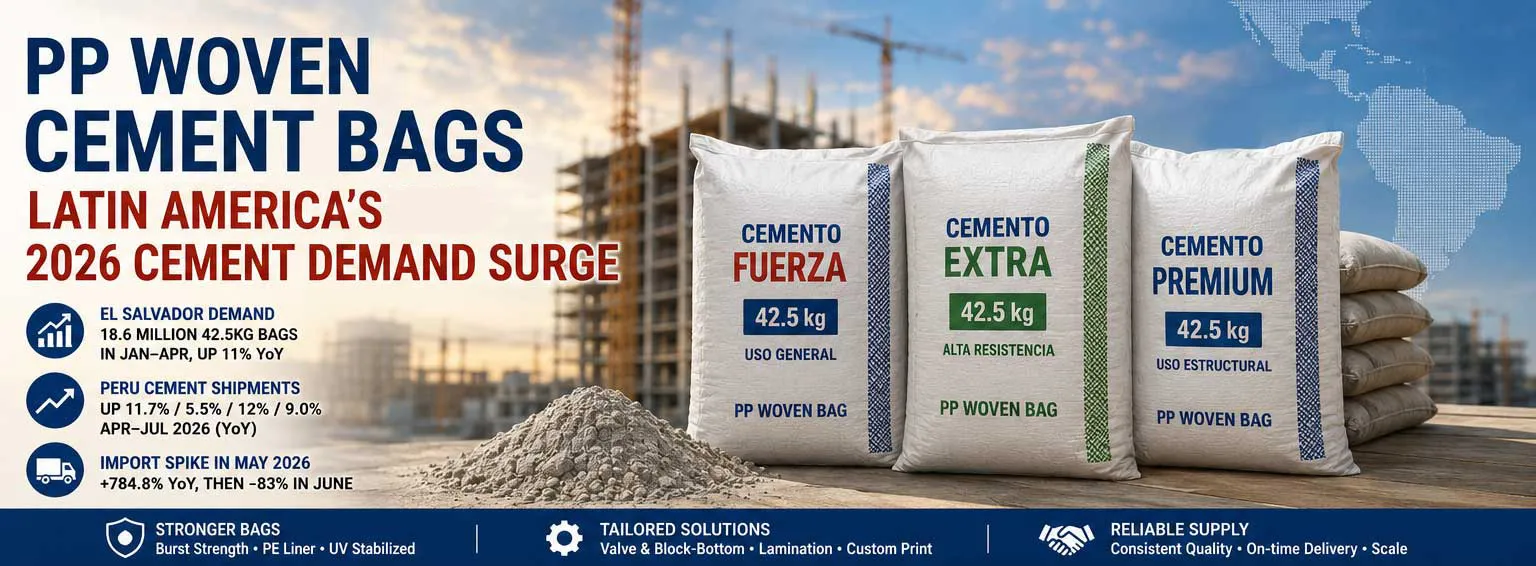
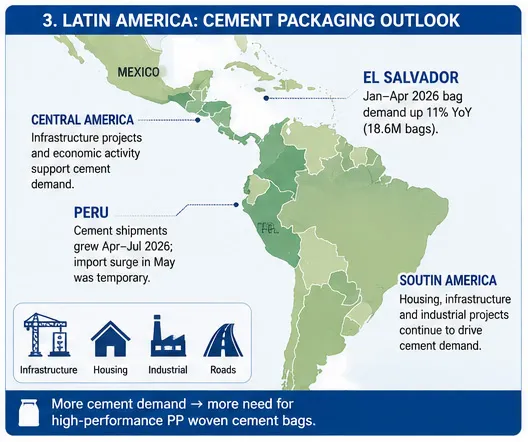
Latin American cement demand shows positive 2026 signals in the two markets examined here, El Salvador and Peru, although these markets should not be treated as a proxy for the entire region. El Salvador recorded demand for 18.6 million 42.5 kg PP woven cement bags in January-April, up about 11% year on year, while Peru reported year-on-year growth in cement dispatches through April-June. For PP woven cement bags buyers, these indicators support closer monitoring of packaging demand, but actual bag requirements still depend on cement shipment volumes, pack formats, filling systems and inventory cycles.
Quick Answer: El Salvador and Peru show positive 2026 cement-demand and shipment signals, but these two markets should not be treated as a complete measure of Latin American demand. For buyers sourcing PP woven cement bags, the key procurement factors are bag weight and strength, PE liner requirements, UV exposure, valve or block-bottom format, lamination, printing, filling-line compatibility and supply capacity.
When cement shipments increase, packaging requirements can increase as well, but the relationship depends on the cement pack format, filling system, bag weight and distribution model used by each producer.
The Demand Evidence: El Salvador and Peru
| Market / period (2026) | Signal |
|---|---|
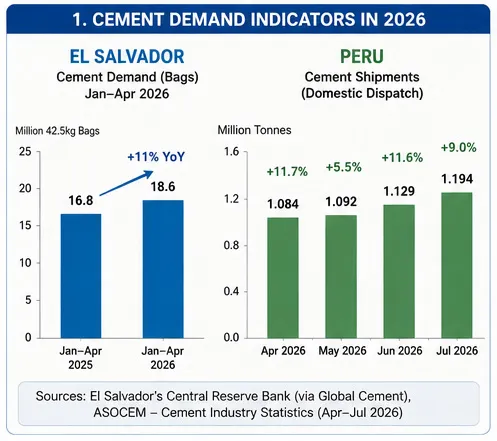
| El Salvador, Jan-Apr | Cement demand equivalent to 18.6 million 42.5 kg bags, +11% YoY (Central Reserve Bank data, as reported by Global Cement) |
| El Salvador, April | Construction activity +14% month-on-month (per El Salvador’s Central Reserve Bank, via Global Cement) |
| Holcim El Salvador (Maya plant) | Cement output +45% YoY (per Holcim El Salvador, reported by Global Cement) |
| Peru, April shipments | +11.7% YoY (per ASOCEM) |
| Peru, May shipments | +5.5% YoY (per ASOCEM) |
| Peru, June shipments | +11.6% YoY; domestic dispatches about 1.129 Mt (per ASOCEM) |
| Peru, July shipments | +9.0% YoY; domestic dispatches about 1.194 Mt (per ASOCEM) |
ASOCEM reports Peru’s domestic cement dispatches at about 1.084 Mt in April, 1.092 Mt in May, 1.129 Mt in June and 1.194 Mt in July 2026; figures are presented per market and should not be read as a full Latin American total.
Peru’s cement imports surged 784.8% year on year in May 2026 to about 75,529 t, with Vietnam accounting for the largest share of reported import flows, before imports fell 83.0% year on year to about 12,014 t in June. The May spike indicates a temporary change in Peru’s cement trade flow, but it should not be treated by itself as proof of a persistent domestic supply gap or a permanent increase in imported packaging demand.
How Cement Shipment Growth Affects PP Woven Cement Bags Demand
PP woven cement bags are heavy-duty polypropylene bags designed to package, fill, transport and stack cement. Depending on the filling system and distribution conditions, they can be supplied with valve or block-bottom construction, PE liners, UV stabilisation, lamination and customised printing.
Cement is a major application for PP woven bags in construction-material packaging. El Salvador’s reported cement demand equivalent to 18.6 million 42.5 kg bags in January-April illustrates the potential packaging scale of a growing cement market, while actual PP woven cement bag requirements vary with pack size, filling method, product mix and distribution practices.
PP Woven Cement Bags Specifications for Latin American Markets
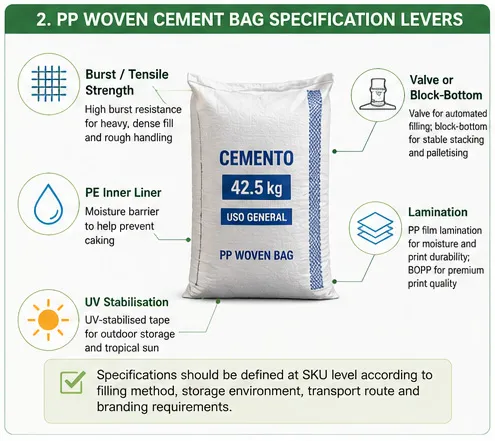
Latin American cement packaging requirements vary by country, storage environment, transport route and filling system. Buyers may need to address humidity, rainfall, solar exposure, temperature changes, outdoor storage and long-distance transport, so the appropriate combination of bag strength, PE liner, UV stabilisation, valve or block-bottom construction and lamination should be defined at SKU level.
- Burst and tensile strength. PP Woven cement bags need sufficient resistance to filling, dropping, stacking and transport. Specify the required bag weight, fabric GSM, tensile strength, burst test method and minimum acceptance value at SKU level rather than using a general “high-strength” requirement.
- PE inner liner. A PE inner liner can provide an additional moisture barrier where cement is exposed to humid storage, condensation or moisture-sensitive transport conditions; buyers should specify liner material, thickness or construction and acceptance criteria according to the actual storage and handling environment.
- UV stabilisation. For bags exposed to prolonged outdoor storage or strong solar radiation, buyers can specify UV-stabilised PP tape and define the required exposure condition and test method. UV stabilisation should be specified where the actual storage environment requires it rather than as a default requirement for every PP woven cement bags.
- Valve or block-bottom construction. Valve and block-bottom constructions should be selected according to the filling equipment, bag handling process and palletisation requirements; for automated cement filling, valve construction can support efficient filling, while block-bottom construction can improve bag shape and stacking performance.
- Lamination and printing. Lamination can improve surface protection, moisture resistance and print durability. Standard PP-film lamination can suit basic protection requirements, while BOPP lamination is an optional higher-graphics solution for cement brands that place greater emphasis on print quality, colour reproduction and visual presentation.
Terminology note: GSM (grams per square metre) is fabric mass per unit area, not strength. Tensile strength is measured under a tensile test; burst resistance is measured under a specified burst test. “High-strength/lightweight” is a commercial positioning claim that needs supporting SKU-level data, so specify the test method and acceptance for the actual bag.
| Spec lever | Why it matters for cement |
|---|---|
| Burst strength | Heavy, dense fill; drop and stack survival |
| PE liner | Moisture barrier against caking |
| UV stabiliser | Outdoor storage and solar exposure |
| Valve / block-bottom | Filling-line and pallet efficiency |
| Lamination | Moisture + brand print durability |
Key Takeaway: The right PP woven cement bags specification is determined mainly by four factors: the filling system, moisture exposure, storage and transport conditions, and printing requirements. Define these factors at SKU level instead of using a generic “cement bag” specification.
Sourcing Implications for the Region
For a PP woven bags manufacturer targeting cement packaging buyers in Latin America, the 2026 indicators from El Salvador and Peru support closer attention to volume planning, climate-specific SKUs, filling-line compatibility, printing requirements and production capacity.
- Annual or multi-month framework agreements with cement producers and building-material distributors can help coordinate volume, specifications and delivery schedules, provided that forecast demand, MOQ, lead time, print approval, QC requirements and backup capacity are agreed before contracting.
- Condition-specific SKUs — specify laminated, PE-lined or UV-stabilised bags where the actual storage, transport or outdoor-exposure conditions require them, while selecting valve or block-bottom construction according to the filling and palletisation system.
- Brand-grade printing — laminated or BOPP-printed sacks for cement brands that need clear product identification, consistent brand presentation and durable graphics during storage, handling and distribution.
The May 2026 increase in Peru’s cement imports shows a temporary change in cement trade flows; for bag suppliers, this may create sourcing opportunities only where local bag availability, filling requirements, logistics and buyer qualification requirements support imported packaging.
Key Takeaways
- 2026 cement demand indicators are positive in the two markets examined here: El Salvador recorded 18.6 million 42.5 kg bags demanded in January-April, up 11% year on year, while Peru recorded year-on-year growth in cement dispatches from April through July.
- Latin America represents a relevant market opportunity for suppliers of PP woven cement bags, but country-level demand, packaging formats, logistics and buyer qualification requirements should be assessed separately.
- Cement shipment growth can support additional cement-bag demand, but the actual requirement depends on pack size, bulk-versus-bagged sales, filling systems, inventory and distribution practices.
- PP Woven cement bags specifications should reflect local environmental and operational conditions, with burst strength, PE liner, UV stabilisation, valve or block-bottom construction and lamination selected according to the SKU and use case.
- The May 2026 increase in Peru’s cement imports reflects a temporary trade-flow change; bag suppliers should evaluate local availability, filling requirements, logistics and buyer qualification before treating it as a sourcing opportunity.
For buyers sourcing PP woven cement bags in Latin America, the practical approach is to define bag weight, dimensions, strength, liner, UV protection, filling format, lamination and printing requirements at SKU level. Then evaluate suppliers on specification compliance, test and QC documentation, production capacity, MOQ, lead time, print approval and delivery reliability. Explore our PP woven bags for the full product and sourcing range.
Sources and Methodology
The market data in this article are based on publicly reported 2026 statistics from El Salvador’s Central Reserve Bank as reported by Global Cement, and monthly cement-industry statistics from Peru’s Asociación de Productores de Cemento (ASOCEM). Country-level figures are presented separately and should not be interpreted as a complete measure of Latin American cement demand.
Data period: the figures in this article refer to publicly reported January-July 2026 statistics (El Salvador Central Reserve Bank via Global Cement; Peru ASOCEM monthly statistics).
Frequently Asked Questions
A cement-bag RFQ should define bag weight and dimensions, fabric GSM, tensile and burst test methods, PE liner requirements, UV stabilisation where applicable, valve or block-bottom construction, lamination and printing, MOQ, lead time, print approval, QC documentation and SKU-level acceptance criteria.
Cement demand matters to PP woven bag suppliers because bagged cement requires packaging capacity, but the relationship is not one-to-one: required bag volume depends on pack size, bagged-versus-bulk sales, filling equipment, inventory and distribution practices.
There is no single specification for all Latin American PP woven cement bags. Buyers should select burst and tensile requirements, PE liner, UV stabilisation, valve or block-bottom construction and lamination according to the local climate, storage conditions, filling system, transport route and branding requirements.
Peru’s cement imports reached about 75,529 t in May 2026, up 784.8% year on year, before falling to about 12,014 t in June. The available ASOCEM data show a sharp but temporary change in import flows, with Vietnam accounting for the largest reported source share in May; the data do not by themselves establish a single long-term cause.
Neither format is universally better. Valve construction is commonly selected when automated filling and fast bag handling are priorities, while block-bottom construction can improve bag shape and palletisation; the correct choice depends on the cement producer’s filling and distribution system.
Laminated printed sacks can be useful when moisture protection, surface durability and brand presentation are important. Standard PP-film lamination suits basic protection needs, while BOPP laminated printing can be considered when higher-resolution graphics and stronger visual branding are required.
For larger cement-bag programs, buyers can use framework agreements or scheduled releases to coordinate volume, specifications and delivery capacity, while defining MOQ, lead time, QC acceptance, print approval and backup production requirements in advance.