




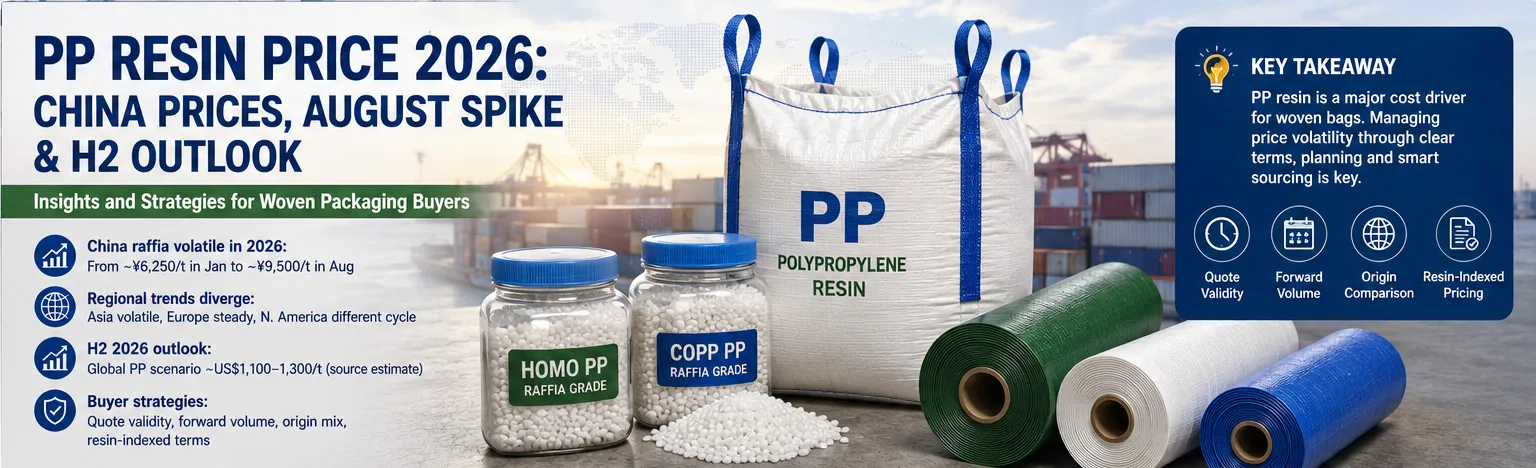
Polypropylene (PP) resin is one of the largest raw-material cost components in woven PP bags, FIBC bulk bags and PP woven fabric, and its price can materially affect supplier quotations. In 2026 the resin market has been anything but calm: a geopolitical shock drove a first-half spike in China, and an August 2026 spot surge pushed raffia grades to roughly ¥9,500/t (+35% year-on-year, per Polymerupdate), while Europe held steady and North America diverged. This PP resin price 2026 overview consolidates figures from CCFGroup, SCI99, Polymerupdate, ICIS/Platts/S&P Global and regional securities research, and translates the volatility into practical guidance for importers and buyers of woven packaging.
Quick Answer: China PP raffia prices were highly volatile in 2026, rising from roughly ¥6,250/t in early January to nearly ¥9,850/t around the H1 peak before easing and strengthening again. By early August, market references reached approximately ¥9,500/t. For woven-bag buyers, the practical response is to set clear quote-validity periods, compare delivered costs by origin, pre-book critical volume and consider resin-indexed pricing rather than relying on spot-price timing alone.
For woven-bag buyers: PP resin price movements matter because raffia-grade polypropylene is the primary polymer feedstock used to make woven tape. When resin prices rise sharply, suppliers may need to revise bag quotations, but the final impact depends on fabric weight, bag construction, conversion cost, printing, lamination, freight, exchange rates and commercial terms. The best purchasing response is not to predict the exact resin bottom, but to define a clear resin-price basis and quotation mechanism.
PP Resin Price 2026 at a Glance
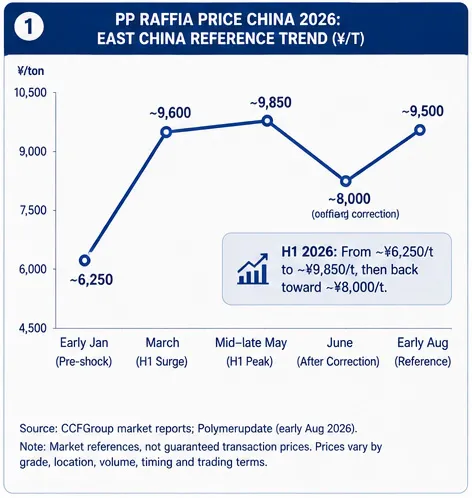
China PP raffia prices moved through several distinct levels during 2026. The following figures are market references rather than guaranteed transaction prices and may vary by grade, location, timing and trading terms.
- Early January 2026: approximately ¥6,250/t in the cited East China reference.
- March 2026: approximately ¥9,600/t during the H1 surge.
- May 2026: approximately ¥9,850/t around the cited H1 peak.
- June 2026: approximately ¥8,000/t in the article’s reference point, while CCFGroup reported mainstream East China homo PP raffia offers around ¥9,700–9,850/t on June 12.
- Early August 2026: approximately ¥9,500/t in the cited Polymerupdate reference.
- H2 2026 scenario: approximately US$1,100–1,300/t in the cited market analysis, treated as a scenario rather than consensus.
PP (polypropylene) resin is the raw polymer pellet that, after extrusion into tape, becomes the woven fabric in every PP bag, FIBC and fabric roll; raffia grade is the tape-extrusion grade used for woven packaging.
How PP Resin Price Affects Woven Bag Cost
Woven PP packaging is fundamentally made from extruded polypropylene tape. A PP woven bags manufacturer buys raffia-grade polypropylene resin, extrudes it into tape, weaves it on circular looms, then laminates, prints and converts the fabric into finished bags. Because resin is one of the largest raw-material inputs, changes in resin prices can materially influence quotations for agricultural sacks, FIBC bulk bags and PP woven fabric, although the final price also depends on conversion, printing, lamination, freight, labor, margins and other costs.
For buyers, three consequences matter:
- Quote validity matters. In volatile periods, suppliers may limit quotation validity, so buyers should confirm the validity period and resin-price basis before placing an order.
- Forward volume can reduce exposure. Pre-booking critical or seasonal volume can help protect against a known supply or price spike, but buyers should balance this against inventory and downside-price risk.
- Origin matters. Asian, European and North American resin markets can move on different cycles, so buyers should compare converted-product pricing using the same grade, delivery basis, freight, lead time and tariff assumptions.
PP Raffia Price China 2026: A Volatile First Half
China’s PP raffia market was highly volatile during H1 2026. The following East China reference points are based on CCFGroup market reporting; they should be treated as market references rather than guaranteed transaction prices because actual offers can vary by grade, location, quantity, timing and trading terms.
| Period (2026) | East China raffia (¥/t) | Note |
|---|---|---|
| Early January | ~6,250 | Pre-shock baseline |
| March | ~9,600 | Middle-East (US-Iran) tensions (per CCFGroup) |
| Mid-late May | ~9,850 | Highest since Nov 2021 |
| June 2026 | ~¥9,700–9,850/t on June 12; ~¥8,000/t after the mid-June correction | Prices remained elevated on June 12 before falling rapidly after the US-Iran peace agreement |
Key Takeaway: The H1 swing — from roughly ¥6,250/t to nearly ¥9,850/t and back toward ¥8,000/t — shows how quickly PP resin prices can change. Buyers should therefore define quotation validity, resin-price basis and forward-volume requirements before committing to large orders.
According to CCFGroup’s H1 2026 review, China’s total PP nameplate capacity remained around 48.3 million t/yr during the first half, while operating rates fell as low as 64%. PP imports reached a single-month low of about 156,000 t in May, while exports reached about 640,000 t in April. The combination of lower operating rates, weak domestic absorption and strong export flows helps explain why domestic supply conditions remained volatile during the period. These figures are market and customs references rather than indicators of an individual supplier’s available capacity.

August 2026 PP Raffia Price: Early-August Levels Near ¥9,500/t
The calm did not last. By early August 2026, China PP raffia prices had strengthened again after the H1 correction. Market reporting cited East China raffia around ¥9,100–9,200/t, with early-August levels reaching approximately ¥9,500/t. The reported year-on-year increase was about 35%, while the exact comparison depends on the assessment date, grade and market basis. For buyers of woven PP bags, this reinforces the need to distinguish between a spot-market reference and the actual resin-price basis used in a supplier quotation.
For a PP woven bags buyer, a 35% resin increase can materially affect the quotation. As a simplified illustration, if PP resin represents 60% of a bag’s conversion-cost base, a 35% increase in resin would increase that resin-linked cost base by about 21%, assuming all other costs remain unchanged. Actual bag-price changes will differ because suppliers also account for conversion, labor, printing, lamination, freight, exchange rates, margins and contract terms.
Regional PP Resin Price Trends: China, Europe and North America
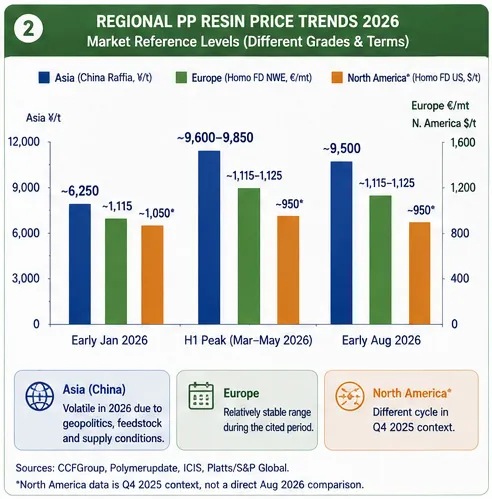
The regional picture is not directly comparable because the cited assessments use different grades, delivery terms and reporting periods. China was volatile in 2026, European PP spot assessments were comparatively stable during the cited period, while the North American example below is included as Q4 2025 context rather than as a like-for-like August 2026 comparison. Buyers should compare the underlying grade, location, Incoterm and assessment date before using regional prices to guide sourcing decisions.
- Asia (China-led): Volatile and currently elevated, driven by geopolitical risk and propylene feedstock.
- Europe: Homopolymer spot FD NWE was reported in a relatively narrow €1,115–1,125/mt range during the cited period, while the August propylene contract settled at €1,420/mt, providing upstream cost support. Buyers should treat these figures as assessment references and verify the applicable grade, date and delivery basis before comparing them with Asian prices.
- North America (Q4 2025 context): North American PP pricing diverged from the Asian trend in the cited period, with some grades declining on abundant feedstock. This is included as historical context rather than as a direct August 2026 comparison with China and Europe.
Polypropylene Price Trend H2 2026: Outlook and Buyer Scenarios
One June 2026 market analysis placed global PP prices in an approximate US$1,100–1,300/t range for H2 2026. This should be treated as one market scenario rather than a consensus forecast. For procurement planning, buyers should monitor regional PP assessments, propylene and crude-oil costs, operating rates, imports, exports and geopolitical developments, because the polypropylene price trend in H2 2026 may differ significantly by region and grade.
- Global PP price scenario: The cited analysis places the global PP market around US$1,180/t, approximately 5% higher year-on-year on its stated assessment basis. This figure should be treated as a scenario reference rather than a universal transaction price or industry consensus.
- Global demand near 85 Mt (+4%, per the cited analysis); Chinese capacity about 48 Mt/yr in H1 2026 per CCFGroup, with further expansion underway.
- Recycled PP (rPP) share is growing per the cited estimates; food-contact recycled PP is subject to specific EU requirements rather than a simple premium claim — see the section below.
The takeaway for buyers: do not assume a return to early-2026 lows. A US$1,100-1,300/t range can keep resin-related cost pressure elevated versus 2025, and any renewed geopolitical or feedstock shock can re-test the H1 highs.
Recycled PP (rPP) Food-Grade Premium in 2026: What Buyers Should Know
Recycled PP (rPP) can play both a material and compliance role in packaging, but food-contact applications require a higher level of documentation and regulatory control. The price of food-contact rPP depends on feedstock quality, collection and sorting, decontamination technology, recycling process, certification or authorisation requirements and supply availability. Buyers should therefore treat any food-grade rPP premium as specification- and market-dependent rather than applying a universal percentage.
- Food-contact rPP requires a separate compliance check. Recycled PP intended for food-contact applications is subject to specific EU requirements for recycled plastic materials and recycling processes under Regulation (EU) 2022/1616. Buyers should specify the intended food-contact use, recycled-content percentage, applicable recycling technology or authorisation route, traceability and supporting compliance documentation rather than relying on a generic “food-grade rPP” claim.
- rPP should be evaluated as a compliance and material strategy, not assumed to be a cost-saving option. The EU Packaging and Packaging Waste Regulation (Regulation (EU) 2025/40) applies from 12 August 2026, but specific recycled-content obligations are phased and have their own application dates. Buyers selling packaging into the EU should therefore confirm the applicable recycled-content target, calculation method, technical documentation and implementation date for the relevant packaging format rather than treating 12 August 2026 as a universal PCR deadline.
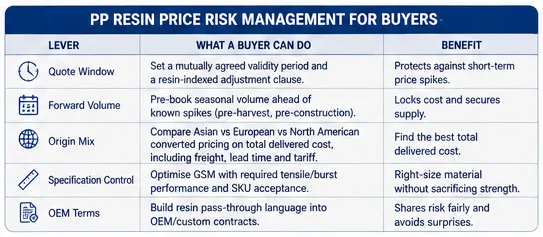
How Buyers Should Manage Resin-Driven Price Risk
| Lever | What a buyer can do |
|---|---|
| Quote window | Set a mutually agreed validity period (a defined window, not a market norm) and a resin-indexed adjustment clause. |
| Forward volume | Pre-book seasonal volume ahead of known spikes (pre-harvest, pre-construction season). |
| Origin mix | Compare Asian vs European vs North American converted pricing; they do not move together, and weigh total delivered cost, MOQ, lead time and tariff/customs treatment before switching. |
| Specification | Optimise GSM together with the required tensile/burst performance and SKU acceptance; lower GSM is not the same as adequate strength, so right-size against the actual specification rather than purely to cut resin. |
| OEM terms | Build resin pass-through language into OEM and custom contracts so neither side absorbs surprise moves. |
Key Takeaway: Index resin exposure where possible, but evaluate total delivered cost — resin price, freight, exchange rates, MOQ, lead time and tariff/customs treatment — and SKU performance before changing origin or specification, not resin price alone.
Key Takeaways
- PP resin is one of the largest raw-material cost components in woven packaging, so significant 2026 price movements can materially affect bag quotations.
- H1 ran hot on geopolitics, eased in June, then re-spiked in August — a year of two surges, not one.
- European PP assessments were comparatively stable during the cited period, while the North American example shows how feedstock conditions can produce a different pricing cycle; the North American figure cited in this article is Q4 2025 context rather than an August 2026 comparison.
- One Rzzro market analysis places global PP in a US$1,100–1,300/t range for H2 2026; this is a source-specific scenario rather than a consensus forecast, so buyers should continue monitoring regional assessments and feedstock conditions.
- Buyers should use quote windows, forward volume, origin comparison and resin-indexed OEM terms to manage risk rather than chase spot.
For procurement teams tracking PP resin price in 2026, the practical approach is to treat resin as a managed input rather than a spot-price gamble: define quotation validity, agree on the resin-price basis, plan critical seasonal volume and compare suppliers on delivered cost, specification, lead time and transparent resin-cost adjustments.
Frequently Asked Questions
China PP raffia prices were highly volatile in 2026, moving from roughly ¥6,250/t in the early-year reference to nearly ¥9,850/t around the H1 peak before easing and strengthening again. Early-August market references reached approximately ¥9,500/t, depending on assessment date, grade and market basis.
PP resin is one of the largest raw-material cost components in woven PP packaging. When resin prices rise, suppliers may adjust bag quotations, but the final impact depends on the bag specification, conversion cost, freight, exchange rates, margins and commercial terms.
Buyers can reduce resin-price exposure by setting clear quotation-validity periods, agreeing on the resin-price basis, pre-booking critical volume, comparing converted-product costs across origins and using resin-indexed adjustment clauses where appropriate.
PP resin is typically one of the largest raw-material cost components in woven-bag conversion. However, there is no universal percentage because the final bag price also includes tape extrusion, weaving, printing, lamination, labor, freight, overhead, margins and other costs.
East China PP raffia was reported around ¥9,100–9,200/t during the cited August period, with early-August levels reaching approximately ¥9,500/t. The reported year-on-year increase was about 35%, but the exact percentage depends on the assessment date, grade and market basis.
China PP raffia prices rose sharply during H1 2026 as geopolitical disruption increased supply and feedstock uncertainty, while lower operating rates and tight spot availability added support to prices. CCFGroup reported that East China homo PP raffia rose from around ¥6,250/t at the start of the year to nearly ¥9,600/t in early March and around ¥9,850/t in mid-to-late May. After the mid-June US-Iran peace agreement, prices corrected rapidly toward around ¥8,000/t. The episode shows that PP prices can respond quickly to changes in feedstock costs, supply availability and geopolitical risk.
One June 2026 market analysis placed global PP prices in a US$1,100–1,300/t range, with a reference point around US$1,180/t. This should be treated as one market scenario rather than a consensus forecast. Buyers should continue monitoring regional PP prices, propylene and crude-oil costs, operating rates, trade flows and geopolitical developments.
Europe was comparatively stable during the cited period, with homopolymer PP spot assessments around €1,115–1,125/mt, while the North American example in this article reflects Q4 2025 conditions rather than August 2026. Buyers should compare grade, delivery basis, assessment date and total delivered cost before using regional prices for sourcing decisions.
Recycled PP (rPP) is polypropylene produced from recycled material. Its price depends on feedstock quality, collection and processing, recycled-content requirements, certification or compliance requirements and end-use specifications. Food-contact recycled PP requires additional regulatory checks in applicable markets, so buyers should not assume that rPP is automatically cheaper than virgin PP.
Buyers can manage resin-price risk by setting clear quote-validity periods, agreeing on the resin-price basis, pre-booking critical seasonal volume, comparing converted-product costs across origins and using resin-indexed adjustment clauses where appropriate. The comparison should include freight, exchange rates, MOQ, lead time, tariffs and SKU performance rather than resin price alone.
For custom and OEM PP woven bags, resin cost can be incorporated into the quotation and pricing discussion according to the agreed specification, order volume, quotation validity and commercial terms. Buyers can discuss resin-indexed adjustment mechanisms with SITONG when longer-term or volume-based contracts require clearer protection against raw-material price volatility.
Sources and Market References
This article uses market and regulatory references from CCFGroup for China PP market and raffia-price developments, Polymerupdate for the cited August 2026 China PP assessment, Rzzro for the H2 2026 market scenario, and official European Union sources including EUR-Lex and the European Commission for PPWR and recycled-plastic requirements. Price references are indicative assessments rather than guaranteed transaction prices and may vary by grade, location, volume, Incoterm, assessment date and trading conditions. Buyers should verify the latest assessment and applicable regulatory requirements before using the figures for procurement or compliance decisions.