




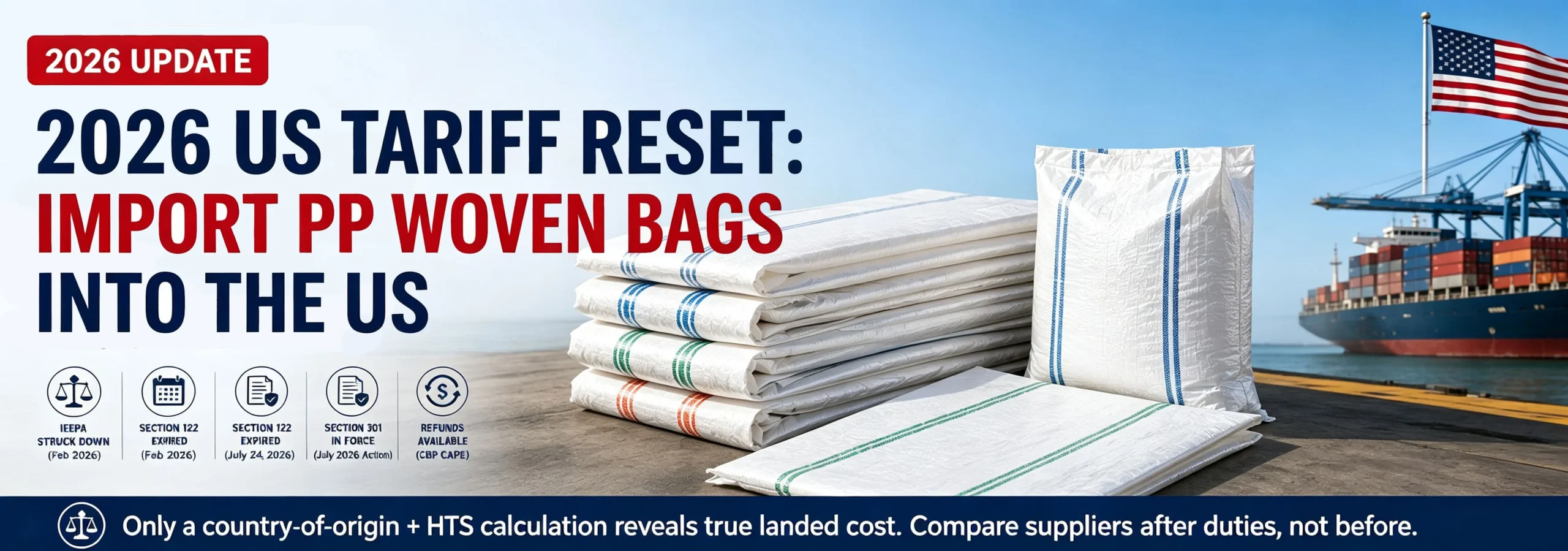
Businesses that import PP woven bags into the US in 2026 face a tariff landscape reshaped by two 2026 events: the Supreme Court’s February ruling that IEEPA does not authorise the disputed tariffs, and a July change in the additional-duty layer. The practical result is a duty stack that depends on country of origin, HTS classification, entry date and applicable trade measures — not a single number. For a PP woven bags manufacturer exporting to the US and for US importers, this guide breaks down the current stack, the refund position and the buying implications.
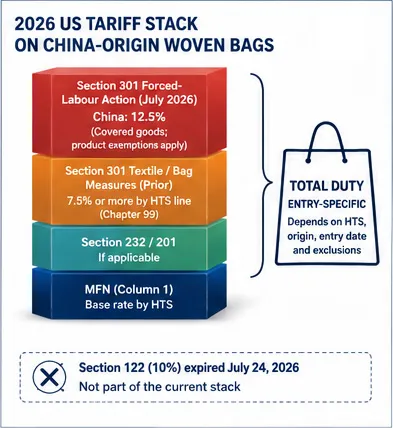
For US imports of PP woven bags, tariff should be treated as an entry-specific stack: the Column 1 (MFN) rate for the applicable HTSUS subheading, plus any applicable Chapter 99 duties or other trade measures based on country of origin and entry date, minus any applicable exclusions or exemptions. The July 2026 Section 301 forced-labour action adds a further layer for covered goods from the affected economies, but its rate and exemptions vary by economy and product. Always calculate the actual duty using the specific HTSUS code, origin and entry date.
The 2026 Tariff Stack, Explained
| Layer | Status in 2026 | How the rate is determined |
|---|---|---|
| MFN (Column 1 base) | Retained | Standard base rate for the HTS subheading |
| Section 301 (textile / bag lines) | In force for covered lines | 7.5% additional duty for many China-origin lines under prior Section 301 textile/bag measures (Chapter 99, e.g. 9903.88.15), varying by HTS subheading |
| Section 301 forced-labour action (July 2026) | In force from 24 July 2026 | Additional Section 301 duty on covered goods of investigated economies; 10% or 12.5% by economy (China 12.5%; India, Mexico 10%), subject to product exemptions |
| Section 122 (Feb–Jul 2026) | Expired 24 July 2026 | Historical only — 10% on entries Feb 24–Jul 23, 2026; no longer charged on new entries |
| Section 201 / 232 | Retained where applicable | Product-specific (e.g., steel/aluminium derivatives under 232) |
Key takeaway: The duty on a shipment is determined by the applicable HTSUS classification, country of origin and entry date. Start with the Column 1 MFN rate, then check each applicable Chapter 99 and other trade measure separately, including Section 301 provisions and any exclusions or exemptions. The July 2026 forced-labour Section 301 action is an additional measure for covered goods from affected economies, but it should not be treated as a universal extra percentage for every PP woven bag.
Refunds for Overturned IEEPA Duties
Following the Supreme Court’s February 2026 decision that IEEPA did not authorize the challenged tariffs, importers may be eligible for refunds of certain IEEPA duties previously paid. The refund process is being handled through CBP’s administrative procedures, including the CAPE process, and eligibility can depend on the affected entry, payment history and applicable CBP instructions. Importers should review their entry records and follow the latest CBP guidance rather than relying on an estimated industry-wide refund figure.
USTR Forced-Labour Section 301: Final, Not Proposed
On 23 July 2026, USTR took final Section 301 action against 60 economies over their failure to impose and effectively enforce prohibitions on imports produced with forced labor. The action applies additional duties of 10% or 12.5% to covered goods, depending on the economy, with specified product exemptions. China is in the 12.5% tier, while India and Mexico are among the economies subject to the 10% tier. The measure became effective for covered entries from 24 July 2026. Importers should check the applicable HTSUS provisions and exemption list rather than applying one rate to every product from an affected economy.
For buyers, the implication is that the stack is not static: exclusions and rate changes can shift landed cost by several points within a season.
Why Origin and HTS Code Decide Everything
Two starting variables are critical to the calculation:
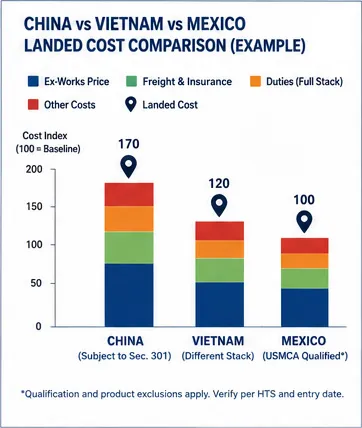
- Country of origin. Additional Section 301 treatment varies by economy and product, and USMCA qualification does not automatically mean the entire tariff stack is zero. A bag from Vietnam or Mexico may face a different duty stack, but the result depends on origin qualification, HTS classification, applicable Section 301 measures and product-specific exclusions.
- HTS classification. Many woven PP bags and FIBC are classified within heading 6305; the FIBC sub-position 6305.32 covers certain flexible intermediate bulk containers. Confirm the exact HTSUS subheading for the SKU — classification depends on the merchandise as imported, including construction, material and applicable HTSUS notes, and the HTS is revised periodically.
A US importer should request origin-specific landed-cost quotes — compare a China-origin quote and a Vietnam-origin quote only after the full duty stack is added for each, and verify that an alternative-origin supplier can actually satisfy the applicable origin rules and product specifications.
What This Means for OEM and Custom Orders
For OEM and custom bag programs shipping to the US, three contract practices reduce risk:
- Tariff scenario clause. State that quoted prices are based on the current duty stack and may adjust if rates change before shipment.
- Origin confirmation. Lock the manufacturing origin in the PO so the duty math is fixed, and document origin for CBP.
- Refund tracking. For entries made under overturned actions, monitor CBP’s refund process.
A manufacturer that can document origin, support multi-country routing and confirm HTS classification is a material advantage in this environment. Buyers should also set MOQ, packaging configuration and supplier production location alongside the tariff math, because a lower ex-works price can vanish after the duty stack and freight are applied. Before comparing landed cost, buyers should compare the same SKU specification, MOQ, packaging configuration, production origin, QC documentation and shipment terms across suppliers.
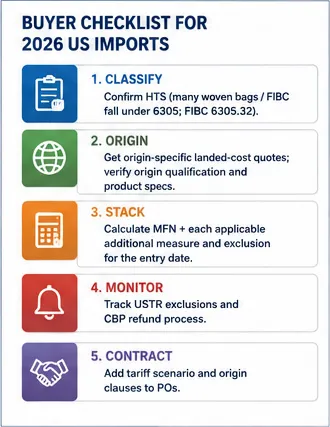
Buyer Checklist for 2026 US Imports
| Step | Action |
|---|---|
| Classify | Confirm HTS (many woven bags / FIBC fall under 6305; FIBC 6305.32 — verify the exact subheading) |
| Origin | Get origin-specific landed-cost quotes; verify origin qualification and product specs |
| Stack | Confirm the exact HTSUS line and origin; then calculate MFN plus each applicable additional measure and exclusion for the entry date |
| Monitor | Track USTR exclusions and CBP refund process |
| Contract | Add tariff scenario and origin clauses to POs |
Key Takeaways
- The Supreme Court ended IEEPA tariffs (Feb 2026). A temporary Section 122 surcharge applied Feb 24–Jul 23 2026 and expired by law on 24 July 2026; it is not part of the current stack.
- The current stack is MFN base + applicable Section 301 (including the July 2026 forced-labour action: 10% or 12.5% by economy, on covered goods with product exemptions) + any Section 232/201 measures — determined by HTS, origin and entry date.
- CBP has a refund process for eligible overturned-IEEPA entries; eligibility and timing depend on the entries, not a single published total.
- The former US$800 de minimis treatment is no longer generally available for covered low-value shipments; applicable duties, taxes and fees depend on the entry.
- Only a country-of-origin + HTS calculation reveals true landed cost; compare suppliers after duties, not before.
For businesses that import PP woven bags into the US, the disciplined approach is to model the full duty stack per origin, watch USTR and CBP developments, and build tariff flexibility into OEM and custom contracts. A manufacturer that can document origin and support multi-country routing is a material advantage in this environment. See our PP woven bags overview for product and specification context.
Frequently Asked Questions
The Supreme Court struck down IEEPA tariffs in February 2026. A temporary Section 122 surcharge (10%) applied Feb 24–Jul 23 2026 and expired by law on 24 July 2026. Section 301 textile-bag duties and MFN, 201 and 232 rates remain; a new July 2026 forced-labour Section 301 adds 10% or 12.5% by economy, on covered goods with exemptions.
The Column 1 base plus applicable Section 301 duties — for covered goods, the July 2026 forced-labour action (China 12.5% tier) may apply in addition to prior Section 301 textile duties of 7.5% or more by HTS line (Chapter 99), subject to product exemptions. The exact total depends on HTS classification and entry date; it is substantial but must be calculated per entry, not assumed as a fixed percentage.
CBP has a process for refunding duties collected under the overturned IEEPA actions. Eligibility and timing depend on the affected entries and CBP’s CAPE process; importers should rely on their entry records and CBP’s published guidance.
The former US$800 de minimis treatment is no longer generally available for covered low-value shipments. Applicable duties, taxes and fees depend on the specific entry, so it should not be read as “every sub-$800 parcel is always dutiable under one rule.”
Many woven PP bags and FIBC are classified within heading 6305; the FIBC sub-position 6305.32 covers certain FIBC. Correct classification sets the base rate before surtaxes — confirm the exact HTSUS subheading for the SKU.
Yes — but only after adding the full, entry-specific duty stack for each origin, and verifying that an alternative-origin supplier can meet the applicable origin rules and product specifications. A lower ex-works price from China can disappear once duties are applied.
Add a tariff scenario clause (prices adjust if rates change before shipment), lock manufacturing origin in the PO, and monitor CBP’s refund process for affected entries.
USTR’s product-exclusion reviews continue, while the July 2026 forced-labour Section 301 is final action (10% or 12.5% by economy, on covered goods with exemptions). The landscape is still moving, so verify the current measure for your HTS and origin.