



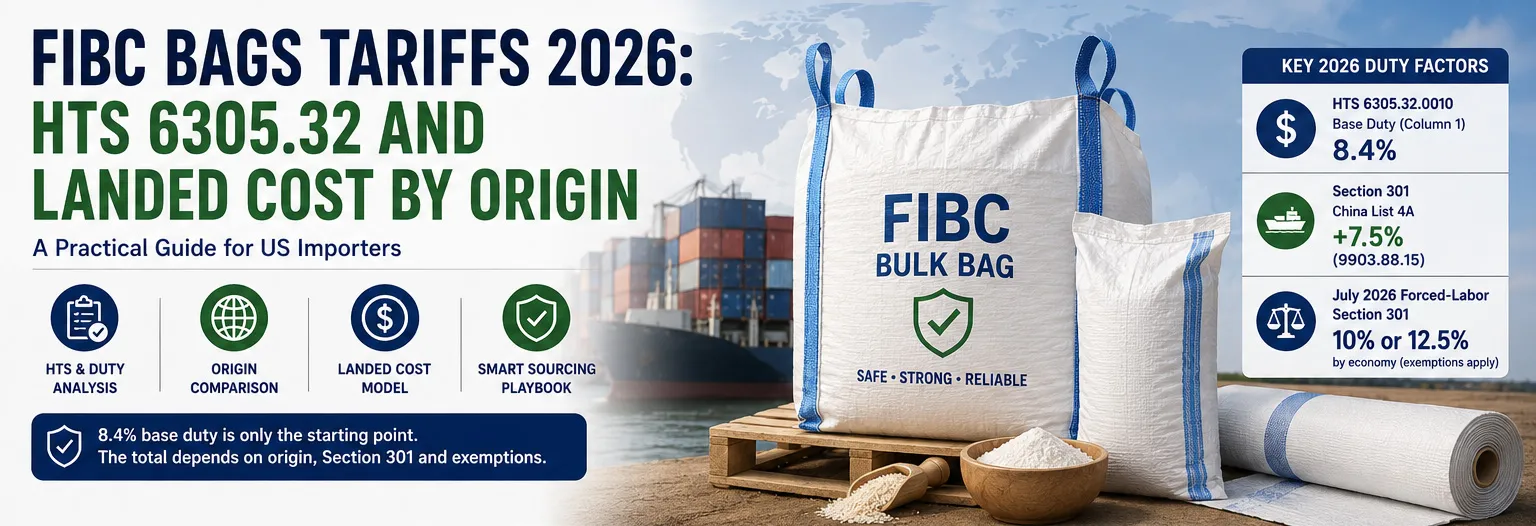
For U.S. importers, FIBC bags tariffs treatment in 2026 depends on the merchandise classification, country of origin, applicable additional duties and the entry date. For FIBCs weighing one kilogram or more and meeting the relevant classification criteria, HTSUS 6305.32.0010 carries an 8.4% Column 1 general duty rate; lighter or differently constructed merchandise may fall under another subheading. The HTS is revised periodically, so importers should confirm the exact 10-digit classification for the SKU before calculating the duty stack. Chinese-origin goods may also be subject to Section 301 measures, while the July 2026 forced-labor Section 301 action adds a separate 10% or 12.5% duty for covered imports from affected economies, subject to the applicable exemptions.
FIBC tariff cost is the combination of the applicable Column 1 duty and any additional duties determined by HTS classification, country of origin, and current U.S. trade measures. The base 8.4% (HTSUS Column 1 general rate for 6305.32.0010) is only the starting point; the entry-specific stack must be calculated per shipment.
Quick Answer:For FIBCs weighing one kilogram or more and classified under HTSUS 6305.32.0010, the U.S. Column 1 general duty rate is 8.4%. The final 2026 import duty can be higher because additional measures may apply by country of origin, including China Section 301 List 4A (+7.5% where covered) and the July 2026 forced-labor Section 301 action (10% or 12.5% depending on the economy), subject to the exact HTS scope and product exemptions. U.S. importers should calculate the complete entry-specific duty stack rather than use a single universal FIBC tariff rate.
The HTS and Base Rate
FIBC are classified under HTS 6305 (sacks and bags of a kind used for the packing of goods), with the FIBC sub-position at 6305.32. For FIBC classified under HTSUS 6305.32.0010, the Column 1 general base rate is 8.4% (per the current HTSUS schedule) — but classification depends on the actual merchandise construction, and the HTS is revised periodically, so confirm the exact subheading for the SKU.
| Classification | Base duty |
|---|---|
| HTS 6305.32.0010 (FIBC) | 8.4% general (verify for the specific SKU) |
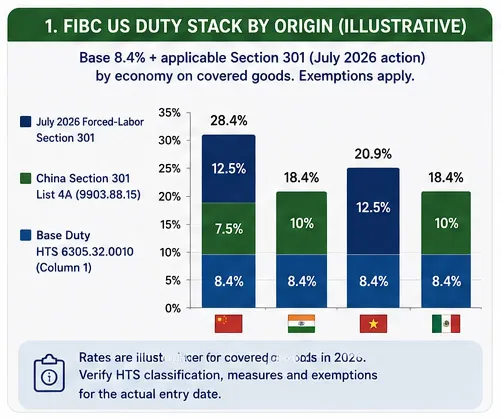
That 8.4% is only the starting point. The total depends entirely on where the bag was made and which additional measures apply. For reference, the 8.4% reflects the HTSUS Column 1 general duty for 6305.32.0010; a China-specific Section 301 additional duty of 7.5% applies under Chapter 99 (e.g., 9903.88.15) for products of China; and the July 2026 forced-labour Section 301 action (USTR, effective 24 July 2026) adds 10% or 12.5% by economy on covered goods, subject to product exemptions.
The Origin Spread
| Origin | Base + applicable additional duties | Buyer takeaway |
|---|---|---|
| China | 8.4% base + China-specific Section 301 +7.5% (Ch. 99, e.g. 9903.88.15) + July 2026 forced-labour Section 301 12.5% tier (covered goods; exemptions apply) | Highest stack; verify entry-specific total |
| India | 8.4% + July 2026 forced-labour Section 301 10% tier (covered goods; exemptions apply) | Not automatically low; depends on HTS and exemptions |
| Vietnam | 8.4% + July 2026 forced-labour Section 301 12.5% tier (covered goods; other framework measures may apply) | Check current HTS and measure, not a fixed low rate |
| Mexico (USMCA) | 8.4% + July 2026 forced-labour Section 301 10% tier (covered goods; USMCA may qualify some goods) | Qualification needed; not automatically zero |
Key takeaway: no origin is automatically “low or zero.” The applicable duty for each source depends on HTS classification, the specific Section 301 measures in force on the entry date for covered goods, product exemptions and (for Mexico) USMCA qualification. A higher ex-works price from a non-China origin can still land cheaper once the full stack is applied — but only after the entry-specific duty is calculated.
Evaluate Bag, Liner and Container Liner Separately
A common mistake is pricing the FIBC body alone. Procurement guides recommend evaluating three cost structures independently:
- The FIBC body — fabric, loops, seams, coating.
- The inner liner — a separate PE liner may have its own HTS classification and duty treatment; classification depends on the liner’s material, construction and intended use, so confirm it separately rather than assuming the FIBC code.
- The container liner — a flexible intermediate bulk container liner (for dry bulk in ocean containers) is a distinct item with its own lead time and cost.
Treating them as one blended number hides where the cost and the duty actually sit.
Beyond duty, buyers qualifying an FIBC supplier should evaluate woven-tape consistency, fabric GSM, seam construction, coating or lamination requirements, liner fit and SKU-level inspection against the approved specification — not only price and origin.
A Disciplined Sourcing Playbook
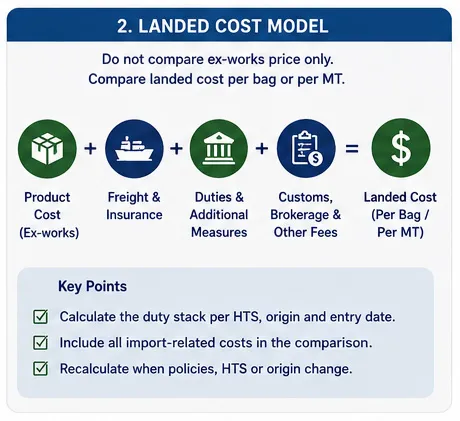
- Run the full duty stack per origin. Compute base + applicable Section 301 + any other surtax before comparing, per HTS and entry date.
- Dual-origin sourcing. Consider maintaining at least two qualified country sources where volume, qualification cost and tariff exposure justify diversification.
- Safety stock. Hold domestic buffer inventory where tariff or shipping volatility warrants it.
- Annual planning. Build tariff scenarios into the yearly procurement plan, not just spot buys.
- Supplier with multi-country manufacturing. A supplier able to support qualified multi-country production can help shift volume when policy changes — provided the relevant plants, specifications and compliance are already qualified.
Why Multi-Country Manufacturing Matters
For a FIBC bulk bag buyer, a supplier with manufacturing relationships across origins is a potential advantage: when one lane’s duty jumps, volume may be shifted more quickly if the supplier has already qualified the relevant plants, specifications and production controls. This is exactly the capability OEM and custom programs should surface in supplier scorecards. Buyers evaluating such suppliers should also confirm MOQ, documentation and lead time alongside tariff math — and can contact the manufacturer to discuss origin options.
Buyer Checklist
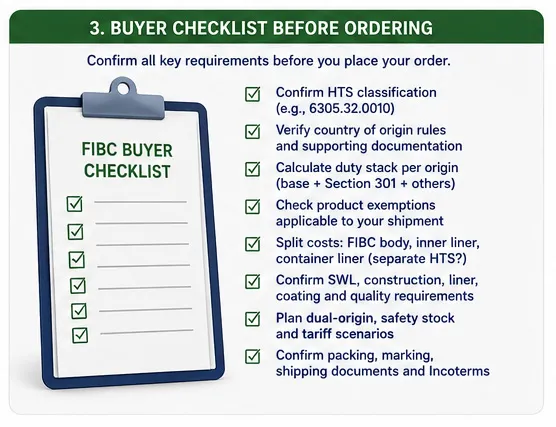
| Step | Action |
|---|---|
| Classify | Confirm HTS 6305.32.0010 and liner/container-liner codes for the SKU |
| Origin stack | Compute 8.4% base + applicable Section 301 (incl. July 2026 action) + other per origin and entry date |
| Split costs | Price body, liner and container liner separately |
| Diversify | Consider ≥2 qualified country sources where justified |
| Plan | Add tariff scenarios to annual procurement |
What to Qualify Before Comparing Origins
Origin and duty are only part of the decision. Buyers should qualify the same specification across suppliers before comparing landed cost:
| Field | What to confirm |
|---|---|
| Construction & material | Woven tape, coating or lamination, liner type — drives HTS and performance |
| GSM / fabric mass | Target fabric mass per unit area for the SKU |
| Tensile / burst / tear / drop | Named test method + SKU-level acceptance limits |
| UV stability | Required exposure hours + validated UV-aging method |
| FIBC Type (A–D) | Electrostatic classification for the product and environment |
| MOQ, lead time, documentation | Supplier’s stated commercial terms and QC records |
| Supplier capability | Documented manufacturing origin, qualification and shipping port (e.g., SITONG’s dual-plant CN+KH network and Dalian port routing) |
Key Takeaways
- US FIBC base duty is 8.4% under HTS 6305.32.0010, but the entry-specific total depends on origin and applicable Section 301 measures — verify per shipment, don’t assume a fixed percentage.
- For covered goods of China, the 12.5% July 2026 forced-labour Section 301 tier applies on top of the prior Section 301 textile duty (China +7.5% under Ch. 99), subject to product exemptions; India and Mexico are in the 10% tier. No origin is automatically low or zero.
- Always compare suppliers after adding the full, entry-specific duty stack, not on ex-works price alone.
- Evaluate the FIBC body, inner liner and container liner as separate cost and duty items.
- Dual-origin sourcing, appropriate safety stock and tariff-scenario planning can reduce exposure where the buyer’s volume and qualification economics justify them.
For US importers, FIBC bags tariffs should be evaluated through a landed-cost model: confirm HTS, compute the entry-specific stack per origin, split the cost stack, and choose suppliers that let you shift lanes when policy moves — qualified multi-country manufacturing is one option where the buyer’s volume and qualification economics justify it.
Frequently Asked Questions
FIBC are classified under HTS 6305, with the FIBC sub-position at 6305.32; the specific US rate line 6305.32.0010 carries an 8.4% general base duty. Confirm the exact subheading for the SKU, as classification depends on construction.
The 8.4% base plus applicable Section 301 duties — for covered goods, the July 2026 forced-labour action (China 12.5% tier) may apply in addition to the prior Section 301 textile duty of 7.5% or more by HTS line (Ch. 99), subject to product exemptions. The entry-specific total is substantial but must be calculated per HTS and entry date.
Each carries the 8.4% base plus the July 2026 forced-labour Section 301 at its tier (India and Mexico 10%, Vietnam 12.5%), with product exemptions for covered goods and (for Mexico) possible USMCA qualification. None is automatically low or zero — verify the entry-specific stack.
No. Compare only after adding the full, entry-specific duty stack per origin; a lower ex-works China price can land more expensive than a higher non-China price.
Each may have its own HTS, duty treatment and lead time; blending them hides where cost and duty actually sit and weakens negotiation.
Confirm the HTS subheading for the SKU, then check the current Column 1 rate plus applicable Section 301 measures (including the July 2026 forced-labour action and any exemptions) for the origin and entry date; CBP and USTR publications are the authoritative sources.
It can — a supplier with qualified multi-country manufacturing may let you shift volume when one lane’s duty jumps, provided the plants, specifications and compliance are already qualified. It is not automatic.
Define HTS-relevant construction, origin, MOQ, liner requirements and validation, then model landed cost per origin with the full duty stack before comparing suppliers.