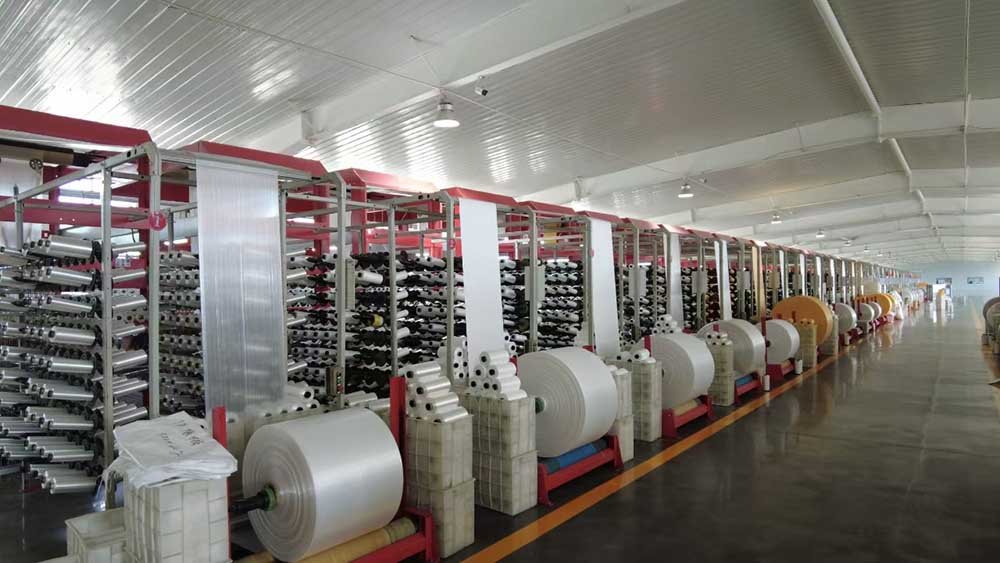
Polypropylene woven bags are a common type of plastic packaging. Polypropylene woven bags production process is straight forward: using polypropylene (or recycled polypropylene) as the raw material, the bags are created through a series of steps—including raw material proportioning, mixing, tape extrusion (drawing), weaving, printing/cutting, and sewing—before undergoing inspection and delivery to the customer. Manufacturing these bags requires equipment such as drying mixers, tachines, and sewing machines. Let’s take a look at the polypropylene woven bags production process.
Raw Material Selection and Proportioning
The production of PP woven bags begins with careful raw material selection. The main material is polypropylene resin, often blended with recycled PP and filler masterbatch.
Typical formulation guidelines include:
- Recycled PP content: usually controlled within 30%–40%
- Filler masterbatch: typically 10%–15%
- Virgin PP: ensures strength and consistency
Proper ratio control is essential because it directly affects tensile strength, weaving stability, and final bag durability.
Mixing Process for Uniform Material Quality
In the mixing stage, virgin polypropylene and recycled materials are blended thoroughly using high-speed mixers. The goal is to achieve uniform dispersion and consistent melt flow characteristics.
Key requirements include:
- Matching melt flow index (MFI) of materials
- Ensuring stable extrusion behavior
- Avoiding uneven stretching during tape production
A well-controlled mixing process improves production stability and reduces defects in later stages.
Polypropylene Tape Extrusion (Film Drawing Process)
The extrusion process is the most critical stage in PP woven bag manufacturing.
Process overview:
- PP raw materials are fed into an extruder
- Materials are melted under heat and screw shear force
- Molten PP is extruded through a die head into a film
- The film is cooled and solidified
- It is then slit into narrow tapes (flat yarns)
These tapes form the foundation of woven fabric and must meet strict standards for tensile strength and uniform thickness.
Flat Yarn Stretching and Heat Setting
After extrusion, the PP tapes undergo stretching in a controlled heating oven.
This stage includes:
- Stretching the tapes to increase strength
- Heat setting for dimensional stability
- Controlled cooling to prevent shrinkage
- Winding into rolls for weaving
This process determines the final strength and elasticity of the woven bag.
Circular Loom Weaving Process
Weaving is performed using circular looms that interlace warp and weft tapes into tubular fabric.
Weaving steps:
- Yarn loading
- Threading setup
- Machine startup
- Continuous weaving operation
- Fabric rolling and unloading
The resulting PP woven fabric is strong, flexible, and suitable for high-load packaging applications.
Printing and Cutting Process
Once woven fabric is produced, it undergoes printing and cutting according to customer specifications.
Printing methods:
- Gravure or flexographic printing (machine-based)
- Screen printing (manual or semi-automatic)
Process steps:
- Design plate or screen creation
- Ink preparation and application
- Image/text transfer onto fabric
- Drying and curing
After printing, fabric is cut into required dimensions for bag making.
Bag Sewing and Finishing Process
Cut pieces are then sewn into finished bags using industrial sewing machines.
Key sewing parameters include:
Stitch density and pattern
- Thread type and strength
- Hem reinforcement
- Bottom closure method
Common bag types include:
- Open mouth bags
- Valve bags
- Gusset bags
- Block bottom bags
After sewing, bags undergo quality inspection before packaging.
Quality Inspection and Packaging
Before shipment, PP woven bags are tested for:
- Tensile strength
- Load-bearing capacity
- Print clarity
- Stitch durability
- Moisture resistance
Only qualified products are packed and delivered to customers for export or domestic distribution.
The polypropylene woven bags production process involves multiple precise stages, including raw material mixing, tape extrusion, weaving, printing, and sewing. Each step plays a critical role in determining final product quality.
Understanding the nuances of the Polypropylene Woven Bags Production Process is vital for innovation and success. By mastering the Polypropylene Woven Bags Production Process, manufacturers can deliver superior products to consumers.
FAQ
1、What are polypropylene woven bags made of?
Polypropylene woven bags are made from polypropylene resin, which can be virgin material, recycled PP, or a blend of both. The resin is melted, extruded into flat tapes, and then woven into strong packaging fabric.
2、What is the PP woven bag extrusion process?
The extrusion process melts polypropylene resin and converts it into thin flat tapes through a die. These tapes are cooled, slit, and stretched to form strong yarns used for weaving fabric.
3、Are polypropylene woven bags waterproof?
PP woven bags are moisture-resistant but not completely waterproof. However, they can be laminated with a BOPP film or coating to improve water resistance.
4、What affects the strength of PP woven bags?
The strength depends on raw material quality, tape thickness, weaving density, extrusion process control, and sewing quality. Proper material ratio and production control are critical.
5、Are polypropylene woven bags recyclable and eco-friendly?
Yes, PP woven bags are recyclable and can be reused multiple times. They are considered a cost-effective and relatively eco-friendly packaging solution for industrial bulk goods.