


In 2026, recyclable mono-material PP woven bags are becoming an increasingly relevant product-development and procurement option for packaging buyers looking to reduce material complexity and support recycling objectives. A recyclable mono-material PP woven bags is designed around polypropylene-compatible packaging components, but recyclability is not determined by material composition alone. The EU Packaging and Packaging Waste Regulation (PPWR) also considers packaging components, sorting, recycling processes and the applicable design-for-recycling methodology. This guide explains the technical route, recycled-content considerations, food-contact requirements and the specifications buyers should request when sourcing recyclable mono-material PP woven bags.
A recyclable mono-material PP woven bag is designed so that its main packaging components are polypropylene-compatible, including the woven fabric, tapes and PP-based film or laminate where used. Buyers should also check liners, inks, adhesives, coatings and other components because recyclability depends on the complete packaging structure and the recycling system available in the target market. For procurement, specify the material structure, target recycled-content level, applicable print system and supporting technical documentation.
Mono-material PP construction can make recycling easier to assess and can reduce material-compatibility barriers, but a mono-material structure is not by itself proof that a bag is recyclable under every market’s rules or recycling system.
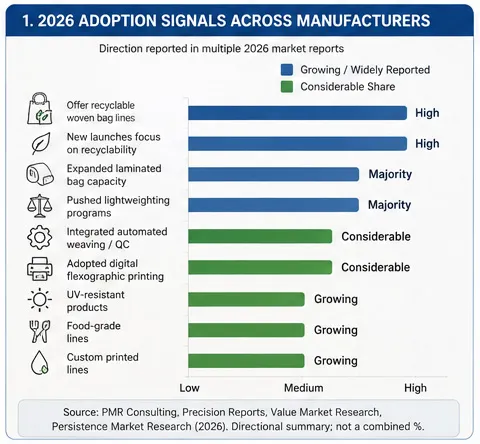
2026 Market Direction for Recyclable PP Woven Bags
The 2026 market reports cited in this article describe growing interest in recyclable packaging, lightweighting, laminated packaging, digital printing and related PP woven bag product development. However, the reports use different methodologies, geographic scopes and definitions, so they do not provide a reliable single percentage for manufacturer adoption. The practical takeaway is that recyclability is becoming a more visible product-development consideration, while actual supplier capability still needs to be verified at SKU level.
| Reported 2026 market direction | Procurement implication |
|---|---|
| Recyclable packaging programs | Ask whether the finished bag uses a PP-compatible structure and request supporting recyclability documentation. |
| Lightweighting | Verify that reduced bag weight still meets the required tensile, burst and handling performance. |
| Laminated packaging | Confirm whether the film or laminate is PP-compatible when mono-material recyclability is required. |
| Digital and flexographic printing | Confirm ink, coating and print-system compatibility with the target market’s requirements. |
| Food-grade packaging | Evaluate food-contact compliance separately from general recyclability claims. |
Source note: PMR Consulting, Precision Reports, Value Market Research and Persistence Market Research are used as secondary market-report references for directional trends. Their methodologies and market coverage differ, so their findings should not be combined into a single manufacturer-adoption rate or treated as a universal measure of supplier capability.
Key Takeaway: The 2026 reports indicate stronger market attention to recyclable packaging and material efficiency, but buyers should verify mono-material structure, recycled content, printing, liner design and performance requirements directly with each supplier.
Mono-Material Design: The Technical Route
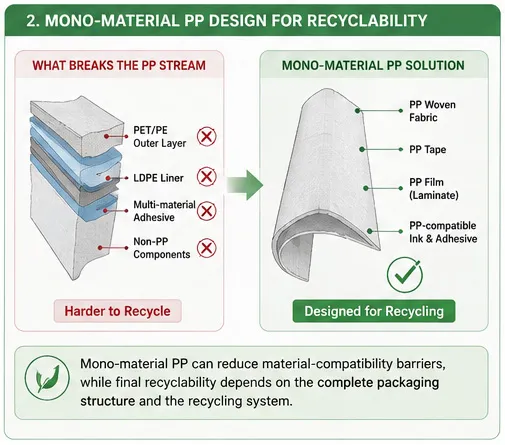
A PP woven bag can be designed around a predominantly polypropylene structure because its woven fabric and tapes are typically based on PP, and PP-based films or laminates can also be used. However, liners, coatings, inks, adhesives and other components must be evaluated as part of the complete packaging structure when recyclability is the objective.
- Films and laminates. A laminate containing non-PP layers can introduce additional material-compatibility considerations for PP recycling, while PP-compatible film or laminate structures can support a mono-material approach. Buyers should identify the resin composition of each major packaging layer rather than judging recyclability from the word “laminated” alone.
- Liners. A separate PE liner introduces another material into the packaging structure and may affect recyclability assessment depending on the applicable recycling system and design-for-recycling criteria. Where a mono-material PP approach is required, buyers can consider a PP-compatible liner or linerless structure where technically feasible.
- Inks, adhesives and coatings. These components may represent a small share of the total bag weight but can still affect recycling compatibility and regulatory assessment. Buyers should specify the applicable print and coating system and request technical or compliance documentation rather than relying on generic claims such as “recyclable ink” or “de-inkable.”
Mono-material PP construction can support the PPWR’s design-for-recycling objectives, but it does not automatically qualify a bag for a specific recyclability grade. Regulation (EU) 2025/40 establishes recyclability performance classes based on applicable criteria, including A, B and C thresholds of ≥95%, ≥80% and ≥70%. The detailed design-for-recycling criteria and assessment methodology are being developed through subsequent EU acts. Buyers should therefore distinguish between a mono-material product claim, a supplier’s recyclability assessment and formal regulatory compliance requirements applicable to the finished packaging and target market.
Recycled Content in PP Woven Bags: PCR Levels and EU Requirements
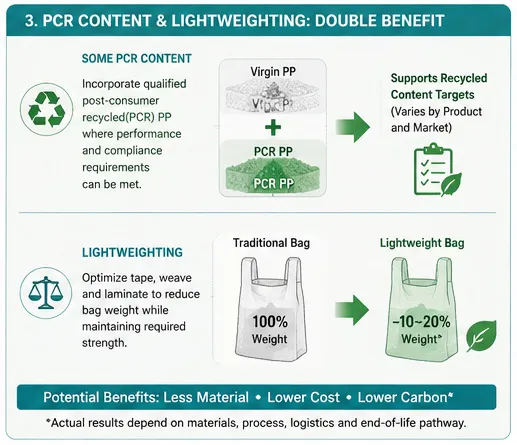
There is no single universal PCR percentage for PP woven bags in 2026. Recycled-content requirements depend on the packaging application, material type, target market and applicable regulation. For EU-bound packaging, buyers should distinguish voluntary recycled-content targets from mandatory minimum requirements and their respective application dates under the PPWR. The target PCR percentage should therefore be defined at SKU level together with the calculation method, evidence and regulatory basis.
- Food contact is constrained. Food-contact use of recycled PP is subject to specific requirements under Regulation (EU) 2022/1616, including rules concerning suitable recycling processes, decontamination and the use of recycled plastic in food-contact materials. Buyers should therefore verify the applicable food-contact compliance route and documentation for the finished bag and intended use. Whether virgin PP or qualified recycled PP is commercially preferable depends on the application, compliance requirements, material availability and supplier economics.
- PCR as a documented requirement. Documented PCR content can help buyers demonstrate recycled-content performance where a recycled-content requirement applies, but the required percentage, calculation method, evidence and application date depend on the applicable regulation and packaging category. Buyers should therefore specify the target PCR percentage together with the required evidence and regulatory basis.
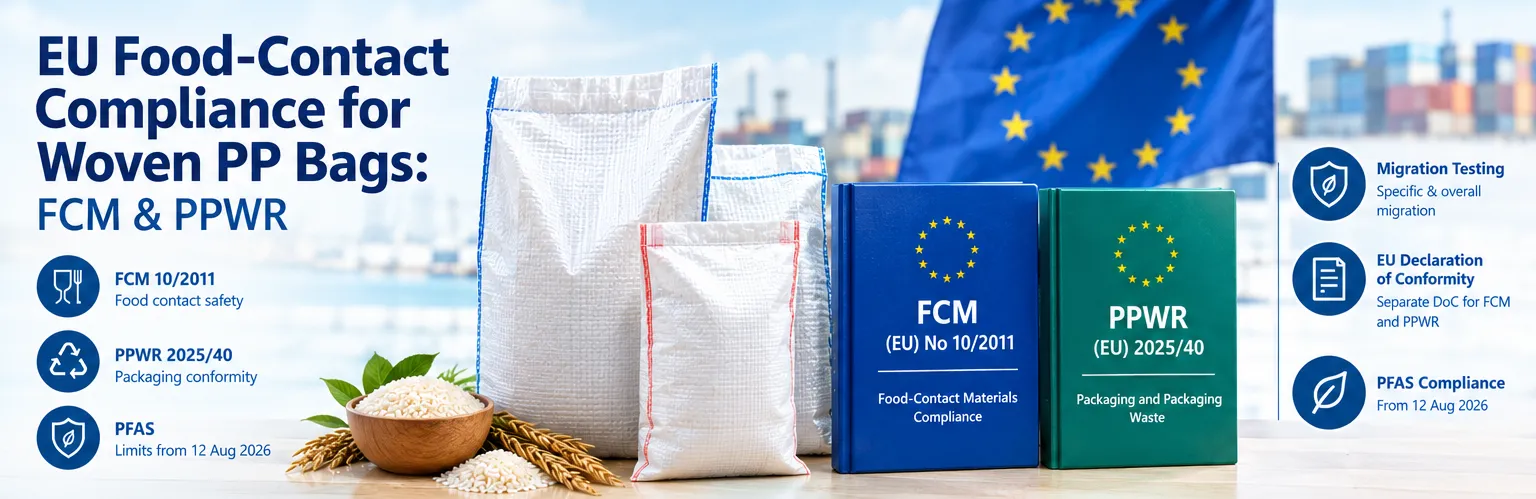
A food-grade PP woven bag and an industrial recyclable PP woven bag may require different material and compliance specifications. Food-contact safety and recyclability should be assessed separately for the finished SKU, including its resin, liner, inks, adhesives, coatings and intended use. A bag should not be described as food-contact compliant or recyclable solely because its main fabric is made from PP.
Lightweighting and Material Efficiency
Lightweighting can reduce PP consumption per bag when the required tensile, burst and handling performance is maintained. It can also reduce material-related cost and transport weight, but the environmental benefit depends on the production process, resin mix, transport profile and end-of-life pathway. Buyers should therefore compare bag weight together with performance data rather than treating lower GSM alone as proof of sustainability.
What Buyers Should Specify
| Specification | What to request |
|---|---|
| Material structure | Identify the resin used in the fabric, tapes, film, laminate and liner, and confirm the intended PP-compatible structure for the target recycling system. |
| Recycled content | State target PCR % and request documented recycled-content evidence for the specified SKU/material |
| Print system | Specify ink and coating chemistry according to the target market, and request documentation demonstrating compliance with applicable substance restrictions and recyclability requirements. |
| Liner | PP liner or linerless where feasible |
| Food contact | Specify virgin PP or legally suitable recycled PP where permitted, and request applicable food-contact declarations, migration testing and supporting documentation for the finished SKU and intended use. |
Note: GSM (grams per square metre) describes fabric mass per unit area, not strength. Buyers should specify both GSM and the tensile or burst requirements for the load, since a light GSM can still meet a high burst grade with the right tape and weave. Custom printed woven bags can use PP-compatible printing and laminate structures where recyclability is part of the buyer’s specification.
Why This Matters for OEM and Brand Buyers
For OEM relationships with a PP woven bags manufacturer, buyers can include mono-material structure, target PCR percentage, recyclability requirements and supporting documentation in the RFQ. These requests can strengthen compliance due diligence, but an RFQ or supplier declaration does not by itself establish legal compliance with the EU PPWR; the responsible economic operator must meet the applicable regulatory requirements and maintain the required technical documentation. Custom PP woven bags can be specified with mono-material structures, PCR targets, printing systems and application-specific performance requirements.
Key Takeaways
- The cited 2026 market reports indicate growing interest in recyclable PP woven bag programs, but supplier capability and adoption levels vary by market, product type and manufacturer.
- Mono-material PP construction can support recyclability objectives and future PPWR design-for-recycling assessment, but it does not automatically determine a recyclability grade or guarantee market compliance.
- PCR content varies by product and market, while EU requirements introduce specific recycled-content obligations and application dates; food-contact recycled PP is subject to additional requirements under Regulation (EU) 2022/1616.
- Buyers should specify material structure, PCR target, printing and liner system, performance requirements and target-market compliance requirements, then request documentation that supports the supplier’s claims and the finished SKU’s intended application.
The practical takeaway for recyclable mono-material PP woven bags is to treat recyclability as a designed-in specification rather than a marketing claim. Buyers should define the material structure, PCR target, printing and liner system, performance requirements and target-market compliance requirements, then request documentation that supports the supplier’s claims and the finished SKU’s intended application.
Sources and Methodology
This article uses secondary 2026 market reports to describe market direction and official EU regulatory sources to explain PPWR and recycled-plastic food-contact requirements. Market-report findings are presented as directional evidence because methodologies and market coverage vary by publisher. Regulatory statements are based on Regulation (EU) 2025/40 and Regulation (EU) 2022/1616.
Data period: market-direction references in this article are 2026 market reports; regulatory statements reflect the EU framework in force at the time of writing (Regulation (EU) 2025/40 and Regulation (EU) 2022/1616).
Frequently Asked Questions
There is no reliable single percentage that can be applied across all manufacturers. The 2026 market reports cited in this article describe growing availability of recyclable woven-bag programs, but their methodologies and market coverage differ, so buyers should verify individual supplier capability rather than use an aggregated percentage as an industry benchmark.
A mono-material PP woven bag is designed so that its main packaging components are polypropylene-compatible, such as PP woven fabric, PP tape and PP-based film or laminate. The presence of inks, adhesives, coatings, liners and other components must also be evaluated when determining the bag’s actual recyclability.
There is no universal PCR percentage for PP woven bags. The appropriate level depends on the application, required mechanical performance, feedstock quality, food-contact requirements and target-market regulations. For EU-bound packaging, buyers should specify the target PCR percentage together with the applicable calculation method, evidence and regulatory requirement.
Not necessarily. A PP-compatible laminate can support a mono-material PP approach, while laminates containing non-PP layers may introduce additional recyclability considerations. Buyers should confirm the resin composition of the laminate and evaluate the complete finished bag rather than assuming that all laminated bags are recyclable or non-recyclable.
Mono-material PP construction can support the PPWR’s design-for-recycling objectives, but it does not automatically qualify for a specific grade. Regulation (EU) 2025/40 establishes A, B and C recyclability performance grades at ≥95%, ≥80% and ≥70%, while the detailed design-for-recycling methodology is established through subsequent EU acts. The relevant requirements phase in from 2030, with additional recycled-at-scale requirements from 2035 and a higher minimum recyclability threshold from 2038.
Not necessarily. Cost depends on resin selection, PCR content, bag weight, printing, lamination, processing efficiency, compliance requirements and supplier economics. A mono-material design may add requirements for specific films, liners or printing systems, while lightweighting can reduce material consumption. Buyers should compare total cost together with required performance and compliance documentation.
Yes, a food-contact PP woven bag can also be designed with recyclability in mind, but the two requirements must be assessed separately. Recycled plastic intended for food contact is subject to Regulation (EU) 2022/1616 and applicable recycling-process and documentation requirements, while recyclability depends on the complete packaging structure and the requirements of the target market.
Specify the intended mono-material PP structure, target PCR percentage, resin and liner requirements, ink and coating system, required tensile or burst performance, target recycling market and applicable compliance requirements. Ask the supplier for supporting technical documentation, recycled-content evidence and any applicable recyclability or design-for-recycling assessment for the finished SKU.