



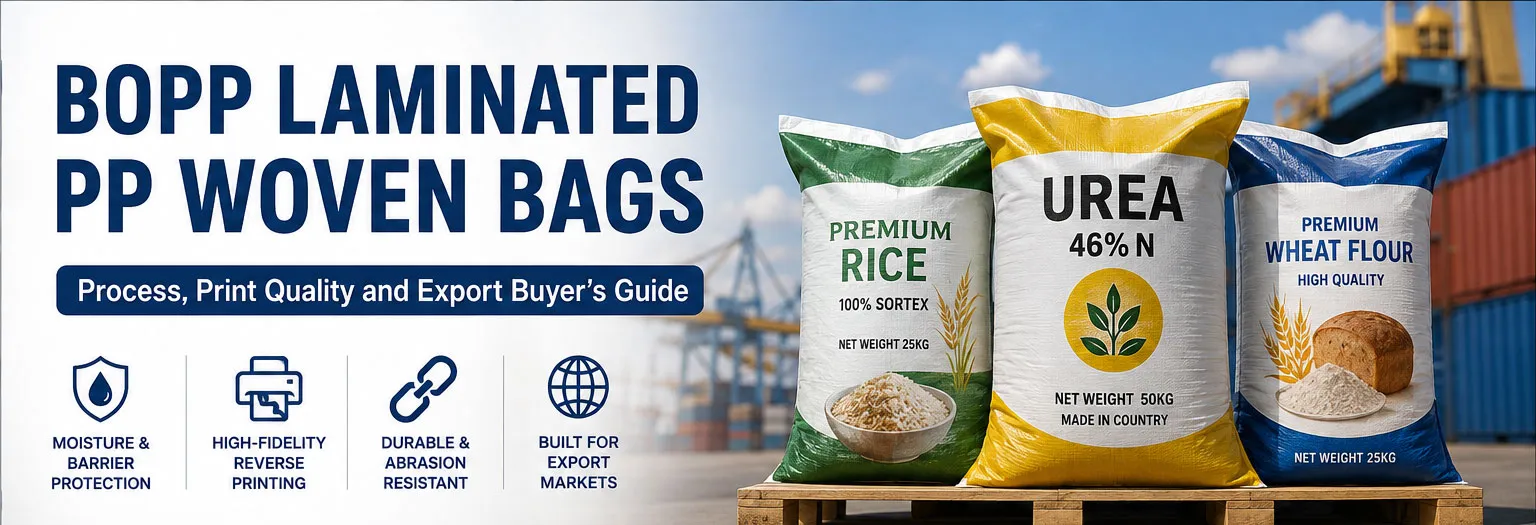
BOPP laminated PP woven bags are a premium tier of woven polypropylene packaging. Market-research estimates of the laminated share of the PP woven bag market vary by product definition and geographic scope; one estimate from Persistence Market Research puts laminated formats at roughly 53.8%, and premium laminated bags can command a higher average selling price than plain non-laminated sacks, with the actual premium depending on film, print and construction. The reason is that lamination adds moisture resistance, durability and a high-fidelity printable surface, while BOPP (biaxially oriented polypropylene) film printed by reverse rotogravure places the graphics within a protective structure that can help resist abrasion and scuffing under normal handling. This guide walks through the manufacturing process, the specs export buyers must define, the certifications to request, and the ink-compliance link to the EU PPWR.
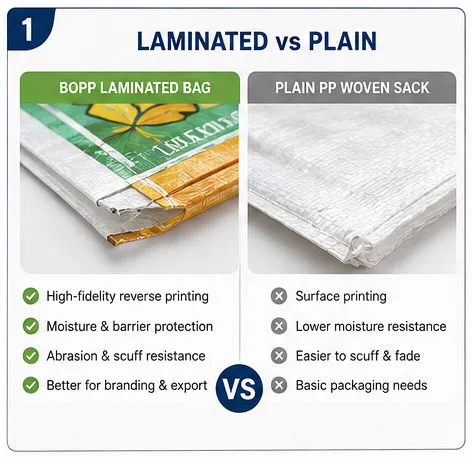
BOPP laminated PP woven bags are woven polypropylene sacks with a biaxially oriented polypropylene (BOPP) film laminated to the print surface. The film is applied by reverse rotogravure so graphics sit beneath a protective layer, and buyers typically select lamination when they need high-fidelity print, moisture or barrier performance, and abrasion resistance for branded or export packaging.
Why Laminated BOPP Leads the Woven Bag Market
Three factors make BOPP lamination important in the category:
- Protection. Extrusion-laminated PP can improve resistance to surface moisture, dust and product leakage; the required construction depends on the product, liner, closure and transport conditions.
- Brand surface. BOPP film supports detailed multi-colour printing and provides a smooth surface for product graphics, instructions and traceability information. For bags exposed to prolonged sunlight, buyers should specify the required lightfastness and UV-exposure performance rather than assuming that BOPP alone guarantees outdoor durability.
- Premium economics. Where end customers pay for print presentation and barrier performance, a higher average selling price on laminated bags can support a value-up path for a PP woven bags manufacturer.
For buyers, lamination is often selected when print presentation and moisture or barrier performance matter; the correct construction still depends on the product, logistics and destination, so the negotiation should focus on film specification and print.
BOPP Laminated Woven Bag Manufacturing Process
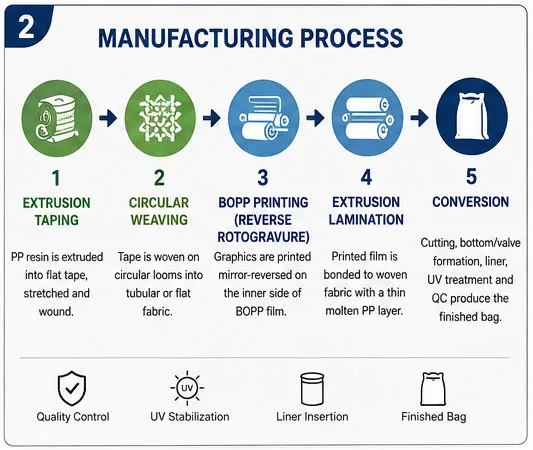
The typical process chain for a printed laminated BOPP bag is:
- Extrusion taping. PP resin is extruded into flat tape, stretched (orientation) and wound — this is the “woven” feedstock.
- Circular weaving. Tape is woven on circular looms into tubular or flat fabric at a defined GSM and weave density.
- BOPP printing (reverse rotogravure). For a reverse rotogravure printed PP woven sack, the artwork is printed in reverse on the appropriate side of the BOPP film before lamination, placing the graphics within the finished film-and-fabric structure.
- Extrusion lamination. The printed film is bonded to the woven fabric with a thin molten PP layer; in this extrusion-lamination route, the described structure does not use a solvent-based adhesive. Lamination structures and adhesive systems vary by supplier and construction, so confirm the actual route for the SKU.
- Conversion. Cutting, bottom/valve formation, liner insertion, UV stabilisation and quality control produce the finished bag; closure construction affects filling-line compatibility, while liner selection affects moisture and contamination control.
Because the ink is encapsulated beneath the BOPP film, buyers should compare abrasion and lightfastness against surface-printed alternatives using agreed SKU-level test methods and acceptance criteria for the intended handling environment, rather than assuming a performance gap from the construction alone.
What Buyers Must Specify
Export buyers should define the following on every request for quotation, because each lever changes both performance and price. For export, note that ocean FCL freight is constrained by both container volume and payload weight, so bag construction should be optimised against the packed product, palletisation and container plan — not simply by weight.
| Spec lever | What to define | Why it matters |
|---|---|---|
| Fabric GSM | Specify the target GSM and define the SKU acceptance range in the approved specification; verify by the agreed GSM test method. | Controls fabric mass and contributes to material cost, but GSM alone does not define bag strength. |
| Tensile / burst strength | Where mechanical performance is critical, add a separate tensile and burst requirement with the agreed test method and SKU-level acceptance values. | Load, drop and stacking performance — measured, not inferred from GSM |
| Weave density | ends × picks per inch | Tear resistance, sift-proofing |
| BOPP film thickness | Specify the target BOPP film thickness and SKU tolerance, with the measurement method defined in the approved specification. | Print fidelity, puncture resistance |
| Print colours | Confirm the maximum colour count against the selected printing process and artwork | Brand fidelity; more colours = cylinder cost |
| Inner liner | LDPE/PE, with or without | Moisture barrier for food/chemical |
| UV stabilisation | Specify the required UV-stabilisation system and define the exposure test and acceptance criterion for the intended outdoor or storage environment. | Required outdoor exposure performance — a formulation percentage alone does not establish service life |
| Closure | open-mouth / valve / block-bottom | Filling line compatibility |
Key Takeaway: Before production, agree the test method and SKU-level acceptance criteria for each important specification, including GSM, film thickness, tensile or burst performance and any required UV-exposure test. The RFQ should also state the bag construction, printing requirements, quantity, packaging method and destination-market compliance requirements. Customs classification should be confirmed separately with the buyer’s customs broker or the relevant authority because tariff classification depends on the specific product and importing market.
A BOPP laminated bag built to a clearly defined specification can be a suitable option for agricultural, food, construction and selected industrial applications where print quality, surface protection and product presentation justify the additional construction. The final design should still be matched to the product, filling method, storage conditions and destination-market requirements.
Look Beyond the Bag Price
For export buyers, the lowest quoted price is not always the lowest packaging cost. A heavier construction may increase material and freight costs, while an under-specified bag can create losses through damaged sacks, product leakage, slower filling or rejected shipments.
A practical comparison should therefore consider the total cost of the packaging system: unit price, container utilization, pallet efficiency, filling-line performance, expected damage rate, storage requirements and compliance costs. For large-volume orders, a slightly higher bag price can be commercially reasonable if it improves filling efficiency or reduces handling losses.
Matte or Gloss BOPP: Which Surface Should Buyers Choose?
Surface finish is another specification that is often overlooked during sourcing. Gloss BOPP generally gives graphics a brighter, more reflective appearance, while matte finishes create a softer visual effect and can reduce the perception of glare under some lighting conditions. The choice is mainly commercial rather than a universal performance upgrade. For food or retail packaging, buyers should approve the actual film sample together with the printed artwork because colour appearance can change with film finish, ink system and lighting conditions.
Approve the Finished Bag, Not Just the Artwork
A printed artwork proof is not enough to approve a BOPP laminated bag. Before mass production, buyers should review a finished physical sample and, where practical, test it under the intended filling, stacking and handling conditions.
The approval sample should represent the final construction, including fabric, BOPP film, print, lamination, liner if applicable, dimensions and closure. Keeping an approved sample and specification sheet gives both sides a physical reference for repeat orders and makes quality discussions much easier.
Export Compliance Documents and Certifications Buyers Should Request
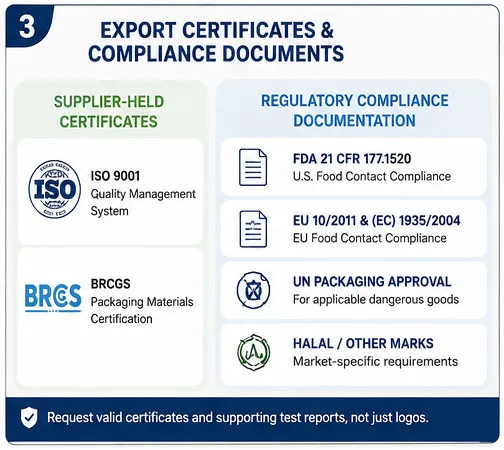
A supplier guide (e.g. Shandong Jiuyuan Packing’s 2026 export buyer’s guide) may list the following as buyer requirements, but the exact documents depend on the product, destination and contract. Verify regulatory requirements against the official authority for each market.
Commercial certifications (supplier-held):
- ISO 9001 — quality management system certification.
- BRCGS — site certification against the applicable BRCGS standard for packaging materials; request the specific scope and site.
Regulatory compliance documentation (not certificates a supplier “holds”):
- FDA 21 CFR 177.1520. FDA requirements applicable to the specific polymer, additives, inks, coatings and intended conditions of use should be reviewed for the complete packaging structure. For a finished BOPP laminated bag, buyers should request application-specific compliance documentation rather than treating one resin regulation as blanket approval of the finished bag.
- EU 10/2011 (+ Regulation (EC) 1935/2004) — EU food-contact regulatory framework; request a Declaration of Compliance and supporting migration data where applicable.
- UN packaging approval — may be required for applicable dangerous goods; determine the requirement from the substance classification, packing instruction and applicable transport regulation, then verify the exact UN design/type.
- Halal / other market-specific marks — where the destination market requires them.
Buyers should ask for valid certificates and, for food contact, migration test reports — not just a logo on the bag.
Ink Compliance and the PPWR Link
Under Article 5 of the EU Packaging and Packaging Waste Regulation (PPWR, Regulation (EU) 2025/40), which applies from 12 August 2026, the combined concentration of lead, cadmium, mercury and hexavalent chromium in packaging must not exceed 100 mg/kg, and PFAS in food-contact packaging are restricted at specified thresholds from the same date. These substance limits are only part of the PPWR; buyers should assess the full applicable requirements for their packaging, destination and product — not only these two controls — and verify that inks, coatings and other relevant components meet the applicable provisions. For non-food applications, the heavy-metal limit and other generally applicable requirements remain the relevant check.
For buyers specifying PP woven bags for the EU, this means requesting inks and coatings that meet the applicable PPWR substance limits, with a declaration of conformity and supporting compliance documentation — the same discipline the PPWR pushes across woven PP packaging.
Traceability and Quality Control
Two production-control practices are becoming increasingly useful for buyers that need stronger traceability and inspection:
- Batch or QR traceability. A batch number or QR code can link a production lot to material information, inspection records and shipment details. The required level of traceability should be matched to the product and recall risk.
- Automated visual inspection. Camera-based inspection systems can help identify selected defects such as printing errors, fabric problems or conversion defects before shipment. These systems are not universal across suppliers, so buyers should treat them as a supplier capability to evaluate rather than a standard requirement for every bag.
For repeat export orders, the more important objective is consistent inspection criteria and traceable production records, regardless of whether inspection is manual, automated or a combination of both.
Choosing a BOPP Laminated Bag Supplier
A short supplier scorecard:
- In-house BOPP printing and lamination (not subcontracted), which can simplify production coordination and lead-time control.
- Documented food-contact and quality certifications, plus applicable regulatory compliance documentation.
- MOQ and capacity confirmed against the buyer’s SKU mix, order volume and peak-season requirements, stated as supplier-specific commercial terms.
- Defined print-registration tolerance and measurement method, specified in the approved artwork/SKU specification.
- Clear price-adjustment terms stating how PP resin changes are reflected in quotation validity and revision.
- Traceability and inspection systems in production.
Key Takeaways
- Market-research estimates of the laminated share vary by definition and geography; one Persistence Market Research estimate puts laminated formats at roughly 53.8%, and laminated bags can command a higher average selling price than plain sacks, though the premium varies by film, print and construction.
- Reverse rotogravure print is encapsulated beneath the film; buyers should verify abrasion and lightfastness against surface print using agreed SKU-level test methods and acceptance criteria.
- Buyers must specify GSM, weave, BOPP thickness, colours, liner, UV and closure on every RFQ.
- Request applicable ISO/BRCGS certificates, plus the relevant food-contact, dangerous-goods and market-specific compliance documentation.
- The EU PPWR sets heavy-metal and food-contact PFAS limits — for EU-bound bags, specify inks and coatings that meet the applicable substance limits and obtain supporting compliance documentation.
- Batch or QR traceability and automated visual inspection can support lot-level control and faster investigation if a quality issue occurs.
For branded and export packaging, the right move is to spec BOPP laminated PP woven bags fully — film, print, liner and certification — and select a manufacturer with integrated printing, documented compliance and traceability.
Frequently Asked Questions
Laminated formats represent a substantial segment of the PP woven bag market, although the reported share varies between market research publishers because product definitions and geographic coverage differ. For buyers, the more useful consideration is whether lamination provides enough moisture protection, print quality, surface durability or branding value for the intended application.
Laminated bags add BOPP film, reverse-printed graphics and a moisture- or barrier-performing structure, so they typically cost more per unit than plain non-laminated sacks. The size of the premium varies with film specification, print coverage and construction, so buyers should compare quotations against an identical spec rather than a generic percentage.
It is a gravure process that prints graphics mirror-reversed on the inside of the BOPP film so the printed layer is positioned within the finished laminated structure, protected from routine scuffing and handling damage. Actual lightfastness and outdoor performance depend on the film, ink system and exposure conditions, so buyers should specify the required test method for the intended application.
Depending on the application and destination, buyers may request ISO 9001, evidence of US food-contact compliance (FDA 21 CFR 177.1520), EU food-contact documentation (EU 10/2011), BRCGS and, for applicable dangerous goods, UN packaging approval — with valid certificates, not just logos.
Regulation (EU) 2025/40, the EU Packaging and Packaging Waste Regulation (PPWR), includes Article 5 restrictions on certain substances in packaging, such as a combined lead, cadmium, mercury and hexavalent-chromium limit of 100 mg/kg and specific PFAS requirements for food-contact packaging, with detailed application subject to the regulation and its implementing guidance. For EU food-contact printed bags, request inks and coatings that meet the applicable limits and obtain a declaration of conformity with supporting documentation. For non-food bags, the PFAS food-contact provision does not apply, so focus on the generally applicable requirements — and note these substance limits are only part of the PPWR, so assess the full applicable requirements for the packaging and destination.
Define fabric GSM, weave density, BOPP film thickness, print colours (confirm the maximum count against the printing process), inner liner, UV stabilisation and closure type — each changes performance and price. Where load or stacking performance is critical, add a separate tensile/burst requirement with its test method and SKU acceptance, since GSM measures fabric mass rather than strength.
It is a batch or QR code on the bag linking it to its production lot, materials and test record. The appropriate level is SKU-specific: some programs need only lot-level coding, while higher recall-risk applications may specify a unique code per bag.
Require printed proof/colour matching against sealed samples, a sealed production sample with the registration tolerance and measurement method specified, and supplier automated or AI-assisted visual inspection reports at the conversion line.