


Demand is led by chemicals, agriculture and food, while safety requirements, product specifications, traceability and sustainability considerations increasingly influence procurement alongside price. This overview draws on 2026 market data and buyer-guide sources for importers and bulk-packaging specifiers.
An FIBC (Flexible Intermediate Bulk Container), also known as an FIBC bag, bulk bag or jumbo bag, is a flexible container typically made from woven polypropylene and designed to store and transport dry flowable materials such as powders, granules and flakes. Common FIBC capacities range from several hundred kilograms to more than one tonne, depending on the design, safe working load and application.
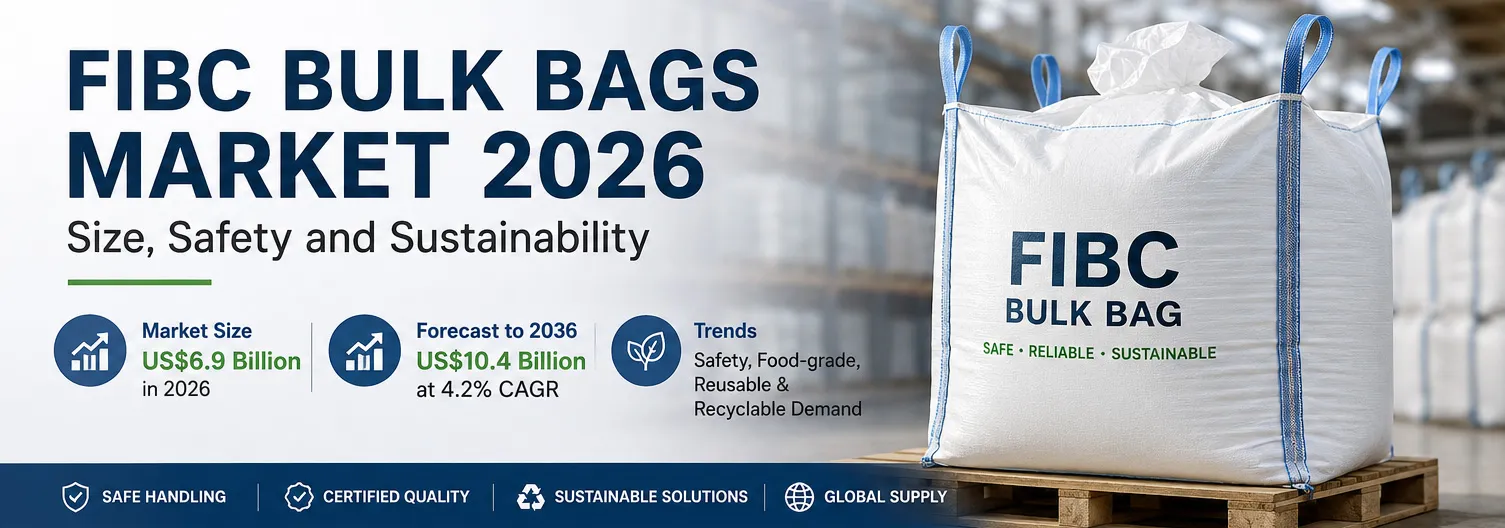
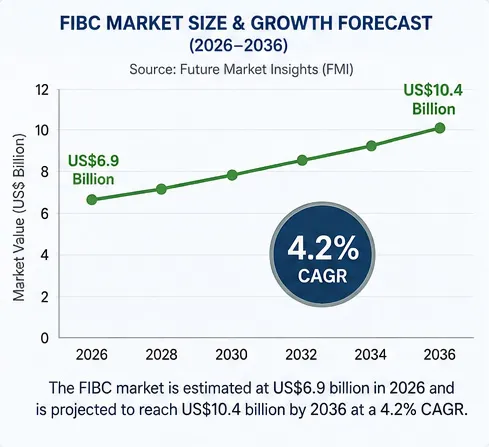
Quick answer: The global FIBC bags market is estimated at US$6.9 billion in 2026 and is forecast to reach US$10.4 billion by 2036 at a 4.2% CAGR. For buyers, the main specification priorities are safe working load, static-control type, food-contact requirements, applicable UN certification for dangerous goods, fabric and liner construction, and documented quality and traceability.
Market Size and Growth
Future Market Insights estimates the global FIBC market at US$6.9 billion in 2026 and projects it to reach US$10.4 billion by 2036, representing a 4.2% CAGR. The projected growth reflects continued demand from established industrial and agricultural applications, alongside ongoing requirements for bulk-material handling, product safety, customization and more sustainable packaging solutions.
End-Use Demand by Sector
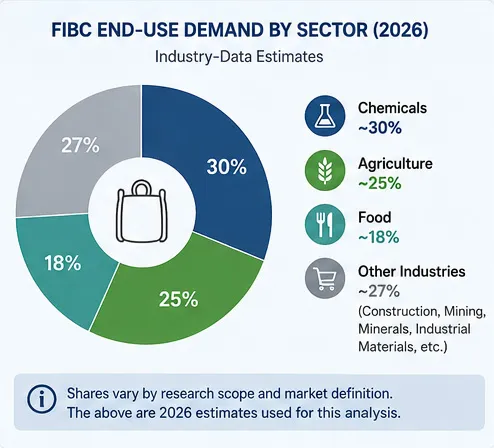
Chemicals, agriculture and food are among the major FIBC end-use sectors. The sector shares shown below are the 2026 industry-data estimates used for this analysis and should be treated as indicative rather than universal market shares, because reported shares vary by research methodology, geography and market definition.
| End-use sector | Share of FIBC demand |
|---|---|
| Chemicals | ~30% |
| Agriculture | ~25% |
| Food | ~18% |
Other important FIBC applications include construction, mining, minerals, chemicals processing and industrial materials. Specification priorities vary by application: electrostatic-control requirements may be important for suitable chemical applications, food-contact documentation for food products, and fabric strength, UV resistance and handling performance for demanding outdoor or mining environments.
Material: Polypropylene Dominates
Woven polypropylene is the dominant FIBC material, with Future Market Insights estimating about 78% share in 2026. PP is widely used because it combines low weight, strength, established conversion processes and useful resistance to many chemicals, although material compatibility should always be confirmed against the specific product, concentration and operating conditions. Typical FIBC construction combines woven PP fabric with lifting loops, filling and discharge configurations, and optional coatings or liners matched to the application.
For FIBC bulk bags, the base material decision is rarely about substitution; it is about fabric weight, coating, liner and loop construction matched to the product and route.
Safety and Compliance: Types, UN and ISO
FIBC safety classification matters because the wrong type for a hazardous or combustible product creates real risk:
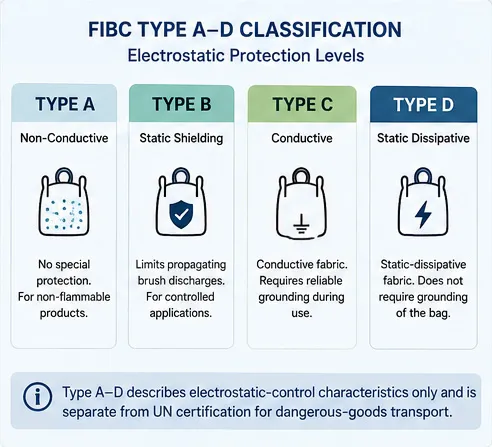
- Type A — plain woven fabric with no static-control protection, generally used for non-flammable products where electrostatic hazards are not present.
- Type B — designed to limit propagating brush discharges and used for suitable applications where the ignition risk from electrostatic discharge is controlled.
- Type C (conductive) — contains interconnected conductive threads and must be reliably grounded during filling and discharge; commonly selected for suitable flammable-powder applications where grounding can be controlled.
- Type D (static-dissipative) — uses static-dissipative fabric and does not require grounding of the bag; commonly selected for suitable electrostatic-hazard applications where the complete bag and operating conditions meet the required safety criteria.
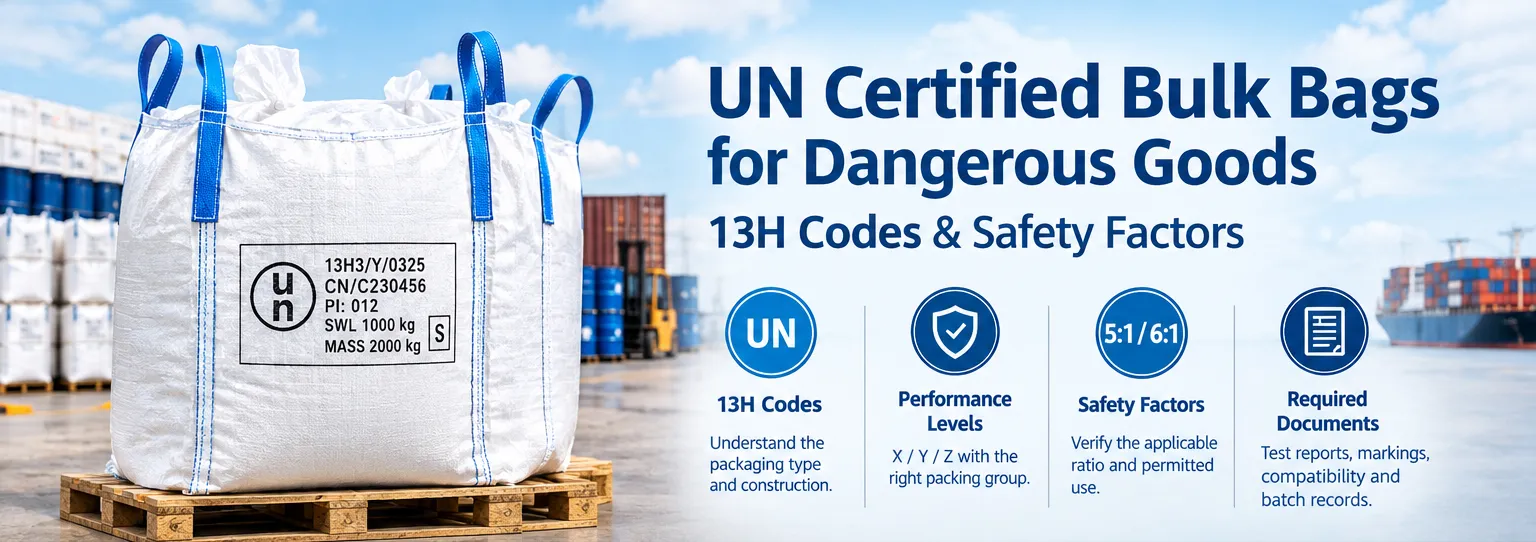
For hazardous-goods transport, the applicable UN dangerous-goods packaging requirements and certification must be followed, with flexible IBC designs identified by codes such as 13H1, 13H2, 13H3 and 13H4. ISO 21898:2024 is a separate FIBC standard for non-dangerous goods and specifies materials, construction, design, type testing and marking requirements. Buyers should request the certification and test documentation applicable to the specific product, filling and transport conditions.
FIBC Type A-D classification describes electrostatic-control characteristics and should not be treated as a substitute for the separate UN dangerous-goods classification required for applicable hazardous-goods transport.
Food-Grade and Sustainability
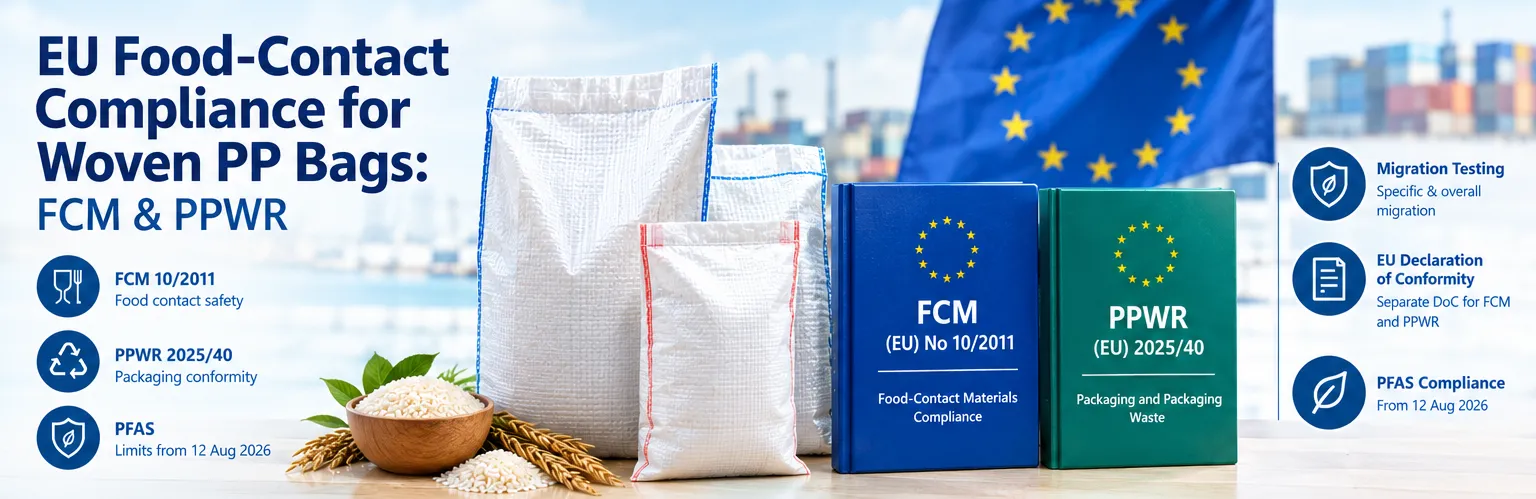
Food-grade FIBCs can be manufactured for food-contact applications using materials, production controls and testing appropriate to the destination market. Buyers should request the specific food-contact declaration, migration or other compliance documentation applicable to the intended product, market and packaging configuration. Recyclability and reusability are increasingly considered in packaging procurement, particularly where buyers have suitable return logistics or material-recovery routes. Reusable PP woven FIBCs can support multiple-use programs when inspection and handling controls are in place, while mono-material constructions may simplify material recovery when compatible collection and recycling infrastructure is available.
Reusable (multi-trip) FIBCs are gaining attention where buyers can control return logistics and inspection programs, because repeated use can reduce cost per use and support packaging-waste reduction goals. For OEM and custom FIBC programs, this increases the importance of documented safety factors, reinforced seams, consistent fabric quality and inspection procedures for the intended number of handling cycles.
Supply: Global Manufacturing and Export Base
China is a major global FIBC manufacturing and export base, supported by integrated polypropylene supply, weaving, sewing and printing capacity. Importers in Africa, South America and Central America source from Asian manufacturers based on production capacity, lead time, customization, certification and total landed cost.
The procurement implication is to qualify suppliers on certification, auditability and traceability rather than price alone, particularly for food-contact and dangerous-goods applications where the required technical and compliance documentation should match the specific product, market and transport conditions.
Buyer Guidance
| If you handle… | Specify… | Why it matters |
|---|---|---|
| Flammable powders / electrostatic hazards | Suitable Type C with a verified grounding procedure, or a suitable Type D design, selected according to the product, atmosphere, filling/discharge equipment and application risk assessment | Controls electrostatic ignition risk when correctly specified and operated |
| Food ingredients | Food-contact compliant materials, controlled production and applicable migration documentation | Supports hygiene and destination-market compliance |
| Hazardous goods | Applicable UN-certified flexible IBC design and required dangerous-goods documentation | Supports dangerous-goods transport compliance |
| Outdoor / mining storage | UV-stabilised fabric, suitable fabric weight and reinforced lifting construction | Improves resistance to weather and demanding handling conditions |
| Circular-economy targets | Reusable construction or recyclable mono-material design with documented material and quality controls | Supports lifecycle and material-recovery objectives |
Key Takeaways
- Future Market Insights estimates the global FIBC market at about US$6.9 billion in 2026 and projects it to reach US$10.4 billion by 2036 at a 4.2% CAGR.
- Chemicals, agriculture and food are among the major end-use sectors, with 2026 industry-data estimates of approximately 30%, 25% and 18% respectively.
- Polypropylene is the dominant FIBC material, with Future Market Insights estimating about 78% material share in 2026; other specifications may use different constructions or materials depending on the application.
- Safety typing (A/B/C/D), applicable UN certification and ISO 21898 for non-dangerous goods are key procurement considerations.
- Food-contact, reusable and recyclable FIBC specifications are increasingly relevant to buyers evaluating hygiene, lifecycle cost, packaging recovery and sustainability requirements.
- China is a major manufacturing and export base; qualify suppliers on certification and traceability, not price alone.
For importers, the practical approach is to specify FIBCs by application and duty, including static-control type, food-contact requirements, applicable UN certification, UV resistance, safe working load, fabric construction and reuse requirements. Suppliers should be able to provide the relevant technical and compliance documentation for the specified configuration. Request a tailored FIBC quotation through the contact page once the required specifications are confirmed.
Frequently Asked Questions
Future Market Insights estimates the global FIBC market at about US$6.9 billion in 2026 and projects it to reach US$10.4 billion by 2036 at a 4.2% compound annual growth rate.
Chemicals, agriculture and food are among the major FIBC end-use sectors. The 2026 estimates used in this analysis indicate approximately 30% for chemicals, 25% for agriculture and 18% for food, but reported shares can vary by research methodology, geography and market definition.
Type C uses conductive elements and must be reliably grounded during filling and discharge, while Type D uses static-dissipative fabric and does not require grounding of the bag. Both can be appropriate for certain electrostatic-hazard applications, but the correct choice depends on the product, atmosphere, filling and discharge equipment, liner and applicable safety requirements.
They can be manufactured for food-contact applications, but “food-grade” does not by itself establish compliance with every FDA or EU requirement. Buyers should request the specific food-contact declaration, migration or testing documentation applicable to the destination market, product and packaging configuration.
ISO 21898:2024 specifies materials, construction, design, type-testing and marking requirements for FIBCs intended for non-dangerous solid materials. It also provides guidance on selection and safe use, so buyers should verify the applicable test and marking documentation against the specific FIBC design and rated safe working load.
Reusable (multi-trip) FIBCs are gaining attention where buyers can control return logistics, inspection and handling programs. Multiple-use systems can reduce packaging cost per use and packaging waste when the bags are suitable for repeated handling and the additional logistics, inspection and maintenance requirements are economically justified.
Most FIBCs are made from woven polypropylene, which is widely used because it combines low weight, strength, chemical resistance and established conversion processes. Future Market Insights estimates polypropylene at about 78% of FIBC material share in 2026. Depending on the application, FIBCs may also include coatings, liners, conductive elements, lifting loops and other components.
China is a major global FIBC manufacturing and export base, serving buyers across Africa, South America, Central America and other markets. Supplier selection should consider production capability, certification, traceability, lead time and total landed cost rather than export origin alone.