


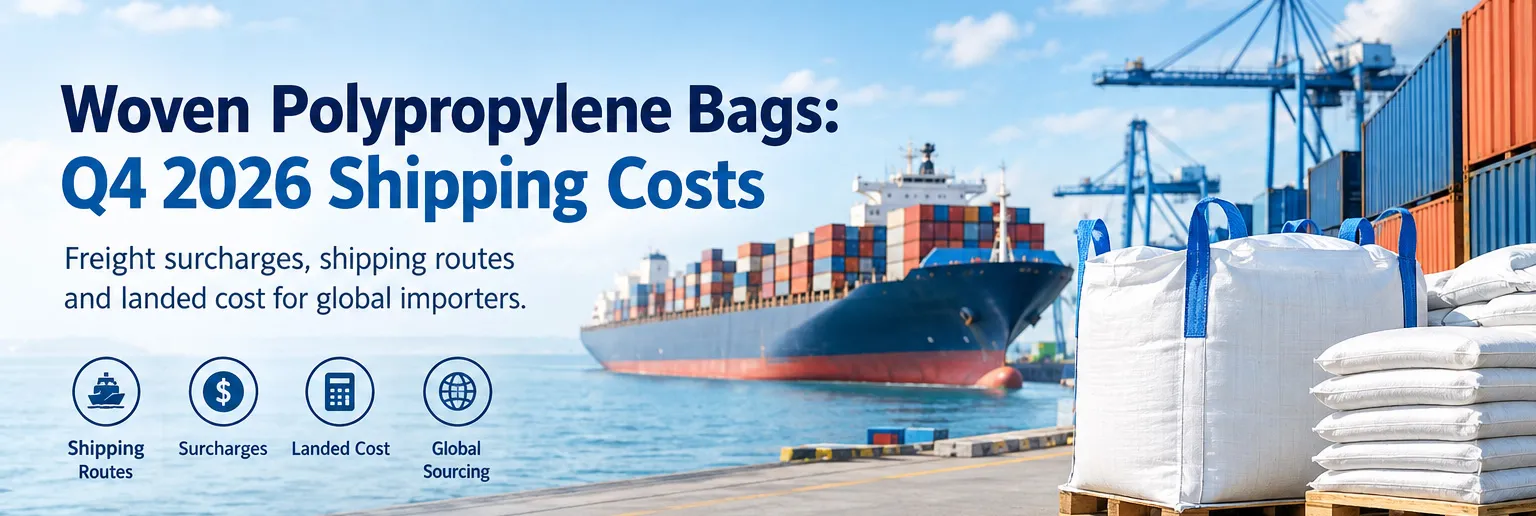
Shipping costs are a critical part of procurement for importers of woven polypropylene bags, PP woven bags and FIBC bulk bags. From 15 October 2026, several carrier rate adjustments affect selected routes from Asia to South Africa, Mauritius and Latin America. Depending on the carrier, equipment type, booking terms and destination, these changes can materially increase the total cost of importing woven bags.
This guide explains how to verify applicable ocean freight surcharges, compare shipping quotations and calculate landed cost per 1,000 bags and per tonne. For importers sourcing from a PP woven bags manufacturer, the goal is to compare suppliers using the same route, container type, shipment quantity and cost assumptions.
October 2026 Carrier Rate Changes: Scope and Applicability
Three published carrier announcements from Maersk, CMA CGM y Hapag-Lloyd are relevant to selected Asia-to-Africa and Asia-to-Latin America shipments. Their charges should be checked separately because the applicable amount depends on the carrier, origin, destination, container type and booking terms.
| Carrier | Route | Rate adjustment | Published amount |
|---|---|---|---|
| Maersk | Selected Far East Asian origins to South Africa and Mauritius | Peak Season Surcharge (PSS) | USD 250 per 20-foot dry container; USD 500 per 40-foot dry container |
| CMA CGM | Asian ports to specified Latin America, Central America, Caribbean and Mexico destinations | Rate increase | USD 1,000 per container |
| Hapag-Lloyd | Far East to specified South American, Mexican, Central American and Caribbean destinations | General Rate Increase (GRI) | Most listed container rates increase by USD 1,000 per container; check equipment-specific exceptions |
Maersk’s announcement specifies an effective date of 15 October 2026 for the covered origins and destinations. CMA CGM identifies 15 October 2026 as the loading date for its announced increase. Hapag-Lloyd also publishes revised rates effective from 15 October 2026, subject to the scope and equipment conditions in its notice.
The published amounts above are subject to each carrier’s official notice, including its covered origins and destinations, equipment-specific conditions and effective dates. Before using these figures in a purchase decision, verify the original announcement and obtain written confirmation from the carrier or freight forwarder. Where a rate has been revised or withdrawn, use the latest applicable quotation instead of relying on an earlier notice.
Before booking, confirm the latest applicable tariff, rate validity, equipment eligibility and whether the adjustment is already included in the quoted ocean freight. Additional origin, destination, fuel, security or local charges may apply.
Conclusión del comprador: Do not add a published surcharge automatically to every quotation. First verify whether the shipment falls within the announcement’s scope and whether the freight rate already includes the adjustment.
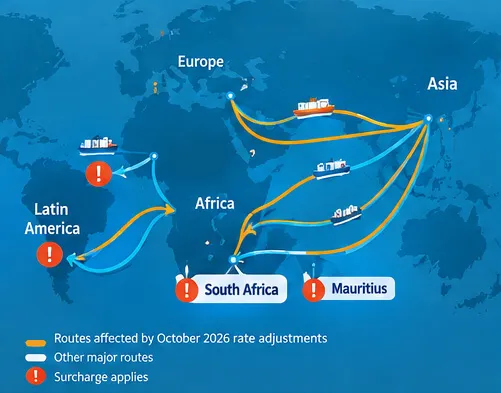
Why Shipping Costs Can Rise Across Africa and Latin America Routes
Carrier rate changes do not necessarily share one cause. Seasonal cargo demand, vessel capacity, equipment availability, sailing schedules and carrier pricing decisions can all influence freight costs, but their impact varies by trade lane.
For woven polypropylene bags and other lightweight, bulky cargo, buyers should focus on the actual cost of the selected route rather than assume that a rate increase on one lane predicts changes elsewhere. A surcharge announced for South Africa and Mauritius does not automatically apply to West African destinations such as Lagos, Tema or Abidjan.
For each shipment, verify the origin and destination ports, effective date, equipment type, carrier and applicable surcharge. Use a current booking quotation to assess whether a published rate change affects the purchase decision.
How to Compare Freight Rates for PP Woven Bags
Ocean freight rates vary by origin port, destination port, container size, equipment availability, carrier and booking date. A single regional average may not reflect the rate available for a specific shipment of PP woven bags.
For a reliable comparison, obtain current quotations for the same origin-destination pair and the same equipment type, such as 40GP or 40HC. Record the quotation date, base ocean freight, applicable surcharges, rate validity and destination charges.
Treat third-party rate indexes as planning references rather than confirmed booking prices. Before committing to an order, verify the total freight cost and applicable surcharges directly with the carrier or freight forwarder.
Landed Cost Calculator for PP Woven Bags
To compare PP woven bags manufacturers quotations fairly, use the same shipment quantity, route, container type and cost assumptions. Factory price alone does not show the full cost of importing the goods.
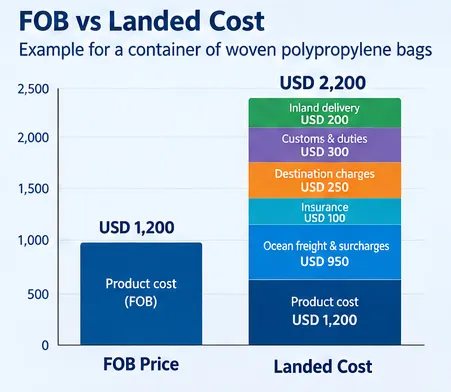
A practical landed-cost model is:
Total landed cost = Product cost + Origin charges + Ocean freight + Applicable surcharges + Insurance + Destination charges + Customs clearance + Import duties and taxes + Inland delivery
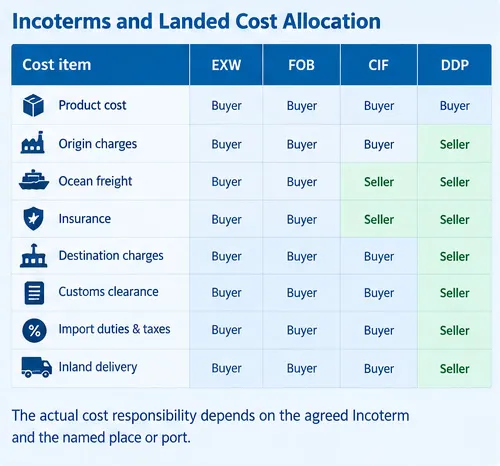
Use FOB as the product-and-origin-cost reference only when the agreed Incoterm and quotation clearly define those costs. For a comparable landed-cost estimate, add the applicable ocean freight, surcharges, insurance, destination charges, customs clearance, import duties and taxes, and inland delivery. Adjust the model to the actual transaction terms, exclude charges already included in quoted rates, and state any excluded costs explicitly. Import duties and taxes must be verified for the destination country and product classification; for US-bound shipments, review the 2026 US tariff guide for PP woven bags before finalising landed-cost assumptions.
For supplier comparisons, calculate:
- Landed cost per 1,000 bags: Total landed cost ÷ Total number of bags × 1,000.
- Landed cost per tonne: Total landed cost ÷ Net product weight in tonnes.
- Freight surcharge per bag: Applicable container surcharge ÷ Total bags in the container.
- Freight surcharge per tonne: Applicable container surcharge ÷ Net product weight in tonnes.
Example: Measuring the Impact of a Container Surcharge
Assume a shipment carries 20 tonnes of woven bags and incurs an additional container charge of USD 500. The surcharge adds USD 25 per tonne before considering any other freight or destination-cost changes.
The per-bag impact depends on how many bags fit into the container. For example, if the shipment contains 40,000 bags, the same USD 500 charge adds USD 12.50 per 1,000 bags, or USD 0.0125 per bag.
These figures are illustrative, not a freight quotation. Actual container loading capacity depends on bag dimensions, packing configuration, payload limits and the applicable transport restrictions.
Conclusión del comprador: Compare landed cost per 1,000 bags for unit economics and landed cost per tonne for weight-based comparisons. Use both measures when evaluating alternative bag specifications or shipping arrangements.
For sourcing enquiries, visit the SITONG PP woven bags manufacturer page to review product information, or contact SITONG with your bag specifications, order quantity and destination port. This information helps the team prepare a quotation based on your actual sourcing and shipping requirements.
Five Ways to Control Shipping Costs for Woven Bags
- Lock the rate: Negotiate a rate validity window and book inside it; surcharges applied “until further notice” can move between bookings.
- Split and mix: Combine bag SKUs into one full container to spread the surcharge across more units.
- Re-evaluate the port: A nearby alternative discharge port can change destination charges more than the ocean line.
- Book strategically: Compare available sailings, space availability and rate validity before confirming an order. Book early when capacity or transit-time requirements justify it, but confirm in writing which freight rates and surcharges are covered by the booking.
- Itemise the quote: Require PSS/GRI as separate lines so future changes are visible and comparable.
For Africa-specific bag demand, see the Bolsas tejidas PP Mercado africano overview. The cement-bag and Nigeria import guides show how landed cost changes the buying case in those markets.
Conclusión
For importers of woven polypropylene bags, shipping costs are an essential part of procurement planning in Q4 2026. Carrier announcements can affect selected routes differently, so buyers should verify each surcharge against the actual booking conditions and calculate total landed cost before placing an order.
Compare PP woven bags manufacturers using consistent product specifications, shipment quantities, freight assumptions and destination costs. By itemising surcharges, checking quotation validity, improving container utilisation and evaluating alternative ports, buyers can make more defensible purchasing decisions and protect import margins.
For sourcing enquiries, visit the SITONG PP woven bags manufacturer page to review product information, or contact SITONG with your bag specifications, order quantity and destination port. This information helps the team prepare a quotation based on your actual sourcing and shipping requirements.
Preguntas frecuentes
Check the carrier’s official notice, origin and destination ports, container type, effective date and booking conditions. Ask your carrier or freight forwarder to confirm the applicable amount in writing.
Use the same bag specifications, order quantity, shipping route, container type and destination-cost assumptions. Compare landed cost per 1,000 bags and per tonne instead of relying on factory price alone.
Divide the applicable container surcharge by the number of bags shipped. For weight-based analysis, divide the surcharge by the net product weight in tonnes. The result depends on the actual loading quantity and container configuration.
Combining compatible SKUs in one container can spread fixed per-container charges across more bags. However, the actual savings depend on loading efficiency, order quantities, handling requirements and whether consolidation changes the freight rate.
Yes, when the alternative is operationally feasible. Compare ocean freight, destination terminal charges, customs clearance, inland transport, transit time and delivery risk before choosing a port.
Depending on the transaction, include product cost, origin charges, ocean freight, applicable surcharges, insurance, destination charges, customs clearance, import duties and taxes, and inland delivery. Avoid double-counting fees already included in the quotation.