


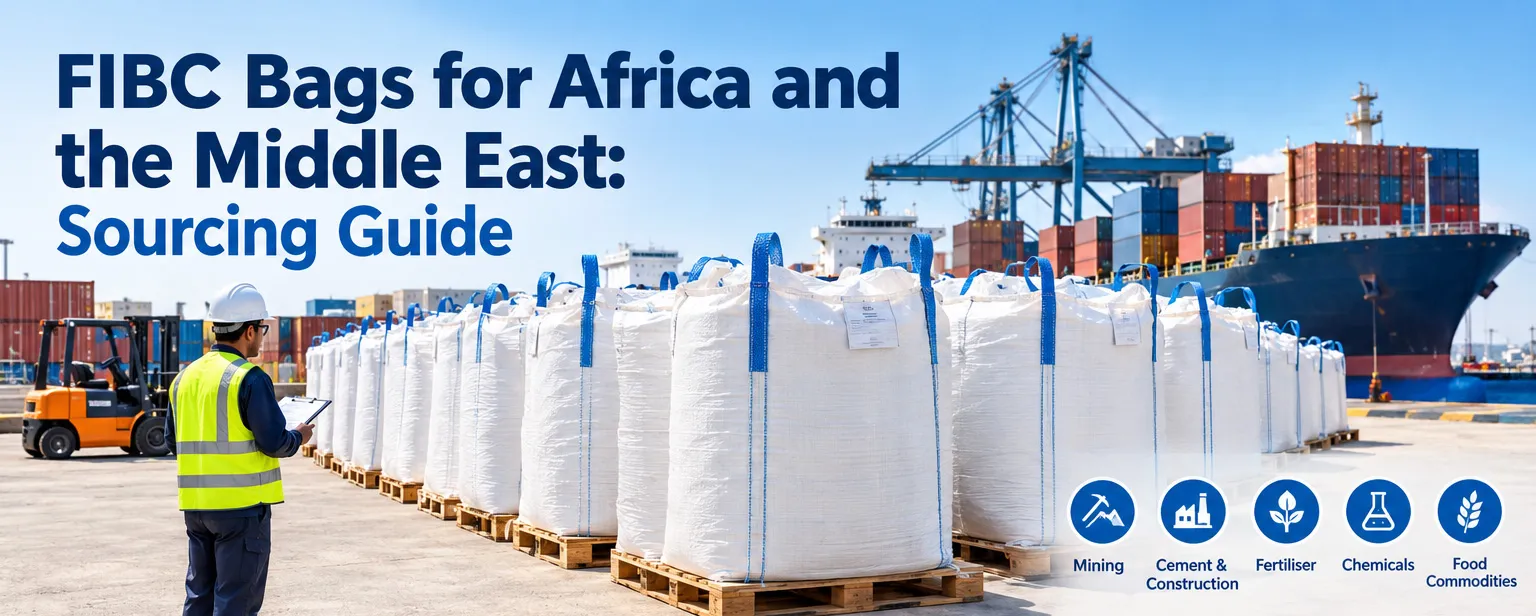
Across markets such as Nigeria, South Africa, Egypt, Saudi Arabia and the UAE, FIBC bags are widely used for cement, minerals, fertiliser and food commodity supply chains. Sourcing FIBC bags for Africa and the Middle East is therefore less about finding a supplier and more about matching the bag to the route: high solar UV exposure, coastal humidity, long inland haulage, and port handling that is often manual at the last leg. This guide covers the demand drivers, how climate and logistics change the specification, and the import steps that decide whether a container clears smoothly.
إجابة سريعة: Demand for FIBC bags across Africa and the Middle East is driven mainly by mining, cement and construction materials, fertiliser, chemicals and agricultural commodities. For importers, the critical buying factors are not only capacity but UV resistance, moisture protection, lift design, stacking stability and compatibility with the handling conditions at both ends of the route.
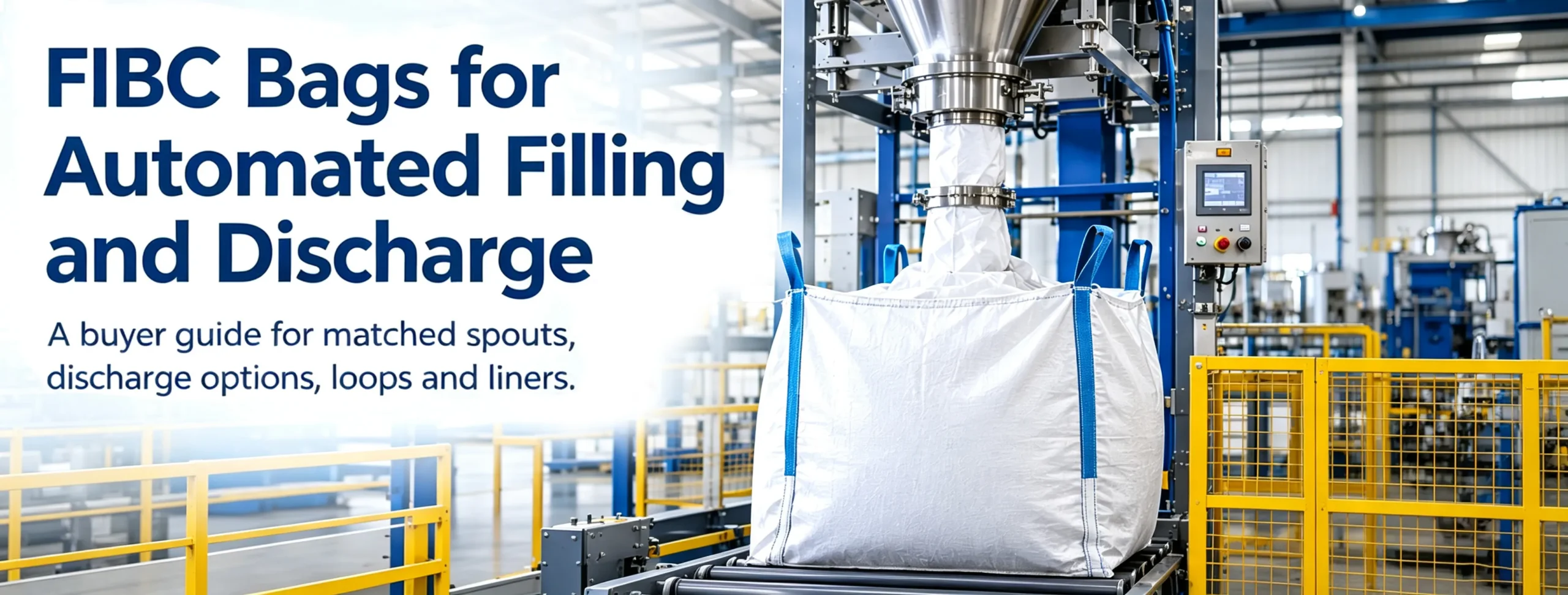
Definition: An FIBC (Flexible Intermediate Bulk Container) is a woven polypropylene bulk bag, typically handling several hundred to a couple of thousand kilograms, lifted by integral loops and used for dry flowable solids. ISO 21898 is the commonly referenced standard for non-dangerous-goods FIBC.
What Drives FIBC Demand Across These Regions
Industry reports on flexible intermediate bulk containers consistently identify construction materials, mining, agriculture, chemicals and food commodities as the major application sectors, per 360iResearch’s coverage of the category. In Africa and the Middle East those sectors are closely connected with infrastructure investment, mineral exports, agricultural production and bulk commodity distribution, and each one pulls a different bag design.
Cement and construction materials
Cement, fly ash, gypsum and dry mortar move in bulk wherever infrastructure and housing programmes are active. These are dense, abrasive, dust-generating products. The bag needs fabric and seam construction appropriate to the fill weight, a filling and discharge arrangement that keeps dust under control at both ends, and a surface that tolerates being dragged across a yard.
Mining and mineral concentrates
Ore concentrates, silica sand, and processed minerals are high-density and frequently exported from inland sites. Bag design here is driven by the lift method at the mine and the discharge method at the smelter or port, and the same requirements appear across mining and mineral packaging in smaller woven formats.
Fertiliser, chemicals and food commodities
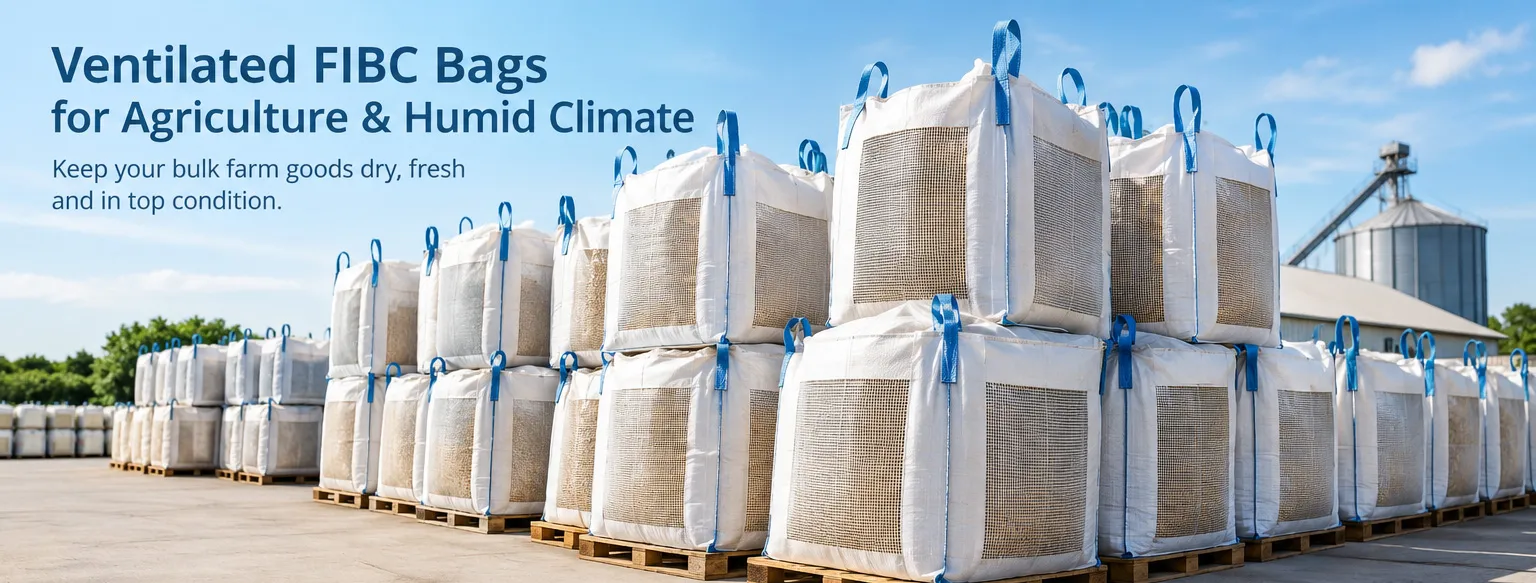
Urea, NPK blends and industrial chemicals are hygroscopic and often shipped across long sea legs. Food commodities such as grain, sugar and flour add a food-contact documentation layer. Moisture protection and, in several cases, a liner become the deciding specification rather than an option.
الوجبات الجاهزة الرئيسية: Four end-use clusters generate most regional volume, and each prioritises a different part of the specification. Naming the product and the route is the first step in specifying the bag.
Regional demand examples: African and Gulf markets
Demand patterns differ by market. South African importers often evaluate FIBC specifications around mining, agriculture and industrial packaging, while West and East African economies draw on them for agricultural commodities, fertiliser distribution and mining exports. Gulf markets including Saudi Arabia and the UAE draw on them for construction, chemicals and industrial processing. Naming the destination market helps an importer settle the bag structure before shipment rather than after arrival.
Why Importers Here Specify Differently
The same bag that performs on a short European route can underperform on a Gulf or West African one. The variables below are the ones that most often change the specification.
| Regional factor | What it does to the bag | Specification response |
|---|---|---|
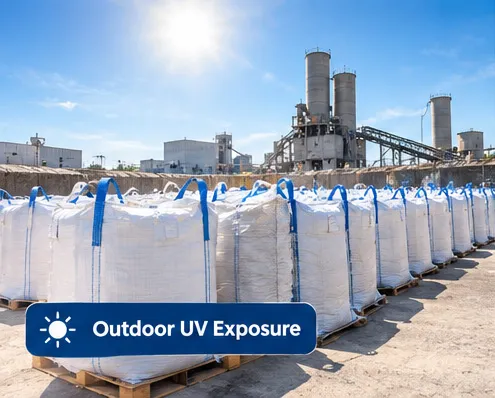
| High solar UV load | Accelerated polymer degradation in outdoor storage | UV-stabilised resin with the stabilisation level and the test method stated, not described only as “UV treated” |
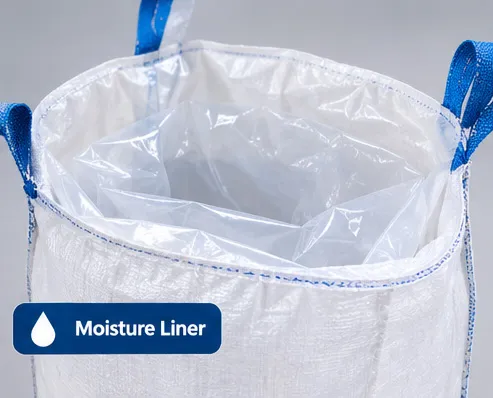
| Coastal humidity and rain | Moisture ingress, caking, and loss of product value | Liner specification, or coating and lamination appropriate to the product’s moisture sensitivity |
| Long inland haulage on rough roads | Abrasion, load shift, and loop damage | Abrasion tolerance in the base fabric, and a stacking or baffle design suited to the transport configuration |
| Manual handling at the final leg | Loops subjected to off-axis lifting | Loop construction and pick-point geometry matched to how the bag is actually lifted on site |
| Containerised export with weight limits | Freight cost driven by volume as much as by weight | Baffled designs where improved cube utilisation offsets the additional build cost |
الوجبات الجاهزة الرئيسية: UV stabilisation is the most commonly under-specified item on these routes. “UV treated” is a description; a stated stabilisation level against a named test method is a specification.
The Import Process: Steps That Decide Whether a Container Clears
Logistics failures in these markets are usually documentation failures. The following sequence reflects what an importer controls directly.
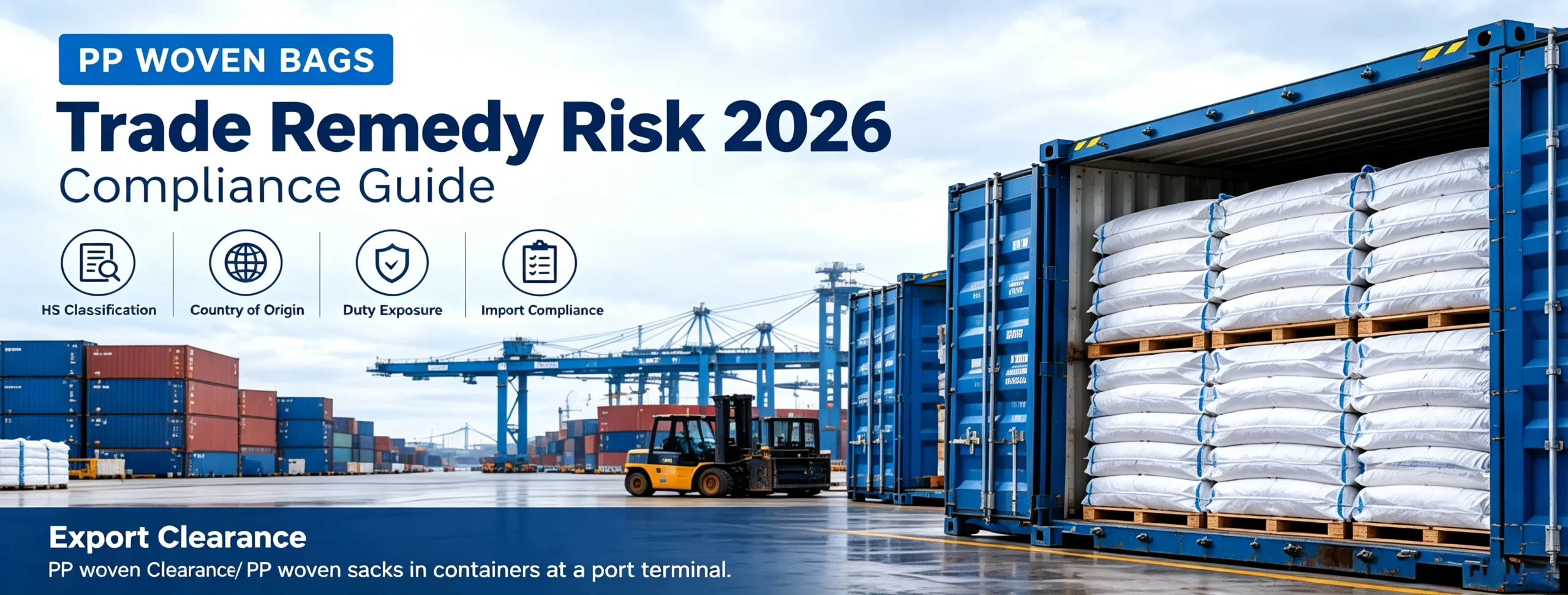
- Classification before pricing. Woven PP sacks and FIBC are commonly entered within HS heading 6305, with FIBC frequently under subheading 6305.32, but the binding determination is made by the customs authority at destination. Obtain it in writing before you fix a landed cost.
- Match documents to the invoice. Commercial invoice, packing list, bill of lading and any required certificate of origin must describe the same goods, in the same quantity, under consistent product descriptions.
- Confirm destination-specific requirements early. Some markets require pre-shipment inspection, conformity assessment, or consignment-specific certification. Requirements change, so verify them per shipment rather than per year.
- Agree Incoterms and responsibility for port-side delays. Demurrage and storage charges at congested ports can exceed the margin on the order. Clarify who carries them.
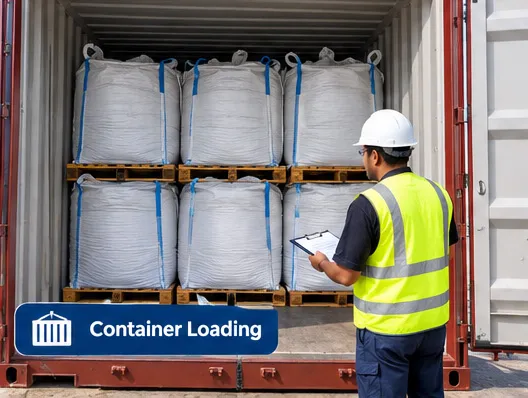
- Plan the container load. Bag dimensions and stacking behaviour determine how many fit and how they ride. Ask the supplier for a loading configuration, not just a piece count.
Specification Priorities by Climate and Route
| Priority | What to state on the order |
|---|---|
| اﻟﻘﻤﺎش | GSM and weave density, with tensile requirement tied to a named test method |
| استقرار الأشعة فوق البنفسجية | Stabilisation level and test method, matched to expected outdoor storage duration |
| Moisture protection | Coating, lamination or liner type, and whether the liner is form-fit, tubular or loose |
| Lift design | Loop configuration matched to the equipment at both ends of the route |
| Stability | Baffled or standard, based on stacking height and container utilisation |
| Duty | Single-trip or multi-trip, with the safety factor and test method confirmed against the current edition of ISO 21898 |
| Acceptance | Sampling plan, test reports, and the dimensional tolerances checked on receipt |
Supplier Checklist for Regional Importers
- Can they quote against a route as well as a product? A supplier that asks about storage duration, handling equipment and transport configuration is specifying, not just selling.
- Is UV stabilisation stated with a test method? If the answer is a generic “UV treated”, the specification is incomplete.
- Can they document origin and lot traceability? Needed both for customs and for any quality claim later.
- Do they hold a documented quality system? Management-system certification describes how the plant is run; it does not by itself establish the performance of a specific bag, which must be evidenced by test method and lot acceptance.
- Can they supply a container loading configuration? This is where freight cost is actually decided.
- Is there a second-origin option? Useful where trade remedy or logistics disruption is a live risk on the route.
Importers comparing FIBC manufacturers or bulk bag suppliers should weigh more than unit price. Production control, testing capability, traceability and export experience all affect whether the bags arrive as specified, and a capable supplier can turn a route requirement — climate, haulage, handling equipment — into a documented specification covering fabric, lifting structure, protection features and a loading plan.
Working With a Manufacturer on These Routes
SITONG PACKAGING has produced woven polypropylene packaging since 1998, with plants in Haicheng (Anshan), Liaoning and in Cambodia, around 20 production lines at roughly 100 tonnes per day, and shipments to more than 70 countries from the port of Dalian. Africa and the Middle East are established destinations within the markets served across Africa and the Middle East, and that route experience shows up in the questions asked at quotation stage: how long the bags will sit outdoors, how they will be lifted on arrival, and what the container configuration needs to be.
Because weaving, coating, cutting, sewing and liner fitting are held in-house, UV stabilisation level, fabric construction and liner type can be specified together on one sheet and traced to a production lot. Importers can then take a route-specific brief to an FIBC bags manufacturer that can quote against it.
خاتمة
Buyers sourcing FIBC bags for Africa and the Middle East get better outcomes when they specify the route alongside the product. Name the end use, state UV stabilisation with a test method, match moisture protection to the climate and the cargo, fix the lift design against the equipment at both ends, and settle the classification before pricing. Those five decisions account for most of the difference between a shipment that performs and one that generates claims.
For buyers planning a programme into these markets, SITONG PACKAGING can work from a route brief — product, loading method and destination conditions — to develop the bag specification before the order is placed.
الأسئلة المتداولة
Cement and construction materials, mining and mineral concentrates, fertiliser and chemicals, and bulk food commodities. Each cluster prioritises a different part of the specification, so naming the end use is the first step.
Bags are often stored outdoors for extended periods under high solar load, which accelerates polymer degradation. A stated stabilisation level and test method is what makes the requirement enforceable; a generic “UV treated” claim is not.
Where the product is hygroscopic or the route involves coastal humidity, moisture protection is usually the deciding specification. The choice between coating, lamination and a liner depends on how sensitive the product is and how long the sea leg runs.
Woven PP sacks and FIBC are commonly entered within HS heading 6305, with FIBC frequently under subheading 6305.32. The binding determination is made by the customs authority at destination, so obtain it in writing before pricing.
Often yes on these routes. Baffles improve stack stability and container cube utilisation; where freight is a large share of landed cost, the utilisation gain can outweigh the additional build cost. It depends on the density of the product.
Documentation inconsistencies rather than bag failures. Invoice, packing list, bill of lading and origin documents must describe the same goods consistently, and destination-specific inspection or conformity requirements should be confirmed per shipment.
They are qualified to different duties. Single-trip suits one-way export; multi-trip requires a cycle duty and a higher safety factor. State which you are buying and confirm the factor and test method against the current edition of ISO 21898.
No. Management-system certification such as ISO 9001 or BRCGS describes how a plant is managed. Performance of a specific bag is evidenced by testing against a named method and by lot acceptance criteria agreed in the order.