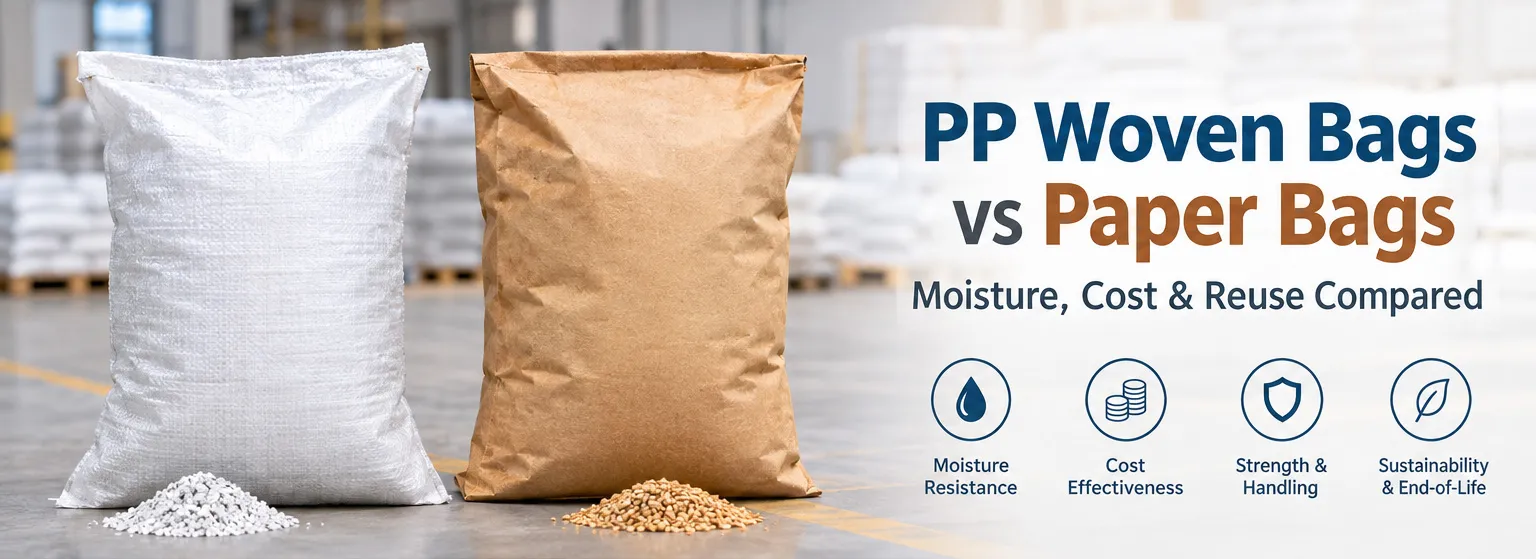


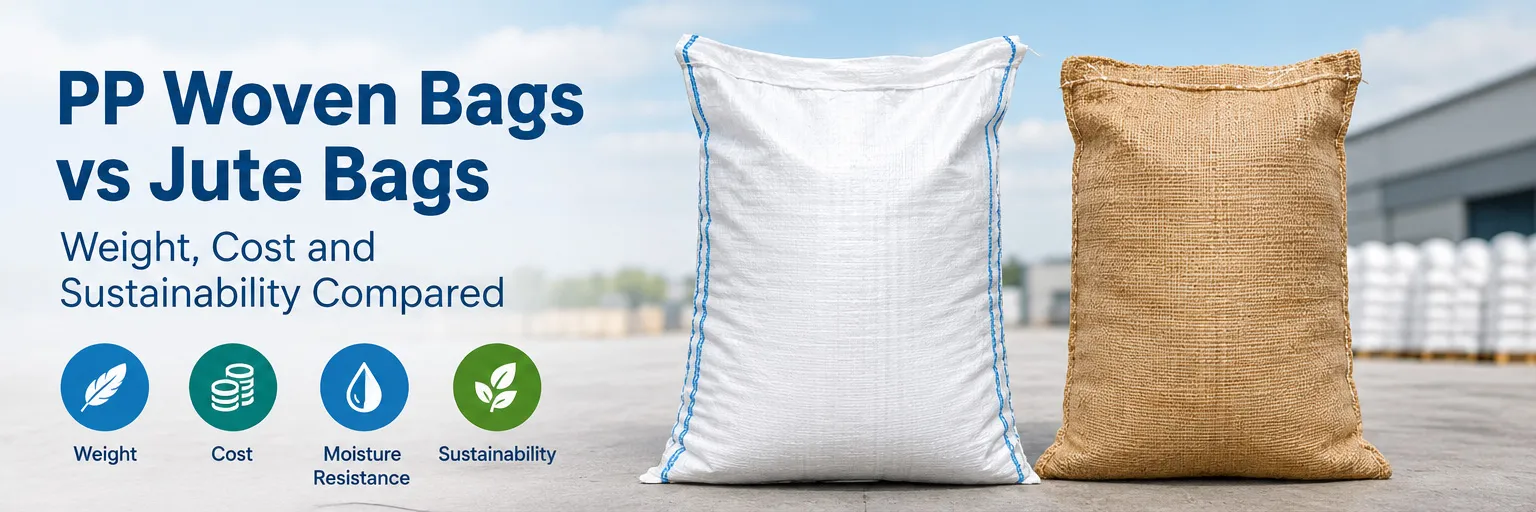
Buyers choosing between 聚丙烯编织袋 (also known as woven polypropylene bags) and jute bags for packaging are comparing two different material systems: lightweight polypropylene against natural jute fibre. PP woven bags can offer low packaging weight, moisture resistance and competitive pricing at production volume, while jute provides natural-fibre content and biodegradability. The right specification depends on the product, bag construction, order volume, transport route, storage conditions and end-of-life infrastructure.
快速回答: PP woven bags generally have an advantage when freight weight, unit cost at volume and moisture resistance dominate the decision. Jute bags have an advantage when natural-fibre origin and biodegradability are part of the product or brand story. The right choice is driven by your route, product and end-of-life infrastructure, not by a universal ranking.
定义: A PP woven bag is made from polypropylene tape yarn woven into a tubular or flat fabric, then cut, printed and sewn. A jute bag is woven from natural jute fibres. Both are used across bulk and retail packaging, but they differ in packaging weight, moisture behaviour, durability, reuse potential and end-of-life options.
PP Woven Bags vs Jute Bags: At a Glance
| 属性 | PP编织袋 | Jute bag |
|---|---|---|
| 材料 | Woven polypropylene tape yarn | Woven natural jute fibre |
| Weight for comparable packaging | Can be designed for low packaging weight and high strength-to-weight performance | Generally heavier for comparable bulk-packaging applications |
| 单价 | Can be competitive at high production volumes; depends on specification and PP resin cost | Depends on fibre cost, bag construction, labour and order volume |
| Moisture behaviour | Low water absorption; generally suitable for humid storage when properly specified | Absorbs moisture and can lose performance when exposed to prolonged wet conditions |
| Reuse potential | Can support repeated handling when designed and specified for reuse | Reuse depends strongly on moisture exposure, construction and handling conditions |
| End-of-life | Recyclable where suitable PP collection and recycling systems exist; not biodegradable | Biodegradable under suitable biological conditions; end-of-life depends on local treatment infrastructure |
| Typical applications | Common in cement, fertilizer, grain, sugar and industrial packaging | Common in coffee, cocoa, agricultural and natural-fibre retail packaging |
| Packaging appearance | Functional and highly customisable through printing and construction options | Natural-fibre appearance and traditional packaging character |
| Freight impact | Lower packaging weight can reduce the packaging portion of shipment weight | Higher packaging weight can increase the packaging portion of shipment weight |
PP Woven Bags vs Jute Bags: Weight Comparison
The packaging weight difference can be significant when comparable bag capacity and performance are specified. Jute fibre has a higher density and moisture regain than polypropylene, while woven PP tapes can be engineered for high strength-to-weight performance. The actual weight gap depends on bag size, fabric construction, GSM, seam design, filling requirements and required load performance, so buyers should compare bags against the same capacity and specification rather than use a fixed weight ratio.
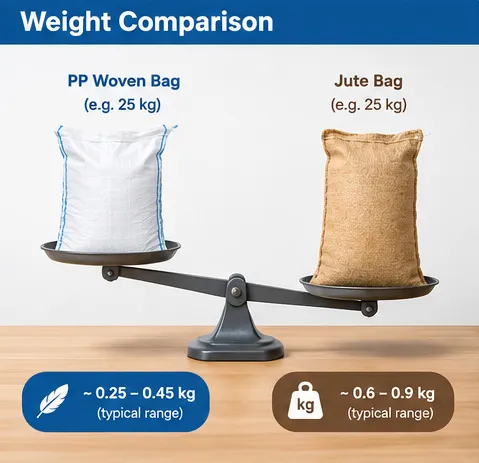
For export shipments, lower packaging weight can reduce the packaging portion of total shipment weight and may improve the product-to-packaging ratio. The actual logistics benefit depends on product density, bag dimensions, palletisation, container utilisation, freight terms and applicable weight limits.
Cost: Unit Price vs Total Landed Cost
| 因素 | PP编织袋 | Jute bag |
|---|---|---|
| Unit bag price | Can be competitive at high production volumes; depends on specification and PP resin cost | Depends on fibre cost, construction, labour and order volume |
| Freight impact | Lower packaging weight can reduce the packaging portion of shipment weight | Higher packaging weight can increase the packaging portion of shipment weight |
| Reuse potential | Can support repeated handling when designed and specified for reuse | Depends on construction, moisture exposure and handling conditions |
| Customisation | Printing, lamination, liners, handles and other construction options | Depends on jute fabric, sewing and bag construction |
要点: Unit price alone does not determine the lowest landed cost. Buyers should compare bag price, packaging weight, freight, expected service life and reuse cycles using the same bag capacity and performance specification for both materials.
For a fair comparison, use the same functional unit: compare bags with the same product capacity, required load performance, transport route and intended number of uses. This prevents a lightweight single-use bag from being compared directly with a heavier reusable bag on price or environmental impact alone.
Sustainability: Two Different Stories
Jute is a renewable natural fibre and is biodegradable under suitable biological conditions, while PP woven bags are made from polypropylene and require appropriate collection and recycling systems for material recovery. The environmental comparison depends on more than material origin. Packaging weight, manufacturing inputs, transport distance, number of reuse cycles, recycling rates and end-of-life treatment can all affect the result. LCA research on bulk sacks has reported lower transport-related energy requirements for lighter PP-based woven sacks in the studied scenarios, but that finding should not be treated as a universal carbon-footprint ranking for every bag specification and supply chain.
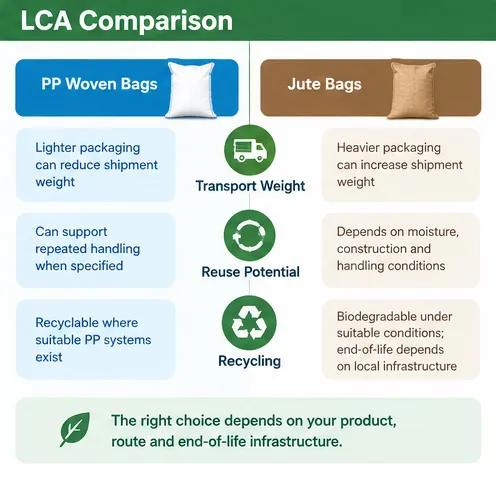
Neither material has the same environmental profile in every application. A meaningful comparison should consider the complete packaging system: material quantity, manufacturing, transport, service life, reuse, recycling infrastructure and end-of-life treatment.
Durability and Moisture
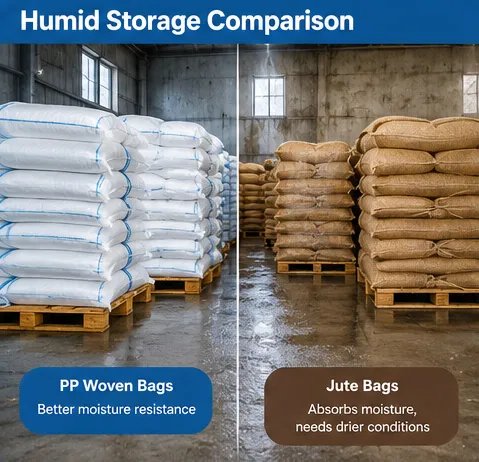
PP woven fabric has very low moisture absorption compared with natural jute fibre and is generally well suited to humid storage when the bag is correctly specified. Jute is hygroscopic and absorbs moisture, while prolonged wet or high-humidity exposure can reduce mechanical performance and increase the risk of biological degradation. Actual performance for either material depends on bag construction, coatings, liners, storage conditions and exposure duration.
Which Should You Specify?
| PP woven bags may be suitable when… | Jute bags may be suitable when… |
|---|---|
| Low packaging weight is an important logistics requirement | Natural-fibre content is an important product attribute |
| High-volume production and custom bag specifications are required | Traditional jute packaging is part of the product presentation |
| Moisture resistance is important during storage or transport | The packaging will be used in relatively controlled and dry conditions |
| Repeated handling or reuse is part of the packaging plan | Biodegradability is an important end-of-life requirement |
| Printing, liners, coatings or other custom construction features are required | A natural-fibre appearance is an important packaging attribute |
For buyers mapping the broader bulk-packaging sector, the PP woven bags market in 2026 provides additional context on market development, product demand and the role of cost and logistics considerations.
A Manufacturing Note
SITONG PACKAGING has manufactured woven polypropylene packaging since 1998, with plants in Haicheng (Anshan), Liaoning and in Cambodia, around 20 production lines at roughly 100 tonnes per day, and shipments to more than 70 countries from the port of Dalian. For brands evaluating recyclable packaging structures, SITONG also produces 可回收单一材质PP编织袋. For export applications where lower packaging weight is important, see the lightweight high-strength PP woven bags for Africa range and confirm the required UV, moisture and strength specifications for the destination market.
Conclusion: PP Woven Bags vs Jute Bags
PP woven bags vs jute bags should be evaluated against the actual packaging specification rather than a single material advantage. PP woven bags generally offer low packaging weight, moisture resistance and flexible customisation, while jute provides natural-fibre content and biodegradability. For export buyers, the most useful comparison combines bag weight, unit price, freight, durability, reuse, recycling infrastructure and end-of-life requirements before the final specification is approved.
常见问题解答
A jute bag of comparable holding capacity is generally heavier than a PP woven bag because jute fibre has a higher density and moisture regain than polypropylene, while woven PP tapes can be engineered for high strength-to-weight performance. The actual weight gap depends on bag size, fabric construction, GSM, seam design, filling requirements and required load performance, so buyers should compare bags against the same capacity and specification rather than a fixed weight ratio.
PP woven bags can be cost-competitive at high production volumes, but unit price depends on bag size, GSM, printing, lamination, liners, order quantity and raw-material costs. Landed cost also depends on packaging weight and freight. Buyers should compare both materials using the same capacity, performance specification and shipment conditions.
There is no universal carbon-footprint result for every PP woven and jute bag. LCA studies of bulk sacks have reported a transport-related energy advantage for lighter PP-based woven sacks, but the result depends on the bag specification, manufacturing footprint, transport distance, reuse cycles and end-of-life infrastructure. A side-by-side LCA on the actual bag and route is the most reliable basis for comparison.
Yes. Jute is a natural fibre and can biodegrade under suitable biological conditions, while polypropylene does not biodegrade in the same way. PP woven bags can be reused and may be recyclable when the complete bag structure is compatible with an appropriate recycling system.
PP woven fabric generally has better moisture resistance than untreated jute because polypropylene has very low water absorption. Jute is hygroscopic and can absorb moisture, while prolonged wet or humid exposure can reduce its mechanical performance and increase the risk of biological degradation.
PP woven bags can be used for many food-packaging applications when the complete bag structure meets the relevant food-contact requirements. Depending on the product, this may involve a suitable liner, coating, laminate, ink and other components. Jute may still be selected where natural-fibre appearance or traditional packaging positioning is an important product attribute.
For long-distance export, PP woven bags can offer advantages when low packaging weight and moisture resistance are important. However, the logistics result depends on product density, bag dimensions, palletisation, container utilisation, freight terms and storage conditions. Jute can remain suitable when natural-fibre characteristics are an important packaging requirement.
PP woven bags can be recyclable where the complete bag structure is compatible with an available PP recycling system. A predominantly polypropylene or mono-material PP structure can support material compatibility, but liners, coatings, laminates, inks, adhesives and other components must also be considered. Buyers should confirm the complete bag structure and recycling requirements of the destination market.