


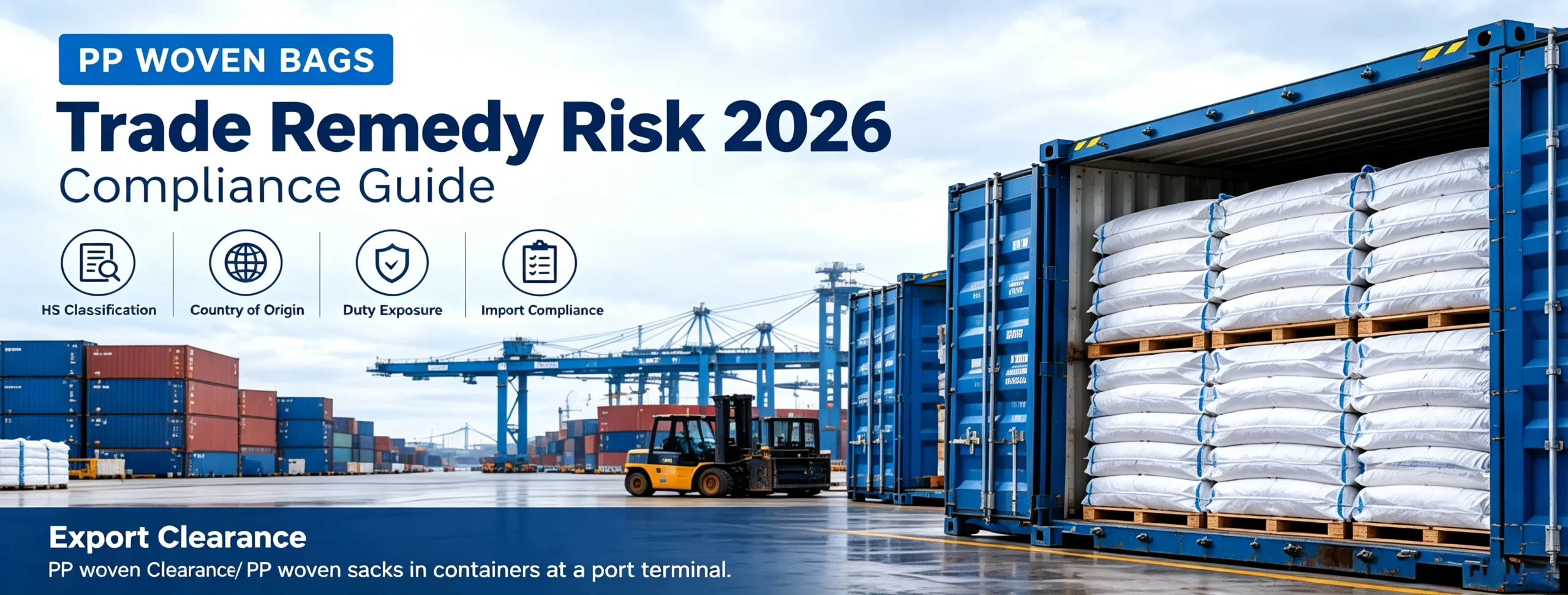
Importers sourcing 聚丙烯编织袋 and FIBC bulk bags in 2026 need to evaluate trade remedy exposure before confirming supplier quotations and shipment plans. Anti-dumping and countervailing duties do not automatically apply to polypropylene packaging, and no measure in force today names woven polypropylene sacks. PP woven bags trade remedy risk is therefore a diligence question rather than a legal footnote: verify the product scope, the HS classification, the country of origin and the supplier’s records before committing to a large-volume order or a shipment schedule. This guide explains how to evaluate that exposure and build a practical import compliance process.
快速回答: Trade remedy risk on PP woven bags is managed, not eliminated. Confirm the anti-dumping and countervailing duty orders in force at your destination, lock the HS or HTS classification before you price, document country of origin and conversion steps, and write change-of-duty clauses into the supply contract. No single certificate removes the exposure.
Definition: A trade remedy is a government import measure — anti-dumping duty (AD), countervailing duty (CVD) or a safeguard — used to address unfair pricing, subsidies or a sudden surge in imports. Such measures apply only to specific products, origins and scope descriptions, not automatically to all goods from a country.
2026 Trade Remedy Trends Importers Should Monitor
Two documented 2026 developments illustrate the direction of travel for flexible plastic packaging. Neither concerns woven polypropylene sacks directly. They show a broader pattern: buyers of flexible packaging should track product scope, country coverage and review timelines, because trade measures can change through formal investigations and reviews.
United States: Sunset Reviews Opened on 1 September 2026
On 1 September 2026 the US Department of Commerce automatically initiated five-year sunset reviews of several AD and CVD orders, per the Federal Register notice published that day (91 FR 56127). The covered merchandise includes polyethylene retail carrier bags from China, Indonesia, Malaysia, Taiwan, Thailand and Vietnam, alongside petroleum wax candles from China. The US International Trade Commission instituted corresponding injury reviews at the same time. Domestic interested parties had 15 days to file a notice of intent to participate, and substantive responses were due within 30 days of publication.
Two features matter to a woven PP buyer. The first is procedural: a sunset review asks whether revoking an order would be likely to lead to continuation or recurrence of dumping, subsidisation and injury, and the order stays in force while that question is answered. The second is the product boundary. The bag order covers polyethylene film carrier bags within defined thickness and dimension ranges; it is not a measure on woven polypropylene sacks. The relevance to your category is procedural rather than direct, and should be presented that way internally.
India: 25 Investigations Initiated in March 2026
India’s Directorate General of Trade Remedies closed fiscal year 2025-26 at a high tempo. Per Lakshmikumaran & Sridharan’s March 2026 analysis, 25 trade remedy investigations were initiated during the month — 21 anti-dumping, 3 countervailing duty, and 1 safeguard investigation in the form of a quantitative restriction. The same analysis notes a gradual shift in instrument choice: where the Ministry of Finance has declined to impose AD measures despite positive DGTR recommendations, domestic industry has begun filing CVD and safeguard petitions alongside AD.
For an importer the practical reading is that remedy filings in large emerging markets are frequent and fast-moving, and the instrument chosen can change mid-stream. A sourcing plan built around one country of origin and one duty assumption is fragile in that environment.
要点: These 2026 examples show why importers of industrial packaging should monitor trade remedy developments in their destination markets. Filing activity, review schedules and product scope changes can affect sourcing decisions even when a specific product is not currently covered.
Why PP Woven Bags and FIBC Require Import Compliance Checks
Woven polypropylene sacks and FIBC occupy the same industrial category as the products that attract remedy petitions: flexible plastic packaging, produced at scale, price-competitive and widely traded. That does not mean a specific duty applies to them in any given market. It does mean a buyer cannot assume exclusion without checking.
The Classification Question Comes First
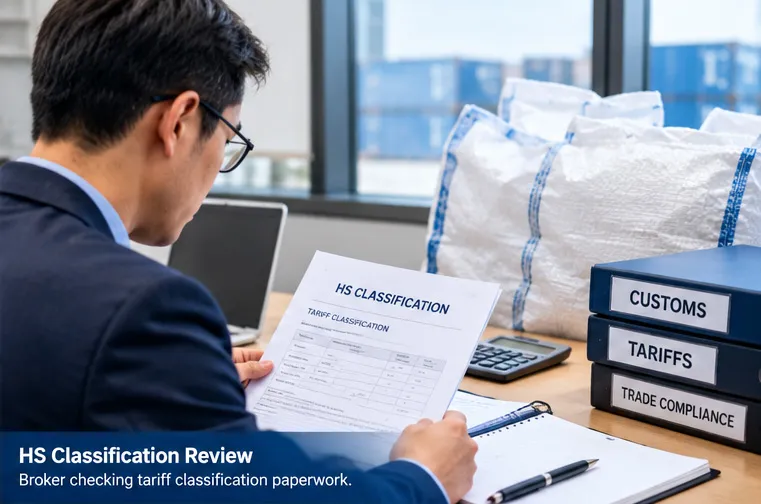
Duty exposure is assessed on covered goods, defined by product description and origin. Woven polypropylene sacks and FIBC are commonly considered under HS heading 6305, with many FIBC products entered under subheading 6305.32. The final classification depends on the importing country’s customs authority and on the specific construction — material, coating, liner and end use. A sack woven from polypropylene tape is not classified as a polyethylene film bag merely because both are described colloquially as plastic bags.
That distinction is the whole point. Two products that look interchangeable on a purchase order can sit in different headings, carry different duty treatment, and fall inside or outside a remedy order.
要点: Ask your broker to confirm the subheading in writing before you fix a landed-cost price. Classification determines which measures, if any, can reach your shipment.
Traceable Manufacturing Makes Auditable Evidence Possible
A useful feature of this product family is that its manufacturing footprint is legible. PP woven bag construction runs from resin to extruded tape, circular weaving, coating or lamination, printing, and finally cutting and sewing. Each stage leaves a record and a location. Where a buyer asks for origin evidence, that chain is what makes a documented answer possible — as opposed to a trading intermediary that can only repeat what it was told.
Importer SOP: Six Checks Before You Confirm an Order
The following sequence fits into an existing purchasing workflow without adding weeks to the calendar. Each row is a check the buyer performs or commissions; none depends on a supplier’s verbal assurance.
| Check | What to obtain | Who confirms it | Importer action |
|---|---|---|---|
| 1. Current remedy status | Search of AD, CVD and safeguard measures in force at destination, by product description and origin | Customs broker or trade counsel | Verify before the price is quoted |
| 2. Classification | Written HS or HTS subheading opinion for your exact bag: material, construction, coating, liner | Broker, using the supplier specification sheet as input | Hold the quotation until the subheading is confirmed in writing |
| 3. Country of origin | Origin declaration plus conversion records showing where weaving and making-up took place | Supplier, checked against shipping documents | Reconcile against the invoice and packing list |
| 4. Duty scenarios | Landed cost under no measure, measure applied, and reclassification | Your finance team | Set the duty reserve before signing |
| 5. Contract terms | Change-of-duty, origin-lock and notification obligations | Your legal team | Amend the standard terms of purchase |
| 6. Second-origin option | A qualified alternative source in a different origin, already sampled and priced | Your sourcing team | Sample and price it before you need it |
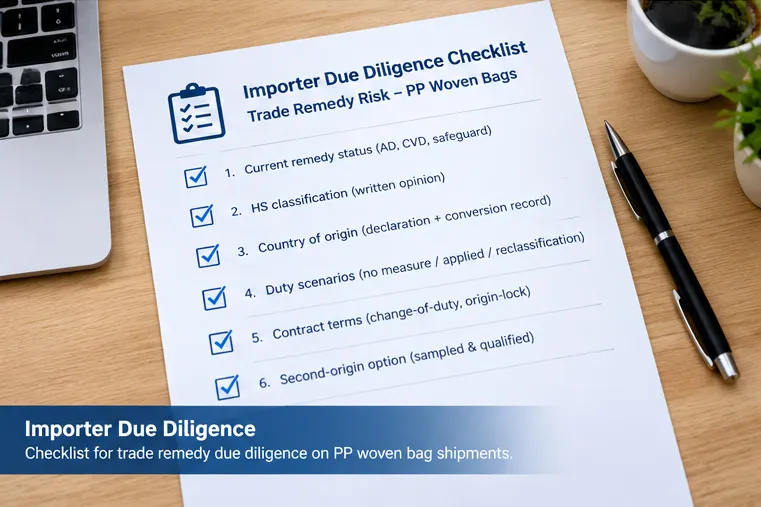
要点: Checks 1 and 2 carry the load. If the classification is wrong, every downstream number built on it is wrong, including the duty reserve.
Document Pack: What to Request From a Supplier
A supplier that can produce these on request is usually one that already runs a documented quality system. A supplier that cannot is a concern irrespective of the duty position.
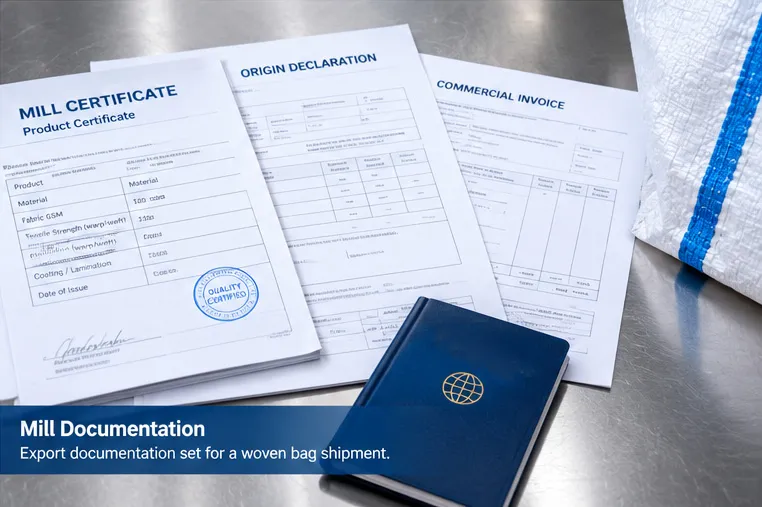
- Country-of-origin declaration tied to the commercial invoice and packing list.
- Conversion record stating where the tape was extruded, woven, coated or laminated, printed, and sewn.
- Specification sheet giving fabric GSM, weave density, coating or lamination type, liner type, dimensions and tolerance, each with the test method applied.
- Test reports for tensile and burst performance, referenced to a named test method and sampling plan rather than to a marketing claim.
- Food-contact declaration where relevant, naming the destination regulation the material is intended to meet.
- Lot-level certificate of analysis, with lot codes traceable to the shipping marks.
Note the pattern across all six: each pairs a value with a method or a record. That pairing is what distinguishes a specification from a claim.
How Trade Remedy Risk Differs by Destination Market
| Market type | Typical posture | Buyer priority |
|---|---|---|
| Established remedy regimes, such as the United States, India and South Africa | Published orders, sunset review calendars, transparent filing deadlines | Monitor order lists and review calendars ahead of each buying season |
| Markets building domestic converting capacity | New petitions more likely; safeguard and quantitative restriction instruments appear alongside AD | Second-origin qualification and flexible contract terms |
| Markets with limited remedy history | Low exposure today, but classification practice may be less settled | Obtain a written classification ruling before the first shipment |
The body that publishes these decisions differs by market: the United States works through published orders and sunset review notices, India through the Directorate General of Trade Remedies, and South Africa through the International Trade Administration Commission (ITAC), whose notices appear in the Government Gazette.
要点: Exposure is not only whether a duty exists today. It is how quickly a measure could appear, and whether the documentation behind the shipment would stand up to review.
Three Misconceptions That Cost Buyers Money
- “It applies to everything from that country.” AD and CVD attach to covered goods defined by product description, and scope rulings and product exclusions are common. Read the scope, not the headline.
- “A lower unit price offsets duty risk.” An assessment is calculated on customs value under the destination’s own rules and can exceed the margin you negotiated. Model the duty first, then negotiate price.
- “Routing through a third country solves it.” Origin is determined by substantial transformation, not by the port of lading. Misdeclared origin turns a commercial exposure into a compliance violation with penalties and seizure consequences.
For importers comparing woven polypropylene bags suppliers, the differentiator is rarely the unit price alone. It is whether the supplier can produce manufacturing records, origin documents, consistent specifications and scalable capacity — the items that matter most to wholesale buyers running repeated container programmes.
How Supplier Documentation Helps Reduce Import Risk
Duty exposure is one of several reasons to favour a manufacturer with a documented and auditable production chain. SITONG PACKAGING has operated since 1998 with plants in Haicheng (Anshan), Liaoning and in Cambodia, running around 20 production lines at an output of roughly 100 tonnes per day, and ships to more than 70 countries from the port of Dalian. Manufacturing capability in more than one origin can support the second-origin option described in check 6 above, although any change of origin still has to be reviewed under the destination’s customs and origin-determination rules before shipment.
Certifications should be evaluated according to their purpose. Management-system certifications such as BRCGS, ISO 9001 and ISO 14001, together with the company’s occupational health and safety management system, demonstrate controlled processes, environmental management and health and safety practice. They do not replace product-specific testing for tensile strength, load performance or UV resistance, which is established by a named test method and lot acceptance criteria.
For shipments entering the United States, the tariff stack is a separate calculation from trade remedy exposure, and the two can apply together; the dedicated guide to the US tariff position on imported PP woven bags covers that side. When you shortlist mills, ask whether the PP编织袋生产厂家 can issue lot-level records — the answer separates a plant from a trading intermediary.
结论
Managing pp woven bags trade remedy risk is a documentation discipline rather than a legal speciality. Confirm the classification, document the origin, model the duty scenarios, and contract for change. Buyers who treat those four steps as routine find that remedy volatility becomes a pricing input instead of a disruption — and can answer with records when a customs authority asks.
常见问题解答
The sunset reviews initiated on 1 September 2026 cover polyethylene retail carrier bags from six origins, not woven polypropylene sacks. The two products are classified differently. Confirm your own subheading with a licensed broker before assuming either inclusion or exclusion.
Woven polypropylene sacks and FIBC are commonly entered within HTS heading 6305, with FIBC frequently under subheading 6305.32. The binding determination is made by the customs authority at destination, so obtain a written opinion for your exact construction.
Every five years. Under section 751(c) of the Tariff Act of 1930 the Department of Commerce and the International Trade Commission automatically review whether revoking an order would lead to continuation or recurrence of dumping and injury.
An anti-dumping duty offsets the margin between a product’s export price and its normal value. A countervailing duty offsets a subsidy granted by a foreign government or public body. Both are country-and-product specific and can apply to the same shipment.
On its own, no. A certificate states origin; it does not establish classification, and it does not tell you which measures reach your product. Treat it as one item in the document pack, alongside the conversion record and the written classification opinion.
It reduces concentration risk rather than removing it, because a new petition can name several origins at once. The benefit is real only if the alternative source has been sampled, qualified and documented before you need it.
Three clauses matter: a change-of-duty provision stating who bears an assessment introduced after order confirmation, an origin-lock clause requiring notice before any change in manufacturing location, and an audit right covering the records behind both.
Before the quotation is issued, not after. Pricing that assumes today’s measure mix is a forecast presented as a fact; building a documented duty scenario into the quote keeps the margin visible to both sides.
Uncertainty can be reduced by confirming the HS classification in writing, reviewing the measures currently in force at destination, requesting origin and conversion documentation, and keeping a qualified alternative source ready before shipment. None of these steps removes exposure; together they make it manageable.
The investigating body in South Africa is the International Trade Administration Commission (ITAC), and its notices are published in the Government Gazette, while customs and the tariff are administered by SARS. A buyer should confirm the tariff subheading with SARS and review the ITAC notice record for that subheading before confirming an order, because coverage is decided line by line rather than by product family.