




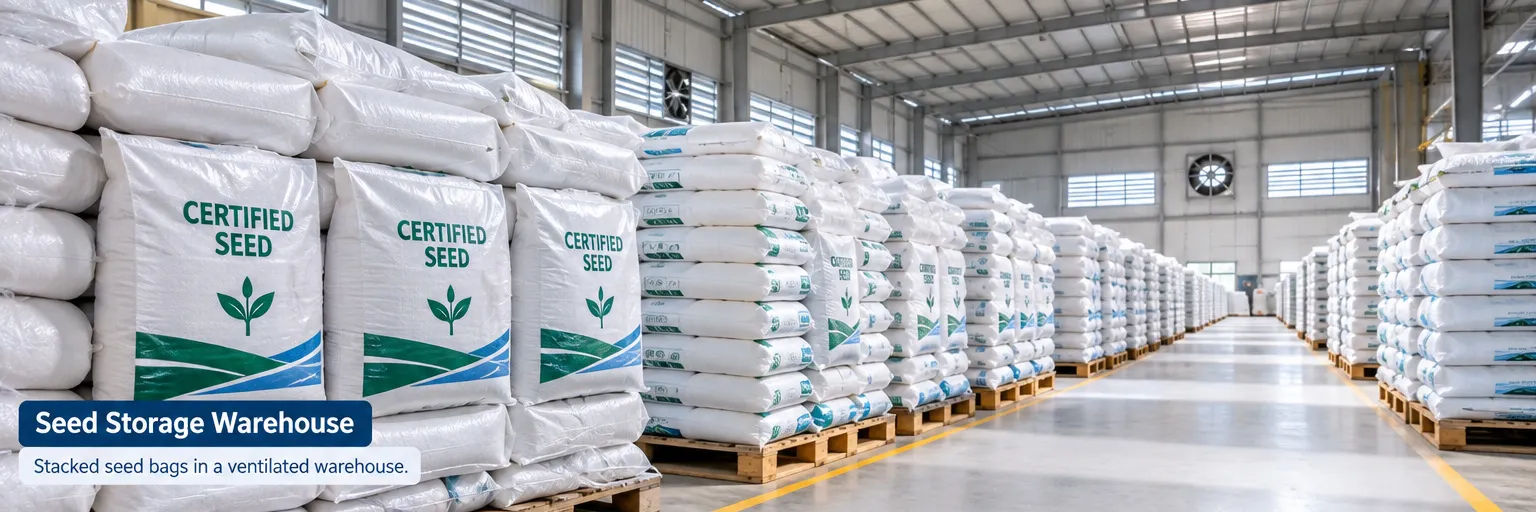
PP woven bags for seed storage are polypropylene packaging bags selected to protect seed quality through storage, transport and handling. A bag of grain is judged on weight, moisture and cleanliness. A bag of seed is judged on what happens months later in the field, which is why a seed bag has to hold germination potential by limiting moisture exchange, reducing mechanical damage and preserving certification information. This guide explains how seed companies choose a structure from the moisture level at packing, the storage conditions and the treatment applied.
Réponse rapide : Choose the bag from the seed’s moisture condition and the intended storage duration. A dry lot that has reached its target can use a lined or hermetic structure to hold that condition, while seed that is still equilibrating may need a breathable woven bag. The bag protects the condition achieved before packing; it cannot replace correct drying.
Définition: Seed viability is the proportion of seed in a lot capable of germinating. It is not fixed at harvest; it declines over time, and the rate of decline is governed by moisture content and temperature during storage, with mechanical damage and pest pressure contributing further losses.
What PP Woven Seed Bags Protect That Grain Storage Does Not
Grain is a commodity with a price. Seed is a biological input with a performance guarantee, and the buyer’s tolerance for failure is much lower. For buyers sourcing pp woven seed bags, those differences create three packaging requirements.
- Viability is invisible. A seed lot can look clean and sound while having lost germination. Packaging cannot restore viability, but it can slow the conditions that take it away.
- Mechanical damage matters. Impact and abrasion can crack seed coats and fracture embryos. Handling and bag surface behave as part of the storage system.
- Identity and certification must survive. Certified seed carries lot numbers, crop and variety, germination percentage and test dates. If the marking degrades, the lot loses certified status in practice.
Research institutions working on seed systems, including the International Rice Research Institute, treat moisture control and drying before storage as the primary determinant of subsequent seed quality, with packaging as the means of holding that condition. For a packaging buyer the sequence follows from that: confirm the moisture target first, then specify the bag that maintains it.
À retenir : Packaging cannot improve a seed lot. It can only preserve the condition the seed was in when it went into the bag, which is why drying before packing is the first specification.
Moisture and Temperature: The Two Variables That Govern Viability
Across crops, the same relationship holds: the higher the moisture content and the warmer the storage, the faster viability declines. The practical implications are straightforward and worth stating as requirements rather than as intentions.
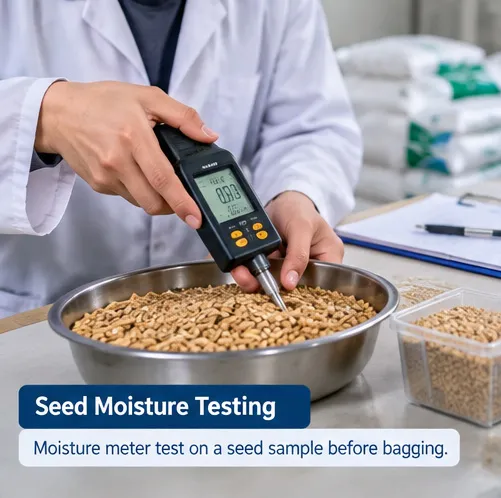
- Dry to a defined target. The correct moisture content is crop-specific and depends on the intended storage duration. Agree the target with your agronomist or seed technologist and record it for the lot.
- Keep storage cool and stable. Temperature fluctuation drives condensation inside a bag, which wets the seed nearest the wall first.
- Avoid re-wetting after drying. Seed dried and then stored in a humid environment will take moisture back up. This is the most common way a good drying job is undone.
- Segregate lots by moisture. Bagging a wetter lot with a drier one averages nothing and risks both.
À retenir : Condensation is the failure mode to design against. Bags moved between temperature extremes sweat on the inside, and the wetted layer is where mould and viability loss begin.
Ventilation or Hermetic? The Answer Depends on Moisture at Packing
These two approaches are often presented as competing products when they are actually answers to different questions.
| Condition at packing | Suited construction | Why |
|---|---|---|
| Seed dried to the target for long storage | Hermetic or lined construction | Limits further moisture exchange and restricts insect activity in a low-oxygen environment |
| Seed still equilibrating, or moisture not confirmed | Breathable woven construction | Allows the lot to continue drying rather than trapping residual moisture against the seed |
| Humid coastal or monsoon storage | Coated or laminated fabric, optionally with a liner | Reduces vapour ingress from a humid environment |
| Long warehouse storage with stable conditions | Either, chosen on pest pressure and monitoring regime | The decision becomes operational rather than structural |
The critical warning: sealing seed that has not reached its drying target concentrates the problem rather than solving it. A hermetic or lined bag is a way of holding a condition already achieved, not a way of achieving it.
Buyers comparing structures can also review hermetic PP woven storage bags, which apply the same moisture-control principles to grain and to seed. The difference is the germination stake: for seed, the moisture target should be verified by test rather than assumed.
Treated Seed Changes the Material Conversation
Seed treated with fungicide or insecticide introduces requirements that untreated seed does not have, and they vary by market and by active substance.
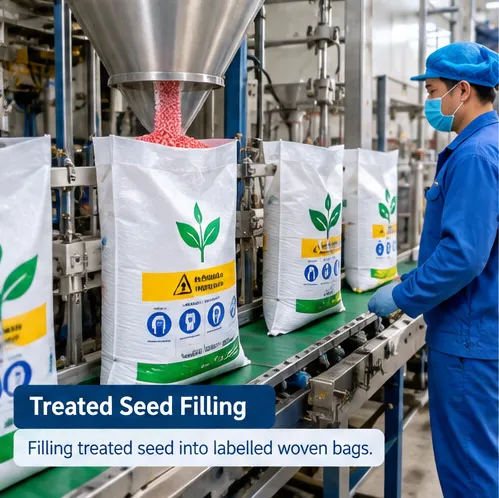
- Material compatibility. Confirm that fabric, coating, ink and any liner are compatible with the treatment applied, and ask for the supplier’s statement in writing.
- Dust containment. Treatment dust released at filling or opening is a handling hazard; seam and closure design should limit it.
- Mandatory labelling. Most markets require treated seed to be labelled as such, often with the active substance and handling cautions. The print area and ink durability have to accommodate that text.
- Segregation. Treated and untreated seed should not share handling equipment or storage without cleaning, and bags should be identifiable at a distance.
Physical Handling: Where Germination Is Actually Lost
A share of viability loss has nothing to do with moisture. It comes from the bag being dropped, dragged, or compressed under a high stack.
- Limit drop heights at filling and at the warehouse.
- Keep stack heights within what the bag construction and the pallet allow.
- Avoid dragging bags across rough surfaces; abrasion damages both bag and seed.
- Use bag surfaces with adequate friction where pallets are stacked high or moved.
Labelling, Traceability and Certification
For certified seed, the bag is a document. Requirements differ by scheme and by country, but the following are commonly required and should be planned into the print area.
- Crop, variety and lot number.
- Germination percentage and the date of the test.
- Treatment statement where applicable.
- Net weight and the responsible party’s identification.
- Traceability coding that links the bag to the production run.
Print durability matters here. A lot code that becomes illegible after a season of warehouse handling has cost the lot its traceability, whatever the ink looked like on day one.
Specification Checklist for Seed Bags
| Article | Ce que définit l'acheteur |
|---|---|
| Crop and variety | Drives moisture target, bag size and any treatment compatibility check |
| Moisture at packing | The agreed target, and whether it is verified by test per lot |
| Storage duration and conditions | Length of storage, ambient range, and whether the site is humidity-controlled |
| Construction | Breathable, coated, laminated, lined or hermetic, based on moisture at packing |
| Tissu | GSM and weave density with tensile requirement tied to a named test method |
| Fermeture | Sewn, taped or sealed, and whether it needs to limit dust release |
| Treatment compatibility | Written statement covering fabric, coating, ink and liner |
| Labelling | Required fields, print area, and durability expectation over the storage period |
| Acceptation | Sampling plan, test reports and the tolerances checked on receipt |
How to Choose a PP Woven Seed Bag Manufacturer
Seed programmes reward suppliers who ask about the crop and the storage window before quoting a bag; a converter that quotes on size and GSM alone has skipped the variable that decides whether the seed performs. Buyers should weigh polypropylene quality, fabric and seam strength, printing accuracy, liner options, treatment compatibility and production traceability rather than price alone.
For a seed packaging programme, a supplier with integrated weaving, coating and conversion capability can hold a specification more consistently across large volumes, because material, printing and final bag performance are controlled in one production chain.
SITONG PACKAGING has produced woven polypropylene packaging since 1998, with plants in Haicheng (Anshan), Liaoning and in Cambodia, around 20 production lines at roughly 100 tonnes per day, supplying more than 70 countries from the port of Dalian. Weaving, coating and lamination, printing, liner fitting and conversion are held in-house, so construction, closure and print durability can be specified on one sheet and traced to a production lot. Seed companies can start from the general sacs tissés en PP agricole range, which also covers agricultural seed bags, then take a crop-specific brief to an experienced Fabricant de sacs tissés en PP.
Conclusion
Spécification PP woven bags for seed storage starts with the seed, not the bag. Confirm the moisture target for the crop and the storage duration, then choose a construction that holds that condition — breathable where the lot is still equilibrating, hermetic or lined where it is already dry. Add the treatment compatibility statement, the certification labelling and a durability expectation for the print, and the bag stops being a container and becomes part of the viability guarantee.
Foire aux questions
Physically, often yes; in specification terms, no. Seed adds viability, treatment compatibility and certification labelling requirements that a grain sack is not specified to meet.
Where the seed has already reached the moisture target for the crop and the storage duration, a hermetic or lined construction can help hold that condition. Sealing seed that is still above target traps the problem rather than solving it.
The target is crop-specific and depends on how long the seed will be stored. Agree it with your agronomist or seed technologist, test per lot, and record the result against the lot number.
When bags move between temperature extremes, moisture condenses on the inner surface and wets the seed nearest the wall. That layer is where mould growth and germination loss typically begin.
They need a documented check rather than a different bag by default. Confirm that fabric, coating, ink and liner are compatible with the treatment, that the closure limits dust release, and that the labelling carries the required treatment statement.
Because the bag carries the certification data. A lot code or germination figure that becomes illegible in storage removes the traceability the certification depends on.
Indirectly. Bag failure leads to spillage, rehandling and impact, and mechanical damage to seed coats reduces germination. Adequate fabric and seam strength is a handling safeguard as much as a containment one.
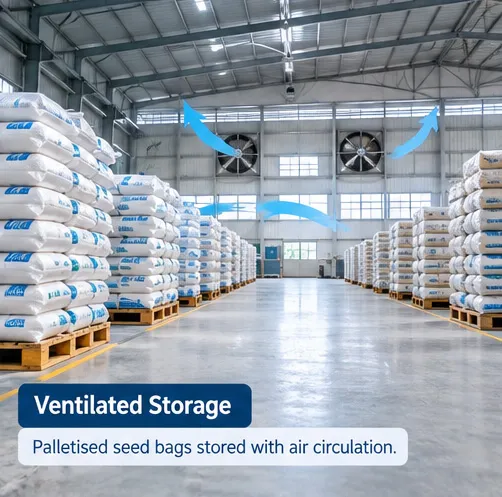
Within the stack height the construction and pallet allow, off the floor, with air movement around the stack, and separated from external walls where temperature swings drive condensation.