

Réponse rapide : India’s September 2026 revision re-quantified anti-dumping duties on specified jute products from Bangladesh and Nepal. For buyers evaluating PP woven sacks vs jute bags, the commercial impact depends on the applicable duty rate, supplier pricing, packaging performance and total landed cost. The revision does not mean that every jute bag became more expensive or that buyers have automatically switched to PP packaging.
India’s 2026 revision of anti-dumping duties on specified jute products from Bangladesh and Nepal creates a new cost-comparison consideration for bulk packaging buyers. Issued by the Central Board of Indirect Taxes and Customs (CBIC) on 24 September 2026, Notification No. 24/2026-Customs (ADD) revised the duty schedule following a mid-term review by the Directorate General of Trade Remedies (DGTR).
For procurement teams comparing PP woven sacks with jute bags, the practical question is whether the applicable duty, bag specification, handling performance and supply costs change the total cost of ownership (TCO). The revised rates vary by product and producer, so the measure should not be interpreted as a uniform cost increase for every jute bag or as evidence that buyers have already switched to polypropylene packaging. This guide explains the policy scope, material trade-offs and validation steps buyers should consider.
India’s 2026 Jute Anti-Dumping Duty Revision: Scope and Rates
On 24 September 2026, CBIC issued Notification No. 24/2026-Customs (ADD), G.S.R. 845(E), amending Notification No. 33/2022-Customs (ADD). The revision followed DGTR’s mid-term review final findings dated 25 June 2026 and revised the anti-dumping duty schedule for specified jute products originating in or exported from Bangladesh and Nepal. The measure identifies relevant tariff headings, including 5307, 5310, 5607 and 6305. Because tariff headings can cover different products, classification under heading 6305 alone does not establish that a product is subject to this jute-specific measure. Importers should verify the product description, origin, producer-specific conditions and applicable customs classification against the official notification.
| Exporter / item | Non-listed Bangladesh | Non-listed Nepal |
|---|---|---|
| Jute yarn / thread | USD 445 / tonne | USD 119 / tonne |
| Jute fabric | USD 88 / tonne | USD 292 / tonne |
| Jute bags / sacks | USD 283 / tonne | USD 247 / tonne |
The figures in this table should be read as product- and producer-specific anti-dumping duty rates, expressed in US dollars per metric tonne, subject to the exact terms of the applicable notification. Before using them in a landed-cost calculation, verify each rate against the official schedule, including the definition of non-listed producers, the relevant product description, country of origin and any producer-specific conditions. A revised duty schedule does not, by itself, establish that every jute bag shipment became more expensive; the actual effect depends on the applicable rate and the shipment’s commercial terms.
Official Sources and Verification
This article refers to India’s Notification No. 24/2026-Customs (ADD), dated 24 September 2026, and the related DGTR mid-term review findings dated 25 June 2026. Before relying on any duty amount, importers should verify the notification’s product descriptions, applicable tariff items, country-of-origin requirements, producer-specific entries and effective conditions.
Primary sources: Consult the relevant DGTR jute anti-dumping case record and locate the corresponding CBIC customs notification in the official notification records. The CBIC homepage is an institutional entry point, not a substitute for the notification text. Where a direct official Gazette link is available, use that link in preference to a general homepage. If the applicable official text cannot be verified, do not present individual rates as independently confirmed.
Mechanism, not a claim of market switching: The revised anti-dumping duty schedule can change the landed-cost comparison between imported jute bags and alternative packaging, including PP woven sacks, where the products are technically suitable. The effect depends on the applicable duty rate, supplier pricing, freight, bag performance and handling requirements. The policy may create a commercial incentive to reassess packaging choices in some cases, but it does not establish that PP woven sacks are always cheaper or that any specific buyer has switched.
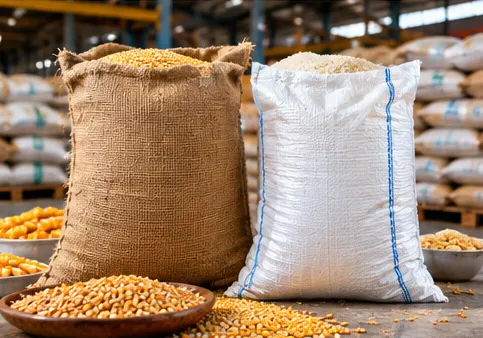
Where PP Woven Sacks and Jute Bags Compete
Jute and PP woven sacks overlap most in:
- Grain and pulses — both used for 25/50 kg commodity packing.
- Engrais — jute and laminated PP both serve bulk agro-input packing.
- Ciment — where jute has a traditional share in some markets.
- Sugar — bulk bagging where jute has historical use.
In each, PP woven offers moisture resistance, puncture strength and, with lamination or liner, a barrier jute does not match. The policy does not make PP “better”; it changes the price relationship a procurement team uses in a total-cost-of-ownership (TCO) comparison.
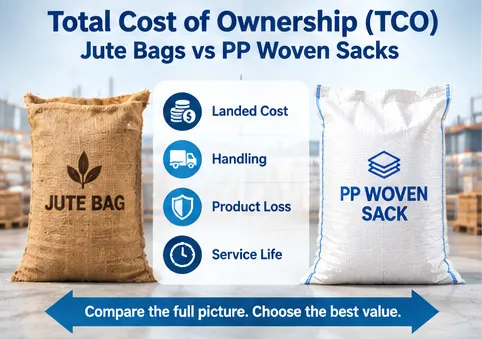
PP Woven Sacks vs Jute Bags: Total Cost of Ownership
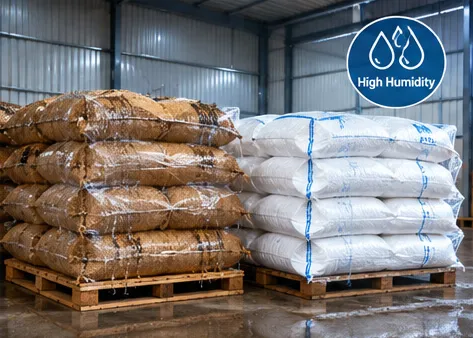
Jute bags and woven polypropylene bags can serve overlapping bulk-packaging applications, but their performance depends on the bag construction and intended use. PP woven sacks can be manufactured with different fabric weights, coatings, lamination and inner liners. These options can improve specific handling or moisture-control characteristics, but performance should be verified for the finished bag rather than inferred from material type alone. Jute bags also vary in construction and suitability. Buyers should compare the complete packaging specification, delivered cost, product protection, filling-line compatibility and expected service life.
| Facteur | Sac en jute | PP woven sack |
|---|---|---|
| Protection contre l'humidité | Depends on fabric and storage conditions | Depends on fabric construction and any coating, lamination or liner |
| Strength and puncture resistance | Verify using the intended bag and load | Depends on fabric, seams, construction and test results |
| Potentiel de réutilisation | Depends on wear, contamination and handling | Depends on bag design, damage and handling conditions |
| Impression | Depends on fabric and printing method | Flexographic printing or BOPP lamination may be available |
| Main cost drivers | Jute price, applicable duties, conversion and freight | PP resin, fabric conversion, optional lamination or liner, duties and freight |
Le Sacs tissés en PP vs sacs en jute guide covers the material trade-offs in depth. This article adds the policy-cost dimension.
How to Evaluate a Switch from Jute Bags to PP Woven Sacks
| Étape | Action |
|---|---|
| Spec definition | Fix fill weight, GSM, lamination/liner, closure |
| Load validation | Drop and stack test for the actual product |
| Filling-line fit | Confirm closure matches the filling equipment |
| Print and traceability | Brand, lot code, regulatory marks |
| Supplier qualification | Test records, MOQ, reorder control |
When sourcing from a Fabricant de sacs tissés en PP, buyers should confirm the required bag dimensions, fabric GSM, load capacity, lamination or liner options, printing method, closure design and applicable quality requirements. Request samples and test records for the intended product and filling line, and verify production capacity, minimum order quantity, lead time and repeat-order consistency. These checks help determine whether a proposed PP woven sack is a practical alternative to the existing jute bag—not merely a lower-priced option on a quotation. For standard structures and specifications, review the full Sacs tissés en PP range.
Conclusion
India’s September 2026 jute anti-dumping duty revision changes the cost framework that importers and packaging buyers need to assess. For businesses comparing PP woven sacks with jute bags, the relevant decision is not whether one material is universally cheaper, but whether the applicable duty, supplier price, bag specification and operational performance produce a better total cost of ownership.
Before switching, verify the official duty schedule and tariff classification, test the proposed bag with the actual product and filling line, and qualify the supplier for repeat orders. Buyers evaluating PP woven bags can use the material comparison and procurement checklist in this guide to define specifications and request quotations from a qualified PP woven bags manufacturer.
Need to compare PP woven sacks with your current jute packaging? Define the bag capacity, dimensions, fabric GSM, closure, printing and any lamination or liner requirements before requesting a quotation. Sharing the intended product, filling method and storage conditions helps a PP woven bags manufacturer assess a suitable specification and identify the tests needed before a packaging change.
Questions fréquemment posées
On 24 September 2026, CBIC issued Notification No. 24/2026-Customs (ADD), revising the anti-dumping duty schedule for specified jute products from Bangladesh and Nepal following DGTR’s mid-term review findings dated 25 June 2026. The revised rates vary by product and producer. Importers should check the official notification for the applicable rate and conditions.
The measure applies to the specified jute products described in the notification, which references tariff headings including 6305. That heading also covers certain non-jute bags, but sharing a tariff heading does not automatically make PP woven sacks subject to the jute anti-dumping duty. Importers should confirm the product description and applicable classification under the current tariff schedule before determining whether a shipment falls within the measure.
Not necessarily. The revised duty schedule may change the landed-cost comparison between jute bags and PP woven sacks for some buyers, but the outcome depends on the applicable duty, supplier quotations, packaging specifications, filling-line compatibility and end-use requirements. Buyers should validate performance and total cost of ownership before changing materials.
Grain and pulses, fertilizer, cement and sugar are potential areas of overlap, depending on local packaging practices and buyer specifications. Whether jute bags and PP woven sacks are practical substitutes depends on the required bag capacity, product characteristics, filling and handling equipment, moisture-control needs and applicable industry requirements. Buyers should compare the specifications and landed costs of the actual alternatives rather than assume that all applications or duty conditions are equivalent.
Neither material is universally better. PP woven sacks offer configurable fabric strength, printing and optional lamination or liners, while jute bags may suit established packaging processes and material-specific requirements. The right choice depends on moisture exposure, product compatibility, handling conditions, required service life and total landed cost.
Confirm the official notification text, then validate the PP spec by drop/stack test, filling-line fit and supplier qualification. Do not change packing on price alone.