




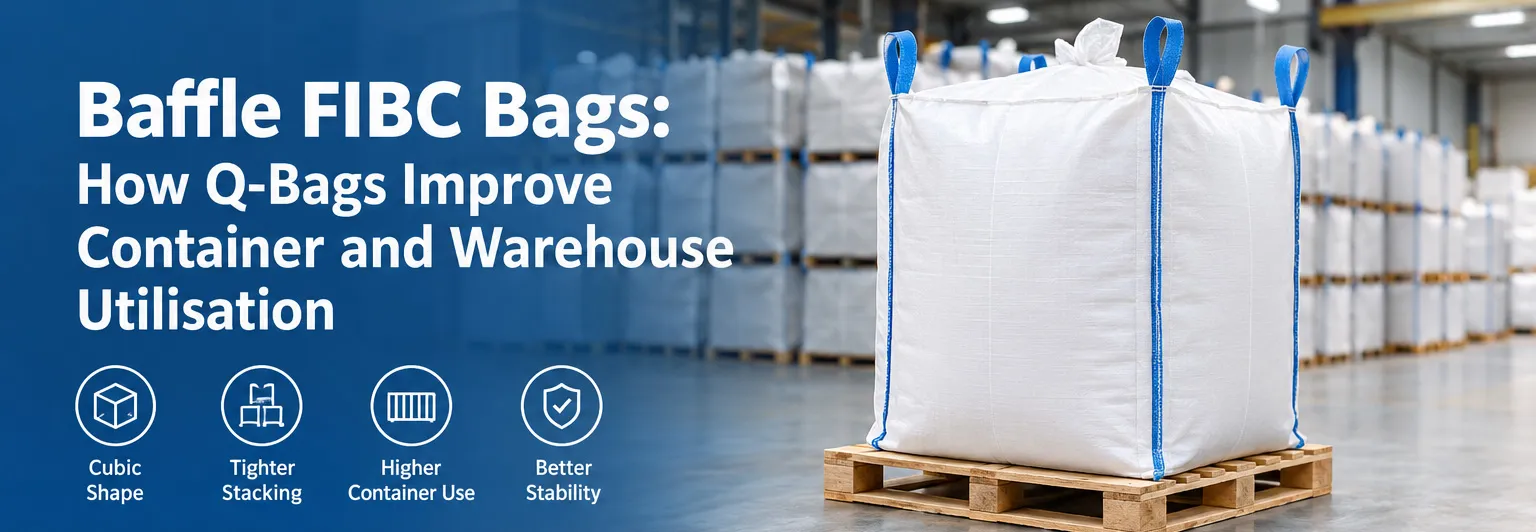
A standard FIBC can bulge as it fills, creating gaps on pallets and between bags in a container. Baffle FIBC bags—often called Q-bags or form-stable bulk bags—use internal panels sewn across the corners to control outward expansion and maintain a near-cubic shape when filled. The result is tighter packing, more consistent stacking and better use of pallet and container space. This guide explains how baffles work, where the space gain comes from and how to decide whether the additional construction cost is justified for your routing.
Réponse rapide : Specifying baffle FIBC bags makes sense when freight or warehouse space is a significant part of your landed cost, especially on long-haul containerised routes. Internal baffle panels control outward expansion so the filled bag keeps a more regular cubic profile, allowing closer packing and more consistent stacking. The trade-off is a higher unit cost and a more complex construction. Confirm the bag’s electrostatic class, liner, discharge design, SWL and stacking requirements separately because baffle construction controls bag geometry rather than automatically determining these performance characteristics.
Définition: A baffle FIBC is a woven polypropylene bulk bag fitted with internal fabric baffles, usually made from PP or another suitable synthetic fabric, that are sewn into the bag structure to limit outward bulging and maintain a more cubic form when filled. These bags are commonly described as baffle FIBCs, Q-bags, Q-bag FIBCs or form-stable FIBCs. Baffles are a shape-control feature rather than a separate FIBC safety category. SWL, construction, lifting-loop design, testing and marking should be specified and verified against the requirements applicable to the intended use, including ISO 21898:2024 where relevant.
What Is a Baffle FIBC Bag (Q-Bag)?
The “Q” in Q-bag refers to the quad/cubic shape the design is built to hold. Inside a standard four-loop FIBC, the side walls bow outward under product pressure; the loose volume at the corners and the gaps between stacked bags are lost space. A baffle FIBC adds panels—typically sewn at several attachment points per corner—that brace the walls and pull the bag toward a square cross-section.
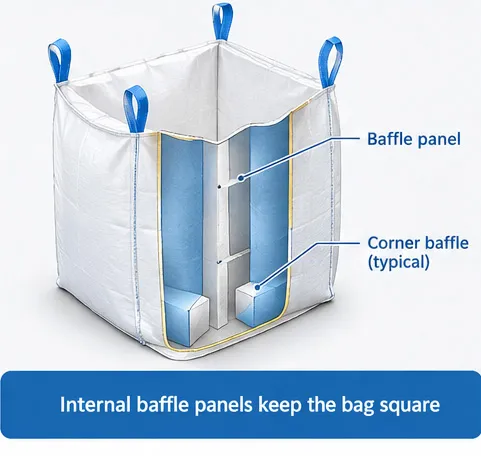
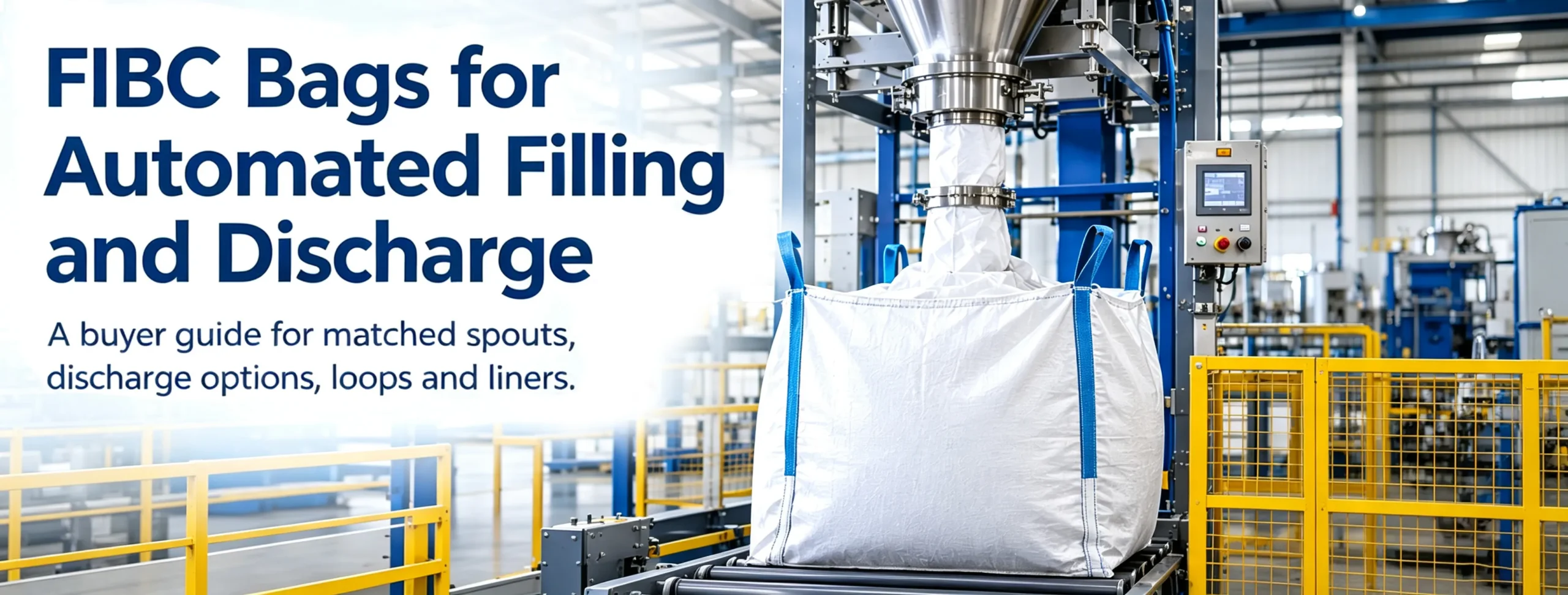
Because the filled shape is more predictable than that of a conventional bulging FIBC, a robotic gripper, palletiser or forklift can work with a more consistent bag profile across normal filling conditions. This repeatability can be valuable on automated and high-throughput lines where variation in bag shape can affect positioning, gripping and palletising.
How Baffle FIBC Bags Improve Space and Stacking
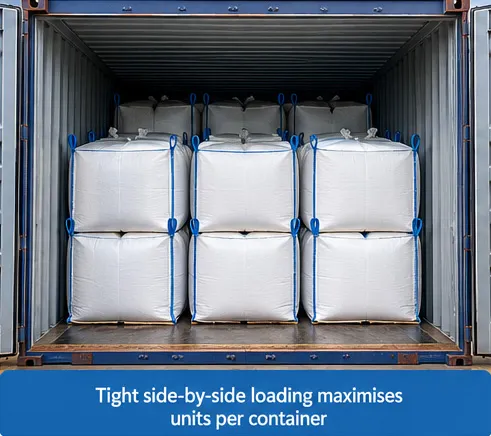
The space gain comes from reducing the gaps created by outward bulging and making the filled footprint more regular. Suppliers of baffle FIBCs commonly cite 20–30% better container or pallet utilisation versus a comparable standard bag, with the exact figure depending on how much the standard bag in use currently bulges.
| Attribut | Standard FIBC | Baffle (Q-bag) FIBC |
|---|---|---|
| Shape when filled | Rounded, bulges at the walls | Cubic / form-stable |
| Pallet and container fit | Gaps between bags; less efficient use of floor space | More regular footprint allows closer side-by-side loading; the actual utilisation gain depends on bag size, product and loading method |
| Stacking stability | Can lean or shift as it settles | More regular shape can improve stacking stability when the bag, load and stacking conditions are suitable |
| Automated handling | Profile varies with fill level | Repeatable profile for grippers and palletisers |
| Unit cost | Lower (simpler build) | Higher (baffle panels + extra sewing) |
À retenir : The baffle does not change the rated load capacity of the bag; its main benefit is geometric—how efficiently that filled bag packs with its neighbours. The payback shows up in freight and storage, not in bag capacity.
Where the Space Saving Comes From
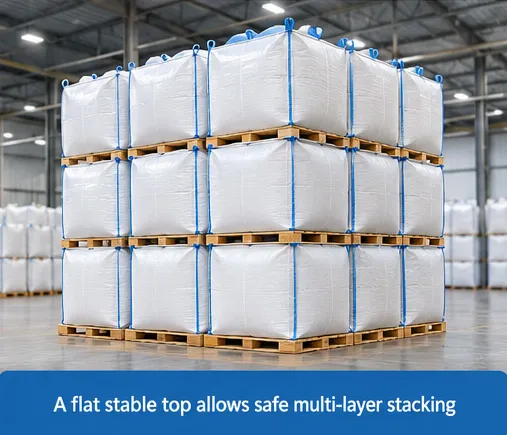
Two effects contribute to the space saving. First, a more regular square profile allows adjacent bags to sit closer together instead of creating large curved gaps. Second, a more stable top and predictable footprint can make multi-layer palletising easier when the bag, product, pallet and operating conditions are suitable. On containerised routes where freight is charged per shipment, even a modest improvement in loading density can be financially meaningful, so the practical saving should be measured using the actual bag dimensions and loading pattern rather than assumed from a generic percentage.
Baffle vs Standard FIBC: A Buyer’s View
| Choose a baffle FIBC when… | Choose a standard FIBC when… |
|---|---|
| Freight or warehouse rent dominates landed cost | Short hauls with low stacking and cheap storage |
| You ship full containers and want maximum units per box | You move small volumes or mixed SKUs loosely |
| Lines are automated or robotic | Manual handling with operator adjustment |
| You need a more predictable pallet footprint for handling or storage | Bag shape variation has little impact on your handling or storage process |
À retenir : Baffle FIBC bags are a logistics decision first and a packaging decision second. If bag purchase price is the dominant cost, a standard FIBC may remain appropriate; if freight, pallet density or warehouse space is a major cost driver, compare the baffle premium with the measurable savings in container freight, pallet handling and storage before deciding.
Baffle Construction Options
Baffles are an internal shape-control feature that can be combined with different FIBC body constructions. When comparing different types of FIBC bags, separate the body construction from optional features such as baffles, liners, coatings and discharge systems.
- 4-panel—four separate side panels form the main bag body, with internal baffles added to control outward expansion.
- U-panel—a U-shaped fabric piece forms the base and two sides, with additional panels and internal baffles completing the bag structure.
- Circular / tubular—a woven tubular body forms the main bag structure, with internal baffles added for shape retention.
- Net-baffle—mesh-style internal baffles can be specified where controlled ventilation or airflow is part of the application requirement.
The appropriate combination depends on the product, filling equipment, pallet footprint, liner requirements and target SWL rather than on the baffle feature alone.
The electrostatic classification should be selected from the product’s ignition hazards, filling and discharge process and site risk assessment, not assumed from the body construction. A bag can be baffled and still be Type A, B, C or D. For conductive or groundable duty, review Conformité à la mise à la terre FIBC de type C as part of the same specification.
When Baffles Pay Off (and When They Do Not)
The extra build cost of a baffle FIBC is typically modest in percentage terms but real, and it is recovered through logistics rather than bag price. The clearest wins are long-haul containerised exports and high-rent warehouses where every cubic metre is priced. For shorter routes or operations with low stacking density, the space benefit may be too small to offset the additional bag cost.
Where the duty is repeat-use, shape retention can also support more consistent handling of multi-trip FIBC bags across repeated handling cycles. Buyers comparing space saving bulk bags should evaluate the total logistics benefit—including freight, pallet density and warehouse storage—rather than the bag price alone.
How to Calculate the Payback of Baffle FIBC Bags
Compare the total cost of a baffle build with a standard build on the same route. Start with the additional cost per bag and multiply it by the annual bag volume. Then estimate the savings from container freight, pallet handling and warehouse storage created by the improved packing density. The result should be based on actual bags-per-container and storage requirements rather than a generic utilisation percentage. If the measurable logistics savings exceed the additional bag cost over the relevant shipment volume, the baffle construction has a stronger business case; if they do not, a standard FIBC may be more suitable.
Specification Checklist for Baffle FIBC Bags
| Article | Ce que définit l'acheteur |
|---|---|
| Base construction | 4-panel, U-panel, circular or net-baffle, matched to product and line |
| Capacity and SWL | Define the target fill weight and required safe working load for the product and handling system |
| Facteur de sécurité et devoir | Define the required safety factor, single-trip or multi-trip duty and test requirements for the intended application; verify against ISO 21898:2024 where applicable |
| Electrostatic class | Select Type A, B, C or D based on the product’s ignition hazards, filling and discharge process, equipment and site risk assessment |
| Top and bottom | Spout, duffle or open top; discharge spout, cone or flat bottom |
| Doublure | Form-fit or loose, material and thickness, if moisture or purity demands it |
| Fabric and coating | GSM, coating, UV stabilisation for outdoor or tropical storage |
| Acceptation | Sampling plan, dimensional tolerances and test reports checked on receipt |
À retenir : Treat the baffle as one line in a full FIBC specification. Define product data, equipment interface, SWL, handling conditions and acceptance criteria first; then evaluate whether the improved packing density justifies the additional baffle construction cost.
A Manufacturing Note
SITONG PACKAGING has manufactured woven polypropylene packaging since 1998, with production in Haicheng (Anshan), Liaoning and in Cambodia, around 20 production lines at roughly 100 tonnes per day, and shipments to more than 70 countries from the port of Dalian. Fabric weaving, coating, cutting, sewing and liner fitting are held in-house, supporting adjustments to bag dimensions, baffle placement, loop configuration and liner fitting based on the customer’s filling, palletising and transport requirements rather than relying only on standard catalogue sizes. Buyers comparing build options can review the FIBC market in 2026 alongside their own routing costs when evaluating whether a cubic FIBC design fits their logistics model.
Conclusion
Baffle FIBC bags trade a higher unit cost for improved shape retention and more efficient use of pallet, container and warehouse space. Suppliers commonly cite space-utilisation improvements in the 20–30% range for suitable Q-bag applications, but the actual result depends on bag dimensions, product characteristics and loading configuration. Specify the baffle together with SWL, electrostatic classification, liner, discharge design and stacking requirements, then compare the measured logistics savings with the additional bag cost before finalising the specification.
Foire aux questions
Suppliers of baffle/Q-bag FIBCs commonly cite around 20–30% better container or pallet utilisation versus a comparable standard bag, but this is not a universal performance figure. The most reliable way to quantify the saving is to compare the number of filled bags loaded under the same container and pallet conditions. The actual result depends on bag size, product density, pallet layout and how much the standard bag in use currently bulges.
Not inherently. Baffle panels improve shape retention and stability, not safe working load. SWL and safety factor are set by the fabric, construction and test method (with ISO 21898:2024 used where applicable) and should be specified independently of the baffle.
Yes. The baffle is geometrically independent of the electrostatic class, so a baffled bag can be built to Type A, B, C or D. The static-control class is chosen from your site’s risk assessment and the product’s ignition characteristics, not from the baffle.
They cost more because of the additional internal panels, sewing and construction steps. Whether the premium is recovered depends on the freight rate, shipment volume, container loading efficiency, warehouse costs and the difference in bag price. For space-constrained routes, calculate the logistics savings against the actual baffle premium rather than assuming a fixed payback.
They can be suitable for automated filling, palletising and warehouse handling because the internal baffles provide a more predictable filled profile than a conventional bulging FIBC. The exact design should still be matched to the filling equipment, gripping method, pallet dimensions and required tolerances.
Free-flowing granules, powders and flakes that benefit from tight, stable stacking—examples include plastic resins, fertilizers, food ingredients, chemicals and construction powders. Very coarse or irregular materials see less stacking benefit.
There is no universal number of stacking layers for baffle FIBCs. A more form-stable cubic profile can make multi-layer stacking easier, but the allowable height depends on the FIBC construction, SWL, product characteristics, pallet, floor conditions and handling procedure. Confirm the permitted configuration with the manufacturer and validate it using the actual filled bags rather than relying on a generic layer count.
Yes. Form-fit or loose liners can be used inside a baffle FIBC where moisture barrier or product purity is required, provided the liner is anchored so it does not collapse into the discharge spout.