




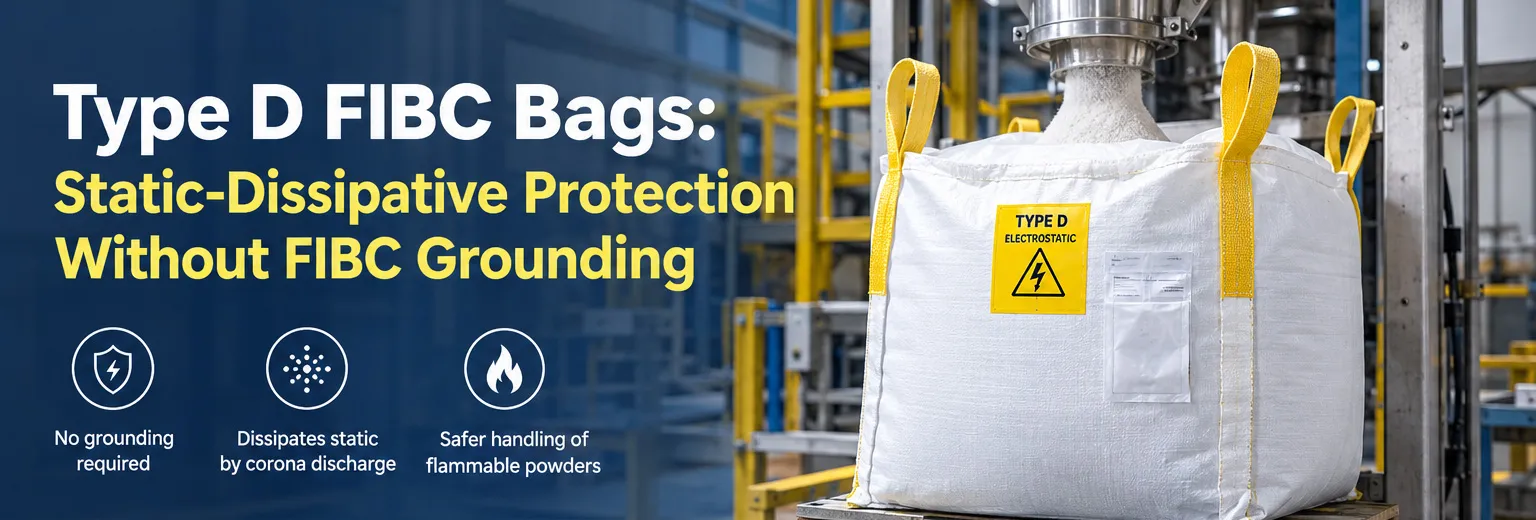
When handling flammable powders or working in hazardous areas where an FIBC earth connection cannot be relied upon, Type D FIBC bags provide a different approach to electrostatic control. Type D FIBC bags are made from static-protective fabric designed to prevent incendiary sparks, brush discharges and propagating brush discharges without requiring the FIBC itself to be connected to earth. Classified under IEC 61340-4-4, Type D is intended for specified hazardous explosive atmospheres when the product, process and site conditions meet the applicable requirements. This guide explains how Type D works, how it differs from Type C, and what buyers should verify when specifying a qualified bag-and-liner system.
Respuesta rápida: Type D FIBC bags are designed for applications where electrostatic ignition risk must be controlled without connecting the FIBC itself to earth. Their static-protective fabric is qualified through the applicable IEC 61340-4-4 test requirements. The liner, labels, document pockets, bag construction and site conditions must also remain within the qualified application. Select the bag from the site’s hazardous-area and process assessment—not from the fabric description alone.
Definición: A Type D FIBC is a flexible intermediate bulk container made from static-protective woven polypropylene fabric. Unlike a Type C conductive FIBC, it is designed to control electrostatic discharges without requiring the FIBC itself to be connected to earth. The fabric construction is qualified to prevent incendiary sparks, brush discharges and propagating brush discharges under the conditions covered by IEC 61340-4-4.
How Static Dissipative FIBC Bags Work
Type D FIBC bags are a specialized form of static dissipative FIBC bags designed to control electrostatic discharge without requiring the FIBC itself to be connected to earth. A Type D FIBC uses a qualified static-protective fabric construction to control electrostatic charge during filling, handling and discharge. The fabric is designed to prevent hazardous discharges without requiring the FIBC itself to be connected to earth. The exact yarn structure, fabric design and electrical characteristics form part of the tested construction, so Type D status should be verified through the supplier’s qualification and test documentation rather than inferred from the appearance or description of the fabric alone.
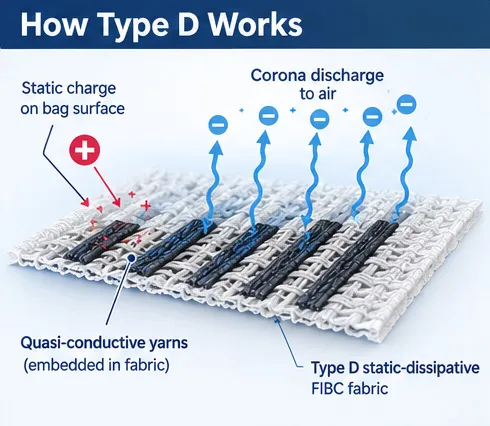
Conclusión clave: The defining advantage of Type D is the removal of the grounding step—and therefore the removal of grounding error as a failure mode.
Buyers may also encounter the term anti static FIBC bags in commercial searches, but the electrostatic classification should be specified by the applicable FIBC type and standard rather than by the generic “anti-static” label.
Type C vs Type D FIBC Bags: Key Differences
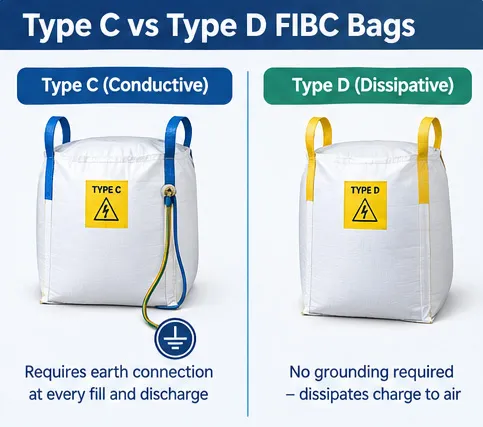
Both Type C and Type D are accepted for flammable materials, but they protect by different mechanisms. Type C uses conductive threads and must be connected to a designated earth point every time it is used; if that connection is missing or faulty, the protection disappears. Type D needs no connection at all.
| Atributo | Tipo C (conductor) | Type D (static-protective) |
|---|---|---|
| Static-control principle | Conductive construction connected to earth | Static-protective fabric designed to control hazardous electrostatic discharges without an FIBC earth connection |
| FIBC earth connection | Required before and during filling and emptying | Not required for the FIBC itself |
| Main control point | Earth connection, electrical continuity and conductive construction | Qualified fabric construction, compatible components and applicable operating conditions |
| Acción del operador | Connect and verify the earth connection before and during the operation | No FIBC earth connection; follow the specified handling and site safety procedures |
| Solicitud | Selected according to the product, process, hazardous area and applicable IEC requirements | Selected according to the product, process, hazardous area and applicable IEC requirements |
For the grounding requirements and the earthing-point language that Type C demands, see Type C FIBC grounding requirements as the companion specification.
What the Standard Requires (IEC 61340-4-4)
IEC 61340-4-4 defines Type D through its static-protective fabric construction and the applicable electrical and ignition-qualification requirements, rather than through a single field-measured resistance value. Under the commonly cited description of the qualified fabric, the electrical breakdown voltage is below 6000 V and the design must pass a series of ignition-attempt tests without causing ignition. A surface or volume resistance in the quasi-conductive range—commonly cited as approximately 10⁸ to 10¹¹ ohms per square—is frequently used by suppliers to describe the fabric, but it is a commonly cited characteristic rather than the formal IEC definition. These are fabric- and construction-level properties verified by the bag’s qualification and test documentation, not by a field measurement the user performs.
Conclusión clave: Treat Type D as a qualified construction, not a property you can test at the dock. Require the supplier’s test qualification and keep it with the batch record.
Liner Rules for Type D FIBC Bags
The liner is part of the electrostatic qualification and must be compatible with the Type D FIBC design. Type L2 is the liner classification permitted for Type D applications, with the relevant surface-resistivity requirement in the range of 1.0 × 10⁹ to 1.0 × 10¹² Ω. Where a liner is used, buyers should verify that its material, construction and electrical properties match the qualified FIBC design. A generic or substituted liner should not be introduced without confirming that the complete FIBC-and-liner combination remains compliant.
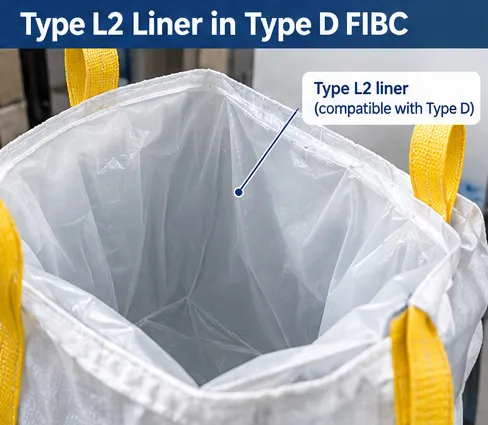
Review Tipos de revestimiento FIBC to match the liner material and barrier to the product while staying inside the Type D qualification.
Labelling and Handling Discipline
Type D FIBC bags carry a yellow electrostatic label and must be used with compatible labels and document pockets that themselves meet the electrostatic requirements. The label itself is part of the qualified FIBC construction and should not be replaced with a non-compliant label. The protection depends on the fabric staying intact: slinging by the loops only, no fork penetration of the body, and no use of non-compliant intermediate bulk liners or outer wraps. As with all FIBCs, keep the bag away from flammable liquids or conductive contaminants that change the hazard picture.
When Type D Is the Right Choice
Specify Type D when any of these hold: the product is a flammable powder or the environment contains combustible dust or vapour; grounding cannot be reliably verified at every fill and discharge station; bags move between areas or sites where earth points differ; or you want to remove one human-error step from the safety system. Where grounding is already reliable and procedural, Type C remains a valid alternative—the choice is driven by your site risk assessment, not by the fabric alone.
Specification Checklist for Type D FIBC Bags
| Artículo | What the buyer defines / verifies |
|---|---|
| Hazard assessment | Product MIE, dust/vapour presence, site grounding reliability |
| Standard | IEC 61340-4-4 for electrostatic classification; ISO 21898:2024 where applicable for FIBC design and performance |
| Tejido | Static-protective construction qualified to IEC 61340-4-4; breakdown-voltage requirement (electrical breakdown voltage below 6000 V) verified as part of the applicable qualification |
| Transatlántico | Compatible Type L2 liner; no substitution without re-qualification |
| Labelling | Yellow electrostatic label; compliant labels and document pockets |
| Construcción | U-panel, 4-panel, circular or baffle build; define SWL according to the product and handling requirements. Typical FIBC capacities can range from 500 kg to 2,000 kg depending on design and application. |
| Factor de seguridad y deber. | Define the required SWL, safety factor and single-trip or reusable duty according to the applicable FIBC design standard and handling requirements |
| Aceptación | Supplier test qualification on file; inspect fabric and label on receipt |
Conclusión clave: The bag is only “Type D” if its qualification, liner and labelling are all intact. Buy the documented system, not just the fabric description.
A Manufacturing Note
SITONG PACKAGING supports matched FIBC-and-liner builds for electrostatic-control applications, with production in Haicheng (Anshan), Liaoning and Cambodia, about 20 production lines at roughly 100 tonnes per day, and shipments to more than 70 countries from the port of Dalian. Fabric weaving, coating, sewing and liner fitting are handled in-house, supporting coordinated bag construction and liner fitting for customized orders. Buyers comparing static-control options can also read the FIBC market outlook alongside their own hazard assessment and request qualification and test documentation for the specific FIBC design.
Conclusión
Type D FIBC bags are designed to control electrostatic ignition hazards without requiring the FIBC itself to be connected to earth. Their static-protective fabric and other qualified components are evaluated under IEC 61340-4-4, while liner compatibility, labelling, document pockets and operating conditions also form part of the safe-use assessment. Specify Type D from the complete product and site hazard assessment rather than from fabric characteristics alone, and request the supplier’s qualification and test documentation for the specific design.
Preguntas frecuentes
No. A Type D FIBC is designed to provide electrostatic protection without an earth connection to the FIBC itself. However, the complete handling system and hazardous-area controls still need to follow the applicable site safety requirements.
Type D FIBCs are classified according to the requirements of IEC 61340-4-4, including their static-protective construction and specified electrical and ignition tests. A Type D FIBC should therefore be verified through supplier qualification and test documentation rather than by relying on a single surface-resistance value.
Type C FIBCs use a conductive construction that must be connected to earth during filling and emptying. Type D FIBCs use a static-protective construction designed to control electrostatic discharges without an earth connection to the FIBC. The appropriate type depends on the product, process and site hazard assessment.
No. Type D FIBCs require a compatible liner configuration when an inner liner is used. Type L2 is the liner classification permitted for Type D applications under IEC 61340-4-4, subject to the specified electrical properties and complete FIBC-and-liner qualification. Do not substitute a generic liner without confirming compatibility with the qualified design.
Require the supplier’s IEC 61340-4-4 test qualification and keep it with the batch record. On receipt, check the yellow electrostatic label and that labels and document pockets meet the standard. Fabric damage or non-compliant liners invalidate the Type D status.
Yes. The electrostatic class is independent of the mechanical build, so a Type D bag can also be baffled (Q-bag), food-grade, or liner-equipped, provided each feature is qualified as part of the same design.
Potentially, but suitability must be established from the applicable hazardous-area classification, product characteristics, process conditions and IEC 61340-4-4 requirements. IEC 61340-4-4 addresses safe use in environments involving combustible dusts and explosive gas atmospheres, but the presence of flammable vapour can introduce additional ignition hazards. Confirm the specific application with the site’s hazardous-area assessment and the supplier’s qualification documentation.
Avoid penetrating the body with forks, slinging by anything other than the loops, using non-compliant outer wraps or liners, and exposing the bag to conductive contaminants or flammable liquids that change the hazard. The protection lives in the qualified fabric system.