




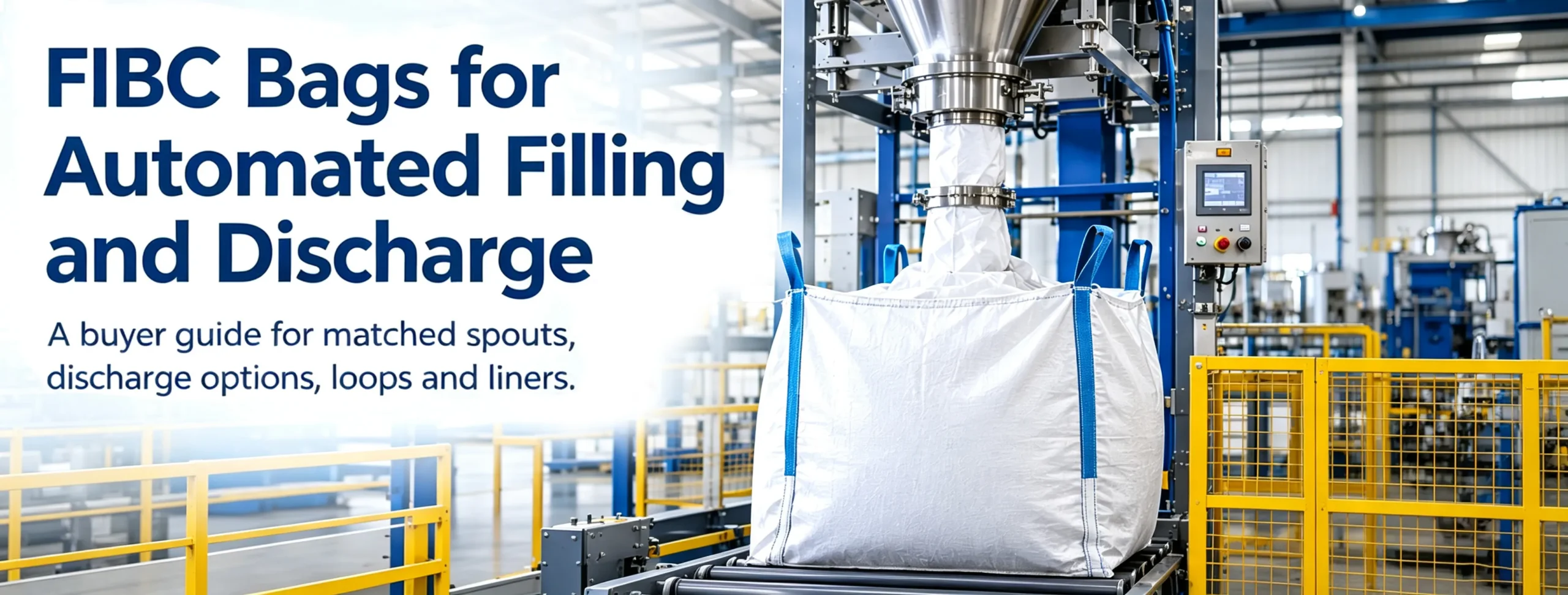
An FIBC that performs well under manual filling conditions can fail on an automated production line. FIBC bags for automated filling are designed not only for load capacity but also for precise interaction with the filling equipment, the discharge system, the lifting device and any liner; the difference is rarely the fabric, it is the interface. This guide covers the top and bottom constructions, lift and stability features, liner behaviour, and the specification checks that reduce the common failures.
Respuesta rápida: When purchasing FIBC bags for automated filling, specify the filling top, the discharge bottom, the loop configuration, the liner design and the machine compatibility as one matched set. Give the supplier the filling and discharge equipment model, the product bulk density, the target fill weight and the cycle requirement, so that dust, unstable lifting and incomplete discharge are designed out rather than corrected on site.
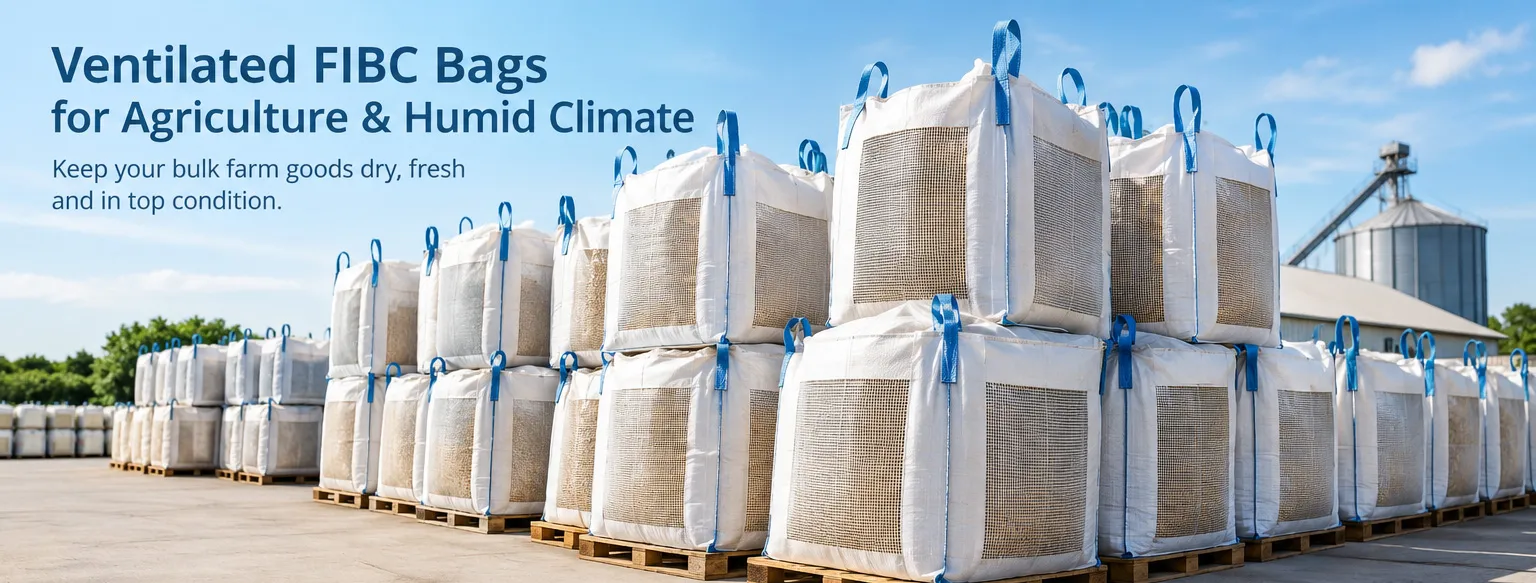
Definition: An FIBC (Flexible Intermediate Bulk Container) is a woven polypropylene bulk bag, typically handling several hundred to a couple of thousand kilograms, lifted by integral loops and used for dry flowable solids. ISO 21898 is the commonly referenced standard for non-dangerous-goods FIBC.
Who Needs Automated FIBC Bags?
Automated FIBC bags are commonly specified by manufacturers handling powders, granules and bulk solids where filling speed, repeatability and clean operation matter. Typical users include chemical processors, food ingredient suppliers, agricultural companies and industrial manufacturers running automated packing or discharging lines.
How Automated Filling Changes FIBC Bag Specifications
Buyer priorities in FIBC purchasing are moving beyond safe working load, size and unit price toward moisture protection, static control, clean sealing and compatibility with automated filling and discharge, as covered in published reporting on FIBC development in 2026. That shift changes the information a manufacturer needs before a bag specification can be developed.
Under manual filling, an operator compensates for variability: they hold the spout, adjust the bag, shake it down. Automation removes that compensation. The bag has to present itself to the filling head, fill to a repeatable geometry, hold shape for lifting, and empty predictably at the discharge station.
Conclusión clave: Manual handling absorbs bag variability. Automation does not. Specify the interfaces, not just the capacity.
FIBC Automation Compatibility: Bag and Machine Must Match
Automated filling FIBC bags depend on consistent positioning and repeatable dimensions. Before ordering, buyers should confirm the relationship between the bag design and the filling equipment: nozzle size, clamp type, lifting frame design, discharge station height and the handling method in use.
Unlike a standard bulk pack, an automated FIBC project involves cooperation between the bag supplier and the equipment operator. Small differences in spout length, loop position or liner installation can affect filling speed, dust control and discharge efficiency.
FIBC Filling Spout and Top Options for Automated Lines
The filling interface is where the bag meets the machine, and on most automated lines that means the filling spout. Choosing a top construction without reviewing the machine interface is a common cause of dust, spillage and slow cycles.
| Top construction | Suited to | Que confirmar |
|---|---|---|
| Filling spout | Gravity and screw fillers with an inflatable or mechanical clamp | Spout diameter and length against the filler nozzle; clamp pressure; whether the spout can be tied or sealed after filling |
| Duffle top | Products needing a wider opening or manual inspection access | Closure method after filling; dust containment during the closing step |
| Open top | Low-dust, free-flowing product with overhead filling | Dust extraction at the fill point; whether the line can close the bag |
| Skirted or covered top | Outdoor storage or hygiene-sensitive product | Whether the cover interferes with the filling head |
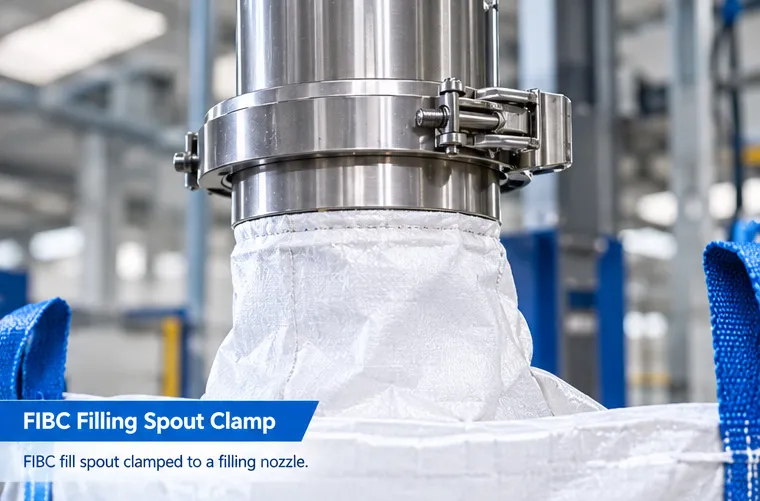
Fill spout length matters more than buyers expect. Too short and the clamp cannot seal; too long and the spout folds into the closure or obstructs the filling head. Both are dimensional questions, and both are cheap to resolve before tooling and expensive after.
FIBC Discharge Spout and Bottom Design Options
Discharge is where residual product and cycle time are won or lost. A design that leaves product in the corners is a cost that repeats on every bag.
| Bottom construction | Discharge behaviour | Typical residual risk |
|---|---|---|
| Flat bottom | Bag is cut or slit open, or the product is tipped out | Highest of the options here, and the bag is not reusable |
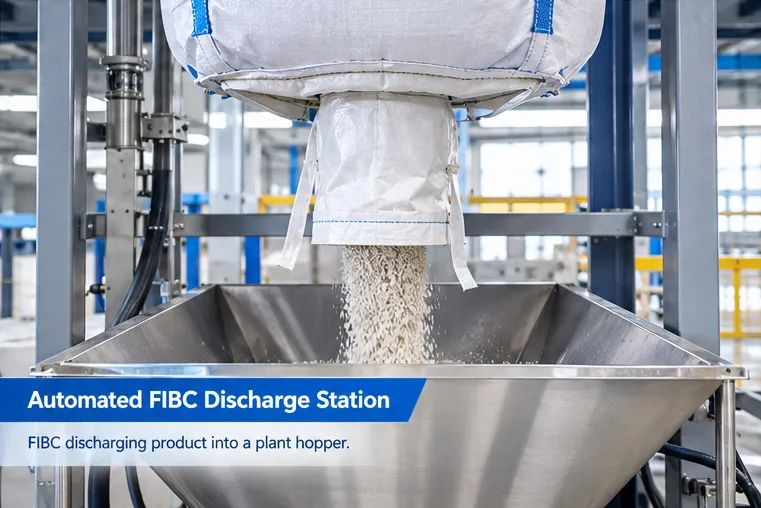
| Discharge spout with petal or iris closure | Controlled release through a spout, closable between partial discharges | Low to moderate, depending on cone angle and product flow |
| Conical or internal cone bottom | Assists flow of cohesive or bridging product | Lower on cohesive powders; cone geometry must match the product |
| Full-open or “B” bottom | Rapid, complete discharge where dust control allows | Lowest, but requires containment at the discharge station |
Product behaviour governs this choice. A free-flowing granule will empty from a simple spout; a cohesive powder may bridge and hold, and is better served by a cone or by discharge aids at the station. Flow is a property of the product, not of the bag, and a supplier can only advise on geometry if they know what is going into it.
Conclusión clave: Tell the supplier the bulk density, particle shape, moisture content and whether the product fluidises. Discharge performance cannot be specified without them.
Lift and Stability: Loops and Baffles
Automated handling usually means a hook, a spreader or a forklift frame engaging the loops repeatably. Loop geometry therefore becomes a positional tolerance.
- Four corner loops are the standard arrangement and suit most hook and frame systems.
- Cross-corner loops present a single pick point and are used where one hook is preferred.
- Tunnel or sleeve lift suits forklift entry in tight layouts.
- Single or two-loop designs reduce fabric and weight for defined lift methods.
Baffles, sometimes called Q-bags, are internal panels that keep the filled bag closer to a cubic shape. They improve pallet and container utilisation and stabilise stacking, at the cost of a more complex build and a different discharge behaviour. Whether they pay depends on whether your cost is freight or bag price — on long-haul containerised routes the utilisation gain is often the deciding factor.
Liners Under Automation
A liner is specified for moisture barrier, product purity or hygiene, and each of those interacts with the line.
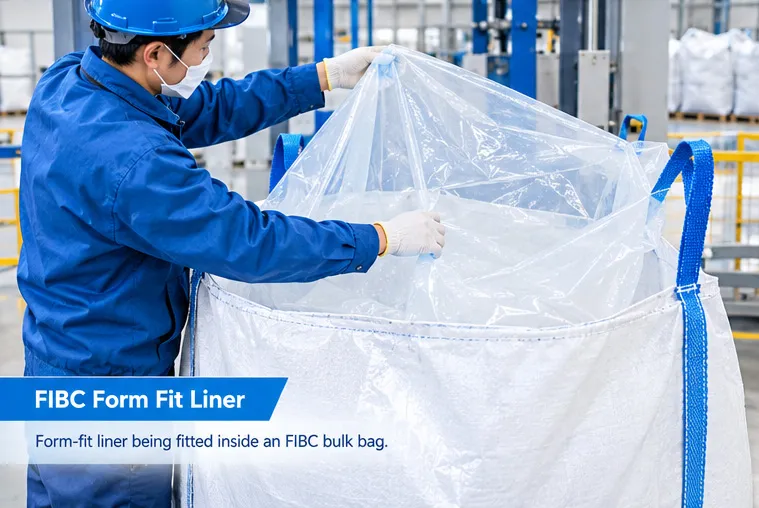
- Form-fit liners follow the bag geometry, reduce folds that trap product, and discharge more completely.
- Tubular or loose liners are simpler and cheaper but can crease and retain product in the folds.
- Liner tabs or ties anchor the liner to the bag so it does not collapse into the discharge spout.
- Conductive or anti-static liners are required in some static-control designs, and must be compatible with the bag’s grounding arrangement.
The last point is where specifications most often conflict. A conductive liner in a bag designed for a different static-control concept can compromise the intended path. Static design is a system property; it is not resolved by choosing one component.
Specification Checklist for Automated Lines
| Item | What the buyer defines |
|---|---|
| Product data | Bulk density, particle form, moisture, flow behaviour, whether it fluidises |
| Filling equipment | Filler type, nozzle diameter, clamping method, target cycle time |
| Top construction | Spout diameter and length, or duffle or open top, plus the closure method |
| Bottom construction | Discharge spout and closure, cone, or full-open, matched to the discharger |
| Lift method | Loop configuration and pick-point geometry against the hoist or frame |
| Stability | Baffled or standard, based on stacking height and container utilisation |
| Transatlántico | Form-fit or loose, material, thickness, tab arrangement |
| Static control | Bag type required by the site’s risk assessment and the product’s ignition characteristics |
| Safety factor and duty | Single-trip or multi-trip, the safety factor and test method, checked against the current edition of ISO 21898 |
| Acceptance | Sampling plan, test reports and the dimensional tolerances that will be checked on receipt |
Conclusión clave: Single-trip and multi-trip designs are not qualified to the same safety factor or cycle duty. State which you are buying before the price is quoted.
Common Failure Modes and What Usually Causes Them
| Symptom on line | Typical cause |
|---|---|
| Dust plume at the fill point | Spout diameter or length mismatch with the filler nozzle, or an unclamped spout during filling |
| Bag will not seat on the filling head | Loop or top geometry not matched to the machine’s locating method |
| Slow discharge, product retained | Product flow behaviour not disclosed; cone geometry or liner fit unsuitable |
| Liner collapses into the spout | Liner not anchored; tabs omitted or undersized |
| Pallet leaning or unstable | Baffles omitted on a high-stacking or long-haul route |
| Loop damage at pick-up | Loop type not matched to the hook geometry or lift angle |
Where Anti-Static Fits
Where the product or the atmosphere creates an ignition risk, static control is not an optional add-on. FIBC selection should follow the product risk assessment and the handling environment: Type C bags require a defined connection to a designated earthing point during use, while Type D designs control electrostatic discharge through specific fabric technologies without that connection. The liner, the coating, the loops and the operating procedure all sit inside that decision, which is why Type C FIBC grounding compliance should be read as part of this specification rather than after it.
Selecting a Supplier for an Automated Program
What distinguishes a capable FIBC partner for automated lines is whether they ask about your equipment before quoting. A supplier that quotes from capacity and dimensions alone is pricing a container, not an interface. Where the duty is specialised, custom FIBC bags can also be developed for applications such as food grade bulk bags and anti-static bulk bags alongside standard bulk material handling designs.
SITONG PACKAGING has manufactured woven polypropylene packaging since 1998, with plants in Haicheng (Anshan), Liaoning and in Cambodia, around 20 production lines at roughly 100 tonnes per day, shipping to more than 70 countries from the port of Dalian. Fabric weaving, coating, cutting, sewing and liner fitting are held in-house, which allows spout geometry, loop layout and liner anchoring to be prototyped and adjusted against a customer’s line drawings rather than against a catalogue. Buyers specifying a program can review the Bolsa a granel FIBC constructions available or discuss a matched design with an FIBC bags manufacturer that controls the full build.
Conclusión
FIBC bags for automated filling succeed or fail at those connection points. Give the supplier the product data and the equipment data, specify the filling spout, the discharge method, the lifting configuration and the liner as one matched set, and agree the tolerances that will be checked on receipt. Automation rewards that discipline: with the bag matched to the line, fewer cycle interruptions can be traced back to the packaging.
Preguntas frecuentes
Normally the product type and bulk density, the filling equipment details, the discharge method, the lifting system, the target capacity and the liner requirement. Providing the machine information early allows the bag design to be developed around the complete automation process.
Yes. Dimensions, spout design, loops, liner anchoring and discharge structures can be adjusted to the machine interface and to how the product behaves, which is usually the point of a custom build rather than a catalogue order.
Possibly, but it should be re-checked rather than assumed. The top and bottom interfaces, loop geometry and liner anchoring all interact with the specific machine; a design that worked with manual handling may not present correctly to a filler.
Product bulk density, particle form, moisture content and flow behaviour; filler type with nozzle diameter and clamping method; discharge method; lift method; target fill weight; and whether the route is single-trip or multi-trip.
Match the bottom geometry to the product. A conical or full-open bottom discharges more completely than a flat one, and a form-fit liner reduces the folds that trap product. Cohesive powders may need discharge aids at the station as well.
It depends on where your cost sits. Baffles improve stack stability and container utilisation, which matters most on long-haul containerised routes where freight dominates. On short routes with low stacking, a standard bag may be more economical.
Yes, in most automated applications. Without tabs or ties a loose liner can be drawn into the discharge spout, restricting flow and leaving product behind.
No. They are qualified to different duties, and multi-trip designs additionally carry a cycle requirement. State which duty you are buying and confirm the safety factor and test method against the current edition of ISO 21898.
No. Static control is a system property. The liner, coating, loops and the site’s earthing arrangement must be compatible with the bag type selected by the hazardous-area assessment.
Most often a spout-to-nozzle mismatch or an unclamped spout rather than a fabric problem. Confirming spout diameter, length and clamping method against the filler usually resolves it.