

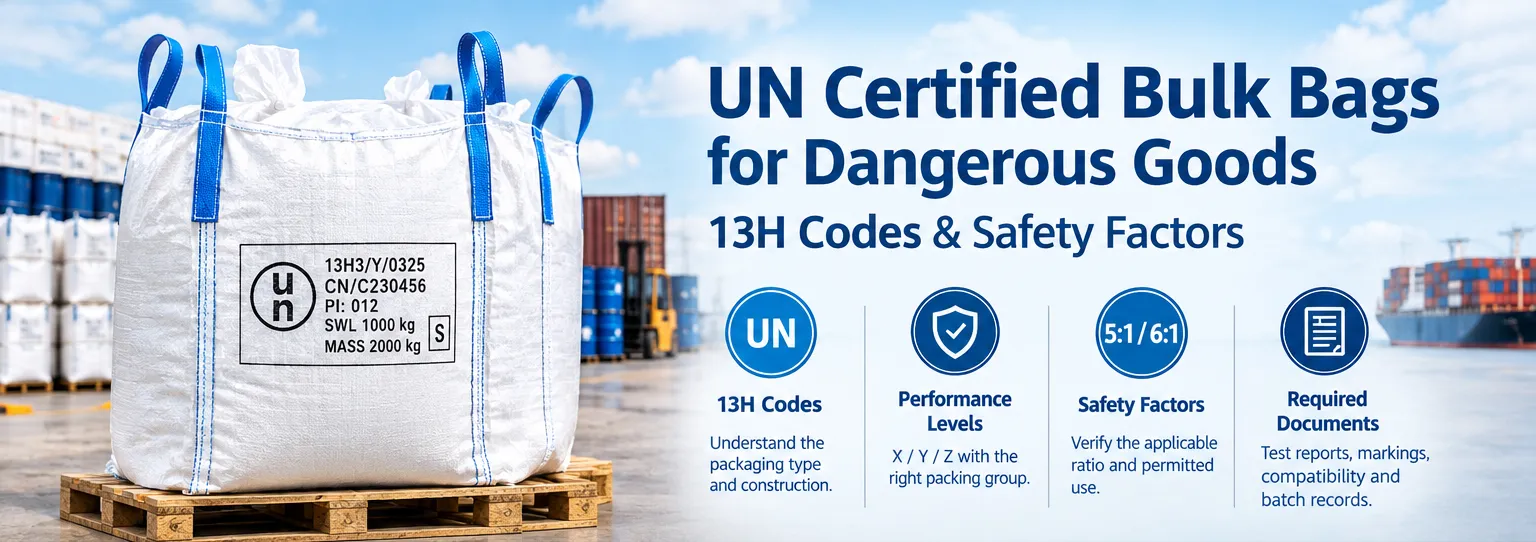
When sourcing UN certified bulk bags for dangerous goods, buyers must verify more than the UN mark. A UN-certified flexible intermediate bulk container (FIBC) has passed the prescribed design-type performance tests for its approved packaging specification, but that approval does not automatically establish chemical compatibility, suitability for every dangerous good, or compliance with every transport route. This guide explains how to interpret 13H packaging codes, read UN markings, assess the 5:1 and 6:1 safety factors, and verify the documentation required before shipment. Buyers should confirm the applicable packaging instructions, packing group, transport regulations and approved bag configuration before placing an order.
Buyer Checklist: Before Ordering UN Certified Bulk Bags
Before approving an FIBC for dangerous goods, verify the following:
- Identify the substance and confirm its dangerous-goods classification.
- Check the applicable packaging instruction and permitted FIBC code.
- Verify the complete UN marking and required performance level.
- Obtain the relevant design-type test report or approval documentation.
- Confirm material compatibility, liner requirements and electrostatic protection where applicable.
- Match the delivered bag specification and batch records to the approved configuration.
These checks help identify documentation gaps before production or shipment. The final packaging decision must follow the regulations applicable to the specific substance and transport route.
What UN Certification Does — and Does Not — Prove
A UN mark on an FIBC means the design type passed the prescribed performance tests (drop, top lift, tear, stack and, where relevant, tilt and hydrostatic/leakage tests) at the rated performance level. It certifies the packaging, not the contents.
Critical boundary: UN certification does not mean the bag is compatible with your chemical. Compatibility (the substance will not attack the fabric, liner or seams) must be verified separately, usually by a compatibility or suitability test for the actual product and conditions.
UN Approval, Compatibility, Electrostatic and Food-Contact: What Each Establishes
| متطلبات | What it establishes | What it does not establish |
|---|---|---|
| موافقة الأمم المتحدة على التغليف | Performance of the approved packaging design type | Compatibility with every substance |
| Material compatibility evidence | Suitability of the specified materials for assessed conditions | Automatic transport approval |
| Electrostatic assessment | Suitability of the electrostatic protection system for assessed conditions | موافقة الأمم المتحدة على التغليف |
| الامتثال لملامسة الغذاء | Compliance with applicable food-contact requirements | Dangerous-goods packaging approval |
The 13H Coding for FIBCs
The 13H series identifies flexible intermediate bulk containers (FIBCs) made from woven plastics or, in the case of 13H5, plastics film. The code indicates the packaging construction, including whether the woven-plastic body has a coating or liner.
| شفرة | Official packaging-type description | اعتبار المشتري |
|---|---|---|
| 13H1 | Woven plastics without coating or liner | Verify whether the uncoated, unlined construction meets the containment requirements. |
| 13H2 | Woven plastics, coated | Confirm the coating specification and approved design. |
| 13H3 | Woven plastics with liner | Verify the liner material and the approved bag configuration. |
| 13H4 | Woven plastics, coated and with liner | Confirm that both the coating and liner match the tested design type. |
The code describes the packaging type; it does not independently establish that the bag is approved for every dangerous good. Check the complete UN marking, applicable packaging instruction and design-type approval documentation before ordering. These FIBCs are intended for solids, subject to the applicable regulations and any specific restrictions on the substance being transported. The packaging-type descriptions above follow the UN Recommendations on the Transport of Dangerous Goods (Model Regulations) and 49 CFR § 178.710; confirm the applicable edition for the specific shipment.
How to Read a UN Marking on an FIBC
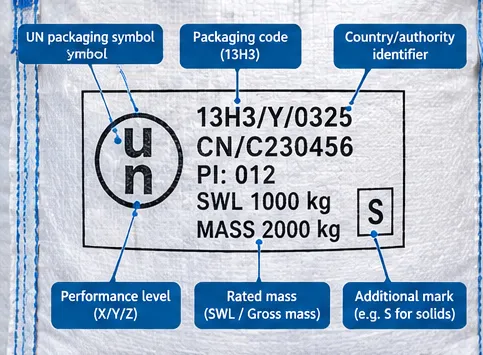
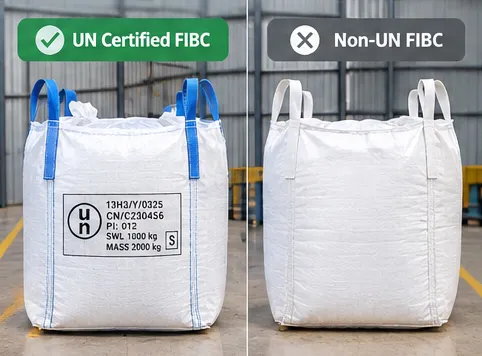
A UN marking identifies the packaging type and relevant performance information required by the applicable regulations. Depending on the packaging and marking rules, it may include the UN packaging symbol, packaging code, performance level, rated mass or capacity information, the letter S for solids where applicable, the year of manufacture, the country or authority identifier, and the manufacturer’s or approval body’s identification code.
The X, Y and Z performance levels are generally associated with packaging requirements for Packing Groups I, II and III, respectively. However, the correct selection must be confirmed against the dangerous good’s classification, the applicable packaging instruction and the complete approval documentation.
Before shipment, request a clear image of the complete marking and compare it with the test report or approval documents and the actual product specification. A partial marking, product photograph or general supplier statement is not sufficient to establish compliance for a specific consignment.
5:1 vs 6:1 FIBC Safety Factor: What Buyers Need to Verify
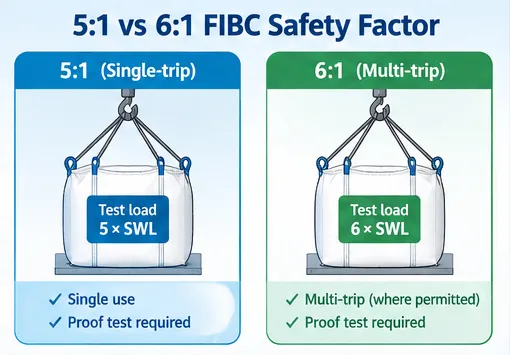
The safety factor is a design-related ratio used in assessing an FIBC’s lifting performance in relation to its safe working load (SWL). It must be interpreted alongside the applicable test requirements, approved design type and intended service conditions.
| عامل الأمان | Buyer verification |
|---|---|
| 5:1 | Confirm the applicable approval, test basis and permitted use for the specific bag. |
| 6:1 | Confirm the same information, including any requirements or restrictions that apply to reuse. |
A 6:1 safety factor should not be treated as a universal requirement for every dangerous-goods FIBC, and a 5:1 rating does not by itself establish suitability for a particular shipment. Buyers must check the applicable regulations, packaging approval and service limitations rather than relying on the ratio alone. Where the requirements are unclear, obtain confirmation from the competent authority or a qualified dangerous-goods specialist before shipment.
Selecting a UN Certified FIBC for Different Cargoes
FIBC selection must begin with the classification of the dangerous good and the applicable packaging instructions, followed by verification of the approved bag construction and compatibility with the actual product.
| Cargo consideration | What buyers should verify |
|---|---|
| Chemical powders | Applicable UN packaging code, permitted packaging instruction, product compatibility, liner specification and electrostatic hazards. |
| Oxidizing substances | Regulatory packaging requirements, material compatibility, contamination control and any special conditions for the substance. |
| Solids containing liquid or capable of wetting the packaging | Whether the material is permitted in the proposed packaging configuration and whether the liner and closure meet the applicable requirements. |
| Heavy or abrasive mineral materials | Approved maximum gross mass, SWL, abrasion resistance, product containment and liner durability where applicable. |
These are preliminary sourcing checks, not substitutes for dangerous-goods classification. Confirm the substance’s UN number, proper shipping name, packing group where assigned, transport mode and applicable packaging instruction before specifying the bag.
Specify the FIBC Liner and Electrostatic Protection as One System
For flammable atmospheres or combustible-dust applications, the FIBC fabric, liner, closures, filling and discharge arrangements, and grounding or charge-dissipation measures must be assessed as a complete system. A conventional polyethylene liner may affect electrostatic performance, but specifying a conductive liner alone does not establish that the complete Type C FIBC system is compliant.
Before ordering, confirm the required electrostatic protection type, the liner’s electrical properties, the bag’s design and test documentation, and the operating procedures for filling, discharge and grounding. Select Type C, Type D or another construction only after a competent assessment of the material and the actual operating environment. UN packaging approval and electrostatic protection address different requirements and must be verified separately.
For liner material options and selection detail, see our FIBC liner types guide.
UN Certified FIBC Supplier: Documents to Request Before Ordering
Before purchasing UN certified bulk bags, ask the supplier for the documents needed to verify the approved packaging design and the actual shipment configuration.
| وثيقة أو سجل | لماذا يهم |
|---|---|
| UN design-type test report or approval documentation | Supports verification of the tested packaging design and performance level. |
| Complete UN marking and product specification | Allows the buyer to compare the code, rated limits and approved construction with the supplied bag. |
| Liner and electrostatic specifications, where applicable | Helps verify material compatibility and electrostatic protection requirements. |
| Product compatibility evidence | Supports assessment of the actual substance, contact conditions and packaging materials. |
| Batch identification and traceability records | Links the delivered goods to the relevant production and quality records. |
| Transport and packaging compliance review | Confirms that the proposed packaging is permitted for the specific dangerous good and route. |
SITONG PACKAGING supplies FIBCs and PP woven packaging for international markets. Buyers evaluating a FIBC bags manufacturer should review the available product range, quality-control procedures and technical documentation relevant to their application. Visit the الشركة المصنعة لأكياس FIBC page and the FIBC bag product page to review product information and request application-specific documentation before confirming an order.
Supplier capability and general product information do not, by themselves, establish that a specific bag is approved for a particular dangerous good. Confirm the approval documents for the exact product and configuration being purchased.
الاستنتاج
Choosing UN certified bulk bags for dangerous goods requires more than checking a UN mark. Buyers must verify the applicable 13H packaging code, performance level, safety factor, approved bag configuration, substance compatibility and transport-specific requirements. The liner and electrostatic protection system must also be assessed separately wherever relevant.
Before confirming an order, obtain the applicable test or approval documentation, complete product specifications and batch traceability records. If you are comparing a FIBC bags manufacturer, provide the supplier with the substance classification, transport mode, required packaging instruction, filling and discharge conditions, and any liner or electrostatic requirements. This allows the supplier to evaluate the requested specification without treating general product capability as proof of dangerous-goods compliance.
For product information, visit the SITONG PACKAGING FIBC manufacturer page and FIBC bag product page to review the available product information. Request confirmation of the documentation applicable to the exact bag configuration before shipment.
الأسئلة المتداولة
UN certification relates to the performance testing and approval of a packaging design type under the applicable regulatory framework. It does not automatically establish compatibility with every substance or authorize the packaging for every transport route. Buyers must verify the complete marking, approved configuration and applicable packaging instructions.
A 13H code identifies an FIBC within the UN packaging-code system. The complete code and marking must be checked against the applicable edition of the relevant regulations and the packaging’s approval documents. Do not determine certification status from a product photograph or the presence of a liner alone.
No. Buyers should not assume that every dangerous-goods FIBC requires a 6:1 safety factor. Verify the applicable requirements, approved design type and permitted service conditions in the relevant regulations and packaging documentation.
Only when the complete bag-and-liner configuration meets the required electrostatic protection design and operating conditions. A conventional non-conductive liner may affect the grounding path, so buyers should verify the liner specification and the complete system’s documentation with the supplier.
These performance levels generally correspond to packaging performance requirements associated with Packing Groups I, II and III, respectively. Buyers must check the complete marking, the substance’s classification and the applicable packaging instruction before approving a shipment.
Requirements depend on the mode of transport, route, substance and applicable jurisdiction. Sea shipments may be subject to the IMDG Code, road transport in Europe to ADR, US transport to applicable provisions of 49 CFR, and air transport to applicable ICAO Technical Instructions and IATA Dangerous Goods Regulations. Confirm the current rules and packaging instructions for the specific shipment.
Request the relevant UN design-type test report or approval documents, a complete marking image, the bag specification, applicable liner and electrostatic information, compatibility evidence and batch traceability records. Additional documents may be required by the dangerous-goods classification, transport mode or competent authority.
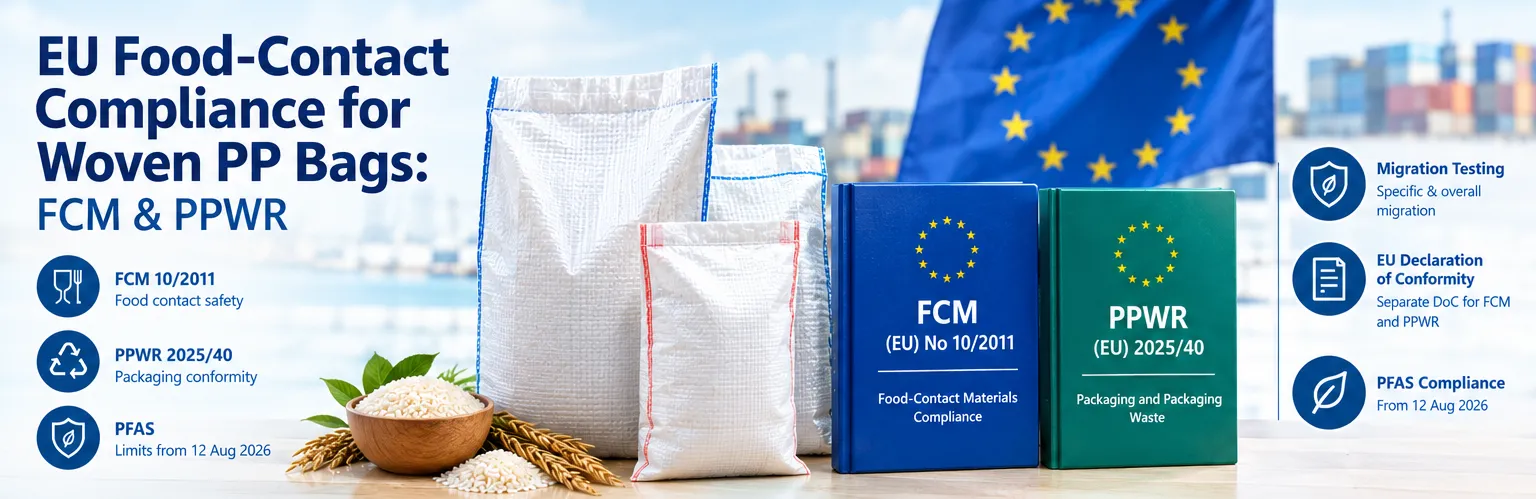
No. UN packaging performance approval and food-contact compliance are separate matters. A bag intended for food applications may require applicable food-contact documentation, material declarations and hygiene controls. Buyers sourcing food grade bulk bags or food grade FIBC products should verify the requirements for the intended market and food-contact use independently.