

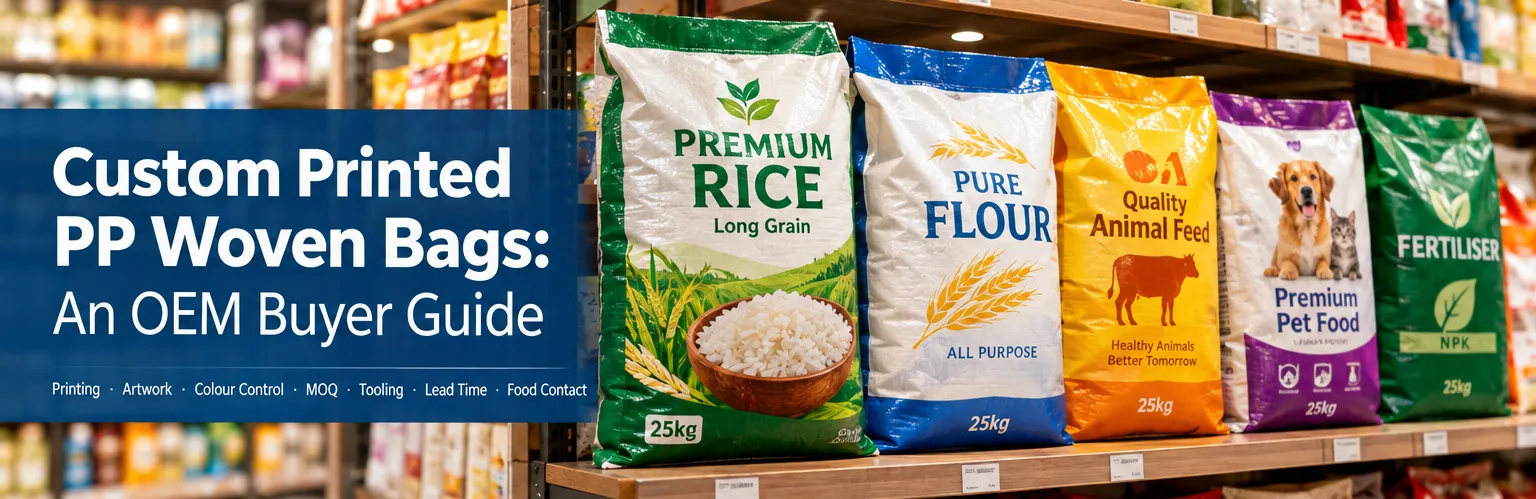
For a miller, a fertiliser blender or a pet-food brand, the bag is often the only physical contact a customer has with the product before purchase. That is why custom printed PP woven bags are specified as a brand asset rather than bought as a commodity sack. These custom polypropylene bags combine woven polypropylene fabric with a printed surface, a coating or BOPP lamination to deliver both load-bearing performance and branded presentation. For many OEM and private-label projects, the artwork, the construction and the printing requirements are defined before production rather than selected from a standard stock range. This guide covers how printed woven polypropylene is made, which print method suits which artwork, what a converter needs from you before the first run, and how minimum quantities and lead times are actually set.
إجابة سريعة: A custom printed PP woven bag is a composite: a woven polypropylene base fabric, a printed BOPP film or a direct-printed woven PP surface, and a conversion step that forms the bag. Print method, colour count, artwork files and tooling requirements influence both the print quality expected and the minimum order quantity, so define all four before asking for a price.
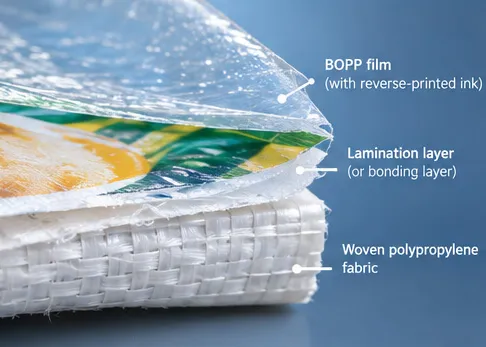
Definition: Reverse printing on a BOPP laminated PP woven bag means printing the artwork on the inner side of the BOPP film before the film is laminated to the woven polypropylene fabric. The printed layer therefore sits beneath the film through filling, transport and shelf handling, which can improve resistance to surface abrasion compared with exposed surface printing.
| Buyer question | Short answer |
|---|---|
| Which print method fits which artwork? | Flexo for text, line work and solid colour designs; gravure on BOPP for high-detail graphics |
| Which construction protects retail print? | A reverse-printed BOPP laminated construction |
| What drives the minimum quantity? | Tooling, print method, colour count, bag size and production volume |
| What artwork should the buyer supply? | Vector files, approved colours and a physical reference sample |
| What does food contact require? | Documentation and test evidence against the destination-market regulation |
The Role of Printing in Commodity Packaging Categories
In rice, flour, sugar, salt, animal feed, pet food and fertiliser, packaging usually has to communicate product information and brand identity before the contents can be evaluated directly.
Independent market coverage of the woven sacks category, including Value Market Research’s sector report, identifies food, feed, fertiliser and industrial end uses as major end-use segments. Within that base, branded retail formats are where print specification carries the most weight, because the bag is doing work that the product cannot do for itself.
For buyers sourcing the same basic bag specification from different suppliers, packaging quality becomes an important point of differentiation. A bag may meet the required GSM, dimensions and seam strength while still differing in colour consistency, print registration, surface finish or scuff resistance. Packaging therefore carries part of the differentiation: a legible, colour-consistent bag signals a controlled supply chain, while a faded or misregistered one suggests the opposite.
This is why brand owners in these categories treat print as a marketing line item and not a packaging cost. It also explains why the print specification needs the same rigour as the fabric specification — GSM, weave density and seam strength can all be correct while the bag still fails on shelf.
الوجبات الجاهزة الرئيسية: In commodity categories the bag is the brand. Treat artwork, colour control and scuff resistance as commercial requirements, not finishing details.
How Custom Printed PP Woven Bags Are Made
Four stages determine what the finished bag looks like and what it costs, and understanding them makes the specification conversation with a converter much shorter. In outline, custom printed PP woven bags are a specialised type of woven polypropylene bags, made by combining woven polypropylene fabric with a printed or coated outer surface and then converting the material into the required bag format. The final construction depends on the product, the filling system, the required print detail and the intended market.
Base fabric: tape extrusion and circular weaving
Polypropylene resin is extruded into tape, drawn to orient the polymer and build tensile strength, then woven on circular looms into fabric. The fabric carries the load; its GSM and weave density set the mechanical baseline. Print quality depends on this substrate being flat and consistent, because weave irregularity shows through a gloss film.
Print method: flexographic versus rotogravure
The two methods in general use behave differently, and the choice is driven by the artwork rather than by preference.
| Dimension | Flexographic | Rotogravure on BOPP film |
|---|---|---|
| Image carrier | Flexible printing plate | Engraved cylinder |
| Typical substrate | Coated or otherwise suitable woven PP surfaces | BOPP film before lamination |
| Artwork suited to | Line work, solid fields, typography | Gradients, detailed graphics, product photography |
| Set-up cost profile | Generally lower plate cost, and plates can be changed more easily | Higher cylinder cost, amortised over volume |
| Colour count | Press-dependent; confirm per supplier | Press-dependent; confirm per supplier |
| Surface protection | Depends on the coating or the construction | Ink sits beneath the BOPP film |
| Final finish | Depends on the substrate and coating | Gloss or matte BOPP options |
| الاستخدام النموذجي | Trade and industrial branding | Retail and consumer-facing packaging |
Lamination and reverse printing
In a typical BOPP laminated construction the film is printed first and then bonded to the woven polypropylene fabric, commonly through an extrusion-lamination or adhesive-lamination process. The resulting structure combines the printed BOPP surface with the woven PP substrate through a lamination layer or bonding process. Because the ink sits beneath the film, the printed image is protected from direct surface abrasion, and the BOPP layer provides a controlled gloss or matte finish.
Matte and gloss affect both appearance and handling, but the actual performance depends on the film and the surface construction. Gloss surfaces can make colours appear more vivid under retail lighting, while matte finishes are often selected for a softer or more natural visual effect. Where pallet stability matters, buyers should specify the required surface friction or anti-skid treatment rather than assuming that a particular sheen will provide it.
Conversion: from printed roll to finished bag
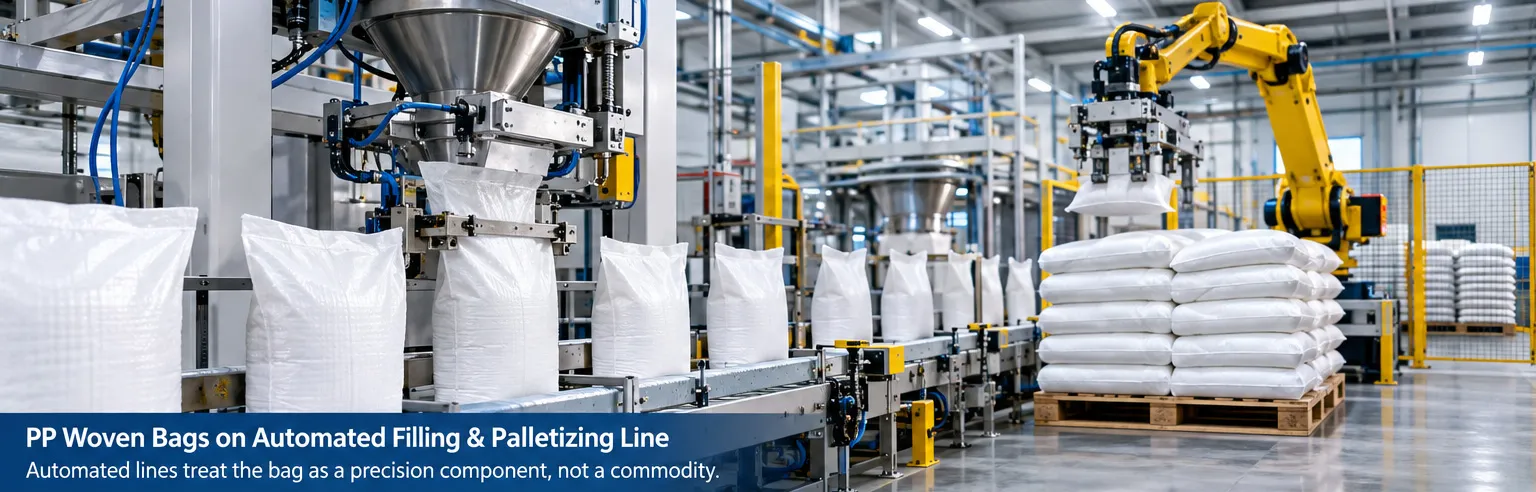
Printed rolls are cut, formed and closed. Common formats are open mouth, block bottom, pinch bottom and valve. The closing method — sewn, heat sealed, or taped — interacts with the filling equipment and with moisture sensitivity of the contents. A valve bag for cement or powder behaves very differently from a block-bottom retail bag.
الوجبات الجاهزة الرئيسية: Print method follows the artwork; conversion style follows the filling line and the product. Specify both, and ask the converter to confirm they are compatible with each other.
Artwork and Colour: What to Send and What to Approve
Most print disputes trace back to the artwork handover, not to the press. The following request list reduces the common failures.
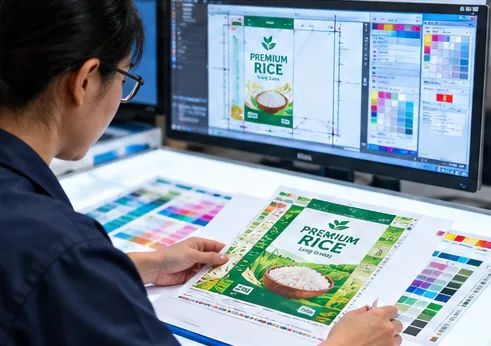
- Vector artwork with text converted to outlines, rather than raster files that cannot be re-separated.
- Named colour references for brand colours, plus a stated production tolerance expressed as a Delta-E value or an agreed physical standard.
- A defined proofing sequence: digital proof for layout, then a physical production sample for colour and finish before the full run.
- Regulatory text placed to survive conversion, keeping nutrition panels, lot codes and origin statements clear of seams, folds and closures.
- A single approved reference sample, signed off and retained by both sides as the acceptance benchmark for reorders.
Colour consistency across reorders is the hardest part of the job and the easiest to get wrong. Ink film thickness, substrate shade and press conditions all move; without a retained reference sample and a stated tolerance, “same as last time” is not a specification.
Specification Checklist for an OEM Order
| Item | What the buyer defines |
|---|---|
| Base fabric | GSM, weave density, tensile requirement with the test method named |
| Print method | Flexographic or rotogravure, with the artwork type stated |
| Printing area | Printable panels, print coverage, registration requirements and any areas that must remain clear |
| Colour count and references | Number of colours, brand references, agreed tolerance |
| Film and finish | BOPP or coating, gloss or matte, anti-skid requirement |
| بطانة | PE liner or tube, loose or attached, where moisture matters |
| Bag style and closure | Open mouth, block bottom, pinch bottom or valve; sewn, sealed or taped |
| Dimensions and tolerance | Flat width, length, gusset, and the acceptable tolerance with measurement method |
| Food-contact requirement | Destination country, the regulation the material must meet, and the document evidencing it |
| Quantity and reorder pattern | First-run volume, expected repeat volume, number of SKUs sharing artwork |
الوجبات الجاهزة الرئيسية: Every row pairs a value with a method or a document. A number without a test method is not a specification, and a food-contact claim without a named regulation is not a requirement.
MOQ, Cylinders and Lead Time: Why the Numbers Move
Buyers often ask for “the MOQ” as though it were a fixed property of the product. In practice, minimum quantity is influenced by tooling, machine set-up, material requirements and the converter’s production economics. Flexographic programmes may involve plate-making costs, while rotogravure programmes typically involve engraved cylinders and a higher initial tooling cost; cylinder cost varies according to factors such as cylinder specification, circumference, engraving requirements, colour count and printing width. The more tooling and set-up that has to be spread across the first production run, the more important order volume becomes to the unit economics.
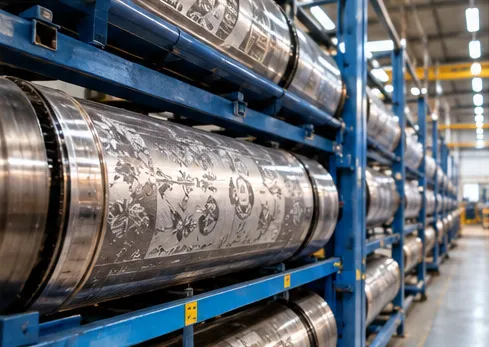
Lead time follows the same logic. A first order carries artwork preparation, cylinder or plate engraving, proofing and sample approval; a repeat order with approved tooling and artwork skips most of those steps. As SITONG’s own reference point, standard OEM custom bag programmes on woven polypropylene commonly begin around 10,000 pieces, while gravure programs are quoted per design once cylinder and artwork scope are fixed. Both are confirmed against the actual specification during quotation, not assumed from a price list.
For a custom printed PP woven bag, the quoted minimum is typically shaped by five variables: bag size, print method, colour count, tooling requirement and production volume. A supplier may therefore quote different minimums for the same artwork when the construction or the printing process changes.
الوجبات الجاهزة الرئيسية: Ask what the minimum is buying — tooling amortisation, machine set-up, or material purchase. The answer tells you where the flexibility is.
Compliance and Documentation for Food-Contact and Retail Channels
Printed bags for food, feed or pet food may require documentation beyond the specifications used for a general industrial sack. Depending on the destination market and the intended use, buyers may need a food-contact declaration, documentation covering the inks and coatings, migration or other compliance testing, and lot traceability from the finished bag back to the production run. The document set should be agreed before production, because these requirements differ by market and by construction.
Management-system certificates such as ISO 9001 or BRCGS describe aspects of how a facility operates; they should not be treated as proof that a specific printed bag complies with every food-contact requirement. For a food-contact project, ask for documentation and test evidence covering the actual substrate, ink, coating or laminate, and the regulation that applies in the destination market.
Choosing a Converting Partner for a Branded Program
The practical test for a private-label program is whether artwork, fabric and conversion are controlled under one roof and one quality system. Where printing is subcontracted, colour accountability is split across two parties, and a dispute about registration or rub resistance becomes a negotiation rather than a fix.
SITONG PACKAGING has produced woven polypropylene packaging since 1998, with plants in Haicheng (Anshan), Liaoning and in Cambodia, around 20 production lines at roughly 100 tonnes per day output, and shipments to more than 70 countries from the port of Dalian. Fabric weaving, coating and lamination, printing and conversion are held in-house, which keeps colour approval, cylinder custody and lot traceability inside a single documented system. For an OEM buyer, that means fabric, printing, lamination and bag construction can be specified within one project rather than managed as separate components. Buyers comparing a BOPP laminated woven bag construction against a simpler coated option can be quoted on both from the same specification sheet. Retail formats, including the PP woven shopping bag range, follow the same artwork and proofing discipline.
خاتمة
Custom printed PP woven bags work best when the buyer treats printing, fabric and bag conversion as one specification rather than as separate purchasing decisions. For an OEM project, define the artwork and the print method first, set a clear colour acceptance standard, confirm the bag construction against the filling line, and ask how the minimum quantity, the tooling and the lead time are calculated. Doing that makes quotations easier to compare and reduces avoidable changes once production has started.
الأسئلة المتداولة
The appropriate method depends on the artwork, the required image detail, the order volume and the bag construction. Flexographic printing is commonly used for typography, line work and solid colour fields, while rotogravure printing on BOPP film suits detailed graphics, gradients and photographic images. Tooling cost and production volume should also be considered before the process is chosen.
The ink is printed on the inner face of the BOPP film before lamination, so the film forms a protective layer between the printed image and external contact surfaces. This helps reduce direct abrasion of the ink layer during filling, transport and handling.
Vector files with text converted to outlines, named brand colour references, and images at a resolution sufficient for the print size. Agree the proofing sequence — digital proof for layout, physical sample for colour — before the production run.
With an approved physical reference sample and a clearly defined colour tolerance. Where the brand owner and the converter use instrumental colour measurement, that tolerance can be specified as a Delta-E range; for other programmes an agreed physical standard may be more practical. The important point is that the acceptance reference and the tolerance are defined before production.
Because engraved cylinders are a significant tooling cost, and that cost rises with the cylinder specification, the number of colours and the print width. The minimum reflects amortising that tooling across the run, which is also why producing several sizes in one first order spreads the set-up over more units.
Yes. Company logos, product names, brand graphics, regulatory information and barcodes can all be printed, subject to the available print area, the colour count and the level of image detail supported by the construction and the printing process. Final artwork and the required print dimensions should be supplied before production proofing.
Yes, where the construction, inks and coatings are selected and tested against the destination regulation. Ask for a declaration naming that regulation and for the test evidence covering the actual laminate, not a generic certificate.
It depends on the filler and on dust behaviour of the product. Valve and block-bottom formats are common on automated lines; confirm dimensional tolerance, surface friction and closure method with the equipment supplier before ordering.
Gloss and matte differ mainly in appearance and surface characteristics. Gloss can provide a brighter, more saturated visual effect, while matte gives a softer, lower-reflective appearance. Handling performance depends on the film, the coating and the surface-friction specification rather than on the finish name alone.
Production time depends on the bag construction, printing method, tooling requirements, artwork approval and the production schedule. A first order usually needs additional time for artwork confirmation, plate or cylinder preparation and sample approval, while repeat orders on approved specifications move faster. As a SITONG PACKAGING reference point, standard lead time on woven polypropylene bag programmes is 20 to 40 days after sample approval, confirmed against the actual specification at quotation.