

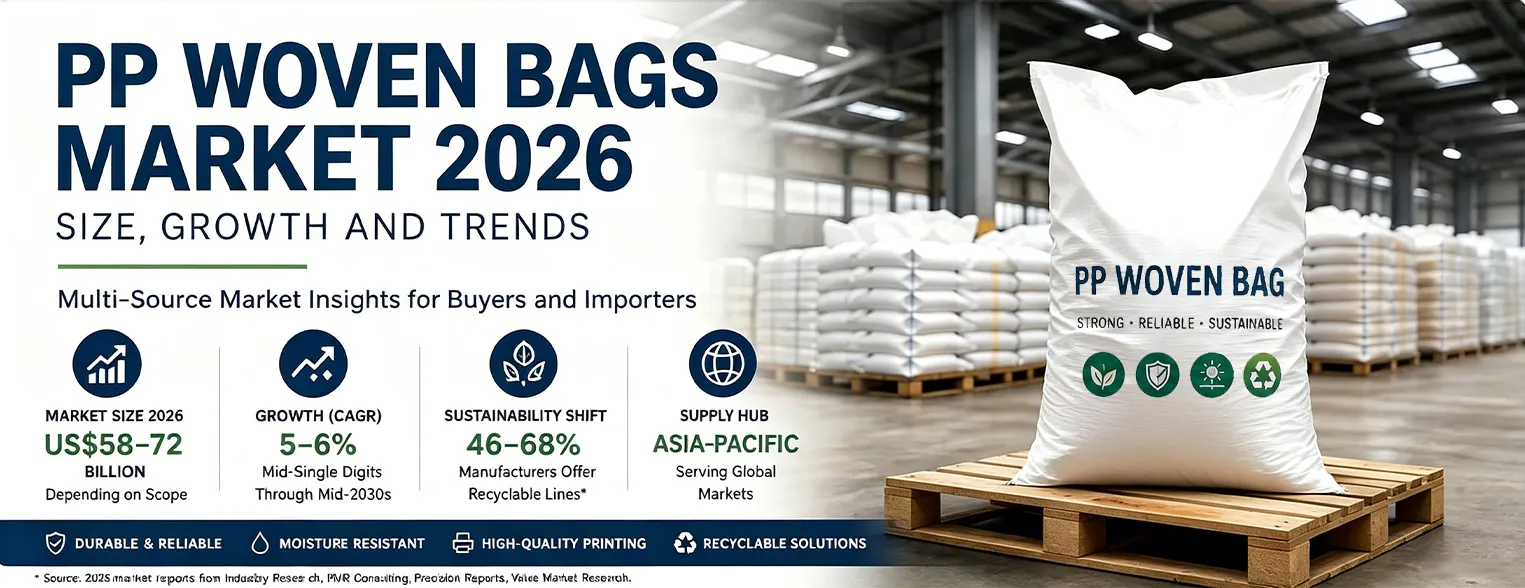
快速回答: The 2025/2026 market reports reviewed for this analysis estimate the broader global PP woven bags market at roughly US$58–72 billion for the current-year base, with reported CAGRs generally in the mid-single digits. Agriculture and construction are major end-use sectors, while laminated, recyclable and application-specific formats are important product segments for buyers.
The global PP woven bags market is estimated at roughly US$58–72 billion in 2026 and is growing at about 5–6% per year through the mid-2030s, depending on market scope and methodology. Demand is anchored by agriculture and construction, while laminated and recyclable formats are gaining attention across industrial and agricultural packaging. Asia-Pacific remains a major manufacturing and supply base. This overview consolidates 2026 figures from multiple market research publishers and adds US application data for importers and buyers.
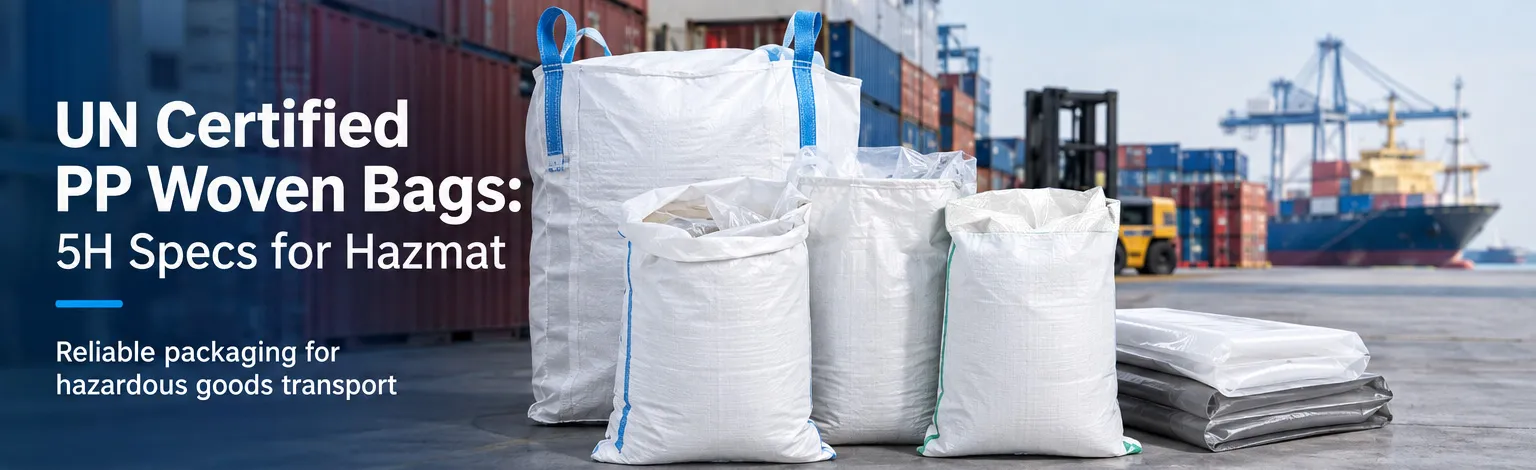
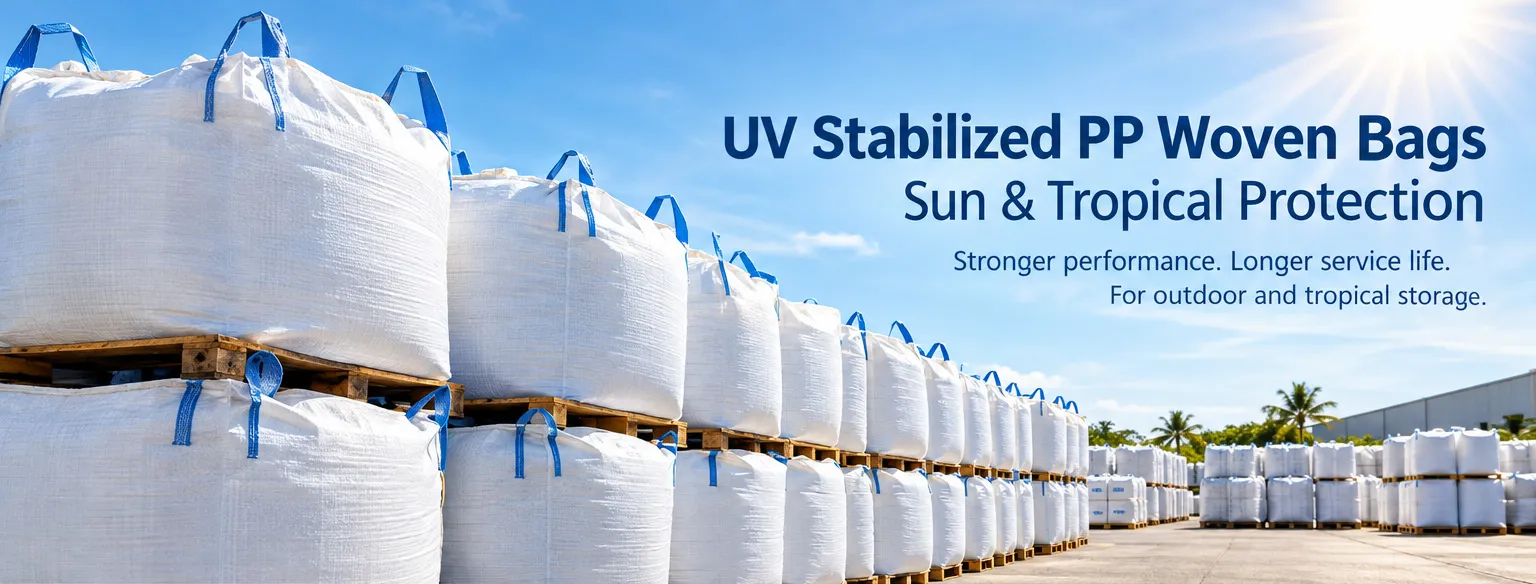
PP woven bags, also known as PP woven sacks, are flexible packaging products made primarily from woven polypropylene tapes. They are widely used for dry bulk materials such as grain, seeds, feed, fertilizer, cement and other industrial products. Bag sizes and constructions vary by application, with lamination, liners, printing, UV stabilisation and other features selected according to filling, storage, transport and end-use requirements.
Market Size: A Multi-Source Consensus
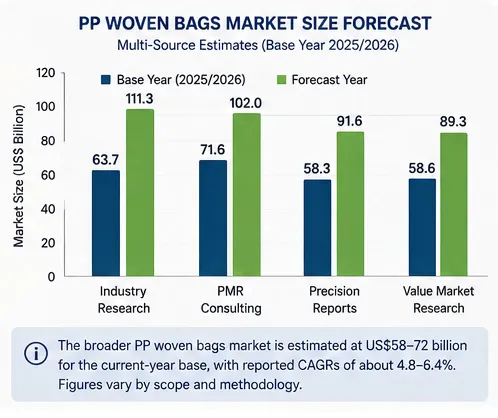
Four independent 2025/2026 market reports converge within a broad range rather than on a single market value, reflecting differences in product scope, geography and methodology:
| 2025/2026 Market Report Estimate | 2025/2026 base | Forecast year | Value | CAGR |
|---|---|---|---|---|
| Report estimate A | 2026 | 2035 | US$63.7B → 111.3B | 6.39% |
| Report estimate B | 2025 | 2032 | US$71.6B → 102B | 5.18% |
| Report estimate C | 2026 | 2035 | US$58.3B → 91.6B | 5.14% |
| Report estimate D | 2025 | 2034 | US$58.6B → 89.3B | 4.79% |
Four independent 2025/2026 market reports place the broader PP woven bags or woven-sack market in a US$58–72 billion range for the current-year base, with reported CAGRs of about 4.8–6.4%. The variation reflects differences in product and market scope. An earlier Persistence Market Research estimate of about US$4.7 billion used a narrower product definition, so market figures should be compared only when the underlying scope is equivalent.

What Drives Demand: Agriculture and Construction
Across the global market-report set reviewed for this analysis, agriculture and allied applications are estimated to account for roughly 37–41% of PP woven bag demand, while construction and building materials account for about 22–28%. These global estimates use a different market scope from the separate US application estimates discussed below.
- Agriculture and allied applications account for roughly 37–41% of demand. Grain, seeds, pulses, sugar and animal feed commonly use PP woven sacks because woven polypropylene provides useful strength, relatively low weight and economical bulk packaging performance compared with many rigid packaging formats.
- Construction and building materials account for about 22–28% of demand in the source set used for this analysis, with cement, sand, aggregates and dry-mix mortar among the important applications. Valve and block-bottom woven formats are commonly selected where automated filling, stacking and handling performance are required.
The US application estimates used in the 2026 source set indicate annual consumption of more than 900 million PP woven bags across agriculture, food, feed and construction. The same estimates place PP woven formats at about 48% of bulk agricultural packaging and construction applications at roughly 22% of US consumption.
Laminated PP Woven Bags: Market Share and Pricing
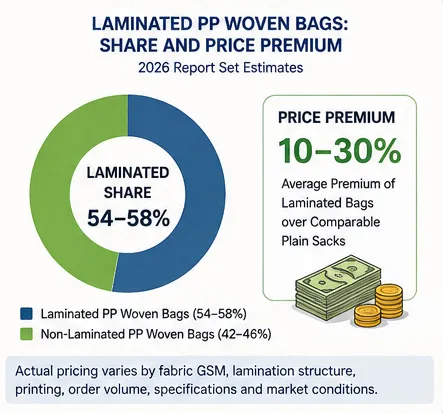
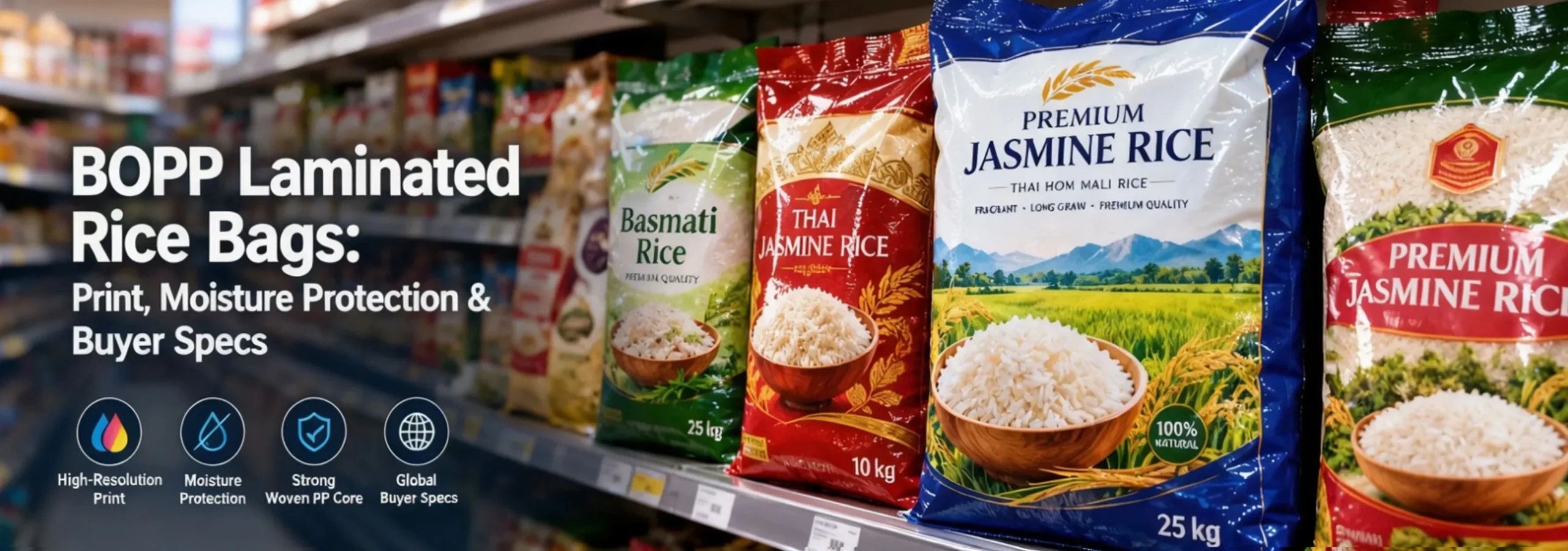
Across the 2026 report set used for this analysis, laminated PP woven bags are estimated to account for roughly 54–58% of the market. Lamination adds moisture resistance, durability and a printable surface, while BOPP lamination can support high-fidelity graphics for branded packaging. The same report set indicates reported average selling-price premiums of about 10–30% for laminated bags compared with comparable plain non-laminated sacks. Actual pricing varies by fabric weight, coating or lamination structure, printing, order volume, specifications and market conditions.
为了 PP编织袋 suppliers, lamination is an important value-added option because it can improve moisture protection, print quality and packaging appearance, particularly for branded products and applications exposed to demanding transport or storage conditions.

Sustainability: Recyclable and Lightweight PP Woven Bags
The 2026 market-report set reviewed for this analysis contains several indicators of sustainability and production development, including reported recyclable-line adoption of approximately 46–68% among manufacturers, recyclability emphasis in about 34–46% of new product launches, laminated-capacity expansion by 57% of producers, lightweighting programs among 63%, automated weaving, cutting or QC integration among 40%, and digital flexographic printing adoption among 37%. These figures come from different report scopes and should be treated as indicative industry estimates rather than a single global survey. Mono-material PP construction can support recyclability assessment because it reduces material complexity, but PPWR recyclability depends on the applicable design-for-recycling criteria, packaging configuration and future implementing rules rather than material composition alone.
Some PP woven bag products incorporate approximately 10–20% post-consumer recycled (PCR) PP, depending on application, performance requirements and applicable regulations. Food-contact applications may face additional restrictions on recycled content.
Regional Supply: Asia-Pacific Manufacturing and Supply Base
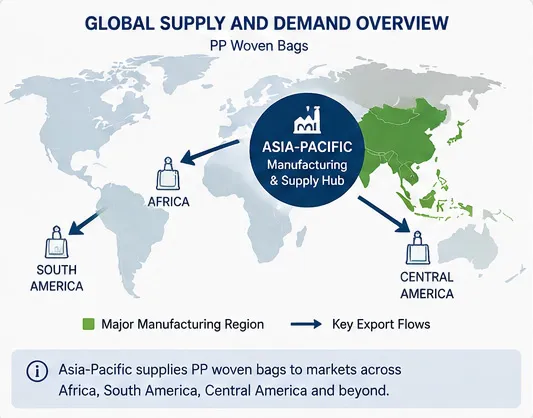
Asia-Pacific is a major global manufacturing and supply region for PP woven bags, with China and India among the important production bases. The region also serves export markets across Africa, South America, Central America and other regions, with buyers typically evaluating Asian PP woven bag manufacturers on production scale, customization, lead time, documentation and landed cost.

Application Snapshot for Buyers
| 应用 | Typical bag | Key spec levers |
|---|---|---|
| Grain, seeds, pulses | Laminated or plain 25-50 kg | Fabric GSM, liner, food-contact documentation, UV stabilisation |
| Animal feed / fertilizer | Laminated valve or open-mouth | Moisture barrier, print, stacking |
| Cement, sand, mortar | Block-bottom / valve woven | Burst strength, PE liner, UV |
| Food retail / branded | BOPP printed laminated | High-fidelity print, traceability |
Each of these applications is covered in dedicated product and application resources such as the agricultural PP woven bag page on the SITONG site, helping importers align bag construction and specifications with the intended product, climate and transport route.
要点
- The broader PP woven bags market is estimated at roughly US$58–72 billion for the current-year base, with four independent reports indicating mid-single-digit annual growth.
- Agriculture and construction are among the largest reported end-use sectors, while laminated formats account for an estimated 54–58% of the market in the 2026 source set.
- Recyclable mono-material designs and recycled-content strategies are becoming increasingly relevant in PP woven bag development, although adoption varies by application, market and regulatory requirements.
- Asia-Pacific is a major manufacturing and supply region, while PP woven bag demand extends across Africa, South America, Central America and other international markets.
For buyers, the practical takeaway is to specify by application — GSM, liner, lamination, UV and print — rather than buy a commodity sack, and to source from a manufacturer that can provide consistent product specifications, quality documentation, material information and any applicable sustainability or recycled-content documentation.
常见问题解答
The 2025/2026 market reports reviewed for this analysis place the broader PP woven bags market at roughly US$58–72 billion for the current-year base, with reported CAGRs generally around 4.8–6.4%. The range reflects differences in product scope, geography and methodology.
Agriculture and construction account for the largest reported end-use shares in the source set, while food, animal feed, fertilizer and other industrial applications make up the remaining demand.
The 2026 report set reviewed for this analysis indicates reported average selling-price premiums of about 10–30% for laminated bags compared with comparable plain non-laminated sacks. Actual premiums vary according to material structure, printing, specifications, order volume and market conditions.
Recyclable PP woven bags are becoming more widely offered. The 2026 report set used in this analysis indicates that approximately 46-68% of manufacturers offer recyclable lines and that about 34-46% of new launches focus on recyclability. Adoption varies by market and application, with mono-material PP being one route to simplify material recovery.
Some PP woven bag products incorporate about 10-20% post-consumer recycled PP, depending on performance requirements and market regulations. Food-contact applications may require additional compliance review before recycled content is used.
Asia-Pacific is a major manufacturing and supply region for PP woven bags, with China and India among the important production bases. Buyers sourcing internationally should compare suppliers on production capacity, customization, quality consistency, lead time, documentation and landed cost rather than origin alone.
There is no single specification that fits every PP woven bag application. Buyers should first define the material, filling weight, handling method and storage conditions, then specify fabric GSM, liner, lamination, UV stabilisation, print method and required food-contact or other compliance documentation.
The US application estimates used in the 2026 source set indicate annual consumption of more than 900 million PP woven bags across agriculture, food, feed and construction. The same source set estimates PP woven formats at about 48% of bulk agricultural packaging and construction at roughly 22% of US consumption; these figures represent application estimates rather than a separate US market-size valuation.