

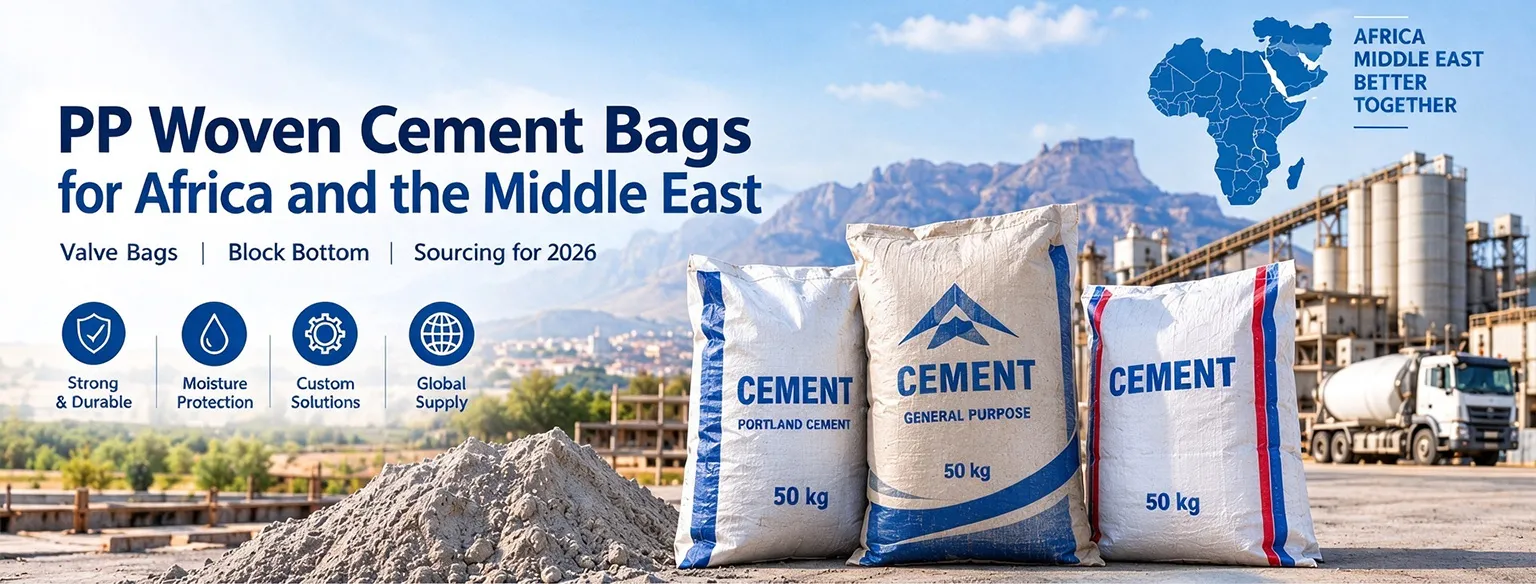
PP woven cement bags are widely used to package and transport cement for construction projects, building-material distributors and industrial supply chains across Africa and the Middle East. Made from woven polypropylene fabric, these cement bags can be configured for different filling systems, bag weights, closure designs and printing requirements.
For buyers sourcing woven polypropylene bags, the right specification depends on filling-line compatibility, mechanical performance, moisture protection, storage conditions and shipping costs. This guide explains how to compare valve and block-bottom designs, confirm material specifications, calculate landed costs and evaluate a PP woven bags manufacturer for reliable repeat orders.
Why Cement Is the Anchor Application for Woven PP
PP woven cement bags are used for packaging cement in high-volume construction and distribution supply chains. Woven polypropylene fabric provides a configurable packaging structure that can be designed for different filled weights, filling systems and handling requirements. Depending on the bag construction, manufacturers may add coatings, lamination, printing or an inner liner to address specific packaging needs.
Cement packaging performance depends on the complete finished-bag design, including fabric properties, seams or valve areas, closure construction and the intended storage environment. For repeat purchases, buyers should prioritize consistent specifications, validated performance and reliable delivery rather than assuming that a particular material or fabric weight guarantees suitability.
Respuesta rápida: For cement packaging in Africa and the Middle East, specify the filled bag weight, dimensions, valve and bottom construction, fabric strength, lamination and any inner liner before requesting quotations. Validate the design against the filling line, handling conditions and applicable performance tests, then compare suppliers using landed cost, quality consistency and delivery reliability.
Cement Packaging Market at a Glance
Cement packaging demand is closely linked to construction activity, infrastructure investment, cement production and the development of local distribution networks. Across Africa and the Middle East, procurement requirements vary by country, producer, filling technology and transport conditions.
For bag buyers, the most useful market indicators are cement output and consumption, packaging-line requirements, local bag manufacturing capacity, import costs and the availability of suppliers that can maintain consistent specifications.
| Market factor | What buyers should assess | Implicación de adquisiciones |
|---|---|---|
| Cement production and consumption | National cement output, demand trends and producer capacity | Estimate recurring bag requirements |
| Packaging-line configuration | Valve filling, open-mouth filling and bottom construction | Match bag design to existing equipment |
| Local bag supply | Production capacity, quality consistency and delivery lead times | Assess the value of local versus imported supply |
| Transport and storage | Humidity, handling intensity and storage duration | Select appropriate barrier and mechanical performance |
| Import economics | Freight, duties, destination charges and delivery terms | Compare suppliers on landed cost |
Use current national statistics, industry reports and documented supplier quotations when estimating market size or purchasing volumes. Regional growth estimates should identify their source, publication date, geographic coverage and measurement basis.
PP Woven Cement Bag Specifications: What Buyers Should Confirm
Finalize the bag specification before requesting quotations. The appropriate construction depends on the filling system, filled weight, handling requirements, storage environment and performance targets.
| Especificación | Options to evaluate | Qué deben verificar los compradores |
|---|---|---|
| Filled weight | 25 kg, 40 kg or 50 kg | Bag dimensions, filling accuracy and handling requirements |
| Construcción de tela | Woven PP tape, fabric weight and weave density | Tensile performance, seam integrity and drop-test results |
| Valve and closure | Valve sleeve, valve design or open-mouth construction | Compatibility with the filling equipment and closure requirements |
| Construcción inferior | Block bottom or other suitable bottom designs | Stability during stacking, palletization and transport |
| Protección de superficies | Unlaminated woven fabric, PE coating or BOPP lamination | Abrasion resistance, print requirements and moisture-barrier needs |
| Forro interior | Optional PE liner where justified | Liner fit, sealing method and required moisture protection |
| Impresión | Flexographic printing or reverse-printed BOPP film | Artwork accuracy, colour consistency and resistance to handling |
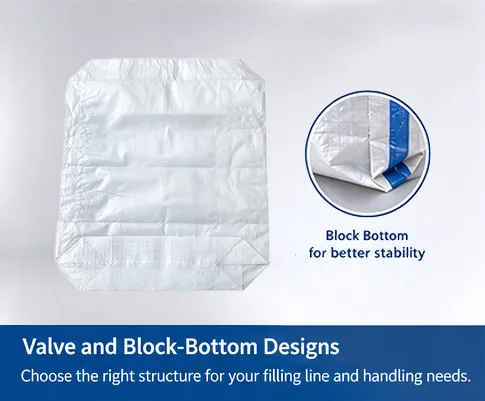
Cement bag selection involves two separate design decisions: how the bag is filled and closed, and how its bottom is constructed. Open-mouth bags are filled through an open top and then closed using a suitable sewing or sealing process. Valve bags use a dedicated filling opening, with closure performance depending on the valve design and overall bag construction. Block-bottom construction creates a more rectangular base that can support bag shape and stacking stability when properly designed.
These features are not mutually exclusive: a block-bottom bag can also use a valve filling system. Before requesting quotations, confirm the required filled weight, bag dimensions, filling-machine configuration, valve position and dimensions, bottom construction, closure method and pallet pattern. Validate the selected design through filling-line trials and agreed finished-bag performance criteria.
Do not select fabric GSM from fill weight alone. Confirm the complete bag construction through representative samples and agreed acceptance criteria. Where relevant, evaluate drop resistance, seam or valve integrity, stacking performance and moisture protection under conditions representative of the intended supply route.
Regional Sourcing Considerations for Africa and the Middle East
Africa and the Middle East should not be treated as a single cement-bag sourcing market. Buyers need to assess local bag manufacturing capacity, import requirements, shipping routes, inland transport and the technical requirements of each cement producer.
For West and East African destinations, confirm port access, destination handling charges, inland delivery arrangements, customs requirements and the availability of local suppliers before comparing imported bags with domestic supply. For Middle Eastern destinations, verify the buyer’s filling-line configuration, order consistency requirements, palletization standards and the storage conditions expected during distribution.
For every destination, establish the annual demand, order frequency, filled weight, bag dimensions, valve and bottom construction, printing requirements, acceptable lead time and delivery location. Request comparable quotations on the same specification and Incoterm, and verify local import rules and applicable taxes before finalizing the purchasing decision.
Country-specific market size, import duties, demand forecasts and freight rates should be included only when supported by current, dated and geographically relevant sources.
Buyers comparing multiple regional markets can also read the PP woven cement bags in Latin America guide for a complementary perspective.
Burst Resistance, Moisture Protection and UV Stability
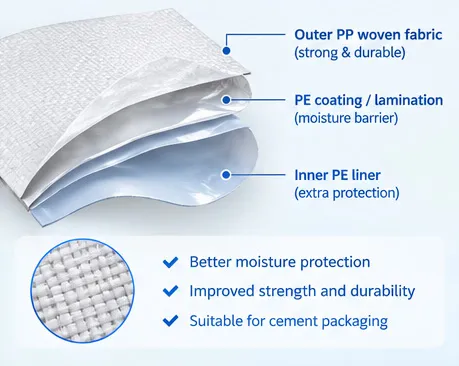
Cement bags must withstand the mechanical stresses of filling, conveying, stacking and transport while providing moisture protection appropriate to the intended storage conditions. Performance depends on the complete bag construction, including fabric properties, seams or valve areas, closure design and any coating, lamination or inner liner.
Depending on the application, buyers may need to evaluate fabric tensile properties, finished-bag drop resistance, seam or valve integrity, stacking performance and moisture-barrier performance. Agree on the applicable test methods and acceptance criteria with the manufacturer before production. Where burst resistance is a specific requirement, identify the test method and the component or finished product to which it applies.
Unlaminated woven PP, coated or laminated fabric, and bags with an additional PE liner provide different protection characteristics. Select the structure according to the expected exposure conditions and validate it with representative samples.
Where bags or empty fabric will be stored outdoors or exposed to sunlight for extended periods, assess whether UV stabilization is required and confirm the expected exposure period and relevant test criteria. Do not assume that lamination or a specified fabric weight automatically guarantees moisture resistance, UV durability or finished-bag strength.
Why Landed Cost Matters More Than FOB Unit Price
The lowest FOB quotation does not necessarily represent the lowest total procurement cost. Ocean freight, applicable surcharges, insurance where applicable, import duties, taxes, destination charges and inland delivery can materially change the final cost of imported cement bags.
A practical comparison uses the following calculation:
Total landed cost = Product cost + Origin charges + Freight + Insurance (if applicable) + Import duties and taxes + Destination charges + Inland delivery + Documented inspection and quality-related costs.
Landed cost per 1,000 bags = Total landed cost ÷ Number of bags × 1,000.
Where relevant, buyers can also calculate packaging cost per tonne of cement by dividing total packaging expenditure by the tonnes of cement packaged. This helps compare bag constructions when unit prices differ.
Use current supplier and freight quotations, confirm which charges are included in the Incoterm, and verify the destination country’s customs valuation, duty and tax rules. Avoid adding the same charge twice when comparing supplier quotations.
How to Evaluate a PP Woven Bags Manufacturer
When evaluating a PP woven bags manufacturer, buyers should review the supplier’s relevant production capabilities, documented quality controls, sample approval process and ability to maintain agreed specifications across repeat orders. Request evidence appropriate to the order, including material specifications, finished-bag test results, applicable certificates and traceable inspection records.
| Audit area | Que verificar |
|---|---|
| Manufacturing equipment | Weaving, coating or lamination, printing, cutting and sewing or valve-bag converting capabilities |
| Documentación de calidad | Applicable certificates, inspection procedures and traceable production records |
| Material specifications | Fabric weight, dimensions, construction and agreed tolerances |
| Finished-bag performance | Relevant drop, seam, valve, stacking and other agreed test results |
| Print consistency | Approved artwork, colour references, plate management and batch-to-batch consistency |
| Commercial terms | MOQ, lead time, payment terms, shipping terms and capacity for repeat orders |
| Sample approval | Pre-production samples, signed specifications and agreed acceptance criteria |
SITONG PACKAGING supplies woven polypropylene packaging for international markets. Buyers evaluating its suitability for cement and construction packaging can review the Fabricante de bolsas tejidas de PP page for manufacturing and export information and the bolsos tejidos PP de construcción page for related applications.
For a comparable quotation, provide the filled bag weight, dimensions, valve and bottom construction, fabric and surface-treatment requirements, printing artwork, order quantity, destination port and preferred shipping terms. Confirm minimum order quantity, production lead time, sample approval requirements and the agreed inspection criteria directly with the supplier before placing a repeat order.
Conclusión
PP woven cement bags are a specification-led purchasing decision for cement producers, distributors and importers across Africa and the Middle East. The right choice depends on filled weight, fabric construction, valve and bottom design, moisture protection, printing requirements and compatibility with the filling line.
Before committing to a supplier, approve the complete bag specification, validate relevant performance tests and compare quotations on a consistent landed-cost basis. For buyers sourcing woven polypropylene cement bags for construction applications, a manufacturer’s documented production capabilities, quality controls and ability to maintain repeat-order consistency are as important as the initial unit price.
SITONG PACKAGING provides a starting point for evaluating manufacturing capability and construction packaging options through its PP Woven Bags Manufacturer and Construction PP Woven Bags pages. Contact the supplier with your required bag weight, dimensions, closure, printing, order quantity and destination to obtain a comparable quotation.
Request a PP Woven Cement Bag Quotation
Looking for a suitable cement bag supplier for your African or Middle Eastern market? Share your required bag weight, dimensions, valve and bottom design, printing artwork, order quantity and delivery destination to request a specification-based quotation.
Contact SITONG PACKAGING to discuss your cement packaging requirements and confirm product specifications, minimum order quantity and delivery lead time.
Preguntas frecuentes
Common industrial formats include 25 kg and 50 kg bags, although other sizes may be specified by individual markets or cement producers. Confirm the filled weight, bag dimensions, filling equipment and pallet pattern before ordering.
Valve bags use a dedicated filling opening, while block-bottom bags have a rectangular base designed to support bag shape and stacking. These features can be combined. Select the design according to the filling machine, closure requirements and handling conditions.
Not every application requires an inner PE liner. The decision depends on the required moisture protection, storage duration, transport conditions and complete bag construction. Confirm the barrier requirement and validate the selected design using representative samples.
There is no universal GSM specification for every 50 kg cement bag. Fabric weight must be assessed alongside weave construction, bag dimensions, seams, material properties and handling conditions. Approve the complete bag specification using agreed finished-bag performance criteria.
Compare quotations for the same bag construction, order quantity, printing requirements, destination and Incoterm. Include applicable freight, insurance, duties, taxes, destination charges and inland transport to calculate landed cost per 1,000 bags.
Customization may include printed branding, product information, colours and artwork, subject to the manufacturer’s capabilities and the selected bag construction. Approve the final artwork and production sample before mass production.
Assess actual transport and storage conditions, including humidity, exposure duration, warehouse conditions and outdoor storage. Select unlaminated, coated or laminated fabric and an optional PE liner according to the required barrier performance rather than assuming every destination needs the same structure.
Review relevant manufacturing capabilities, quality documentation, material specifications, finished-bag test results and repeat-order controls. Approve a representative sample, document acceptance criteria and verify the initial production batch before scaling recurring orders.